
#FactCheck- Dharwad LPG Cylinder Blast Falsely Shared as Bomb Test at Madrasa Scientist’s Home
Executive Summary
A CCTV video showing a powerful blast on a street lined with houses is going viral on social media. The video is being shared with the claim that it shows a bomb being tested. The posts also claim that the blast took place at the home of a ‘renowned madrasa scientist’ named Abdul Ghaffar and that his entire family was killed during the alleged bomb test. Research by the CyberPeace Research Wing found that the claim is false. The blast took place in Dharwad, Karnataka, on August 25 due to an LPG cylinder leak.
Claim
The video was shared on Facebook with the caption: “Setback for Modi’s ‘Make in India’ campaign: Renowned Madrasa scientist ‘Abdul Ghaffar’ has passed away along with his entire family. The incident occurred during a bomb test at home.”
https://www.facebook.com/reel/1439446978053404

Fact Check
To verify the truth behind the viral claim, we conducted a Google search using relevant keywords. We did not find any news reports about a ‘madrasa teacher Abdul Ghaffar’ who died along with his family due to a bomb test at home. We also conducted a reverse image search of keyframes from the viral video. During the search, we found the same video shared on Instagram on August 28. The caption read, “A domestic LPG cylinder exploded inside a house in Dharwad, Karnataka, triggering panic in the area. The blast was so powerful that the gas cylinder was reportedly hurled out of the house at high speed.”
https://www.instagram.com/p/Dck0dlQRzMy/c/18102766577220962/

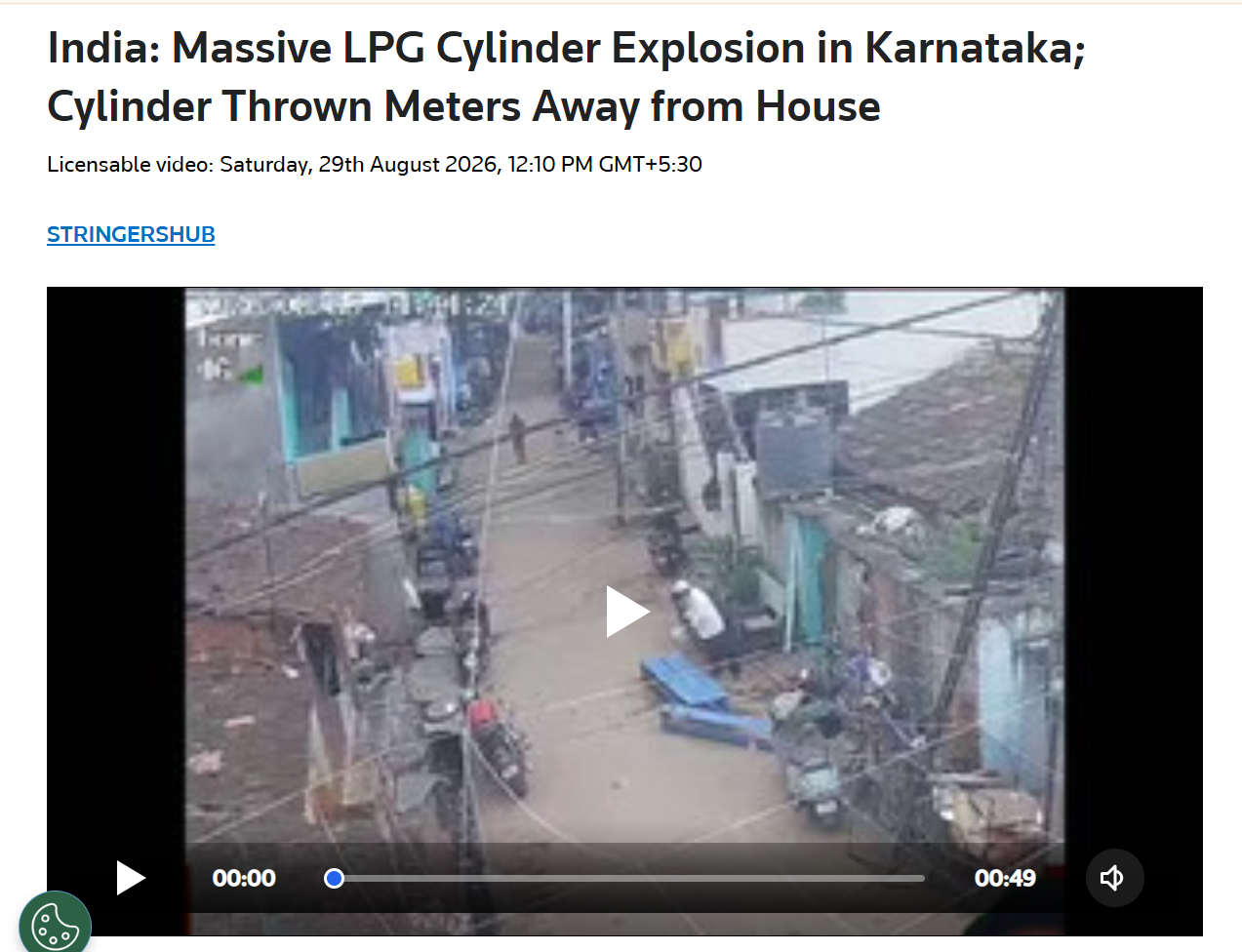
We also found the video shared on Reuters Connect, a media licensing platform. According to Reuters’ description, the incident shown in the video took place on August 25, when an LPG cylinder exploded due to a gas leak.
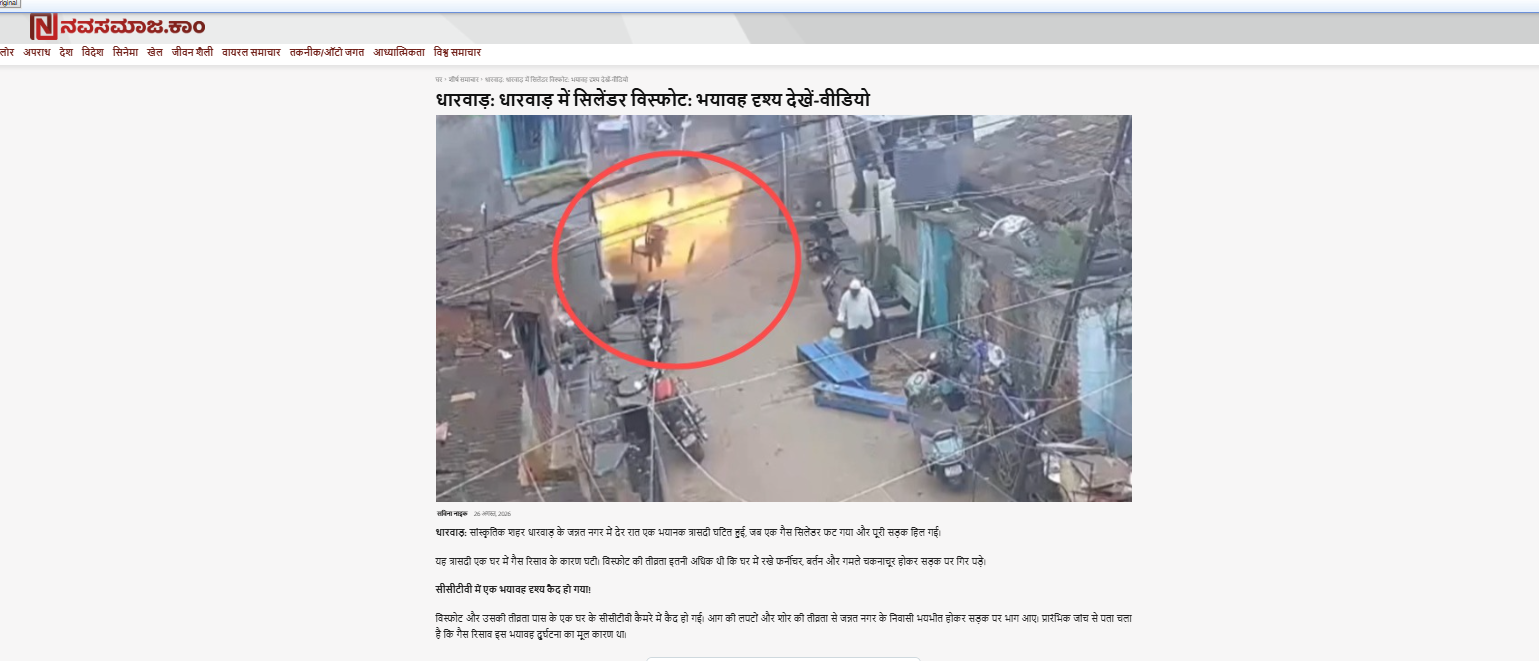
Karnataka-based website Navasamaja published a report on August 26, using a screenshot from the viral video as the cover image. According to the report, the incident took place in Jannat Nagar, Dharwad. The report states, “A young man named Rajasabh Neeralakatti was fast asleep at home when the incident occurred. The sudden blast left the young man severely burned and injured several parts of his body.”
Conclusion
Our research found that the viral claim is false. The video does not show a bomb test at the home of a ‘renowned madrasa scientist’ Abdul Ghaffar or the death of his family. The viral footage actually shows an LPG cylinder explosion that took place on August 25 in Jannat Nagar, Dharwad, Karnataka, following a gas leak. Reports about the incident, along with the original video, confirm that the blast was caused by an LPG cylinder and was unrelated to any bomb testing. Therefore, the viral video is being shared with a false and misleading claim.

Related Blogs

Executive Summary
A news video is being widely circulated on social media with the claim that Bihar Chief Minister Nitish Kumar has resigned from his post in protest against the ongoing UGC-related controversy. Several users are sharing the clip while alleging that Kumar stepped down after opposing the issue. However, CyberPeace research has found the claim to be false. The researchrevealed that the video being shared is from 2022 and has no connection whatsoever with the UGC or any recent protests related to it. An old video has been misleadingly linked to a current issue to spread misinformation on social media.
Claim:
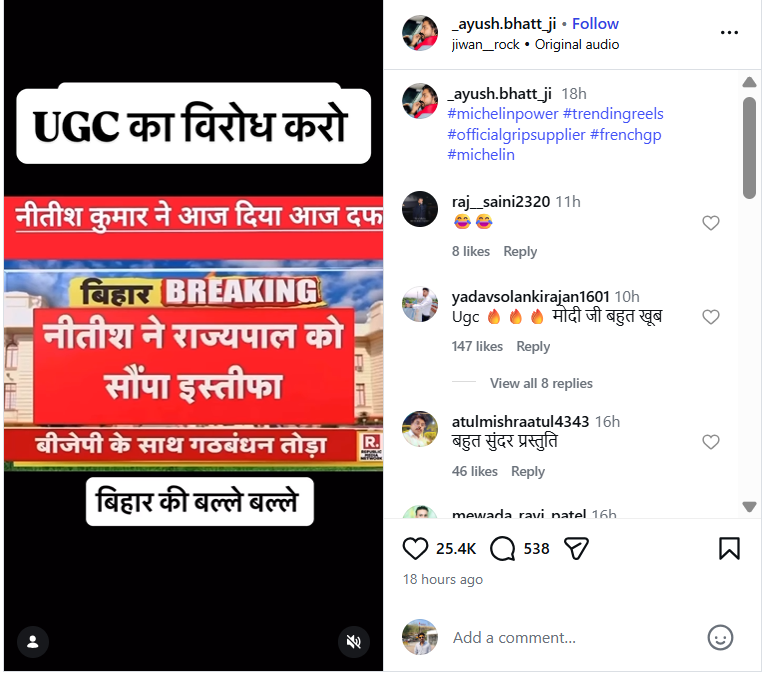
An Instagram user shared a video on January 26 claiming that Bihar Chief Minister Nitish Kumar had resigned. The post further alleged that the news was first aired on Republic channel and that Kumar had submitted his resignation to then-Governor Phagu Chauhan. The link to the post, its archived version, and screenshots can be seen below. (Links as provided)
Fact Check:
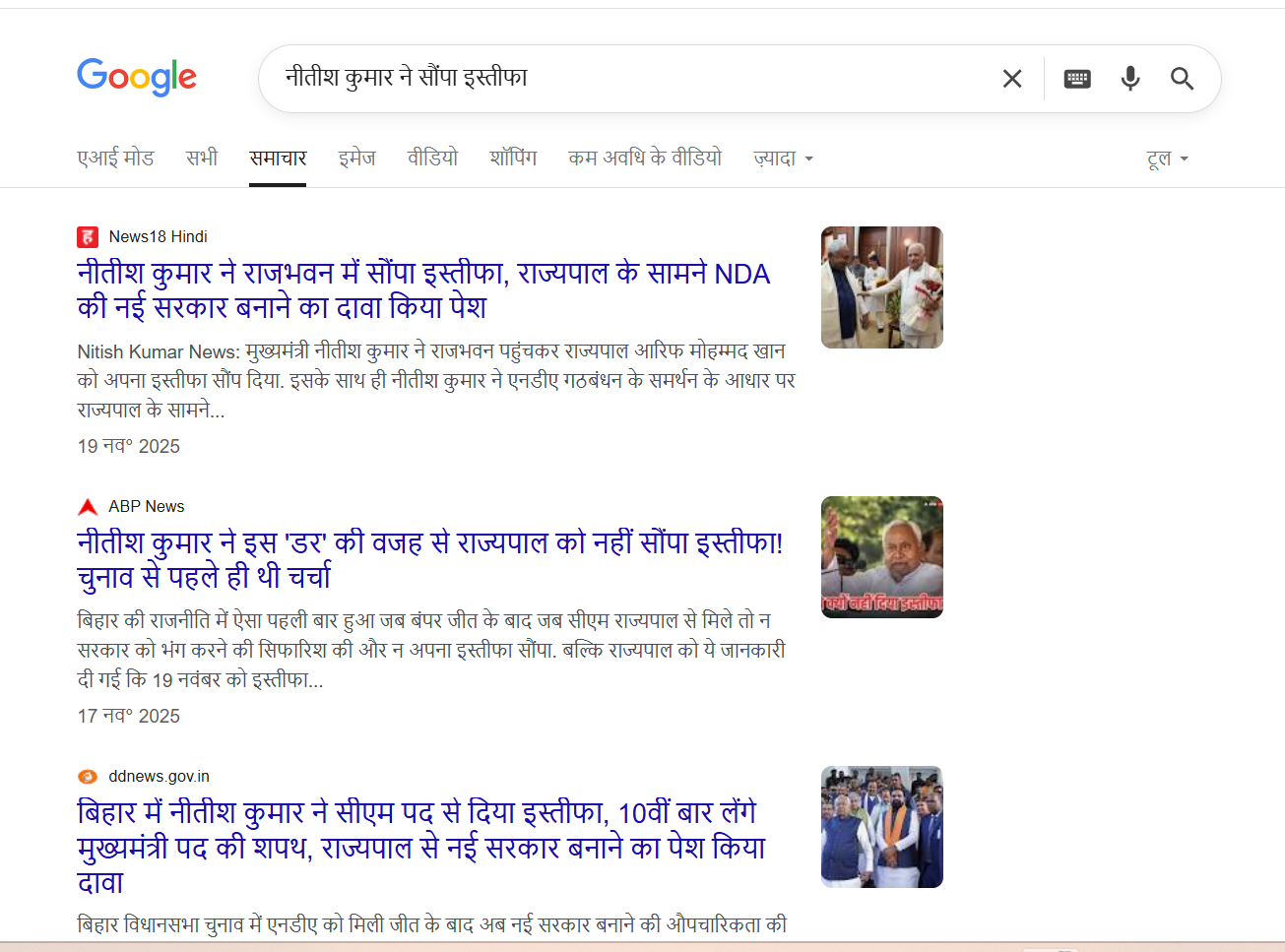
To verify the claim, CyberPeace first conducted a keyword-based search on Google. No credible or established media organisation reported any such resignation, clearly indicating that the viral claim lacked authenticity.
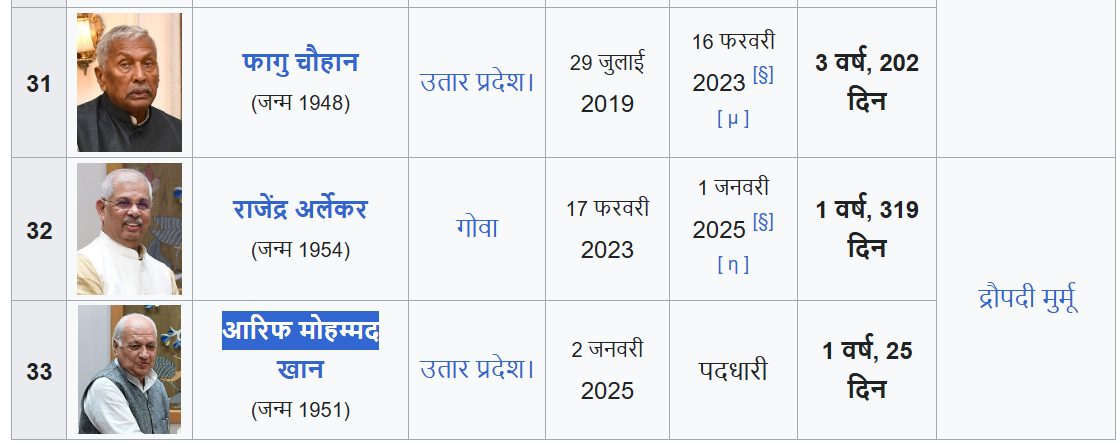
Further, the voiceover in the viral video states that Nitish Kumar handed over his resignation to Governor Phagu Chauhan. However, Phagu Chauhan ceased to be the Governor of Bihar in February 2023. The current Governor of Bihar is Arif Mohammad Khan, making the claim in the video factually incorrect and misleading.
In the next step, keyframes from the viral video were extracted and reverse-searched using Google Lens. This led to the official YouTube channel of Republic Bharat, where the full version of the same video was found. The video was uploaded on August 9, 2022. This clearly establishes that the clip circulating on social media is not recent and is being shared out of context.

Conclusion
CyberPeace’s research confirms that the viral video claiming Nitish Kumar resigned over the UGC issue is false. The video dates back to 2022 and has no link to the current UGC controversy. An old political video has been deliberately circulated with a misleading narrative to create confusion on social media.

Introduction
AI has penetrated most industries and telecom is no exception. According to a survey by Nvidia, enhancing customer experiences is the biggest AI opportunity for the telecom industry, with 35% of respondents identifying customer experiences as their key AI success story. Further, the study found nearly 90% of telecom companies use AI, with 48% in the piloting phase and 41% actively deploying AI. Most telecom service providers (53%) agree or strongly agree that adopting AI would provide a competitive advantage. AI in telecom is primed to be the next big thing and Google has not ignored this opportunity. It is reported that Google will soon add “AI Replies” to the phone app’s call screening feature.
How Does The ‘AI Call Screener’ Work?
With the busy lives people lead nowadays, Google has created a helpful tool to answer the challenge of responding to calls amidst busy schedules. Google Pixel smartphones are now fitted with a new feature that deploys AI-powered calling tools that can help with call screening, note-making during an important call, filtering and declining spam, and most importantly ending the frustration of being on hold.
In the official Google Phone app, users can respond to a caller through “new AI-powered smart replies”. While “contextual call screen replies” are already part of the app, this new feature allows users to not have to pick up the call themselves.
- With this new feature, Google Assistant will be able to respond to the call with a customised audio response.
- The Google Assistant, responding to the call, will ask the caller’s name and the purpose of the call. If they are calling about an appointment, for instance, Google will show the user suggested responses specific to that call, such as ‘Confirm’ or ‘Cancel appointment’.
Google will build on the call-screening feature by using a “multi-step, multi-turn conversational AI” to suggest replies more appropriate to the nature of the call. Google’s Gemini Nano AI model is set to power this new feature and enable it to handle phone calls and messages even if the phone is locked and respond even when the caller is silent.
Benefits of AI-Powered Call Screening
This AI-powered call screening feature offers multiple benefits:
- The AI feature will enhance user convenience by reducing the disruptions caused by spam calls. This will, in turn, increase productivity.
- It will increase call privacy and security by filtering high-risk calls, thereby protecting users from attempts of fraud and cyber crimes such as phishing.
- The new feature can potentially increase efficiency in business communications by screening for important calls, delegating routine inquiries and optimising customer service.
Key Policy Considerations
Adhering to transparent, ethical, and inclusive policies while anticipating regulatory changes can establish Google as a responsible innovator in AI call management. Some key considerations for AI Call Screener from a policy perspective are:
- The AI screen caller will process and transcribe sensitive voice data, therefore, the data handling policies for such need to be transparent to reassure users of regulatory compliance with various laws.
- AI has been at a crossroads in its ethical use and mitigation of bias. It will require the algorithms to be designed to avoid bias and reflect inclusivity in its understanding of language.
- The data that the screener will be using is further complicated by global and regional regulations such as data privacy regulations like the GDPR, DPDP Act, CCPA etc., for consent to record or transcribe calls while focussing on user rights and regulations.
Conclusion: A Balanced Approach to AI in Telecommunications
Google’s AI Call Screener offers a glimpse into the future of automated call management, reshaping customer service and telemarketing by streamlining interactions and reducing spam. As this technology evolves, businesses may adopt similar tools, balancing customer engagement with fewer unwanted calls. The AI-driven screening will also impact call centres, shifting roles toward complex, human-centred interactions while automation handles routine calls. They could have a potential effect on support and managerial roles. Ultimately, as AI call management grows, responsible design and transparency will be in demand to ensure a seamless, beneficial experience for all users.
References
- https://resources.nvidia.com/en-us-ai-in-telco/state-of-ai-in-telco-2024-report
- https://store.google.com/intl/en/ideas/articles/pixel-call-assist-phone-screen/
- https://www.thehindu.com/sci-tech/technology/google-working-on-ai-replies-for-call-screening-feature/article68844973.ece
- https://indianexpress.com/article/technology/artificial-intelligence/google-ai-replies-call-screening-9659612/

Introduction
When Tamil Nadu Police arrested a man from Vellore in May 2026 on suspicion of being the point person helping Indian youth to be smuggled into cyber scam compounds in Cambodia, the papers led with the accused. They shouldn't have led with the accused but with the system. The arrest, one in a long string of them in Tamil Nadu, Madurai, and other states, is not simply another one-off policing victory. Rather, the arrest gives us an insight into a larger, darker world: an international criminal organisation that has successfully combined human trafficking and cybercrime, a new trend in criminality that specialists are calling 'cyber slavery.'
What Is Cyber Slavery?
“Cyber slavery” involves trafficking persons under the pretence of employment, forcing them into committing online fraud to serve criminal enterprises. Victims are not merely victims of the work they are forced to do; they are often turned into culprits as they become complicit in victimising others. Trafficked victims are compelled to participate in frauds targeted at unsuspecting victims all around the globe. These activities, organised into robust criminal schemes, involve victims of sex or labour trafficking who are forced into operating romance scams or the so-called "pig butchering" scams that defraud people of their investment in cryptocurrency, all in heavily secured complexes guarded with threats of violence and torture. The extent of the problem is enormous, with the UN Office of the High Commissioner for Human Rights estimating in a 2023 report that there are over 100,000 victims of cyber scam compounds in Cambodia and another 120,000 in Myanmar. Schemes throughout Southeast Asia were projected to commit as much as $39.9 billion in fraudulent schemes a year.
Why Southeast Asia? The Geography of Organised Crime
In order to answer why Cambodia, Myanmar, Laos, and the surrounding regions have developed into the cyber slavery hub of the world, we can draw together an array of structural reasons:
- Casino clampdown and crime diversification: Cambodia's ban on online gambling in 2019 broke down established casino-related criminal networks. This saw old casinos and Special Economic Zones turn into cyber scam compound operations.
- Corruption and state complicity: A pre-existing environment of corruption and involvement of politically linked figures permitted scamming networks to flourish, and the armed groups in the border areas of Myanmar are reportedly complicit in these operations through supplying land and protection for the networks to operate in.
- Poor governance in the border areas: The lack of state control in the frontier areas of Myanmar provided the criminal networks with a secure sanctuary in which they could operate with impunity and cross borders to escape crackdowns and move their operations.
- Post-pandemic growth: The economic stress associated with the COVID-19 pandemic led to an increase in the supply of vulnerable individuals available to fill the scam networks, as well as unprecedented profit margins on scams.
The Recruitment Pipeline: How Are Indian Youth Trapped?
The typical journey from an Indian town or village to a locked compound in Southeast Asia follows the same narrative:
- The bait: On platforms like Facebook, WhatsApp, and Telegram, gangs lure with posts of lucrative overseas employment for IT work, customer service, data entry, and digital marketing with attractive, albeit feasible, pay packages (Rs. 80,000 to Rs. 1.5 lakh per month) and destinations such as Thailand and Singapore added for a veneer of genuineness.
- The recruiters: Local agents who gain trust, arrange visas and flight tickets, and collect the application fees are key intermediaries. Cases registered in Vellore and Madurai hint at recruitment agents receiving a commission for each person successfully smuggled into a trap, linked to larger travel and immigration networks.
- The lie: Victims are assured that they will be working legitimately in Thailand, but on reaching the border and crossing over, they find themselves pushed into scam compounds in neighbouring countries and have their passports, mobile phones and devices confiscated, thus rendering any escape attempt futile.
- The trap: In the interim, fake interviews, false job promises and convincing flight tickets serve to maintain the facade until the victims are forced to participate in cyber-fraud schemes.
The Architecture of Coercion: Life Inside the Scam Compounds
It is in these compounds that the fates of the victims become known. Survivor accounts, investigations and UN human rights reports provide evidence of these circumstances. These compounds are often surrounded by barbed wire fences, monitored with cameras and heavily guarded. Once a potential victim is captured, they are stripped of their passports and any other electronic devices, preventing them from being able to contact the outside world or to escape. Workers are allocated stringent targets, ranging from the number of potential victims they must solicit for scams and the amount of money they must acquire through such scams. Failure to do so, or perceived disobedience, may lead to beatings, electroshock treatment, starvation and long periods in confinement. These beatings are supplemented with psychological torture, with scammers assuring their victims that they owe money for their journey, stay and training. This method of debt bondage keeps people at the compound even when the opportunity for escape is presented to them. The victims are then forced to take part in more complex online scams, which involve romance scams, fake investment scams, and impersonation scams using scripts and with supervision. In some cases, families will be encouraged to pay for their captive relatives' release by ransom, whereas those who refuse to comply or meet performance requirements may be sold and transferred to another compound as a piece of property within a transnational criminal network.
Cybercrime Is No Longer Just About Hacking
This emergency challenges the existing notion of cybercrime. The scam compound of Southeast Asia is not about a lonely hacker or a standalone breach; it is a form of organised cyber slavery in which trafficked individuals are made to commit financial fraud on an industrial level.
The probe of India's NIA found that recruitment is done in the Indian states of Bihar and Uttar Pradesh. Transport agents in Chennai and Madurai provide logistics, and Dubai and Bangkok act as transit points on the way to Cambodia, Laos, and Vietnam. It makes use of cryptocurrency wallets, shadow banking, and shell companies for the movement of funds across international borders. Companies such as the Huione Group has been accused of facilitating billions of dollars in financial transactions for scam infrastructure before receiving sanctions from the U.S.
To illustrate the threat landscape, the U.S. Treasury imposed sanctions on 19 entities spread across Myanmar and Cambodia and said that cyber scam operations looted $10 billion worth last year. Also, cryptocurrency transactions related to trafficking crimes jumped by 85% last year, which speaks to the expanding nature of the global criminal infrastructure.
India's Exposure: A National Vulnerability
The scale of exposure for India is large and expanding. The most likely victims are educated, and aspirational young men and women from Tier 2 and Tier 3 cities, seeking work abroad, which perfectly aligns with the primary target of such human trafficking networks.
Repeated incidents of people from Tamil Nadu falling victim to these networks have come to light. As far back as 2022, the chief minister wrote to the prime minister that close to 300 Indians, roughly 50 Tamils included, were being held in Myanmar. The Madurai-Cambodia case that came to light in 2026 revealed an entire network spanning Cambodia, Laos, and Vietnam, with authorities believing that thousands of Indians might have been trafficked there over the past three years. Such cases from Kerala, Karnataka, Andhra Pradesh, and some northern Indian states have been reported. Last year, India had to charter Air Force flights to rescue over 549 Indians from cyber scam centres along the Myanmar-Thailand border.
The Indian embassy in Phnom Penh assisted the Indian nationals along with the CBI, MEA, and NIA in the rescue of 67 Indians in September 2024; however, these operations are largely reactive in the face of the vast and evolving transboundary crisis.
Prevention
The best solution is awareness. The following are tangible signs that a job offer might be a lead to trafficking:
Red Flags within the job offer:
- Receiving unsolicited recruitment messages on WhatsApp, Telegram or Instagram from unknown numbers/contacts.
- Offer of unbelievably high salaries in undefined roles like ‘data entry,’ ‘online marketing’ or ‘customer service’ outside India.
- Request for upfront money to cover costs of visas, travel, accommodation, and training.
- Job offers to places in Thailand or Singapore involving complex transit routes through other countries.
- An interview process entirely through messaging apps, where the company has no real office address or registration number.
- Urgency and/or confidentiality required.
Verification:
- Check if the recruiter is registered on MEA's e-Migrate portal-this is a portal where MEA lists authorised overseas recruiters.
- Verify the authenticity of the company through its business registration with official registries in the foreign country.
- Contact the Indian Embassy/Consulate in that foreign country if something doesn't add up about the offer.
- Do not hand over your passport to your employer on arrival; it is standard practice for recruiters working as traffickers to confiscate it.
What to do if trapped:
- Contact the closest Indian embassy or consulate immediately.
- Call the MEA overseas helpline: 1800-11-3090.
- Lodge a report on the National Cybercrime Reporting Portal (cybercrime.gov.in).
Policy Imperatives
On their own, individual consciousness cannot undo such a massive criminal infrastructure. India has to enforce the Emigration Act rigorously, implement mandatory licensing of recruitment agents and create a specialised task force consisting of NIA, CBI, MEA and the states’ cybercrime units. Pre-departure orientations should also become mandatory for migrant workers who go to Southeast Asia. Globally, India needs to work more closely with Cambodia, Myanmar, Thailand and Laos via intel sharing protocols, victim repatriations and action against scam compounds. Financial probes must be on par with enforcement investigations to catch up with the perpetrators’ network, the cryptocurrency and hawala channels that facilitate money laundering and finance trafficking operations, as that would severely hit these networks.
Conclusion
This arrest of the recruiter in Vellore is just a small piece of a larger network. What we see in these instances is the marriage of cybercrime, trafficking, and financial fraud into a larger transnational ecosystem that systematically preys on the economic vulnerability of individuals. These young Indians are not simply falling for scams; they are being systematically targeted, recruited, trafficked, and forced into these criminal operations by a networked structure. The scam compounds in Cambodia and along the border of Myanmar and Thailand are only the end of a process that very likely starts with a convincing job offer on social media. Fighting cyber slavery will not be as simple as more arrests; we need education and international efforts, as well as policy responses that match the scope and scale of the problem.
References
- https://the420.in/78415-2vellore-man-cambodia-cyber-slavery-trafficking-case/
- https://the420.in/madhan-vadivel-cambodia-cyber-slavery-trafficking-racket-investigation/
- https://www.newsonair.gov.in/tamil-nadu-police-arrest-key-recruiter-in-cambodia-cyber-slavery-racket/
- https://kashmirdotcom.in/2026/05/16/cambodia-linked-human-trafficking-cyber-slavery-racket-nia-chargesheets-five-including-absconding-kingpin/
- https://www.aljazeera.com/news/2025/7/16/more-than-1000-arrested-in-cambodian-cyber-scam-raids
- https://www.pbs.org/newshour/world/why-southeast-asias-online-scam-industry-is-so-hard-to-shut-down
- https://www.cfr.org/articles/how-myanmar-became-global-center-cyber-scams
- https://www.amlrightsource.com/resources/scam-states-the-cybercrime-corruption-complex-in-southeast-asia-and-the-collapse-of-anti-money-laundering-enforcement
- https://newlinesinstitute.org/global-security-mil-priorities/cybercrimes-human-trafficking-and-cryptocurrency-in-southeast-asias-special-economic-zones/
- https://www.theweek.in/news/india/2026/03/21/lured-by-jobs-sold-into-slavery-indias-crackdown-on-cyber-trafficking-continues.html
