
#FactCheck- AI-generated videos and fake claims targeting Delhi CJP protests circulate on social media.
Executive Summary
Even after the conclusion of the Cockroach Janata Party (CJP) protest at Delhi’s Jantar Mantar, several misleading claims related to the demonstration continue to circulate on social media. During the protests, multiple AI-generated videos, deepfakes and fabricated narratives were circulated with the intention of misleading users. CyberPeace Research Wing’s Fact Check Team investigated several such viral claims and found that many of the videos were digitally manipulated or created using artificial intelligence (AI). The research revealed that fake audio, misleading captions and altered visuals were used to falsely attribute statements to public figures, including police officials, military officers and Union ministers. The following are four major false claims debunked by the CyberPeace Research Wing:
Claim 1: Delhi Police DCP Sumit Jha resigned from IPS in support of student protests
A video of Delhi Police DCP Sumit Jha was widely shared on social media with the claim that he resigned from the Indian Police Service (IPS) in support of the student movement at Jantar Mantar. In the viral video, DCP Sumit Jha is allegedly heard saying that he was resigning from his post with immediate effect and could not remain part of a system that forced him to spread false information against students. The video was shared with the claim that Delhi Police DCP Sumit Jha resigned from his position to support protesting students.
Claim
An Instagram user shared the viral video on July 28, 2026, claiming that Delhi Police DCP Sumit Jha had resigned from his post in support of protesting students.
https://www.instagram.com/reel/DbUr6CPoB13/

Fact Check
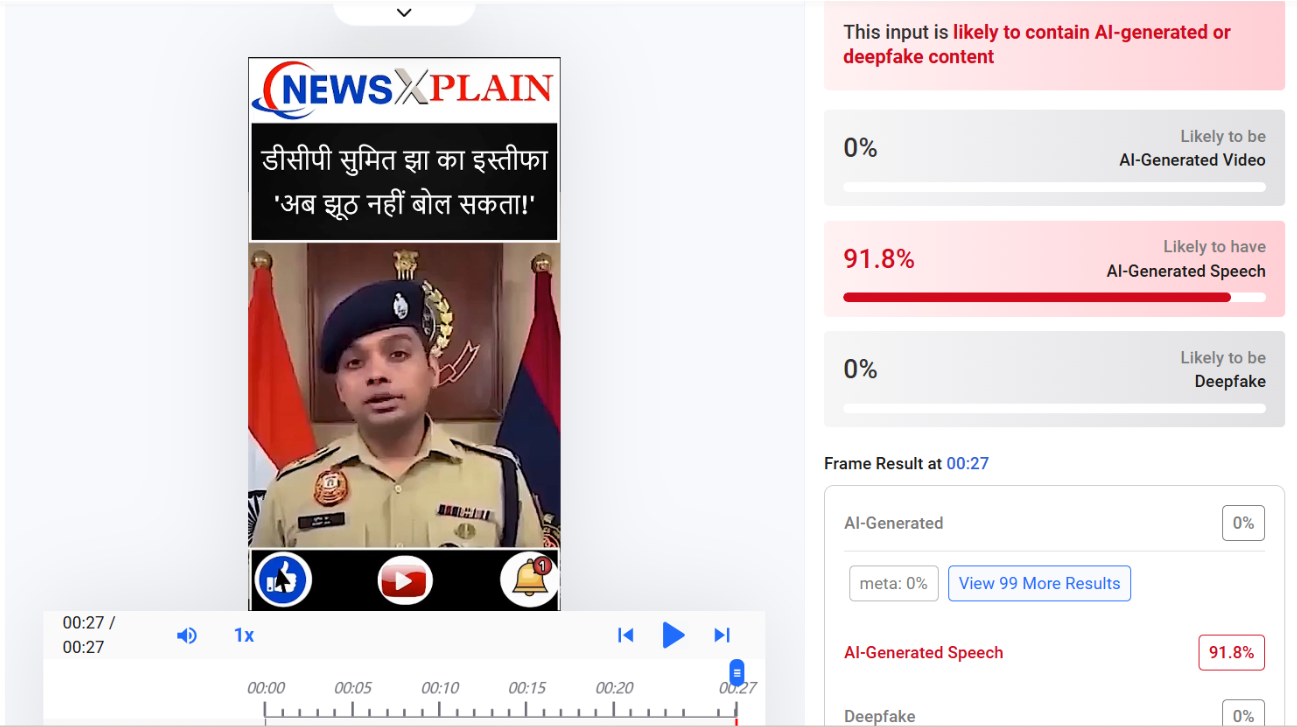
CyberPeace Research Wing’s research found the claim to be false. The research revealed that DCP Sumit Jha has not resigned from his position. The viral video was digitally manipulated by adding AI-generated audio to an original video shared by the Delhi Police on its official X account on July 23, 2026.
The video was further analysed using the AI detection tool HIVE Moderation. The tool’s analysis indicated that the audio used in the viral video had a 91.8 per cent probability of being AI-generated, confirming that the audio was artificially created and was not authentic.
Claim 2: CDS Raja Subramani confirmed that more than 30,000 soldiers resigned over Jantar Mantar protests
A video featuring Chief of Defence Staff (CDS) General Raja Subramani was widely circulated on social media with the false claim that he confirmed the resignation of more than 30,000 Indian Army personnel following the Jantar Mantar protest. The viral video claimed that soldiers had refused to serve the government after police action against protesting students.
Claim
A Facebook user shared the video claiming: "After the protests at Jantar Mantar, India’s Chief of Defence Staff Raja Subramani has issued an emergency alert, saying that more than 30,000 soldiers have resigned in protest because their children were brutally beaten at Jantar Mantar."

Fact Check
CyberPeace Research Wing’s research found the claim to be false. The research revealed that the video featuring CDS Raja Subramani was digitally manipulated using AI-generated audio. The original video did not contain any statement related to soldiers resigning or the Jantar Mantar protest. Further research led us to the same video posted by the Instagram account myyouthindia, where CDS Raja Subramani can be seen extending his best wishes to teams participating in the 135th Indian Oil Durand Cup Football Tournament. https://www.instagram.com/reels/DbEGRGBsKv8/

The audio circulating with the viral video was falsely added to create a misleading narrative.
Claim 3: Defence Minister Rajnath Singh warned protesters of strict action
A video featuring Union Defence Minister Rajnath Singh was widely circulated on social media with the claim that he issued a strict warning against student protesters. In the viral clip, Singh was allegedly heard saying that the government would not tolerate “anarchy” and that strict action would be taken against those blocking roads, disturbing public order or damaging government property.
Claim
An X user (@ForumDefence) shared the video on July 22, 2026, claiming that Rajnath Singh had issued a warning regarding the ongoing student protest.

Fact Check
CyberPeace Research Wing’s research found the claim to be false.The original video available on Rajnath Singh’s official YouTube channel was digitally altered by adding AI-generated audio. The statement heard in the viral video was not made by the Defence Minister and was created using artificial intelligence. The viral video was also analysed using the AI detection tool HIVE Moderation. The analysis indicated that the speech used in the video had an 88.1 per cent probability of being AI-generated.

Claim 4: Piyush Goyal threatened to hang CJP supporters
A video of Union Minister Piyush Goyal was shared on social media with the false claim that he threatened protesters and called for two to three CJP supporters to be hanged to "teach the rest of them a lesson." In the AI-manipulated video, Goyal was allegedly heard saying: "To teach the CJP a lesson, we should hang two to three of its supporters so that they understand the real power of the government."
https://x.com/HinduReformer/status/2080367073117790288?s=20

Fact Check
CyberPeace Research Wing’s research found that the viral video was digitally manipulated using AI-generated audio. The original video, posted on the Press Trust of India’s official X account, showed Piyush Goyal discussing the government’s response to examination paper leaks and appealing for the issue to be resolved through dialogue. He made no remarks threatening protesters or calling for the execution of CJP supporters.
The audio and statements attributed to him in the viral video were fabricated using AI technology.

Conclusion
CyberPeace Research Wing’s research found that all four viral claims related to the CJP protest were false. The videos circulating on social media were either digitally manipulated or created using AI-generated audio to falsely attribute statements to public officials. The research highlights how AI-generated deepfakes and manipulated content are increasingly being used to spread misinformation during sensitive events.

Related Blogs

Executive Summary:
A viral claim circulating on social media suggests that the Indian government is offering a 50% subsidy on tractor purchases under the so-called "Kisan Tractor Yojana." However, our research reveals that the website promoting this scheme, allegedly under the Ministry of Agriculture and Farmers Welfare, is misleading. This report aims to inform readers about the deceptive nature of this claim and emphasize the importance of safeguarding personal information against fraudulent schemes.


Claim:
A website has been circulating misleading information, claiming that the Indian government is offering a 50% subsidy on tractor purchases under the so-called "Kisan Tractor Yojana." Additionally, a YouTube video promoting this scheme suggests that individuals can apply by submitting certain documents and paying a small, supposedly refundable application fee.


Fact Check:
Our research has confirmed that there is no scheme by the Government of India named 'PM Kisan Tractor Yojana.' The circulating announcement is false and appears to be an attempt to defraud farmers through fraudulent means.
While the government does provide various agricultural subsidies under recognized schemes such as the PM Kisan Samman Nidhi and the Sub-Mission on Agricultural Mechanization (SMAM), no such initiative under the name 'PM Kisan Tractor Yojana' exists. This misleading claim is, therefore, a phishing attempt aimed at deceiving farmers and unlawfully collecting their personal or financial information.
Farmers and stakeholders are advised to rely only on official government sources for scheme-related information and to exercise caution against such deceptive practices.
To assess the authenticity of the “PM Kisan Tractor Yojana” claim, we reviewed the websites farmertractoryojana.in and tractoryojana.in. Our analysis revealed several inconsistencies, indicating that these websites are fraudulent.
As part of our verification process, we evaluated tractoryojana.in using Scam Detector to determine its trustworthiness. The results showed a low trust score, raising concerns about its legitimacy. Similarly, we conducted the same check for farmertractoryojana.in, which also appeared untrustworthy and risky. The detailed results of these assessments are attached below.
Given that these websites falsely present themselves as government-backed initiatives, our findings strongly suggest that they are part of a fraudulent scheme designed to mislead and exploit individuals seeking genuine agricultural subsidies.


During our research, we examined the "How it Works" section of the website, which outlines the application process for the alleged “PM Kisan Tractor Yojana.” Notably, applicants are required to pay a refundable application fee to proceed with their registration. It is important to emphasize that no legitimate government subsidy program requires applicants to pay a refundable application fee.


Our research found that the address listed on the website, “69A, Hanuman Road, Vile Parle East, Mumbai 400057,” is not associated with any government office or agricultural subsidy program. This further confirms the website’s fraudulent nature. Farmers should verify subsidy programs through official government sources to avoid scams.

A key inconsistency is the absence of a verified social media presence. Most legitimate government programs maintain official social media accounts for updates and communication. However, these websites fail to provide any such official handles, further casting doubt on their authenticity.

Upon attempting to log in, both websites redirect to the same page, suggesting they may be operated by the same entity or individual. This further raises concerns about their legitimacy and reinforces the likelihood of fraudulent activity.

Conclusion:
Our research confirms that the "PM Kisan Tractor Yojana" claim is fraudulent. No such government scheme exists, and the websites promoting it exhibit multiple red flags, including low trust scores, a misleading application process requiring a refundable fee, a false address, and the absence of an official social media presence. Additionally, both websites redirect to the same page, suggesting they are operated by the same entity. Farmers are advised to rely on official government sources to avoid falling victim to such scams.
- Claim: PM-Kisan Tractor Yojana Government Offering Subsidy on tractors.
- Claimed On: Social Media
- Fact Check: False and Misleading

Introduction:
Technology has become a vital part of everyone’s life nowadays, it occupies essential activities of a person’s life whether we are working or playing and studying. I would say from education to corporate, technology makes everything easier and simpler to achieve the goals for a particular thing. Corporate companies are using technology for their day-to-day work and there are many law-based foundations that are publishing blogs and papers for legal awareness, many lawyers use internet technology for promoting themselves which amounts to growth in their work. Some legal work can now be done by machines, which was previously unthinkable. Large disputes frequently have many documents to review. Armies of young lawyers and paralegals are typically assigned to review these documents. This work can be done by a properly trained machine. Machine drafting of documents is also gaining popularity. We’ve also seen systems that can forecast the outcome of a dispute. We are starting to see machines take on many tasks that we once thought was solely the domain of lawyers.
How to expand law firms and the corporate world with the help of technology?
If we talk about how lawyers’ lives will be impacted by technology then I would explain about law students first. Students are the one who is utilizing the technology at its best for their work, tech could be helpful in students’ lives. as law students use SCC online and manupatra, which are used for case laws. And during their law internships, they use it to help their seniors to find appropriate cases for them. and use it as well for their college research work. SCC and manupatra are very big platforms by which we can say if students use technology for their careers, it will impact their law career in the best ways.
A lawyer running a law firm is not a small task, and there are plenty of obstacles to that, such as a lack of tech solutions, failure to fulfil demands, and inability to innovate, these obstacles prevent the growth of some firms. The right legal tech can grow an organization or a law firm and there will be fewer obstacles.
Technology can be proven as a good mechanism to grow the law firm, as everything depends on tech, from court work to corporate. If we talk about covid during 2020, everything shifted towards the virtual world, court hearings switched to online mode due to covid which proved as a bone to the legal system as the case hearings were speedy and there was no physical contact due to that.
Legal automation is also helping law firms to grow in a competitive world. And it has other benefits also like shifting tedious tasks from humans to machines, allowing the lawyer to work on more valuable work. I would say that small firms should also need to embrace automation for competition in the corporate sector. Today, artificial intelligence offers a solution to solve or at least make the access-to-justice issue better and completely transform our traditional legal system.
There was a world-cited author, Richard Susskind, OBE, who talked about the future of law and lawyers and he wrote a book, Online Courts and the Future of Justice. Richard argues that technology is going to bring about a fascinating decade of change in the legal sector and transform our court system. Although automating our old ways of working plays a part in this, even more, critical is that artificial intelligence and technology will help give more individuals access to justice.
The rise of big data has also resulted in rapid identification systems, which allow police officers to quickly see an individual’s criminal history through a simple search.The FBI’s Next Generation Identification (NGI) system matches individuals with their criminal history information using biometrics such as fingerprints, palm prints, iris recognition, and facial recognition. The NGI’s current technologies are constantly being updated, and new ones are being added, to make the NGI the most comprehensive way to gather up-to-date information on the person being examined
During covid, there were e-courts services in courts, and lawyers and judges were taking cases online. After the covid, the use of technology increased in the law field also from litigation to corporate. As technology can also safeguard confidential information between parties and lawyers. There was ODR, (online dispute resolution) happening meetings that were taking place online mode.
File sharing is inevitable in the practice of law. Yet sometimes the most common ways of sharing (think email) are not always the most secure. With the remote office, the boom has come an increased need for alternate file-sharing solutions. There is data encryption to protect data as it is a reliable method to protect confidential data and information.
Conclusion-
Technology has been playing a vital role in the legal industry and has increased the efficiency of legal offices and the productivity of clerical workers. With the advent of legal tech, there is greater transparency between legal firms and clients. Clients know how many fees they must pay and can keep track of the day-to-day progress of the lawyer on their case. Also, there is no doubt that technology, if used correctly, is fast and efficient – more than any human individual. This can prove to be of great assistance to any law firm. Lawyers of the future will be the ones who create the systems that will solve their client’s problems. These legal professionals will include legal knowledge engineers, legal risk managers, system developers, design thinking experts, and others. These people will use technology to create new ways of solving legal problems. In many ways, the legal sector is experiencing the same digitization that other industries have, and because it is so document-intensive, it is actually an industry that stands to benefit greatly from what technology has to offer.
Introduction
A policy, no matter how artfully conceived, is like a timeless idiom, its truth self-evident, its purpose undeniable, standing in silent witness before those it vows to protect, yet trapped in the stillness of inaction, where every moment of delay erodes the very justice it was meant to serve. This is the case of the Digital Personal Data Protection Act, 2023, which holds in its promise a resolution to all the issues related to data protection and a protection framework at par with GDPR and Global Best Practices. While debates on its substantive efficacy are inevitable, its execution has emerged as a site of acute contention. The roll-out and the decision-making have been making headlines since late July on various fronts. The government is being questioned by industry stakeholders, media and independent analysts on certain grounds, be it “slow policy execution”, “centralisation of power” or “arbitrary amendments”. The act is now entrenched in a never-ending dilemma of competing interests under the DPDP Act.
The change to the Right to Information Act (RTI), 2005, made possible by Section 44(3) of the DPDP Act, has become a focal point of debate. This amendment is viewed by some as an attack on weakening the hard-won transparency architecture of Indian democracy by substituting an absolute exemption for personal information for the “public interest override” in Section 8(1)(j) of the RTI Act.
The Lag Ledger: Tracking the Delays in DPDP Enforcement
As per a news report of July 28, 2025, the Parliamentary Standing Committee on Information and Communications Technology has expressed its concern over the delayed implementation and has urged the Ministry of Electronics and Information Technology (MeitY) to ensure that data privacy is adequately ensured in the nation. In the report submitted to the Lok Sabha on July 24, the committee reviewed the government’s reaction to the previous recommendations and concluded that MeitY had only been able to hold nine consultations and twenty awareness workshops about the Draft DPDP Rules, 2025. In addition, four brainstorming sessions with academic specialists were conducted to examine the needs for research and development. The ministry acknowledges that this is a specialised field that urgently needs industrial involvement. Another news report dated 30th July, 2025, of a day-long consultation held where representatives from civil society groups, campaigns, social movements, senior lawyers, retired judges, journalists, and lawmakers participated on the contentious and chilling effects of the Draft Rules that were notified in January this year. The organisers said in a press statement the DPDP Act may have a negative impact on the freedom of the press and people’s right to information and the activists, journalists, attorneys, political parties, groups and organisations “who collect, analyse, and disseminate critical information as they become ‘data fiduciaries’ under the law.”
The DPDP Act has thus been caught up in an uncomfortable paradox: praised as a significant legislative achievement for India’s digital future, but caught in a transitional phase between enactment and enforcement, where every day not only postpones protection but also feeds worries about the dwindling amount of room for accountability and transparency.
The Muzzling Effect: Diluting Whistleblower Protections
The DPDP framework raises a number of subtle but significant issues, one of which is the possibility that it would weaken safeguards for whistleblowers. Critics argue that the Act runs the risk of trapping journalists, activists, and public interest actors who handle sensitive material while exposing wrongdoing because it expands the definition of “personal data” and places strict compliance requirements on “data fiduciaries.”One of the most important checks on state overreach may be silenced if those who speak truth to power are subject to legal retaliation in the absence of clear exclusions of robust public-interest protections.
Noted lawyer Prashant Bhushan has criticised the law for failing to protect whistleblowers, warning that “If someone exposes corruption and names officials, they could now be prosecuted for violating the DPDP Act.”
Consent Management under the DPDP Act
In June 2025, the National e-Governance Division (NeGD) under MeitY released a Business Requirement Document (BRD) for developing consent management systems under the DPDP Act, 2023. The document supports the idea of “Consent Manager”, which acts as a single point of contact between Data Principals and Data Fiduciaries. This idea is fundamental to the Act, which is now being operationalised with the help of MeitY’s “Code for Consent: The DPDP Innovation Challenge.” The government has established a collaborative ecosystem to construct consent management systems (CMS) that can serve as a single, standardised interface between Data Principals and Data Fiduciaries by choosing six distinct entities, such as Jio Platforms, IDfy, and Zoop. Such a framework could enable people to have meaningful control over their personal data, lessen consent fatigue, and move India’s consent architecture closer to international standards if it is implemented precisely and transparently.
There is no debate to the importance of this development however, there are various concerns associated with this advancement that must be considered. Although effective, a centralised consent management system may end up being a single point of failure in terms of political overreach and technical cybersecurity flaws. Concerns are raised over the concentration of power over the framing, seeking, and recording of consent when big corporate entities like Jio are chosen as key innovators. Critics contend that the organisations responsible for generating revenue from user data should not be given the responsibility for designing the gatekeeping systems. Furthermore, the CMS can create opaque channels for data access, compromising user autonomy and whistleblower protections, in the absence of strong safeguards, transparency mechanisms and independent oversight.
Conclusion
Despite being hailed as a turning point in India’s digital governance, the DPDP Act is still stuck in a delayed and unequal transition from promise to reality. Its goals are indisputable, but so are the conundrum it poses to accountability, openness, and civil liberties. Every delay increases public mistrust, and every safeguard that remains unsolved. The true test of a policy intended to safeguard the digital rights of millions lies not in how it was drafted, but in the integrity, pace, and transparency with which it is to be implemented. In the digital age, the true cost of delay is measured not in time, but in trust. CyberPeace calls for transparent, inclusive, and timely execution that balances innovation with the protection of digital rights.
References
- https://www.storyboard18.com/how-it-works/parliamentary-committee-raises-concern-with-meity-over-dpdp-act-implementation-lag-77105.htm
- https://thewire.in/law/excessive-centralisation-of-power-lawyers-activists-journalists-mps-express-fear-on-dpdp-act
- https://www.medianama.com/2025/08/223-jio-idfy-meity-consent-management-systems-dpdpa/
- https://www.downtoearth.org.in/governance/centre-refuses-to-amend-dpdp-act-to-protect-journalists-whistleblowers-and-rti-activists
