
#FactCheck - Viral Video of Burning Aircraft Falsely Linked to UAE, Found to Be AI-Generated
Executive Summary:
A video is being shared on social media showing an aircraft engulfed in massive flames on an airport runway. The video is being linked to the UAE. It is being claimed that a UAE airport was completely destroyed due to recent drone and missile attacks by Iran. Research by the CyberPeace found the viral claim to be false. Our research revealed that the viral video is not real, but AI-generated.
Claim:
On social media platform Facebook, a user shared the viral video on March 3, 2026, and wrote, “Amid the Iran-US-Israel conflict in the Middle East, operations at several major airports, including Dubai International Airport, have been temporarily suspended, causing thousands of flight cancellations and delays. Due to multiple missile and drone attacks from Iran, the United Arab Emirates (UAE) had shut its airspace, and limited structural damage at Dubai Airport was also confirmed, with reports of four staff members being injured. Later, considering the security situation, a limited number of flights were resumed, but full operations are still delayed due to ongoing safety concerns. This tension has significantly impacted regional aviation, travel, and global flight routes.”

Fact Check:
To verify the viral video, we searched relevant keywords on Google. However, we did not find any credible media report confirming the claim.However, we found a video report on the YouTube channel of CNN-News18 mentioning explosions near Dubai Airport after a suspected Iranian drone strike. But the visuals shown in that report are completely different from the viral video.

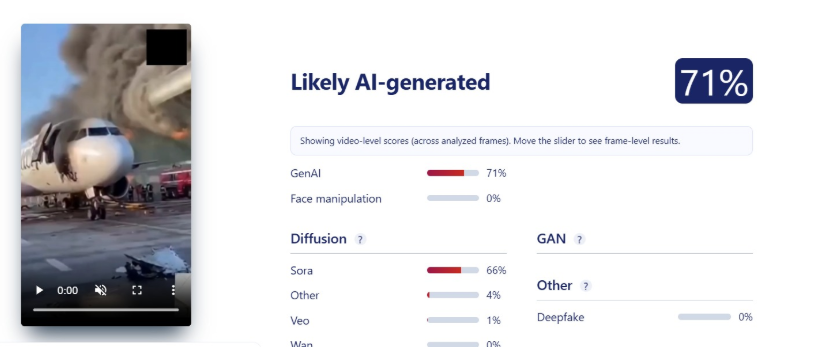
Upon closely examining the viral video, we noticed several inconsistencies, raising suspicion that it might be AI-generated. We then analyzed the video using the AI detection tool Sightengine. The results indicated that the video is 71 percent likely to be AI-generated.
Conclusion:
Our research found that the viral video is not real, but AI-generated.

Related Blogs
.webp)
At Semicon India 2025 held recently, the Prime Minister declared, “when the chips are down, you can bet on India”. The event showcased the country’s first indigenous microprocessor, Vikram, developed by ISRO’s Semiconductor Lab, and announced that commercial chip production will begin by the end of 2025. India aims to become a global player in semiconductor production, and build self-reliance in a world where global supply chains are shifting rapidly.
Why Semiconductors Matter
Semiconductors power almost everything around us, from laptops and air conditioners to cars and even the tiniest gadget we hardly notice . They’ve rightly been called the “oil of the digital age” because our entire digital world depends on them. But the global supply chain for chips is heavily concentrated. Taiwan alone makes over 60% of the world’s semiconductors and nearly 90% of the most advanced ones. Rising tensions between China and Taiwan have only shown how fragile and risky this dependence can be for the rest of the world. For India, building its own semiconductor base is not just about technology, it is about economic security and reduced dependence on imports.
India’s Push: The Numbers and Projects
The government has committed nearly US$18 billion across 10 projects, making it one of the country’s largest industrial bets in decades. Under the Production Linked Incentive (PLI) scheme, ₹76,000 crore (about US$9.1 billion) was set aside, of which most has already been allocated.
Key developments include:
- Vikram processor – developed at ISRO’s Semiconductor Lab, fabricated on 180nm technology.
- CG Power facility in Sanand, Gujarat – launched in 2024, scaling chip assembly and testing.
- Micron’s investment – ₹22,500+ crore in Gujarat for packaging and testing.
- Tata Electronics–PSMC partnership – ₹91,000 crore tie-up with Taiwan’s Powerchip for fabs.
The domestic market, valued at US$38 billion in 2023, is expected to touch US$100–110 billion by 2030 if growth sustains.
The Technology Gap
While the Vikram chip, a 32 bit microprocessor, is a proud milestone, it highlights the technology gap India faces. The chip was fabricated using a 180nm CMOS process, a process that was cutting-edge back in the early 2000s. Today, companies like TSMC and Samsung are already producing 3nm chips for smartphones and AI servers, whereas those like Nvidia and Apple have developed chips 2ith 64-bit processing capabilities.
This means India's main focus, to become self-reliant in the mature end of the spectrum useful for space, defense, and automotives and electronics, is far from the global cutting edge. Bridging this gap will require both time and deep technical expertise.
Talent and Design Strengths
On the positive side, India already contributes around 20% of global semiconductor design talent. Two advanced design centers—one in Noida and another in Bengaluru—are working on 3nm designs. The government’s Design Linked Incentive scheme has cleared 20+ projects to nurture startups in chip design.
Over 60,000 engineers have been trained under various programs, but scaling this to the hundreds of thousands needed for fabs remains a challenge. Unlike software development, semiconductor fabrication demands highly specialised skills in process engineering, yield optimization, and supply chain logistics.
Lessons from Global Players
Countries like Taiwan, South Korea, and the US didn’t build their chip industries overnight. Taiwan’s TSMC spent decades and billions of dollars mastering yield rates and building trust with clients. The US recently passed the CHIPS and Science Act to revive domestic production, while the EU has its own Chips Act. Japan, too, has pledged billions, including ¥10 trillion in cooperation with India.
These examples show that success depends not just on funding , but also on harmony between government and private players, consistent execution, ecosystem building, and global partnerships.
The Challenges Ahead
India’s ambitions face several hurdles:
- Capital intensity – A single leading-edge fab costs US$10–20 billion, and requires constant upgrades.
- Supply chain complexity – Hundreds of chemicals, gases, and precision tools are needed, many of which India doesn’t yet produce domestically.
- Technology transfer – Advanced lithography machines (from ASML in the Netherlands, for example) are tightly controlled and not easily available.
- Execution risks – Moving from announcements to commercially viable fabs with competitive yields is where many countries have stumbled.
The Way Forward
India has big ambitions in the field of semi-conductor design and manufacturing, with the goal of becoming a major global exporter instead of importer. The country appears to be adopting a step-by-step approach, starting with assembly, testing, and mature-node fabs, while simultaneously investing in design, research, and talent. Every successful global power in this industry first mastered older nodes before advancing to cutting-edge levels.
At the same time, international collaborations with players like Micron, Tata-PSMC, and Japan will be critical for technology transfer and capacity building. If India can combine its engineering talent, rising domestic demand, and government backing with the PLI scheme, and drive global collaborations, the outlook can be promising.
Conclusion
India’s semiconductor story is just beginning, but the direction is clear. The Vikram processor and investment announcement at Semicon 2025 shows the intent of the government. The hard part now lies ahead: moving from prototypes to large-scale production and globally competitive fabs in an industry that demands substantial investment, flawless execution, and years of patience.
Yet the stakes couldn’t be higher. Semiconductors will shape the future of economies and national security . If India plays its cards right by nurturing talent, innovating and researching, and driving global partnerships, the dream of becoming a global semiconductor hub may well move from ambition to reality.
References
- https://www.ndtv.com/india-news/when-chips-are-down-bet-on-india-pm-narendra-modis-big-semiconductor-push-6539317
- https://www.indiatoday.in/science/story/what-is-vikram-32-bit-chip-presented-to-pm-modi-at-semicon-india-2025-2780582-2025-09-02#
- https://www.visionofhumanity.org/the-worlds-dependency-on-taiwans-semiconductor-industry-is-increasing/
- https://m.economictimes.com/tech/artificial-intelligence/tata-electronics-and-powerchip-semiconductor-manufacturing-corporation-to-build-indias-first-semiconductor-fab/articleshow/113694273.cms
- https://www.business-standard.com/economy/news/10-trillion-yen-in-10-years-japan-pledges-big-investment-in-india-125082901564_1.html
- https://www.oecd.org/content/dam/oecd/en/publications/reports/2023/06/vulnerabilities-in-the-semiconductor-supply-chain_f4de7491/6bed616f-en.pdf
- https://techwireasia.com/2025/09/semiconductor-india-commercial-production-2025/
.webp)
Introduction
We were all stunned and taken aback when multiple photos of streets in the U.S. surfaced with heavily drugged individuals loosely sitting on the streets, victims of a systematically led drug operation that has recently become a target of the Trump-led “tariff” war, which he terms as a war on drug cartels. The drug is a synthetic opioid, fentanyl, which is highly powerful and addictive. The menace of this drug is found in a country that has Wall Street and the largest and most powerful economy globally. The serious implications of drug abuse are not about a certain economy; instead, it has huge costs to society in general. The estimated cost of substance misuse to society is more than $820 billion each year and is expected to continue rising.
On June 26, the International Day against Drug Abuse and Illicit Trafficking is observed globally. However, this war is waged daily for millions of people, not on streets or borders, but in bloodstreams, behind locked doors, and inside broken homes. Drug abuse is no longer a health crisis; it is a developmental crisis. The United Nations Office on Drugs and Crime has launched a campaign against this organised crime that says, “Break the Cycle’ attributing to the fact that de-addiction is hard for individuals.
The Evolving Drug Crisis: From Alleyways to Algorithms
The menace of Drug abuse and illicit trafficking has also taken strides in advancement, and what was once considered a street-side vice has made its way online in a faceless, encrypted, and algorithmically optimised sense. The online drug cartels operate in the shadows and often hide in plain sight, taking advantage of the privacy designed to benefit individuals. With the help of darknet markets, cryptocurrency, and anonymised logistics, the drug trade has transformed into a transnational, tech-enabled industry on a global scale. In an operation led by the U.S. Department of Justice’s Joint Criminal Opiod and Darknet Enforcement (JCODE) and related to Operation RapTor, an LA apartment was only to find an organised business centre that operated as a hub of one of the most prolific methamphetamine and cocaine distributors in the market. Aaron Pinder, Unit Chief of the FBI Hi-Tech Organised Crime Unit, said in his interview, “The darknet vendors that we investigate, they truly operate on a global scale.” On January 11, 2025, during the Regional Conference on “Drug Trafficking and National Security,” it was acknowledged how cryptocurrency, the dark web, online marketplaces, and drones have made drug trafficking a faceless crime. Reportedly, there has been a seven-fold increase in the drugs seized from 2004-14 to 2014-24.
India’s Response: Bridging Borders, Policing Bytes
India has been historically vulnerable due to its geostrategic placement between the Golden Crescent (Afghanistan-Iran-Pakistan) and Golden Triangle (Myanmar-Laos-Thailand), and confronts a fresh danger from “click-to-consume’ narcotics. Although India has always adopted a highly sensitised approach, it holds an optimistic future outlook for the youth. Last year, to commemorate the occasion of International Day against Drug Abuse and Illicit Trafficking, the Department of Social Justice & Empowerment organised a programme to engage individuals for the cause. The Indian authorities are often seen coming down heavily on the drug peddlers and cartels, and to aid the cause, the Home Minister Amit Shah inaugurated the new office complex of the NCB’s Bhopal zonal unit and extension of the MANAS-2 helpline to all 36 states and UTs. The primary objectives of this step are to evaluate the effectiveness of the Narcotics Coordination Mechanism (NCORD), assess the progress of states in fighting drug trafficking, and share real-time information from the National Narcotics Helpline ‘MANAS’ portal with the Anti-Narcotics Task Force (ANTF) of states and UTs.
The United Nation’s War on Narcotics: From Treaties to Technology
The United Nations Office on Drugs and Crime (UNODC) is leading the international response. It offers vital data, early warning systems, and technical support to the states fighting the drug problem. The UNODC incorporates cooperation in cross-border intelligence, overseeing the darknet activities, encouraging the treatment and harm reduction, and using anti-money laundering mechanisms to stop financial flows. India has always pledged its support to the UN led activities, and as per reports dated 26th March, 2025, India chaired the prestigious UN-backed Commission on Narcotic Drugs (CND) meeting held in vienna, wherein India highlighted the importance of opioids for medical purposes as well as the nation’s notable advancements in the field.
Resolution on June 26: From Commemoration to Commitment
Let June 26 be more than a date on the calendar- let it echo as a call to action, a day when awareness transforms into action, and resolve becomes resistance. On this day, CyberPeace resolves the following:
- To treat addicts as victims rather than criminals and to pitch for reforms to provide access to reasonably priced, stigma-free rehabilitation.
- To integrate anti-drug awareness into digital literacy initiatives and school curricula in order to teach frequently and early.
- To demand responsibility and accountability from online marketplaces and delivery services that unwittingly aid traffickers
- To tackle the demand side through employment, mental health services, and social protection, particularly for at-risk youth.
References
- https://www.gatewayfoundation.org/blog/cost-of-drug-addiction/#:~:text=The%20estimated%20cost%20for%20substance,Alcohol%3A%20%24249%20billion
- https://www.unodc.org/unodc/en/drugs/index-new.html
- https://www.fbi.gov/news/stories/global-operation-targets-darknet-drug-trafficking
- https://www.thehindu.com/news/national/dark-web-crypto-drones-emerge-as-challenges-in-fight-against-drug-trafficking-amit-shah/article69088383.ece
- https://www.pib.gov.in/PressReleaseIframePage.aspx?PRID=2028704
- https://www.newindianexpress.com/nation/2025/Mar/26/in-a-first-india-chairs-un-forum-on-narcotics-pledges-to-improve-access-to-pain-relief-and-palliative-care

Introduction
For years, the story of terror recruitment in Jammu & Kashmir followed a familiar arc: physical infiltration across the Line of Control, local Over Ground Workers (OGWs) acting as couriers, and recruitment pitches on mainstream apps like WhatsApp and Facebook Messenger. Indian security agencies built entire surveillance architectures around that arc. Now, officials say, the architecture is being outflanked in a way few anticipated: through pornography and dating platforms.
The New Front: Chat Rooms Nobody Is Watching
According to officials cited in recent reporting, Pakistan-based terror handlers working in coordination with Pakistan's ISI have begun exploiting the real-time chat features built into pornography and dating websites to reach recruits in Jammu & Kashmir. These pornography platforms feature real-time chat tools that operate under the guise of helping users find dates nearby, and handlers are exploiting that feature to broadcast messages and coordinate activities. It's a strikingly mundane pivot for an organisation engaged in violent extremism, but that is precisely the point that nobody expects a counter-terror dragnet to be watching a dating chatbox.
Officials say the tactic is designed to evade the surveillance that has become standard on conventional social media platforms, allowing handlers to convey instructions to recruits while staying off the radar of established monitoring tools. WhatsApp, Signal and Facebook Messenger have all, in various ways, become known quantities to Indian intelligence subject to legal intercepts, metadata analysis and years of institutional familiarity. A chat window buried inside an adult content site is not.
Tor, Encrypted Nodes, and Apps Built to Disappear
Other than porn sites, investigators have also flagged a cluster of niche, privacy-first messaging apps that route traffic through Tor-based, encrypted nodes to mask user identity. Security agencies have placed a wide array of specialised digital tools under scrutiny, with terror handlers relying on Tor-based messaging applications like Coatex and Conion to route data through encrypted nodes and obscure user identities. Access to at least one of these apps' installation files is reportedly already restricted within India, though enforcement against sideloaded Android packages remains an uphill battle.
What makes these platforms attractive to handlers isn't unique code so much as the design philosophy behind privacy-first messaging generally. Some of these apps offer only basic encryption, while others go further with end-to-end encryption, self-destructing messages, and strong on-device encryption algorithms that keep data processing off any third-party server. Several reportedly allow account creation without a phone number or SIM verification, stripping away one of the most basic identity anchors that Indian telecom-linked surveillance depends on.
There's also an operational, almost logistical, reason for the shift: connectivity. Officials note that some of these applications provide end-to-end encryption, self-destructing messages and registration without a phone number or email, making it difficult for security agencies to trace users, even as terror networks also shift away from commonly used platforms. In the hilly, forested and often poorly connected terrain of Jammu's border districts, apps engineered to function on weak 2G or EDGE networks have an obvious tactical advantage over data-hungry mainstream platforms.
VPNs, Banned Apps, and a Cat-and-Mouse Game
Virtual Private Networks add another layer of obfuscation, letting operatives access apps banned in India and mask the geographic origin of their traffic. This isn't new tradecraft, but its pairing with adult-content chat infrastructure and Tor-routed messaging represents a genuinely novel combination in the Kashmir context, according to the officials describing the pattern to reporters.
The broader trend line, officials say, is a steady migration away from platforms Indian agencies have learned to monitor. Terror networks are increasingly moving away from mainstream, commonly used platforms in favour of more obscure alternatives, forcing intelligence agencies into a perpetual game of catch-up: each time a monitoring capability matures against one platform, handlers migrate to the next.
This is not the first time investigators have flagged this cat-and-mouse dynamic. Reporting on a recent case in Jammu's Bathindi area described a 19-year-old allegedly radicalised through the encrypted app. Session the same platform reportedly linked to suspects in a Delhi bomb plot investigation after months of contact with Pakistan-based handlers. Investigators in that case noted that terror organisations have increasingly turned to multi-layered encrypted messaging services specifically to evade monitoring by intelligence agencies.
The Virtual SIM Problem
Alongside app-layer evasion, foreign-issued virtual SIM cards remain a persistent headache for investigators. The most cited example remains the 2019 Pulwama attack investigation, in which agencies reportedly traced more than 40 virtual SIM cards to the Jaish-e-Mohammed suicide bomber and his network numbers that could be provisioned and abandoned without ever touching an Indian telecom's KYC system. That case became something of a template for how virtual and foreign-registered numbers can be used to build communication chains that are extremely difficult to map after the fact, since there is no physical SIM, no retail purchase record, and often no domestic carrier data trail at all.
More recent J&K cases echo the same pattern in a different form. Police investigating a cross-border radicalisation network noted that intelligence agencies now suspect unauthorised SIM card distribution is being used by terrorists to communicate with handlers across the border, part of a broader push to choke off the logistical and communication backbone that keeps sleeper modules alive even when direct physical contact with a local handler is minimal or non-existent.
How Agencies Are Responding
To their credit, security agencies aren't standing still. Officials say cyber-surveillance frameworks are actively being redesigned to map and intercept these "off-grid" communication channels, a phrase that itself signals how far outside traditional monitoring territory this recruitment method has moved. Agencies say they continue to adapt their cyber-surveillance frameworks specifically to map and intercept these off-grid communication channels. That has included moving to restrict access to specific APKs, tightening scrutiny of virtual number providers, and, as seen in recent CIK (Counter Intelligence Kashmir) operations, proactively disrupting online propaganda networks before recruitment pitches can mature into operational plots. One recent CIK operation, for instance, intercepted attempts to recruit two teenage boys who were allegedly being fed terror content in the direction of a Pakistan-based handler, underlining how young the target pool for these campaigns has become.
Conclusion
What this episode really illustrates isn't a single clever trick but a structural truth about counter-terror surveillance: it is inherently reactive. Every time agencies build competence around a platform, handlers find a low-attention, high-friction-to-monitor alternative: first fringe messaging apps, then Tor-routed clients, and now the sprawling, largely unregulated back-end of adult content platforms, which few people would ever think to associate with national security. It's a reminder that the fight against radicalisation online is no longer confined to obviously "extremist" corners of the internet; it can hide in plain sight, inside the most ordinary-looking corners of the web.
Sources
- New J-K terror tactic: Pornography apps, Tor network used for secret messaging — The Tribune
- New J&K terror tactic: Handlers turn to porn sites, encrypted apps to contact recruits — Deccan Herald
- Terrorists using porn website, encrypted apps for chats with recruits — Organiser
- New J&K Terror Tactic: Pornography Apps, Tor Network Used For Secret Messaging — Kashmir Dot Com
- From WhatsApp to Porn Sites: Terror Groups Adopt New Digital Tactic in J&K — Jammu Kashmir Now
- Jammu teenager's arrest exposes cross-border radicalisation network — The Tribune
- After OGW network, J&K cops target communication channel of terrorists — The Tribune
- CIK busts online radical network, foils recruitment of two minors — The Tribune
