
#FactCheck - Viral Image of Broken Mahatma Gandhi Statue Is Not from Bangladesh
An image showing a damaged statue of Mahatma Gandhi, broken into two pieces, is being widely shared on social media. The image shows Gandhi’s statue with its head separated from the body, prompting strong reactions online.
Social media users are claiming that the incident occurred in Bangladesh, alleging that Mahatma Gandhi’s statue was deliberately vandalised there. The image is being described as a recent incident and is being circulated across platforms with provocative and inflammatory captions.
Cyber Peace Foundation’s research and verification found that the claim being shared online is misleading. Our rsearch revealed that the viral image is not from Bangladesh. The image is actually from Chakulia in Uttar Dinajpur district of West Bengal, India
Claim:
Social media users claim that Mahatma Gandhi’s statue was vandalised in Bangladesh, and that the viral image shows a recent incident from the country.One Facebook user shared the video on 19 January 2026, making derogatory remarks and falsely linking the incident to Bangladesh. The post has since been widely shared on social media platforms. (Archived links and screenshots are available.)

Fact Check:
Our research revealed that the viral image is not from Bangladesh. The image is actually from Chakulia in Uttar Dinajpur district of West Bengal, India. To verify the claim, we conducted a reverse image search using Google Lens on key frames from the viral video. This led us to a report published by ABP Live Bangla on 16 January 2026, which featured the same visuals. Link and screenshot
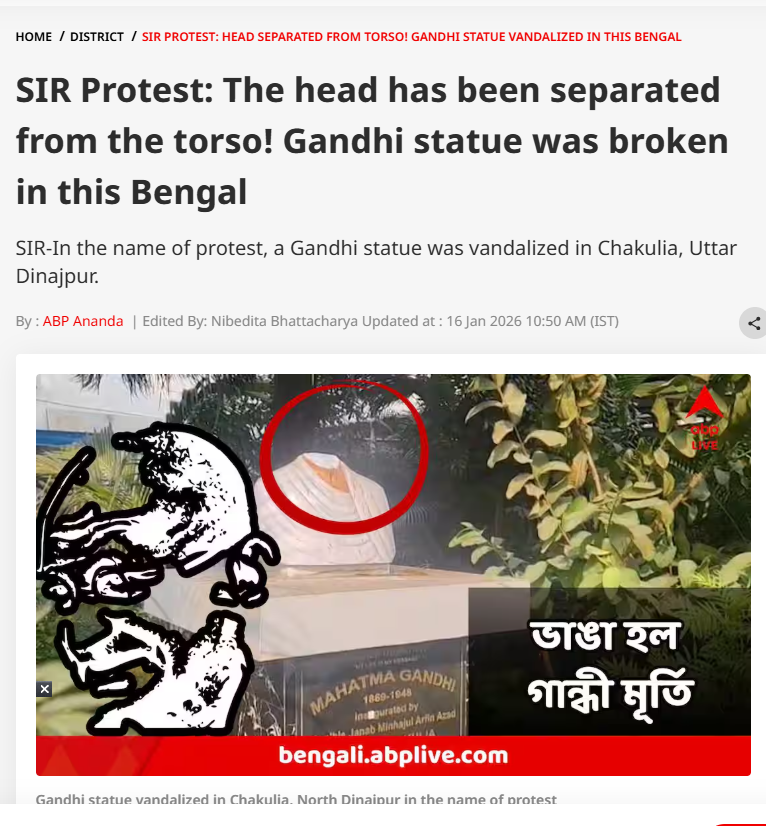
According to ABP Live Bangla, the statue of Mahatma Gandhi was damaged during a protest in Chakulia. The statue’s head was found separated from the body. While a portion of the broken statue remained at the site on Thursday night, it was reported missing by Friday morning. The report further stated that extensive damage was observed at BDO Office No. 2 in Golpokhar. Gandhi’s statue, located at the entrance of the administrative building, was found broken, and ashes were discovered near the premises. Government staff were seen clearing scattered debris from the site.
The incident reportedly occurred during a SIR (Special Intensive Revision) hearing at the BDO office, which was disrupted due to vandalism. In connection with the violence and damage to government property, 21 people have been arrested so far. In the next stage of verification, we found the same footage in a 16 January 2026 report by local Bengali news channel K TV, which also showed clear visuals of the damaged Mahatma Gandhi statue. Link and screenshot.

Conclusion:
The viral image of Mahatma Gandhi’s broken statue does not depict an incident from Bangladesh. The image is from Chakulia in West Bengal’s Uttar Dinajpur district, where the statue was damaged during a protest.

Related Blogs
.webp)
Starting on 16th February 2025, Google changed its advertisement platform program policy. It will permit advertisers to employ device fingerprinting techniques for user tracking. Organizations that use their advertising services are now permitted to use fingerprinting techniques for tracking their users' data. Originally announced on 18th December 2024, this rule change has sparked yet another debate regarding privacy and profits.
The Issue
Fingerprinting is a technique that allows for the collection of information about a user’s device and browser details, ultimately enabling the creation of a profile of the user. Not only used for or limited to targeting advertisements, data procured in such a manner can be used by private entities and even government organizations to identify individuals who access their services. If information on customization options, such as language settings and a user’s screen size, is collected, it becomes easier to identify an individual when combined with data points like browser type, time zone, battery status, and even IP address.
What makes this technique contentious at the moment is the lack of awareness regarding the information being collected from the user and the inability to opt out once permissions are granted.
This is unlike Google’s standard system of data collection through permission requests, such as accepting website cookies—small text files sent to the browser when a user visits a particular website. While contextual and first-party cookies limit data collection to enhance user experience, third-party cookies enable the display of irrelevant advertisements while users browse different platforms. Due to this functionality, companies can engage in targeted advertising.
This issue has been addressed in laws like the General Data Protection Regulation (GDPR) of the European Union (EU) and the Digital Personal Data Protection (DPDP) Act, 2023 (India), which mandate strict rules and regulations regarding advertising, data collection, and consent, among other things. One of the major requirements in both laws is obtaining clear, unambiguous consent. This also includes the option to opt out of previously granted permissions for cookies.
However, in the case of fingerprinting, the mechanism of data collection relies on signals that users cannot easily erase. While clearing all data from the browser or refusing cookies might seem like appropriate steps to take, they do not prevent tracking through fingerprinting, as users can still be identified using system details that a website has already collected. This applies to all IoT products as well. People usually do not frequently change the devices they use, and once a system is identified, there are no available options to stop tracking, as fingerprinting relies on device characteristics rather than data-collecting text files that could otherwise be blocked.
Google’s Changing Stance
According to Statista, Google’s revenue is largely made up of the advertisement services it provides (amounting to 264.59 billion U.S. dollars in 2024). Any change in its advertisement program policies draws significant attention due to its economic impact.
In 2019, Google claimed in a blog post that fingerprinting was a technique that “subverts user choice and is wrong.” It is in this context that the recent policy shift comes as a surprise. In response, the ICO (Information Commissioner’s Office), the UK’s data privacy watchdog, has stated that this change is irresponsible. Google, however, is eager to have further discussions with the ICO regarding the policy change.
Conclusion
The debate regarding privacy in targeted advertising has been ongoing for quite some time. Concerns about digital data collection and storage have led to new and evolving laws that mandate strict fines for non-compliance.
Google’s shift in policy raises pressing concerns about user privacy and transparency. Fingerprinting, unlike cookies, offers no opt-out mechanism, leaving users vulnerable to continuous tracking without consent. This move contradicts Google’s previous stance and challenges global regulations like the GDPR and DPDP Act, which emphasize clear user consent.
With regulators like the ICO expressing disapproval, the debate between corporate profits and individual privacy intensifies. As digital footprints become harder to erase, users, lawmakers, and watchdogs must scrutinize such changes to ensure that innovation does not come at the cost of fundamental privacy rights
References
- https://www.techradar.com/pro/security/profit-over-privacy-google-gives-advertisers-more-personal-info-in-major-fingerprinting-u-turn
- https://www.ccn.com/news/technology/googles-new-fingerprinting-policy-sparks-privacy-backlash-as-ads-become-harder-to-avoid/
- https://www.emarketer.com/content/google-pivot-digital-fingerprinting-enable-better-cross-device-measurement
- https://www.lewissilkin.com/insights/2025/01/16/google-adopts-new-stance-on-device-fingerprinting-102ju7b
- https://www.lewissilkin.com/insights/2025/01/16/ico-consults-on-storage-and-access-cookies-guidance-102ju62
- https://www.bbc.com/news/articles/cm21g0052dno
- https://www.techradar.com/features/browser-fingerprinting-explained
- https://fingerprint.com/blog/canvas-fingerprinting/
- https://www.statista.com/statistics/266206/googles-annual-global-revenue/#:~:text=In%20the%20most%20recently%20reported,billion%20U.S.%20dollars%20in%202024

Introduction
India’s digital growth journey has been moving at a tremendous pace. According to MeitY’s report, India’s digital economy is expected to rise to US$ 500 billion by 2025, up from US$ 200 billion in 2019. The digitisation drive that we are experiencing is likely to foster and boost a favourable business environment that will attract rapid investment and augment economic growth across sectors. This will, in turn, compel businesses to adopt digital platforms as solutions to meet customer expectations. Due to accelerated digitisation, cyber risks often deter business growth. Cybercrimes are becoming more rampant and complex and the costs associated with such breaches are not only increasing but also becoming more systemic.
Development of the Cyber Insurance Landscape
Digitization of businesses started in the 1980s with the use of mainframes. Personal computers entered the game and further modified the landscape from the 2000s along with LANs, the internet and the dot-com boom of the 2000s. In the late 1990s, cyber-insurance was developed as a risk management tool to ensure information security. Coverage was limited, and clients included SMEs in need of insurance to qualify for tenders, or community banks too small to hedge the risks of their online banking operations. The first cyber insurance policy was written in 1997 through AIG, against hacking as a third-party liability policy.
The current trends in the cyber insurance space are focused on the prevention of cyber risks, which by nature are hard to outline and constantly evolving. The result is that the buyers have limited clarity on the types of cyber risks covered under cyber insurance, and even lesser visibility on the scope and amount of optimum coverage. Unfamiliarity with the claim procedure and resolutions, ambiguous claim thresholds during settlements, and confusion around exclusions and coverage of regulatory fines and penalties under a purchased scheme further discourage potential buyers from seriously investing in cyber insurance products.
Key Factors in Cyber Insurance Evolution and Its Role in Risk Management
The cyber insurance market in India has three key influencing factors, namely the speed of achieving digital maturity, government initiatives to digitise and enforce stringent cyber laws, and the evolving landscape with technology giants and MNCs entering the cyber insurance domain. The latter are the catalyst for intensifying competition in this market.
Advancements in technology in terms of AI, machine learning, big data, robotics, blockchain, augmented and virtual reality, and IoT are expected to reshape the insurance industry and help reach untapped audiences in a more digital-forward manner. With the absence of a standard cyber insurance policy, regulators need to take the following variables into consideration while developing cyber insurance policies: the risk insured against, the scope of the loss covered and the limits/ sub-limits.
Challenges
With the complexity of cyber risks increasing exponentially the challenges to counter the same are growing too which is leading to gaps in the coverage offered for cyber threats. Resultantly, the compliance regulations are dependent on the risks which exist and cyber threat actors adopt new technologies faster and exploit them to their benefit. A lack of historical data and predictability in future cyber risks, the possibility of large overwhelming loss events, uncertainties among market participants about what is specifically covered under such policies, and legal battles over fundamental issues are some of the challenges identified.
Future Outlook/ Recommendations
India's cyber infrastructure requires a multi-faceted approach that involves collaboration between government, industry, and academia should be developed. Some recommendations are:
- Risk assessments should be a general practice and the cyber insurance policies should be simplified, clearing the mismatch between the premium paid and insurance coverage and there should be standard verbosity across cyber policy language.
- Promoting R&D tailored to India focused on education programs that have public-private partnerships and global collaborations to share threat intelligence, best practices, and expertise in critical infrastructure protection.
- Cyber insurance can also be promoted as compliance with the DPDP Act, which would lead to better development of cyber infrastructure and cyber hygiene practices.
- Regular updates to cyber insurance policies to ensure relevance and effectiveness. Insurers could create and offer holistic cyber insurance risk management plans.
Conclusion
According to a report by Deloitte in 2023, the cyber insurance market in India is expected to grow by 27-30 per cent in the coming years and it is currently valued at USD 50-60 million, while maintaining a steady 27-30 per cent CAGR in the past three years. The Indian cyber infrastructure’s nature is challenging, however, it offers opportunities for growth, innovation, and collaboration. A proactive approach, supported by robust policies, advanced technologies, and skilled professionals, will be essential to building a resilient cyber infrastructure capable of withstanding evolving threats.
Reference
- https://www2.deloitte.com/content/dam/Deloitte/nl/Documents/financial-services/deloitte-nl-fsi-demystifying-cyber-insurance-coverage-report.pdf
- https://www.dnaindia.com/business/report-what-s-cyber-liablity-insurance-and-why-you-may-need-it-2136556
- https://economictimes.indiatimes.com/industry/banking/finance/insure/cyber-insurance-gains-momentum-in-india-set-to-witness-exponential-growth-deloitte/articleshow/104189297.cms?from=mdr

Executive Summary:
A video purporting to be from Lal Chowk in Srinagar, which features Lord Ram's hologram on a clock tower, has gone popular on the internet. The footage is from Dehradun, Uttarakhand, not Jammu and Kashmir, the CyberPeace Research Team discovered.
Claims:
A Viral 48-second clip is getting shared over the Internet mostly in X and Facebook, The Video shows a car passing by the clock tower with the picture of Lord Ram. A screen showcasing songs about Lord Ram is shown when the car goes forward and to the side of the road.

The Claim is that the Video is from Kashmir, Srinagar

Similar Post:

Fact Check:
The CyberPeace Research team found that the Information is false. Firstly we did some keyword search relating to the Caption and found that the Clock Tower in Srinagar is not similar to the Video.

We found an article by NDTV mentioning Srinagar Lal Chowk’s Clock Tower, It's the only Clock Tower in the Middle of Road. We are somewhat confirmed that the Video is not From Srinagar. We then ran a reverse image search of the Video by breaking down into frames.
We found another Video that visualizes a similar structure tower in Dehradun.

Taking a cue from this we then Searched for the Tower in Dehradun and tried to see if it matches with the Video, and yes it’s confirmed that the Tower is a Clock Tower in Paltan Bazar, Dehradun and the Video is actually From Dehradun but not from Srinagar.
Conclusion:
After a thorough Fact Check Investigation of the Video and the originality of the Video, we found that the Visualisation of Lord Ram in the Clock Tower is not from Srinagar but from Dehradun. Internet users who claim the Visual of Lord Ram from Srinagar is totally Baseless and Misinformation.
- Claim: The Hologram of Lord Ram on the Clock Tower of Lal Chowk, Srinagar
- Claimed on: Facebook, X
- Fact Check: Fake
