
Cyber Safety and Information Resilience during India-Pakistan Tensions
Introduction
The Pahalgam terror attack, which took place on April 22, 2025, was a tragic incident that shook the nation. The National Investigation Agency (NIA) formally took over the Pahalgam terrorist attack case on Sunday, April 27, 2025. Following India's strikes on Pakistan, tensions between the two countries have heightened, leading to concerns about potential escalation, including the risk of cyber attacks and the spread of misinformation that could further complicate the situation. It is crucial for corporations, critical sectors, and all netizens in India to stay proactive and vigilant against cyber attacks, while also being cautious of the risks of misinformation. This includes protecting themselves from being affected and avoiding the inadvertent or deliberate spread of false information.
Be Careful with the Information You Consume and Share
It is crucial to note that the Press Information Bureau (PIB) has alerted citizens to stay cautious of fake narratives being circulated by Pakistani handles. Through an official fact check, PIB debunked several misleading claims aimed at undermining India’s internal stability and security forces. Citizens are urged to verify any suspicious content via PIB Fact Check before sharing it further. As social media becomes a hub for viral content, netizens must be cautious about the information they consume and share. Misleading information, old videos, false claims, and misinformation flood the platform, making it essential to be mindful of the content you consume and share, as spreading unverified content can have severe consequences.
CyberPeace Recommends Following Crucial Cyber Safety Tips to Stay Vigilant Against Potential Digital Threats:
- Do not open/download any video file you receive in social media groups or from unknown sources.
- As per several media reports, a video file named "Dance of the Hilary" is being circulated, which may be intended for a cyber attack on India. Please refrain from clicking, downloading, or sharing any such file. Additionally, there are reports of suspicious files circulating on WhatsApp, including tasksche.exe, OperationSindoor.ppt, and OperationSindhu.pptx. Do not download or open any of these files, as they may pose a serious cyber threat.
- To receive accurate alerts, you can enable government notifications on your iPhone. Go to Settings > Notifications and scroll down to Government Alerts. Make sure all the toggles under Government Alerts are turned on. This will allow you to receive timely information and important alerts from government agencies, and your device will display critical notifications to keep you informed and safe.
- Turn off automatic media download in WhatsApp to reduce the risk of downloading potentially harmful files.
- To protect your privacy, disable location services on apps like WhatsApp, Instagram, Snapchat, and X unless absolutely necessary.
- Refrain from sharing sensitive information like government data, confidential details, or personal records on unsecured devices or networks.
- To avoid misinformation and manipulation during conflict, verifying and cross-checking the news before sharing it with anyone is crucial. Stay updated with official news updates, and be cautious while sharing information.
Conclusion
In times of heightened tensions, all of us need to stay vigilant, protect our digital spaces, and verify the information we encounter. Together, we can safeguard ourselves from cyber threats and misinformation, ensuring the safety, stability, and digital security of our nation. As proud citizens, let us unite to protect both our physical and digital well-being.
References
- https://www.thehindu.com/news/national/pakistan-has-unleashed-propaganda-machine-in-response-to-successful-operation-sindoor-ib-ministry/article69549084.ece
- https://sambadenglish.com/national-international-news/india/centre-asks-people-to-stay-alert-against-misinformation-in-social-media-9048169
- https://www.youtube.com/watch?v=gLHo_Vd1_H0&t=19s

Related Blogs
Introduction
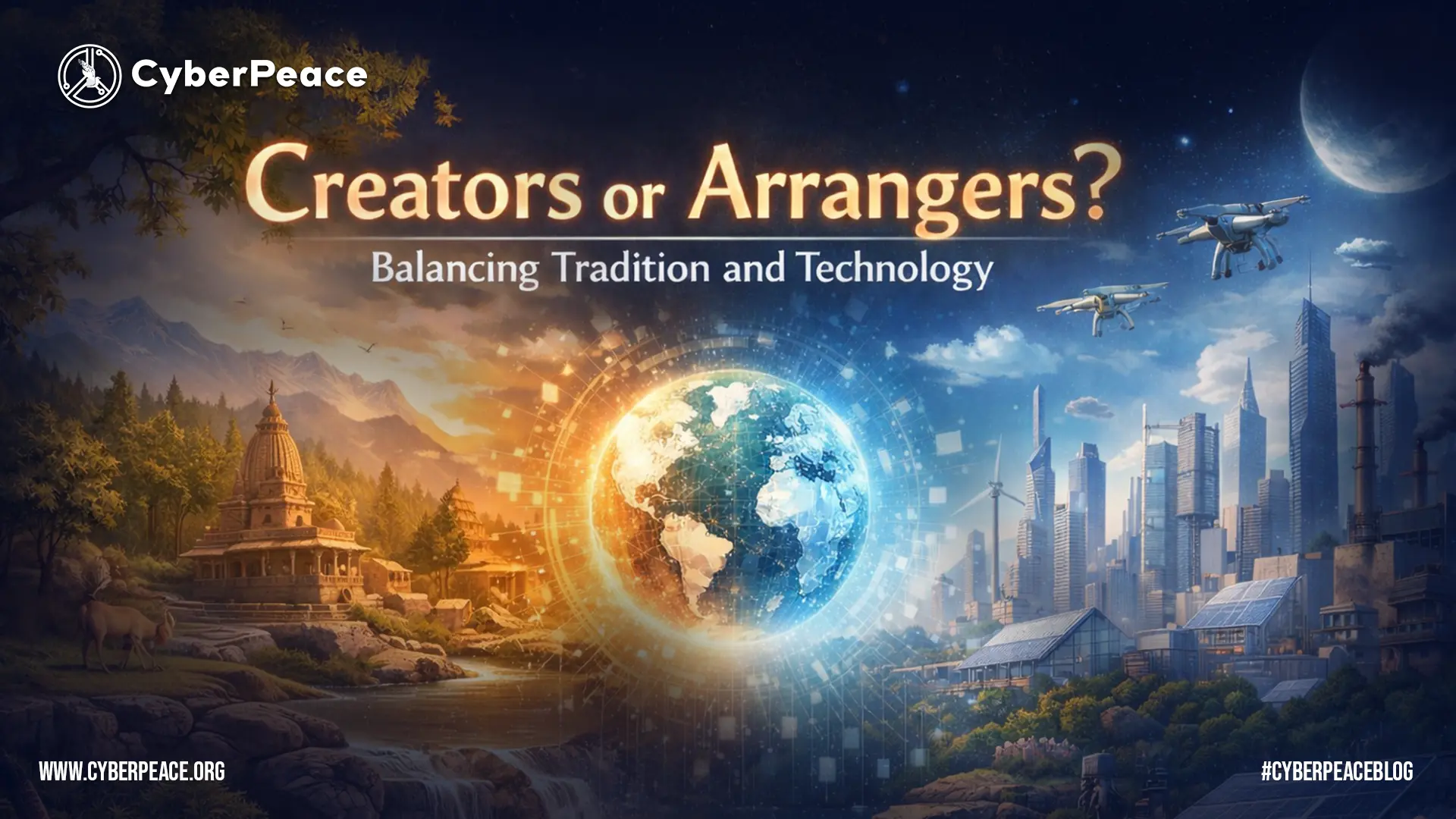
We live in a time where technological change is no longer slow or subtle. Robotics, automation, artificial intelligence, and digital systems are transforming the way we work, think, and even imagine the future. This is often celebrated as great progress. But a deeper question quietly waits behind the noise. Is every advancement truly an uplift when seen through the lens of scriptures, culture, and Indian philosophical thought? Are we creating for the good of humanity, or are we only chasing convenience and speed? And what kind of future are we actually preparing, not just for ourselves, but for those who will be born into this world shaped by these tools from the very beginning?
India has long been seen as a land that values balance, purity, and harmony with nature. Its rivers, mountains, forests, and traditions are not just geography or history, they are part of a civilizational way of thinking that connects life, duty, and responsibility. In this context, it becomes important to ask what the long-term cost of our technological appetite might be. Every invention has a footprint. Industries change landscapes. Energy demands reshape ecosystems. Convenience today often hides consequences that only appear years later. Progress, when measured only in speed and output, forgets to ask what it takes away in silence.
There is also a quieter change happening inside the human mind. As tools become smarter, humans begin to feel more powerful. The thought slowly shifts from “I can use this” to “I control this.” With artificial intelligence, the language becomes even bolder. We start hearing phrases like “we can create worlds, faces, voices, even minds.” But history have always warned us about ‘overreach’. Not because power is evil, but because pride blinds judgment. When ability grows faster than wisdom, imbalance follows. We can already see early signs of this in concerns about shrinking attention spans, weakening cognitive habits, and a growing dependence on systems that think for us before we learn to think for ourselves deeply.
None of this is an argument to reject innovation. The idea is not to blacklist technology or romanticise the past. The real question is about direction and responsibility. Advancements are not only for the comfort of the present generation. They shape the mental, moral, and emotional world of future generations who will grow up surrounded by these systems as something normal and unavoidable. What values will guide that world? What habits will it encourage? What will it quietly take away?
This is where the richness of Indian thought becomes relevant, not as nostalgia, but as guidance. Ideas of dharma, restraint, balance, and ethical action were never anti-progress. They were reminders that power without responsibility becomes dangerous, and that ability without humility leads to decline. In modern terms, we talk about safety by design, ethical innovation, and human-centred technology. In older language, we talked about duty, limits, and the consequences of unchecked desire. The words have changed, but the concern is the same.
Perhaps the real question is not whether we are becoming creators, but whether we remember that we are also caretakers. We do not bring existence out of nothing. We reshape what already exists. And in that reshaping, the line between wisdom and arrogance, between progress and pride, becomes the most important line of all.
The futuristic impact of AI, robotics, and technologies
In every yuga, humans have extended the limits of what they can do. What changes is not the desire, but the form it takes. Our ancient history speak of extraordinary abilities, not as fantasies, but as reminders of how power tests character. Figures like Naradmuni (a prominent divine sage (Rishiraja) in Hinduism) are described as moving from one place to another in moments. Others gained immense strength, knowledge, or influence through years of discipline and tapasya. Ravana (Figure from Ramayana) himself was learned and powerful, far beyond ordinary human measure. Sanjaya (the charioteer and advisor of King Dhritarashtra in the Mahabharata) receives the gift of divya drishti and narrates the events of the battlefield without being physically present there, seeing and speaking across distance in a way that still feels remarkable even today.
In this yuga, that ancient search for power and reach has not disappeared, it has only changed its language, and today it speaks through robotics, artificial intelligence, and advanced technologies, making us ask whether we are truly creators or only very advanced arrangers of what already exists.
In this age, science and technology are attempting something similar in a different language. We may not travel like Naradmuni, but we send our voices, images, and thoughts across the world in seconds. We build machines that can see, listen, respond, and even imitate human thinking. Artificial intelligence and robotics promise comfort, speed, and efficiency, and in many ways, they truly improve human life. Yet the old question remains. Not just what can we do, but how far should we go, and at what cost.
When we primarily build for human convenience, we often fail to thoroughly examine the long-term consequences. The environmental impact of large-scale technology is already visible in the pressure on resources, the growth of waste, and the slow damage to air, water, and soil. Nature does not recover at the pace of human ambition. What feels like small compromises today can become heavy burdens for tomorrow.
There is also the impact on the human mind. As systems become more capable, humans risk becoming more dependent. When answers arrive instantly, patience weakens. When machines start deciding for us, the habit of deep thinking slowly fades. Over time, this can affect attention, memory, and judgment. Knowledge becomes easier to reach, but wisdom becomes harder to build. Just as in old stories, the danger is not in having power, but in losing clarity while using it.
Future generations will not encounter these technologies as new inventions. They will be born into them. What we treat today as tools, they will experience as the normal environment of life. This makes responsibility unavoidable. The real question is not only whether these systems work, but what kind of humans they will shape.
The purpose of this reflection is not to reject progress. It is to ask for balance. Building for human comfort is important, but building without studying long-term impact is risky. If this age has the power to create intelligent systems, it must also have the wisdom to protect the environment, care for future generations, and preserve the depth of the human mind. Otherwise, advancement becomes speed without direction, and power without responsibility.
The Acceleration of the Technological Age
The current era has reached a state where technological progress now occurs through instantaneous changes which transform our methods of working and decision-making and future planning. People often view robotics and automation and artificial intelligence as signs of progress yet a less audible inquiry persists through time which asks whether every technological advancement enhances human existence or whether we merely pursue efficient and easy solutions without thinking about their implications. Indian philosophical thought offers a useful lens here, one that does not reject progress but asks whether it aligns with balance, responsibility, and long-term harmony. The definition of intelligence according to this perspective extends beyond computational skills and pattern imitation because it requires people to achieve awareness and intent and their complete understanding. Current machines possess the ability to mimic human reasoning and produce language while they can replicate decision-making processes, but they lack both consciousness and personal experience.
Power, Responsibility, and Ethical Imbalance
The development of new technological capabilities brings with it ethical responsibilities which every society must handle. Human beings must take on new ethical duties which match their increasing capabilities according to historical evidence. The current situation shows that people create new things at a speed which exceeds their ability to think about those innovations. Systems exist to enhance operational performance while they determine human actions and extend their power but they do not always evaluate their complete impact. Indian traditions emphasize dharma, the principle of balance and rightful action, which shows that power without ethical grounding creates destructive human force. The state of imbalance exists without showing its presence at all times. The process of imbalance development takes place through three channels: environmental degradation, social inequalities, and the gradual decline of human control.
The current society demonstrates this transformation through its existing results. The algorithms now determine our consumption choices and our methods of understanding everything around us. The system provides users with personalized comfort, but it also creates hidden patterns that determine their preferences. The process starts with decision assistance before it progresses to decision influence which eventually leads to decision conditioning. The concept of swatantrata as inner freedom becomes more complicated within such an environment. People stop making freedom choices when they find it easier to select between things that exist in their surroundings because they lose their ability to choose. People start to measure their work activities and personal identity through systems that use optimization techniques and digital validation systems, which leads to a decrease of space that exists for individuals to think and consider matters independently.
Technology, Ecology, and Civilizational Values
The environmental impact of technological demand exists together with social transformations. All systems need power while all infrastructure creates environmental effects and all products, we use contain unknown expenses which become apparent after many years. India's civilizational values maintain their dedication to nature because people see rivers and forests and ecosystems as essential parts of existence. Success in modern society measures output as the main achievement while actual value disappears through the evaluation process. The future requires us to create new things but we must also decide which things to keep intact.
The current situation requires progress to be defined differently because it needs to be measured through precise management instead of continuous rapid development. The question now extends beyond technological advancement to include the need for technologies to be operated through intelligent guidance. The increasing abilities of machines create a greater need for people to maintain their essential human characteristics. Human beings must actively maintain their capacity to make ethical decisions and understand their life's meaning and purpose. The future depends on two factors: the “innovations that will emerge and the values that will guide their development.”
Conclusion
It is high time we pause and honestly examine the path we are taking. The question is not whether technology should grow, but whether its overreach should be allowed to shape the future without restraint. We are building faster than ever, developing systems that touch every part of life. That makes it even more important to study their long-term impact, not only on markets or productivity, but on nature, on the human mind, and on the generations who will inherit this tech-driven world.
Progress should benefit those who come after us, not quietly weaken them. A future where people are born into pure convenience, surrounded by tools that think, decide, and act for them, may look comfortable, but comfort alone does not build strong, aware, or responsible human beings. Growth without effort and ease without discipline slowly takes away depth, resilience, and clarity. Technology should support human potential, not replace it.
This is why morality, ethics, and balance cannot be treated as optional ideas. They must guide innovation, not follow it. We do not need to overcreate. We need to create ‘wisely’. We need to build systems that remain under human control, not systems that slowly train humans to surrender their judgment, attention, and responsibility. Tools should remain tools. They should serve life, not define it.
Indian thought has always placed intention at the centre of action. Karma is not judged only by outcome, but by the spirit in which an act is performed. A tool in itself is neither pure nor impure. It becomes one or the other through the hand that uses it. This is a lens through which modern technology can also be examined. Artificial intelligence can help doctors read scans faster, help farmers predict weather patterns, and help students in remote areas access knowledge. At the same time, it can be used to watch, to sort, to exclude, and to reduce human beings to data points that fit neatly into a system. The difference lies not in the machine, but in the values of those who design and deploy it.
The purpose of this reflection is simple. We should build, but we should build with responsibility. We should innovate, but with awareness of consequences. True progress is not just about what is possible today. It is about what remains healthy, meaningful, and sustainable tomorrow. If this age can combine intelligence with humility, and power with restraint, then technology will not become a symbol of overreach. It will become a sign of maturity.

Introduction
With mobile phones at the centre of our working and personal lives, the SIM card, which was once just a plain chip that links phones with networks, has turned into a vital component of our online identity, SIM cloning has become a sneaky but powerful cyber-attack, where attackers are able to subvert multi-factor authentication (MFA), intercept sensitive messages, and empty bank accounts, frequently without the victim's immediate awareness. As threat actors are becoming more sophisticated, knowing the process, effects, and prevention of SIM cloning is essential for security professionals, telecom operators, and individuals alike.
Understanding SIM Cloning
SIM cloning is the act of making an exact copy of a victim's original SIM card. After cloning, the attacker's phone acts like the victim's, receiving calls, messages, and OTPs. This allows for a variety of cybercrimes, ranging from unauthorised financial transactions to social media account hijacking. The attacker virtually impersonates the victim, often leading to disastrous outcomes.
The cloning can be executed through various means:
● Phishing or Social Engineering: The attack compels the victim or a mobile carrier into divulging personal information or requesting a replacement SIM.
● SIM Swap Requests: Attackers use fake IDs or stolen credentials to make telecom providers port the victim's number to a new SIM.
● SS7 Protocol Exploitation: Certain sophisticated attacks target weaknesses in the Signalling System No. 7 (SS7) protocol employed by cellular networks to communicate.
● Hardware based SIM Cloning: Although uncommon, experienced attackers will clone SIMs through the use of specialized hardware and malware that steals authentication keys.
The Real-World Consequences
The harm inflicted by SIM cloning is systemic as well as personal. The victims are deprived of their phones and online accounts, realising the breach only when improper dealings or login attempts have occurred. The FBI reported over $50 million loss in 2023 from crimes associated with SIM, most of which involved cryptocurrency account and high net-worth persons.
Closer to home, Indian entrepreneurs, journalists, and fintech users have reported losing access to their numbers, only to have their WhatsApp, UPI, and banking apps taken over. In a few instances, the attackers even contacted contacts, posing as the victim to scam others.
Why the Threat Is Growing
Dependence on SMS-based OTPs is still a core vulnerability. Even as there are attempts to move towards app-based two-factor authentication (2FA), most banking, government, and e-commerce websites continue to employ SMS as their main authentication method. This reliance provides an entry point for attackers who can replicate a SIM and obtain OTPs without detection.
Vulnerabilities in telecom infrastructure are also a part of the issue. Insider attacks at telecom operators, where malicious employees handle fraud SIM swap requests, also keep cropping up. On top of that, most users are not even aware of what exactly SIM cloning is or how to identify it, leaving attackers with a head start.
Very often, the victims are only aware that their SIM has been cloned when they lose mobile service or notice unusual activity on their accounts. Red flags include loss of signal, failure to send or receive messages, and inability to receive OTPs. Alerts on password changes or unusual login attempts must never be taken lightly, particularly if this is coupled with loss of mobile service.
How Users Can Protect Themselves
● Use A Strong SIM Pin: This protects your SIM from access by unauthorized users should your phone be lost or stolen.
● Secure Personal Information: Don't post sensitive personal information online that can have a place in social engineering.
● Notify your Carrier of Suspicious Activity: If your phone suddenly has lost service or is behaving strangely, contact your mobile operator immediately.
● Register for Telecom Alerts: Many providers offer alerts to SIM swap or porting requests that are useful to preliminarily detect a possible takeover.
● Verify SIM card status using Sanchar Saathi: Visit [https://sancharsaathi.gov.in](https://sancharsaathi.gov.in) to check how many mobile numbers are issued using your ID. This government portal allows you to identify unauthorized or unknown SIM cards, helping prevent SIM swapping fraud. You can also request to block suspicious numbers linked to your identity.
Conclusion
SIM cloning is not a retrograde nod to vintage cybercrime; it's an effective method of exploitation, especially where there's a strong presence of SMS-based authentication. The attack vector is simple, but the damage it causes can be profound, both financial and reputational. With telecommunication networks forming the backbone of digital identity, users, regulators, and telecom service providers have to move in tandem. For the users, awareness is the best protection. For Telecoms, security must be a baseline requirement, not a value-add option. It's time to redefine mobile security, before your identity is in anyone else's hands.
References
● https://www.trai.gov.in/faqcategory/mobile-number-portability
● https://www.cert-in.org.in/PDF/Digital_Threat_Report_2024.pdf
● https://www.ic3.gov/PSA/2022/PSA220208/
● https://www.hdfcbank.com/personal/useful-links/security/beware-of-fraud/sim-swap
● https://security-gen.com/SecurityGen-Article-Cloning-SimCard.pdf
● https://www.p1sec.com/blog/understanding-ss7-attacks-vulnerabilities-impacts-and-protection-measures

Introduction
Ministry of Electronics and Information Technology (MeitY) Announces to Centre Government to Plan to Certify Permissible Online Games.
In a recent update to the notification released by the Ministry of Electronics and Information Technology (MeitY) on April 6, MeitY has requested gaming entities to establish self-regulatory organisations (SROs) within a timeframe of 30 days or a maximum of 90 days from the date of the notification, which is April 6, 2023. The Ministry of Electronics and Information Technology (MeitY) has further announced that the central government will certify which online games are permissible until the SROs are officially established. The intention behind establishing SROs is to assist intermediaries, such as Apple or Google, in determining what constitutes a permitted online game, but the SRO will take 2-3 months to complete. In the meanwhile, the Central government will step in and determine what is a permissible online game.
Information Technology (Intermediary Guidelines and Digital Media Ethics Code) Rules, 2021 & Intermediary Guidelines and Digital Media Ethics Code Amendment Rules, 2023
By enacting these rules, the Indian government has taken decisive action to protect Indian gamers and their financial resources against scams and fraud. The rules also serve to promote responsible gaming while preventing young and vulnerable users from being exposed to indecent or abusive content.
Amendment Rules developed the concept of a “Permissible online real money game.” This designation is reserved for games that have passed a review process conducted by a self-regulatory body (SRB). Amendment rules indicate that Online Gaming Intermediaries must ensure that they do not permit any third party to host non-permissible online real money games on their platforms. This development is important because it empowers us to distinguish between legitimate and illicit real money games.
The Amendment Rules define an online gaming provider as an “intermediary” under the Information Technology Act of 2000, creating a separate classification called ‘Online Gaming Intermediary’.

Central government to certify what is an ‘Online Permissible Game’
The industry has been wondering what games come under wagering and will be banned. So, until the SROs are officially established, the government, in the interim, will certify what is a permissible game, what is wagering, and what is not wagering. Games that involve elements of wagering are going to be barred. The new regulations prohibit wagering on any outcome, whether in skill-based or chance-based games. Hence gaming applications involving wagering and betting apps will be barred.
Self-Regulatory Organizations (SROs)
According to the new regulations by the Ministry of Electronics and Information Technology (MeitY), online gaming intermediaries must establish a Self-Regulatory Body (SRO) to approve games offered to users over the Internet. The SRO must be registered with the Ministry and develop a framework to ensure compliance with the IT Rules 2021 objectives. An ‘online game’ can be registered by the SRO if it meets specific criteria, which include that the game is offered by an online gaming intermediary that is a member of the self-regulatory body, the game is not containing any content harmful to India’s interests, and complying with all relevant Indian regulations. If these requirements are met, the intermediary can display a visible registration mark indicating its registration with the self-regulatory authority.
Conclusion
MeitY found that with the rapid growth of the gaming industry, the real money gaming (RMG) sector had to be regulated properly. Rules framed must be properly implemented to stop gambling, betting, and wagering apps.
The IT Rules 2021, along with the Amendment Rules 2023, are created to take concrete action to curb the proliferation of gambling, betting, and wagering apps in India. These rules empower to issue of directives to ban specific apps that facilitate or promote such activities. The app ban directive allows the government to take decisive action by blocking access to these apps, making them unavailable for download or use within the country. This measure is aimed at curbing the negative impact of gambling, betting, and wagering on individuals and society, including issues related to addiction, financial loss, and illegal activities. Rules aim to actively combat the spread and influence of such apps and provide a safer online environment for gaming users.
The self-regulatory body in the context of online gaming will have the authority to grant membership to gaming intermediaries, register online games, develop a framework for regulation, interact with the Central Government, address user complaints, report instances of non-compliance, and take necessary actions to safeguard online gaming users.
