
Behind Every Scam Call: The Hidden Business of Fraudulent SIM Cards
Introduction
Recently, the Delhi Police arrested a licensed telecom PoS agent, who identified himself as “Shivam Telecom," from a roadside kiosk adjacent to Hindu Rao Hospital. On the face of it, the headline may have simply read, “One man, one arrest." However, beneath that arrest is the unsettling story of a fully legitimate retail shop actively forging other people’s identification documents into weapons, one SIM card at a time, for as little as ₹500-600 each. This is not an account of an isolated offender; it is a peek into the vulnerability of SIM card security for typical end-users and the reasons why every mobile phone subscriber must pay attention to the unseen journey of his number.
Why SIM Security Matters Now
Erstwhile, a SIM card was only a simple device for sending text messages and making calls. Today, however, it’s also a direct link to most of our lives online, be it online banking to verify it through one-time passwords (OTP) or Unified Payments Interface (UPI); social media platforms; or email accounts to reset a forgotten password, two-factor authentications (2FA), or even numerous other online services. Therefore, losing a SIM card and getting it fraudulently issued under your name, or criminals accessing your identity to buy a SIM, can be a serious cause of concern, as they can then impersonate you, conduct various frauds, bypass checks, or commit acts that can lead to you being wrongly implicated.
According to the investigation, criminals were procuring SIM cards through the authorized outlets of telecom companies, not unlicensed dealers. This clearly proves a deficiency in the Know Your Customer (KYC) process for the SIM card activation. The situation, however, is worse and is also highlighted by the fact that more than 21 lakh mobile numbers from the more than 114 crore mobile numbers reviewed under the Sanchar Saathi initiative launched by the department of telecommunications (DoT) were associated with fake or invalid identity documents. A state police chief of Tamil Nadu claims that 90% of the cyber fraud cases involved SIM cards obtained through misused identity documents.
How Illegally Activated SIMs Fuel Everyday Scams?
Once a SIM is activated using someone else's identity documents or biometric data, without their knowledge, it becomes a disposable, hard-to-trace tool for criminals. Here's how that plays out in practice:
- Phishing and impersonation calls: Using an honest person’s details for a SIM registration allows the scammer to have a “clean” number that won’t tip off victims about a potential scam immediately when carrying out a fake bank call, fake delivery scam, or fake impersonation of an officer.
- OTP and account-takeover fraud: Since the SIM card is used as the anchor to OTP verification, an unauthorized SIM can be used to capture one-time passwords to activate new digital payments, create a new digital payments account, or use other personal information linked to your phone number to reset your service passwords.
- Financial fraud and money mule networks: According to the investigators, such SIMs were extensively being used to open digital payment accounts as well as to flow money across a number of fraud chains, thus enabling the fraudsters to build a layer of financial infrastructure that is not linked with their actual identities.
- Identity theft with real-world consequences: The identity of the Aadhaar holder (whose document was used to activate the SIM card) might be unaware that a SIM exists under his name until the fraud is uncovered during a loan default or a criminal investigation where he is forced to justify a crime committed using “his” number that he is oblivious to.
That is the anonymity that SIM-card fraud has: the fact that the SIM on the face of it seems genuine, but the one operating it and the registered owner have absolutely no relationship whatsoever.
Red Flags Every Mobile User Should Watch For
Most people won't know their identity has been misused until something goes visibly wrong. A few warning signs are worth taking seriously:
- Your SIM suddenly loses network connectivity or displays "No Service" for an extended period without any known outage, SIM replacement request, or billing issue.
- You stop receiving OTPs or verification messages for banking, UPI, or other online services, particularly if login attempts continue to occur on your accounts.
- You receive unexpected OTPs, verification codes, or account alerts for services you never signed up for, indicating that someone may be attempting to use your mobile number.
- You receive calls or messages intended for someone else or asking you to confirm activities you never performed, which may suggest your number has been misused or duplicated.
- Your bank or telecom provider notifies you of unusual account activity, failed identity verification, or changes that you did not authorize.
- You discover multiple mobile connections registered in your name that you never requested, a risk that often remains unnoticed unless you proactively check through the Department of Telecommunications' Sanchar Saathi portal.
None of these guarantee fraud, but any of them is a reason to check further rather than assume it's a glitch.
Practical Steps to Protect Yourself
The good news is that Indian users now have direct tools to check and control this exposure:
- Identify your SIMs: Via the Department of Telecom’s Sanchar Saathi website, you can access a list of all mobile numbers registered in your name. Report and get any SIMs you do not recognize deactivated promptly.
- Safeguard your identity documents and biometrics: Do not disclose your Aadhaar information, OTPs, or biometrics to unofficial persons or retail agents. Ensure your SIM is activated in your presence by an official dealer of the telecom company.
- Tighten the security of your accounts: Wherever possible, use the most secure multi-factor authentication methods; an authenticator app, rather than just SMS, would be ideal. Consider enabling account change or SIM swap notifications from your telecom provider.
- Stay vigilant about your bank accounts and financial activities. Watch for unusual OTP requests, password change requests, login notifications, and unrecognized devices being logged into your online accounts. Being observant early on helps minimize losses.
- Take swift action if a SIM stops working: Contact your telecom provider and report the misuse to the Sanchar Saathi website as well as your nearest cyber station, or file a complaint through the cybercrime helpline number.
A Shared Responsibility
Consumer vigilance is not enough to save the system. Telecom providers must verify customer authenticity and check their retail points sufficiently so that a roadside vendor of the likes of “Shivam Telecom” cannot have their retail outlet anywhere the retail outlets may not need to be established and can be run even from an abandoned car body on the street for weeks. Authorities are ensuring this by making all franchisees and PoS agents and distributors register, such that the individual activating each SIM is perfectly identifiable. Consumers should take precautions and report suspicious patterns and be vigilant for fraud detection and protect themselves by knowing the system, like the use of the Sanchar Saathi platform.
Conclusion
The Delhi fake SIM case proves that even sophisticated technologies are not enough to protect India’s telecom ecosystem. No amount of biometric validation, AI fraud prevention tools, or rigid KYC compliance can offset a single corrupt agent selling SIM cards over the counter. While law enforcement works to clamp down, the responsibility also falls upon consumers, who need to regularly monitor their SIM registrations, safeguard their identity, and report any suspicious transactions in time to minimize the threat of identity theft and SIM-based cybercrime.
Sources
- https://www.prokerala.com/news/articles/a1784141.html
- https://the420.in/dots-sanchar-saathi-initiative-exposes-21-lakh-sim-cards-activated-illegally
- https://www.sancharsaathi.gov.in/
- https://www.pib.gov.in/PressReleasePage.aspx?PRID=2113857
- https://www.business-standard.com/amp/industry/news/nearly-4-million-sims-deactivated-as-govt-cracks-down-on-digital-fraud-125080500300_1.html
- https://www.digit.in/news/telecom/here-are-5-new-sim-card-rules-implemented-by-dot-amid-rising-scams-and-frauds.html

Related Blogs

Executive Summary:
Internship scams have infiltrated the academic landscape, scamming students of many prestigious colleges. The students often prefer to carry out internships to gain knowledge and work experience. These scams use the name of popular multinational companies to exploit the students. This report studies the various case studies, their modus operandi, impact on the students and preventive strategies. This report emphasises the importance of awareness and proactive measures to protect students from falling victim to such frauds.
1. Introduction
Internships are the opportunity to overcome the gap between the practical knowledge acquired at the university and practical experience, to get practical skills and contacts in the field of activity, as well as improve employment prospects. Instead, because of high paying internships and interesting positions students have become targets of work scams. As we have seen with the advancement in digital technology, scammers take advantage of the disguise of the internet, making very neat, smart, and convincing scams.
Internship scams are very prevalent and they include fake job listings and phishing schemes as well as payment frauds which make students lose lots of money and also emotionally expose them. In this specific case, this paper examines how these scams work, the warning signs, and ways of protecting students from falling victim to them.
2. Detailed Modus Operandi of Internship Scams
Internship scams often employ a variety of tactics to attract and deceive unsuspecting students. Below is a detailed breakdown of the common methods used by scammers:
- Fake Job Listings and Offers:some text
- Scammers post attractive internship offers on popular job portals, social media platforms, and even send personalised messages via LinkedIn. These listings often mimic the branding and style of reputable companies, including well-designed logos, professional email addresses, and official-looking websites.
- Example: A fake internship offer from a reputed software firm circulates on a job portal, with a professional landing page. Students who apply are quickly “hired” without any interviews, and are asked to pay a security deposit to confirm their acceptance.
- Upfront Payment Requests:some text
- Scammers ask for payment such as registration fees, training materials, background checks, or security deposits. These payments comes under non-refundable payment and it act as the primary revenue stream for the fraudsters.
- Example: A group of students receive internship offers requiring a payment of INR 10,000 for "training materials" and "online assessments." After making the payment, the students never hear back from the company, and all attempts to contact them were futile.
- Phishing and Identity Theft:some text
- Beyond financial fraud, some scams aim to steal personal information. Fake internship applications often require detailed personal data, including identity proofs, bank account details. This data will be used as identity theft or sold on the dark web.
- Example: A student applies for an internship that asks for copies of identification documents and bank details. This information sharing led to unauthorised transactions in their bank account.
- Work-from-Home Frauds:some text
- With the rise of remote work, scammers also offer work-from-home internships that require students to purchase software or pay for specialised training. After payment, students are often given irrelevant tasks or no tasks at all, leaving them with no real work experience.
- Example: An internship advertised as a "remote data analysis role" required students to buy a proprietary software licence. After paying, students realised the software was freely available online, and the internship tasks were non-existent.
- Impersonation of Reputed Companies:some text
- Scammers use the name of well-known companies, they modify the email addresses or create fake websites that look original. They use these platforms to send offer letters, making it difficult for students to identify the scam.
- Example: A scammer creates a fake website mirroring a major consulting firm's internship page. The only difference is a minor change in the URL. Dozens of students are duped into paying registration fees.
3. Case Studies of Real-Life Incidents
- Case Study 1: The Certification Course and Internshipsome text
- A group of students received personalised emails from an official domain of a reputed tech industry providing an internship offer. Students were asked to pay Rs 10,000 to undergo a certification course to carry the internship. After paying the amount, the students did not receive any instructions, and the company was found to be nonexistent. The scammer had spoofed the company’s email domain, making it difficult to trace the source.
- Case Study 2: The Social Media Trapsome text
- A student from a university encountered an internship post on Instagram, advertising roles at a popular fashion brand. The application process involved a "screening fee" of INR 5,000. Despite appearing legitimate, the internship was fake, and the brand had no knowledge of the post. The student's personal data was also compromised, leading to unauthorised social media activity.
- Case Study 3: Internship Providing Social Platformssome text
- A popular internship providing platform, faced an incident where a scammer posted fraudulent internship offers under the guise of a major multinational. The scam involved asking students to purchase expensive software to start their work. The platform had to issue warnings and remove the listings after several complaints.
4. The Impact on Students
The consequences of internship scams extend beyond immediate financial loss, affecting students on multiple levels:
- Financial Impact:some text
- Students lose their money, ranging from minor fees to significant payments.
- Emotional and Psychological Distress:some text
- These kinds of scams can lead to anxiety, depression and loss of confidence in availing the opportunities in future.
- Exposure to Further Scams:some text
- Scammers often share details of their victims with other fraudsters, making students susceptible to repeated scams, including phishing attacks, financial frauds, and unsolicited offers.
5. Preventive Measures
- Verification of Internships:some text
- Always verify the authenticity of the internship by researching the company on official platforms such as LinkedIn, the company’s official website, and through trusted contacts or college placement cells.
- Avoid Upfront Payments:some text
- Employers do not ask for money in exchange for job or internship offers. If they demand for any kind of payment, then the employer is not original. Always question the necessity of such payments and consult trusted advisors before proceeding.
- Use Trusted Job Portals:some text
- Apply for internships through recognized platforms like LinkedIn, Internshala, or your college’s placement cell, which have verification processes to filter out fraudulent postings.
- Reporting Scams:some text
- Report suspicious offers to your college authorities, placement cells, and local cybercrime departments. Additionally, use platforms like Internshala’s “Report This Job” feature to flag fraudulent listings.
- Stay Educated and Updated:some text
- It is important to educate students by providing workshops, webinars, and awareness sessions on cybersecurity to stay informed and report about the latest scams.
6. Conclusion
Internship scams are a severe threat to the student society since they manipulate the student’s desire for an internship. The best ways to prevent such cons are by being cautious and receptive to whatever is being offered. Internship seekers, colleges and the placement cells have to work hand in hand to ensure that there is no fear among people seeking internships.
References
- Smith, J. (2024). Internship Scams on the Rise: How to Spot and Avoid Them. Retrieved from example1.com.
- Brown, A. (2023). Student Internship Scams in India: A Growing Concern. Retrieved from example2.com.
- Johnson, L. (2024). How to Protect Yourself from Fake Internship Offers. Retrieved from example3.com.
- Gupta, R. (2024). Social Media and the Rise of Job Scams. Retrieved from example4.com.

Executive Summary
A photograph is being widely circulated on social media with the claim that it shows Chinese soldiers blindfolding and escorting three Indian soldiers after entering 60 kilometres inside Arunachal Pradesh. The image is being shared as evidence of an alleged Chinese military intrusion into Indian territory.
CyberPeace Research Wing’s research found the claim to be false. Our research revealed that the viral image is AI-generated and has no connection to any real incident in Arunachal Pradesh. The Government of India and the Indian Army have also rejected claims of Chinese forces entering Indian territory.
Claim
An Instagram user, 'star8atik', shared the viral image on July 6, 2026, with the caption:"China has occupied 60 km of land in Arunachal Pradesh."
https://www.instagram.com/reel/Dac60uVtH4j

Fact Check
To verify the claim, we first performed a reverse image search using Google Lens. However, we did not find any authentic source or credible report linking the viral image to an actual incident involving Chinese troops in Arunachal Pradesh. We also conducted keyword-based searches on Google using terms related to the alleged Chinese incursion. The search yielded no credible news reports confirming that Chinese soldiers had captured Indian troops or entered 60 kilometres inside Arunachal Pradesh. We then closely examined the image and noticed several visual inconsistencies commonly associated with AI-generated content. The facial features and body proportions of the soldiers in the background appeared distorted and unnatural. Additionally, one of the Indian soldiers was shown with what appeared to be a Chinese flag patch on his arm, but its design and placement were inconsistent and visually flawed. These anomalies raised strong suspicions that the image had been generated using artificial intelligence. To verify this, we analysed the image using the AI detection tool Hive Moderation, which indicated a 98% probability that the image was AI-generated.
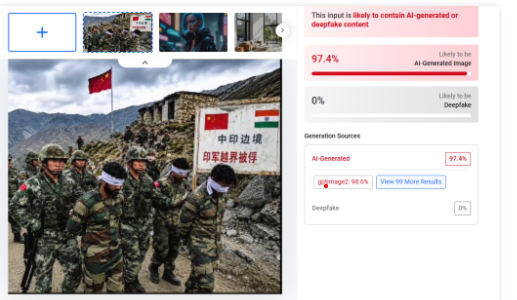
For additional verification, we also scanned the image using Undetectable AI, which found a 97% probability that the image had been digitally generated or manipulated using AI.

Conclusion
Our research found that the viral image claiming to show Chinese soldiers capturing Indian troops after entering Arunachal Pradesh is fake. The image is AI-generated and is being falsely circulated to support misleading claims of a Chinese military incursion. Furthermore, Union Minister Kiren Rijiju and the Indian Army have publicly rejected claims that Chinese forces entered Indian territory, making the viral claim baseless.
.webp)
Introduction
India is confronting a wake-up call as a recent cyber incident aimed at the aviation sector underscores the fragile nature of digital systems that guide national air travel. The disclosure in Parliament has pushed the conversation on flight safety, signal integrity, and cyber readiness back into urgent focus. In a written response to a Parliamentary question, Civil Aviation Minister Ram Mohan Naidu acknowledged that GPS spoofing, a malicious method employed to alter navigation signals, had been noticed at seven major airports of the country. New Delhi flights had not been affected during the incident, but still, it was an event that again made air travel's safety, GNSS interference, and the overall cyber threat to India's airspace an issue of concern.
The Incident: What Happened?
Initial notices came from Indira Gandhi International Airport in Delhi, where the pilots of the different inbound flights talked about GPS spoofing as the reason for their landing. Spoofing is the process of sending counterfeit GPS signals which mislead the aircraft's navigation systems and may cause a wrong measure of the altitude, the position or the runway alignment. In Delhi, pilots operating under GPS-based landing procedures over Runway 10 experienced errors in their approaches and promptly switched to the alternative procedures without any delay.
The Minister said that apart from Delhi, other airports, viz. Kolkata, Amritsar, Mumbai, Hyderabad, Bengaluru, and Chennai were the 6 airports that recorded similar GNSS interference patterns consisting of both jamming and spoofing. Though no major interruptions or incidents occurred, these occurrences are a sign of a steady and enlarging threat.
Why Is GPS Spoofing So Dangerous?
Satellite navigation and communication systems are the backbone of modern aviation, which is now a matter of great precision. Signal jamming by malicious actors comes with a bunch of risks:
- Diversions and Delays: Pilots may be forced to either give up attempts to land or divert flights, which translates into higher consumption of fuel and more complicated operations due to the case of jamming.
- Threat of Safety Issue: Pilots are trained to deal with such incidents by following the prescribed fallback procedures, but still they depend very much on the GNSS signals that are accurate for safe manoeuvring, especially in low visibility situations.
- Pressure on Old Systems: Indian airports are still in the process of completely converting from ground-based navigation aids to GNSS. Signal disruptions entail the use of older technologies, which results in putting additional pressure on the already overburdened air traffic control systems.
- Opening Up Possibilities for Direct Attacks: Signal jamming can be made a tool for more clever tactics of operation that can include causing confusion during the busy traffic period or performing coordinated attacks to create chaos.
Aviation and Cyber Threats
The disturbances that have been mentioned at the seven airports are not unique. The civil aviation regulators all over the world have already reported an increase in GNSS jamming. The exemplary cases in the Middle East, Eastern Europe, and East Asia have revealed that the safety of airspace has turned into a tactical issue.
Moreover, India's quick adoption of digital technology in the aviation sector could open threat vulnerabilities from state-sponsored groups, hackers. In this instance, the government has not yet announced who was responsible for the spoofing, but the trend points to an adversary with advanced technology.
Government and Regulatory Response
The confirmation from the Civil Aviation Minister underscores a proactive stance by agencies such as:
- Directorate General of Civil Aviation (DGCA)
- Ministry of Civil Aviation
- Airports Authority of India (AAI)
The involved entities are collaborating now to do an inquiry into the cases and set up preventive measures.
The main steps that are taken in response are:
- More thorough observation of GNSS signal anomalies
- More pilot briefings and training on dealing with spoofing situations
- Improving navigation aids to set up a backup
- Working with IT security experts to find out the sources of interference
- Communicating with other global aviation authorities to share the best practices
India, being a significant player in the world aviation market, is not allowed to relax its guard. Cyberattacks on airports show how digital as well as physical security are becoming more and more intertwined.
The Bigger Picture: Protecting Critical Infrastructure
Aviation is a sector that very clearly shows that threats from cyberspace can easily translate into security issues for a nation. The airport system not only becomes more vulnerable to attacks but also the whole aviation industry as the digital ecosystems gain more complex forms together with integrated telecommunications networks, the Internet of Things (IoT)-enabled systems, and cloud-based services.
One of the many threats in the form of GNSS spoofing demonstrates so-called:
- Ransomware attacks on airport systems
- Contamination of air traffic control infrastructure
- Data breaches conducted by insiders
- Passenger data attacks
- Hinderance of airport logistics and baggage systems
What Needs to Happen Next?
India is compelled to embrace a multi-faceted approach in order to manage the intricacies of GNSS interference risk:
- Cybersecurity Measures in Aviation Enforced: New monitoring tools, anomaly detection systems, and instant response plans will be put into service.
- Redundant Technology: The non-GNSS-based navigation system will be expanded to guarantee the continuity of operations in the event of jamming.
- Cyber Drills Across all Sectors: To get pilots, air traffic control personnel, and airport operators ready, the aviation cyber drills will be conducted at the national level.
- Global Cooperation: International organisations will be approached to share the information and standardise the procedures.
- R&D and Innovations: Funding will be directed towards anti-spoofing technology, stronger satellite signals, and the domestic navigation system, like NavIC.
Conclusion
The cyberattack that targeted the seven airports serves as a clear reminder that aviation cybersecurity should not be considered a secondary issue anymore. Even though the quick reaction from the authorities managed to averted any disruptions, the event still shows the vulnerabilities of modern aviation systems. India's air travel infrastructure expansion will be a good time for the country to install its strong cybersecurity frameworks to protect its passengers, maintain the continuity of operations, and secure the airspace of its territory. At CyberPeace, we believe that a coordinated, proactive, and technology-driven approach is no longer an option, it is the new fundamental of aviation security in the digital age.
Reference
