
Who Controls Encrypted Conversations? The Battle Over Telegram and Digital Rights
Introduction
In June 2026, the Government of India temporarily restricted access to Telegram amid concerns that the platform had been used to facilitate examination related malpractice, including the alleged circulation of leaked question papers during the NEET UG re examination. The move reignited a familiar debate about the responsibility of digital platforms for unlawful activities carried out through them.
Critics of such restrictions raise a fundamental question: if a traffic accident occurs on a road, do we shut down the road? If theft takes place inside a shopping mall, do we close the entire mall? By the same logic, is it reasonable to block a communication platform because some individuals misuse it? These questions lie at the heart of a broader conflict between state interests in maintaining public order and the protection of digital rights, privacy, and freedom of communication in an increasingly interconnected world.
The controversy surrounding Telegram therefore extends beyond a single examination or messaging application. It raises a deeper and more pressing question: who should bear responsibility for illegal acts committed through encrypted digital platforms, and where should the law draw the line between effective enforcement and the preservation of fundamental digital freedoms?
Beyond mere communication for millions of students in India, Telegram is a classroom in the digital sense, an archive for their notes, practice papers, lecture recordings, and community groups that hundreds of millions of candidates refer to every single day. Therefore, why on a routine day in June 2026 did the messaging app top every other channel? Temporary internet restriction on the platform had become necessary to stop examination-related malpractice like leakage of question papers and was temporarily suspended, with reports suggesting that this move by the government was on the occasion of the NEET-UG re-examination.
This ban once again brings up a bigger question that cannot be contained within one particular examination. When has it become okay to hold a communication platform responsible and accountable for illegal acts committed over it? Or are the perpetrators solely to blame, and the service can be prohibited? Ultimately, where is the line drawn between public interest, law enforcement, and digital rights and privacy?
End-to-End Encryption: Architecture and Benefits
At the heart of these discussions of Telegram and other apps lies a technology referred to as "end-to-end encryption" or "E2EE." Quite literally, it means a message is locked with cryptography on the sender's device and can only be unlocked by the intended recipient. Not even the tech platform running the communication app can decipher it for everyone else; it just looks like random gibberish.
The Process
This kind of modern communication relies on public key cryptography. Each person has a public key they can share with anyone and a private key that stays only on their devices. When they send you a message, it is scrambled with crypto that can be unlocked by only your private key. WhatsApp and Signal, for example, use the Signal Protocol, which features "perfect forward secrecy" and is designed to protect communications from ever being unlocked even if one key is compromised. Telegram's approach is a bit unique. By default, Telegram messages aren't encrypted with end-to-end crypto; this only comes via an optional feature called "Secret Chats," a key difference in the regulatory debate.
The Dark Side: Crime, Misuse, and the Moderation Dilemma
The very features that make end-to-end messaging popular among everyday people are privacy, speed, anonymity, and mass reach which also make end-to-end messaging popular among criminals. That, unfortunately, is the catch for policymakers globally: The technology designed to protect innocent users is also the technology that facilitates criminal activity.
3.1 Criminal Abuse
Telegram, in particular, has frequently come under fire for its role in hosting a spectrum of criminal activities, most notably in the recent controversy in India regarding NEET-UG 2026 examination papers where channels allegedly advertised leaked question papers for enormous sums, convincing desperate candidates. In these instances, messages could be altered or deleted using Telegram’s message editing feature, fabricating evidence of prior leaks. However, this extends to illicit marketplaces, drug trafficking, financial fraud, money laundering, and distributing other prohibited content. Telegram's usage in disseminating extremist propaganda and aiding criminal organizations is also frequently cited, leading to bans or restrictions in countries ranging from Brazil to Nepal to Somalia to Vietnam.
3.2 The Moderation Dilemma
But the difficulty is not just with misuse; it’s also about effective moderation. Moderation, however, requires content transparency. Strong encryption is built to obscure just that. Many end-to-end messaging services like Signal and WhatsApp emphasize that even if they wanted to, they would have been able to decipher the content of a user’s message due to their architecture. Telegram has been in scrutiny for years due to its limited cooperation with law enforcement agencies because its default chats are not completely end-to-end encrypted, though there has been an attempt by Pavel Durov, the platform’s founder, to increase cooperation following his 2024 arrest in France.
This gives policymakers the following challenge: How can governments require increased access to fight crime without forcing tech companies to weaken security for everyone? As cryptographers point out, a specific "backdoor" intended to allow access to law enforcement officials can be easily exploited by hackers, foreign governments, and any other actor with nefarious intent.
Comparison of Regulatory Approaches Worldwide
4.1 Authoritarian Countries' Responses
China, for instance, has had the app blocked as part of its strategy to control access to the internet since 2015, and Iran did so in 2018 when the app was used to help organize protests against the government. An infamous Russian bid to block Telegram in 2018 turned into a cautionary story. Trying to censor the service disrupted the IPs of millions of computers, including significant services like those run by Amazon and Google. The move was met by a surge of users turning to VPNs to get access. It’s an expensive, disruptive, and incomplete form of censorship.
4.2 Democratic Countries' Approaches
Democratic jurisdictions generally prefer targeted interventions. Telegram was suspended in Brazil in 2022 and 2023, though again, only in response to a judge’s order in relation to particular investigations, and was lifted when it came into compliance. The EU’s approach has been to build on an established approach of regulation by use of a broader legislative framework, including the Digital Services Act and the Digital Markets Act, aimed at platform liability rather than outlawing encryption outright.
Meanwhile, the proposed scanning of encrypted communications has run into strong judicial headwinds, with the European courts stressing the danger of backdoors to privacy.
4.3 The United Kingdom Approach
The UK offers a middle way. With its Investigatory Powers Act, the government can oblige tech companies to collaborate in legitimate investigations. But this came to a head earlier this year with the case of Apple and the government's attempts to force it to unlock encrypted iCloud backups. Apple not only refused to reduce its encryption but also decided instead to disable some of its features for British users. This has created a problem for democracies across the world: how to balance access for investigators against the need to maintain the security that makes our systems safer.
Judicial and Legislative Perspectives: India and Beyond
In the Indian context, to have a perspective about the legal frameworks concerning content moderation, let’s explore some of the foundational decisions from the Supreme Court. Three decisions have laid the building block for digital rights laws: the first being Shreya Singhal v. Union of India (2015), where Section 69A of the IT Act, 2000, was upheld, but only by laying rigorous conditions on the review process and chance of challenging the said decision. Another important decision in this sphere is Justice K.S. Puttaswamy v. Union of India (2017) which stated that the right to privacy is fundamental in nature under Article 21 of the Constitution and stipulated the constitutional requirements of legality, legitimacy, and proportionality against the state’s interventions in fundamental rights. The most recent important case law to consider, in this context, would be Anuradha Bhasin v. Union of India (2020) which set certain limitations, such as any internet shut-downs or orders have to be temporary, proportional, and have scope for appeal. Further, the Supreme Court demanded transparency around any and all orders of blocking.
These principles of proportionality and legal limitations are highly pertinent to the Telegram issue, especially since Section 69A confers powers to block information in case of concerns about public order, national security, etc., but activists often cite this power to target specific content rather than entire platforms like Telegram. The ban on Telegram in June 2026 and disabling of message editing will force authorities to justify not only their statutory authority but also the need for proportionate means.
These aspects are amplified by IT Rules, 2021, which mandate that some instant messaging platforms may require identification of the ‘first originator’ of messages, and the Digital Personal Data Protection Act, 2023, to protect digital personal data by ensuring it does not undermine national security exceptions to this end.
Moreover, the use of encryption to ensure secure and private communications is becoming an important point of legal discourse globally. Recently, the European Court of Human Rights in Podchasov v. Russia (2024) held that mandating decryption on devices as a tool of investigative power constituted a disproportionate interference with an individual's right to privacy implying that while states may indeed have authority to regulate communication and digital services, any such measures limiting the scope of encryption will have to meet strict requirements of legality, necessity, and proportionality to be legally justifiable.
Constitutional Validity of the Ban
The government's case for a constitutional ban on Telegram rests upon its ability to satisfy the proportionality framework established by Puttaswamy and Anuradha Bhasin.
- Legitimate aim: The state's strong suit. This is the government's best argument. Protection of the integrity of NEET-UG, a high-stakes test with close to 2.4 million students, can indeed be a legitimate state objective. Given that there is evidence of channels that allegedly were involved in selling leaked question papers, the action is presumably justifiable under section 69A for preventing the incitement or occurrence of public disorder or preventing cognizable offenses.
- Necessity: The National Testing Agency (NTA) itself admitted that localized removal of suspicious accounts on Telegram had already mitigated the risks, while Telegram insisted that it had independently taken down numerous channels. The fact that the block affected more than 150 million users in India, where the medium is widely used for personal communication and is also utilized on other platforms like WhatsApp, Discord, and Instagram to a similar or higher extent, raises the responsibility to justify a strict platform-wide ban. Moreover, there is a significant legal question regarding the state’s authority under section 69A to direct Telegram to disable its message-editing capability.
- Proportionality and process: The block, even though it was temporary and intended to ensure fairness in the examination system, severely undermined legitimate uses of the platform by students who used it to share educational materials and organize study groups. Moreover, the opaqueness around the section 69A order is itself hard to reconcile with the transparency requirements set out in Anuradha Bhasin.
Thus, while the objectives of preventing exam fraud may be legitimate, the necessity and proportionality of single platform-wide bans remain highly suspect under Indian constitutional law.
Policy Recommendations and the Path Forward
The Telegram controversy points to the need for a better balancing act in platform governance in India. Firstly, instead of blanket platform shutdowns, action should target specific channels, bots, or URLs, as may be the case. Secondly, any attempt to dictate changes to features, such as disabling message editing, should be based on specific statutory provisions, not an expansive reading of Section 69A. Furthermore, there is a dire need for increased transparency; blocking orders must state the justification for the order, what is being blocked, and for how long, as far as possible. In the long run, stricter cross-border cooperation via streamlined MLATs, or through the appointment of local legal representatives by foreign platforms, would facilitate easier enforcement. Ultimately, all major blocking decisions must be accompanied by proportionality assessments. Lastly, India must resist pressure to provide access to encryption backdoors; while this might ease investigative burdens, doing so would severely jeopardise the cybersecurity of India, its businesses, and citizens.
Conclusion
The Telegram ban is an example of the tricky equilibrium between protection of public interest and protection of digital liberties in our hyper-connected world. While the intent to counter exam fraud is justifiable, a blanket ban on any platform has much broader implications on questions of necessity, proportionality and transparency. India has a well-developed constitutional and legal framework to deal with this issue already, and the challenge will be to see if those powers are used appropriately.
References
Cases:
- Shreya Singhal v. Union of India (2015) 5 SCC 1 — Supreme Court of India
- Justice K.S. Puttaswamy v. Union of India (2017) 10 SCC 1 — Supreme Court of India (Nine-Judge Bench)
- Anuradha Bhasin v. Union of India (2020) 3 SCC 637 — Supreme Court of India
- Podchasov v. Russia, European Court of Human Rights (Application No. 33696/19, February 2024)
- Apple Inc. v. United States (In re Search of an Apple iPhone, C.D. Cal. 2016)
- Telegram Messenger Inc. v. Union of India & Anr., Delhi High Court (June 2026) — Sub judice
Legislation & Rules:
- Information Technology Act, 2000 (India) — Sections 69A, 79
- IT (Procedure and Safeguards for Blocking Access to Information by Public) Rules, 2009
- IT (Intermediary Guidelines and Digital Media Ethics Code) Rules, 2021
- Digital Personal Data Protection Act, 2023 (India) & DPDP Rules, 2025
- EU Digital Services Act, 2022 (Regulation 2022/2065)
- EU Digital Markets Act, 2022 (Regulation 2022/1925)
- EU Child Sexual Abuse Regulation (CSAR) Proposal — In Trilogue, June 2026
- UK Investigatory Powers Act, 2016
Policy Sources:
- Internet Freedom Foundation, Statement on Telegram Block, 16 June 2026
- European Commission, ProtectEU Security Strategy, June 2025
- MeitY Section 69A Blocking Order re: Telegram (June 2026)
- NTA Press Release on NEET-UG 2026 Re-Examination, 16 June 2026

Related Blogs
Executive Summary:
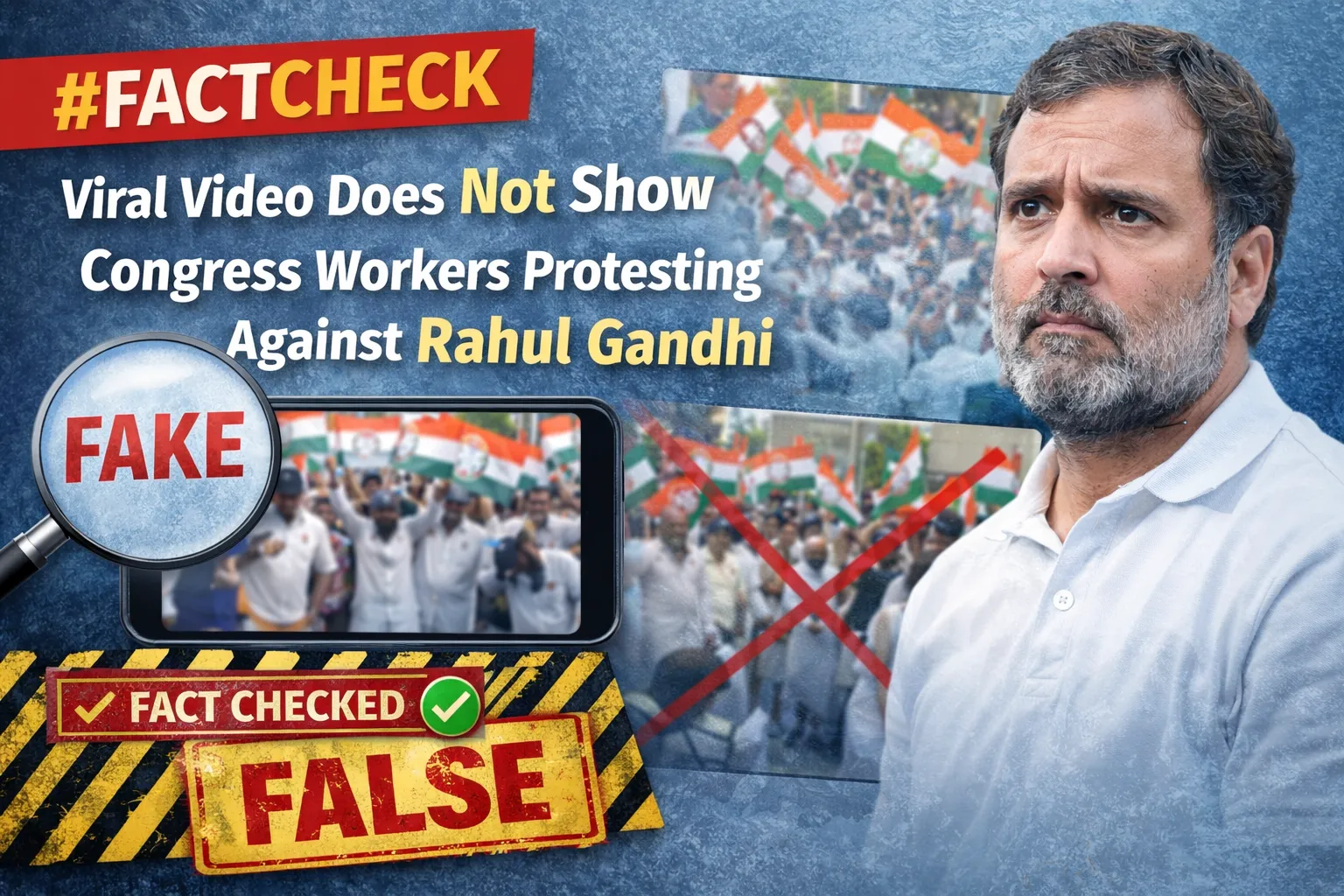
A video circulating on social media shows a group of people tearing Congress posters and raising controversial slogans. The clip is being shared with the claim that the individuals seen in the video are workers of the Congress party who were protesting against Rahul Gandhi and raising slogans against him. However, research by the CyberPeace found the viral claim to be misleading. Our research revealed that the video dates back to February 21, 2026. On that day, members of the Bharatiya Janata Yuva Morcha (BJYM) staged a protest outside a Congress office. During the demonstration, they raised slogans and tore Congress posters. The same video is now being circulated with a false narrative.
Claim
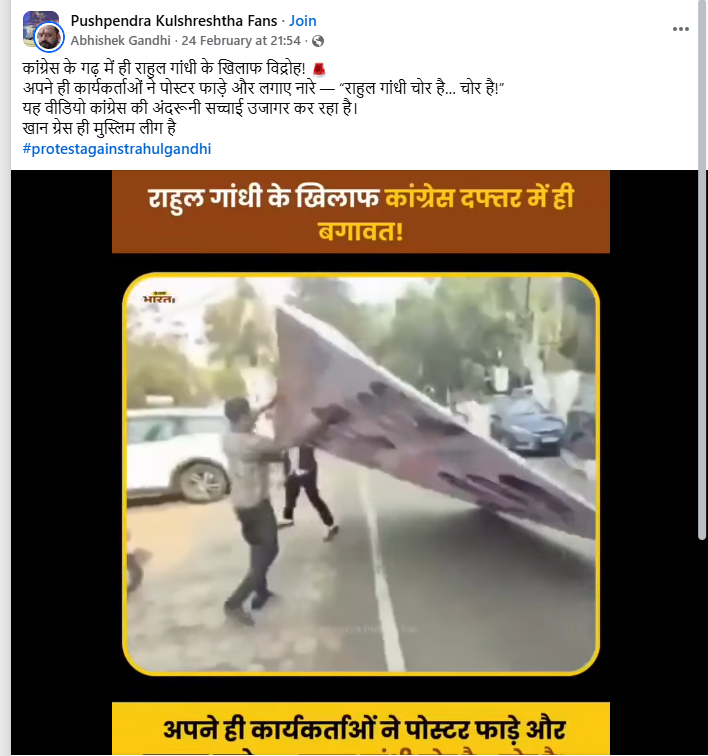
On February 24, 2026, a Facebook user shared the viral video with the caption:“Rebellion against Rahul Gandhi in Congress’ own stronghold! Party workers themselves tore posters and raised slogans — ‘Rahul Gandhi is a thief… a thief!’ This video exposes the internal truth of Congress. Congress itself is Muslim League.”
Fact Check
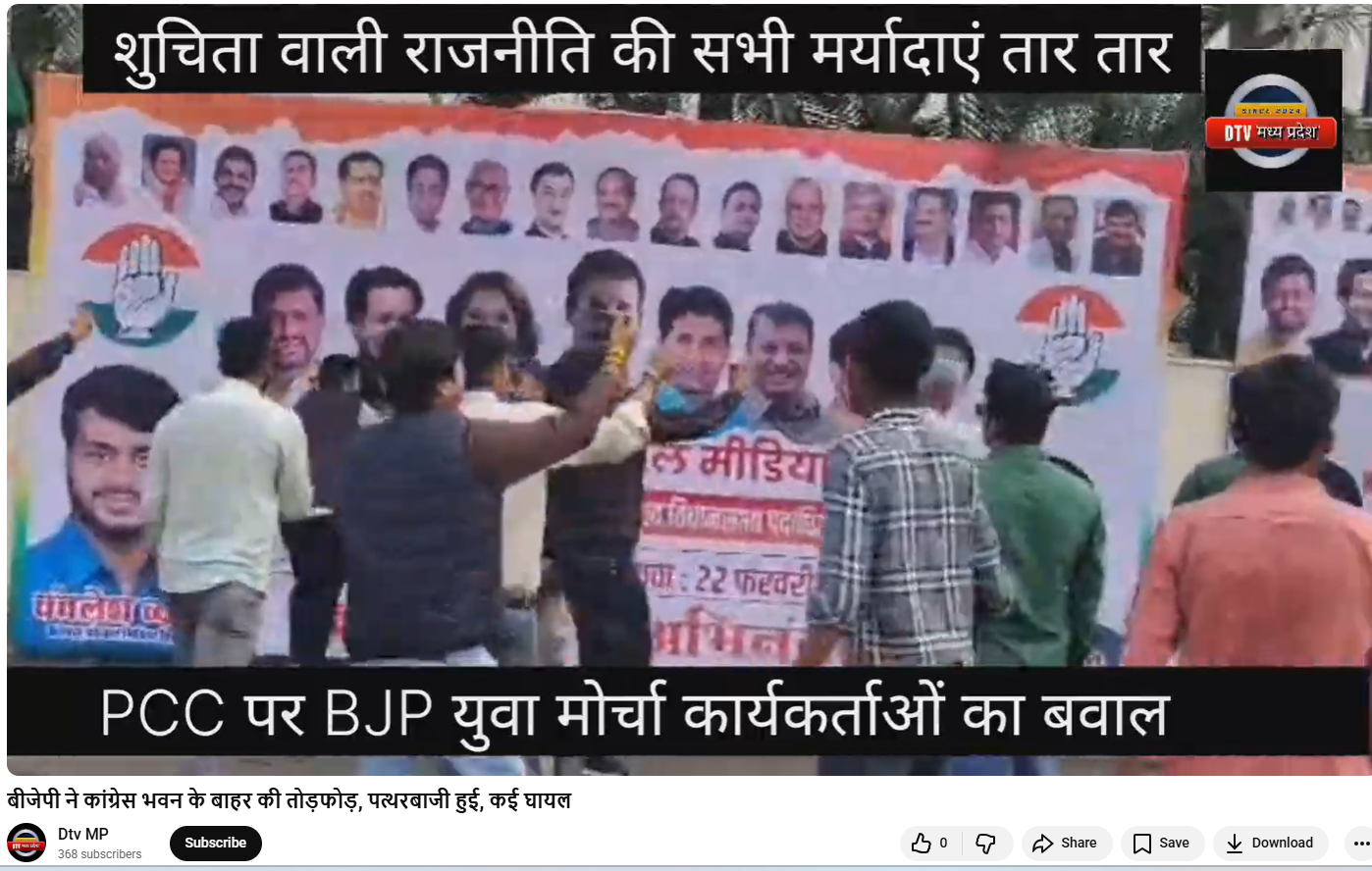
To verify the claim, we extracted key frames from the viral video and conducted a reverse image search using Google Lens. During the search, we found the same video uploaded on YouTube on February 21, 2026.
According to the description accompanying the video, BJP workers had staged a protest outside a Congress building. The report mentioned vandalism and stone-pelting during the protest, resulting in injuries to several individuals
- https://www.youtube.com/watch?v=pW-13mSvJ2c
Using this lead, we conducted a keyword search on Google and found a report published on February 21, 2026, by the Hindi news website Raj Express. The visuals in the report closely matched those seen in the viral clip.
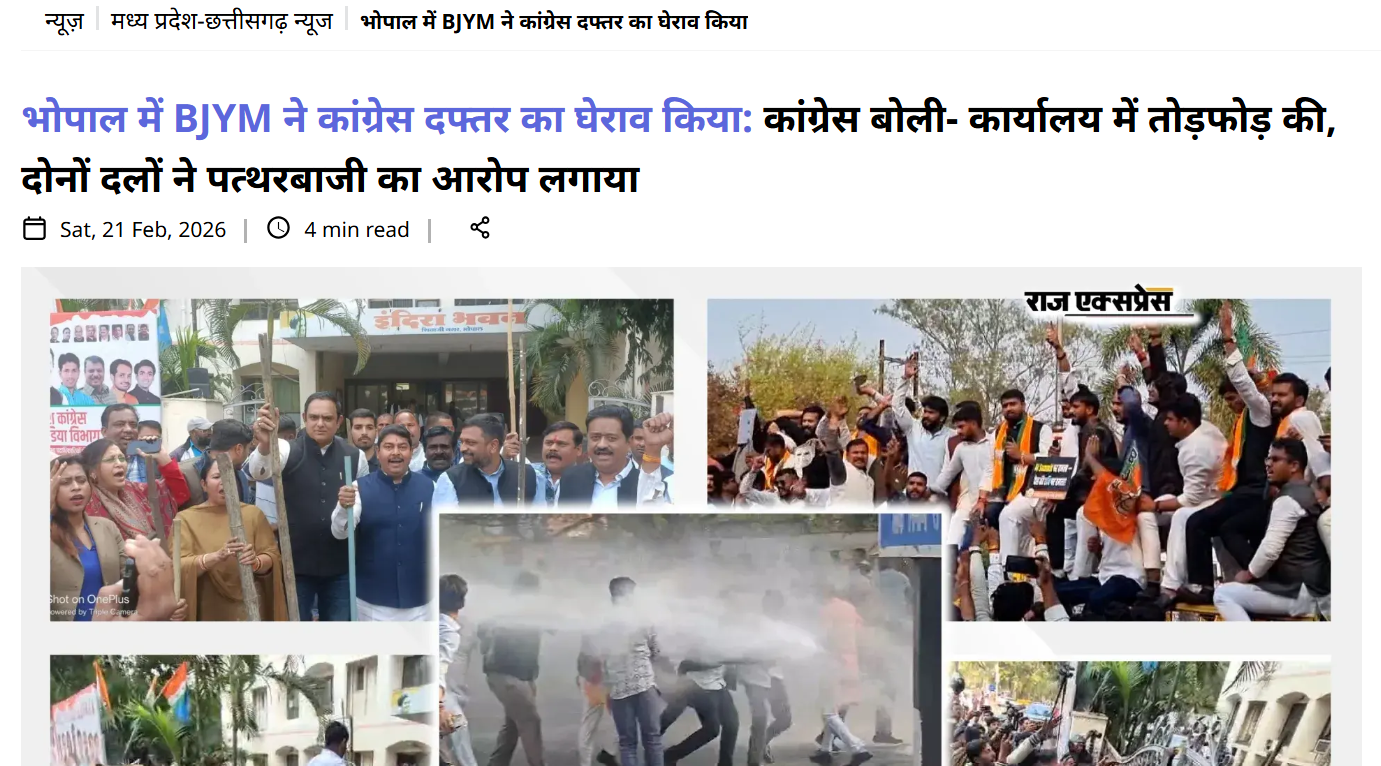
According to the report, the protest in Bhopal was organized by the Bharatiya Janata Yuva Morcha in response to a T-shirt protest staged by the Youth Congress during an AI Summit held at Bharat Mandapam in New Delhi. The situation escalated when protesters marched toward the state Congress office in Shivaji Nagar. Police attempted to disperse the crowd using water cannons, but some protesters reportedly entered the Congress office premises, leading to tension.
Further, we found the same viral video on the official Facebook page of Indian National Congress - Madhya Pradesh, where it was posted on February 26, 2026. In the post, the Congress unit alleged that BJYM workers and BJP-affiliated individuals had entered the Congress office, vandalized property, and created chaos in the presence of police officials.
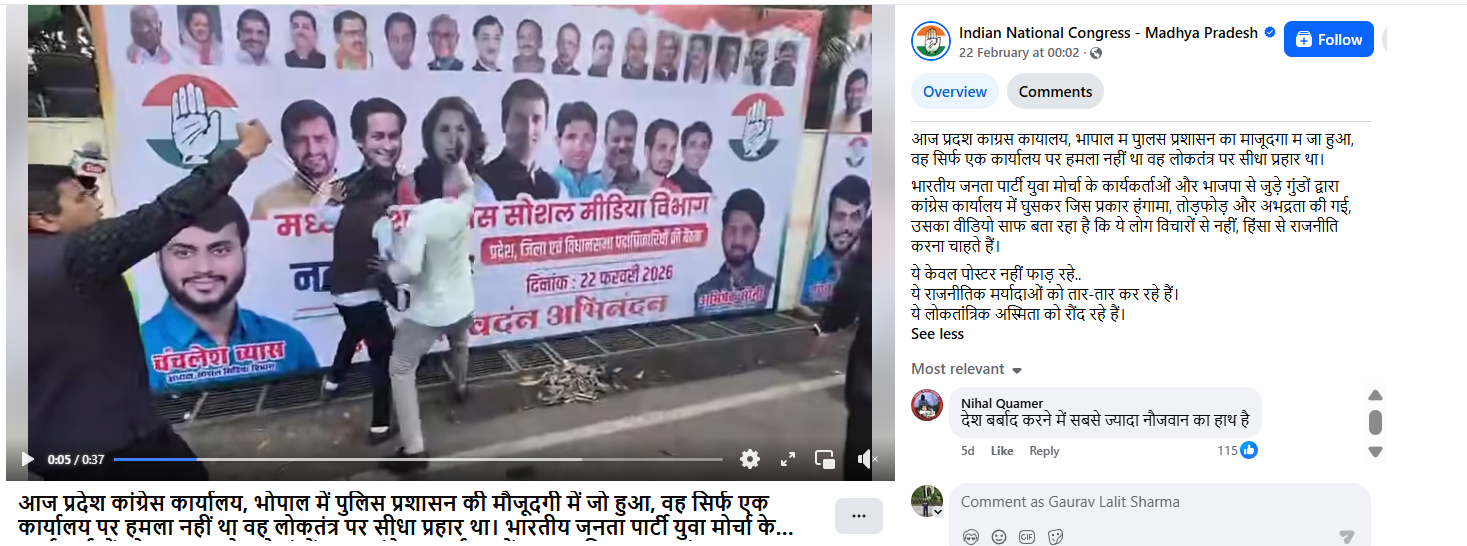
Conclusion
Our research found that the viral claim is misleading. The video is from February 21, 2026, when BJYM workers protested outside a Congress office and engaged in vandalism. The footage is now being falsely shared as evidence of an internal rebellion by Congress workers against Rahul Gandhi.

Introduction
Human Trafficking has been a significant concern and threat to society for a very long time. The aspects of our physical safety also have been influenced by human traffickers and the modus operandi they have adopted and deployed over the years. We are always cautious of younger children in regard to trafficking whenever we go out to crowded or unknown places. This concern and threat have also migrated to cyberspace and now pose new and different tangents of threats. These crimes are committed using technology and are further substantiated by different cybercrimes.
What is Cyber-Enabled Human Trafficking?
Cyber-enabled human trafficking is the new evolution of human trafficking in the digital age. Bad actors lure the victims via the internet and use social engineering to exploit their vulnerabilities to get them into their traps. In today's time, crime is often substantiated in lieu of fake job offers and a better lifestyle in new and major metropolitan cities. Now this crime has gone beyond the geographical boundaries of our nation, and often the victims end up in remote locations in the Middle East or South East Asia.
Cybercrime Hubs in Myanmar
The reports have indicated that a lot of trafficked victims are taken down to various cybercrime hubs in Myanmar. The victims are often lured on the pretext of job offers overseas, which pay handsomely. The victims make their way into the foreign nation but are then cornered by the bad actors and are segregated and taken into different hubs. The victims are often school graduates and seek basic jobs for their earnings. The victims are taken into Cybercrime hubs which Chinese syndicate criminals allegedly run.The victims are kept in tough conditions, beaten up, and held captive in remote jungles. Once the victim has lost hope, the criminals train them to commit cyber frauds like phishing. The victims are given scripts and mobile numbers to commit cybercrimes. The victims are given targets to ensure their survival, and due to the dark and threatening conditions, the victims just give up on the demands just to remain alive. Some of the victims make their way back home as well, but that is after 6-7 years of such constant torture and abuse to commit cybercrimes. The majority of such survivors face trouble seeking legal assistance as the criminals are almost impossible to track, thus making redressal for crimes and rehabilitation for survivors tough.
How to stay safe?
The criminals in such acts often target the vulnerable sector of the population, these people generally hail from tier 3 towns and rural areas. These victims aspire for a better life and earning opportunities, and due to less education and minimal awareness, they fail to see the traps set by the victims. The population at large can deploy the following measures and safe practices to avoid such horrific threats-
- Avoid Stranger interaction: Avoid interacting with strangers on any online platform or portal. Social media sites are the most used platforms by bad actors to make contact with potential victims.
- Do not Share: Avoid sharing any personal information with anyone online, and avoid filling out third-party surveys/forms seeking personal information.
- Check, Check and Recheck: Always be on alert for threats and always check and cross-check any link or platform you use or access.
- Too good to be true: If something feels like Too good to be true, it probably is and hence avoid falling for attractive job offers and work-from-home opportunities on social media platforms.
- Know your helplines: One should know the helpline numbers to make sure to exercise the reporting duty and also encourage your family members to report in case of any threat or issue.
- Raise Awareness: It is the duty of all netizens to raise awareness in society to arm more people against cybercrimes and fraud.
Conclusion
The name of cybercriminals is spreading all across the ecosystems, and now the technology is being deployed by such bad actors to even substantiate physical crimes. We need to be on alert and remain aware of such crimes and the modus Operandi of cyber criminals. Awareness and education are our best weapons to combat the threats and issues of cyber-enabled human trafficking, as the criminals feed on our vulnerabilities, lets eradicate them for once and for all and work towards creating a wholesome safe cyber ecosystem for all.https://www.scmp.com/week-asia/politics/article/3228543/inside-chinese-run-crime-hubs-myanmar-are-conning-world-we-can-kill-you-here

Introduction
In the evolving landscape of cybercrime, attackers are not only becoming more sophisticated in their approach but also more adept in their infrastructure. The Indian Cybercrime Coordination Centre (I4C) has issued a warning about the use of ‘disposable domains’ by cybercriminals. These are short-lived websites designed tomimic legitimate platforms, deceive users, and then disappear quickly to avoid detection and legal repercussions.
Although they may appear harmless at first glance, disposable domains form the backbone of countless online scams, phishing campaigns, malware distributionschemes, and disinformation networks. Cybercriminals use them to host fake websites, distribute malicious files, send deceptive emails, and mislead unsuspecting users, all while evading detection and takedown efforts.
As India’s digital economy grows and more citizens, businesses, and public services move online, it is crucial to understand this hidden layer of cybercrime infrastructure.Greater awareness among individuals, enterprises, and policymakers is essential to strengthen defences against fraud, protect users from harm, and build trust in thedigital ecosystem
What Are Disposable Domains?
A disposable domain is a website domain that is registered to be used temporarily, usually for hours or days, typically to evade detection or accountability.
These domains are inexpensive, easy to obtain, and can be set up with minimal information. They are often bought in bulk through domain registrars that do not strictly verify ownership information, sometimes using stolen credit cards or cryptocurrencies to remain anonymous. They differ from legitimate temporary domains used for testing or development in one significant aspect, which is ‘purpose’. Cybercriminals use disposable domains to carry out malicious activities such as phishing, sextortion, malware distribution, fake e-commerce sites, spam email campaigns, and disinformation operations.
How Cybercriminals Utilise Disposable Domains
1. Phishing & Credential Stealing: Attackers tend to register lookalike domains that are similar to legitimate websites (e.g., go0gle-login[.]com or sbi-verification[.]online) and trick victims into entering their login credentials. These domains will be active only long enough to deceive, and then they will disappear.
2. Malware Distribution: Disposable domains are widely used for ransomware and spyware operations for hosting malicious files. Because the domains are temporary, threat intelligence systems tend to notice them too late.
3. Fake E-Commerce & Investment Scams: Cyber crooks clone legitimate e-commerce or investment sites, place ad campaigns, and trick victims into "purchasing" goods or investing in scams. The domain vanishes when the scam runs out.
4. Spam and Botnets: Disposable domains assist in botnet command-and-control activities. They make it more difficult for defenders to block static IPs or trace the attacker's infrastructure.
5. Disinformation and Influence Campaigns: State-sponsored actors and coordinated troll networks use disposable domains to host fabricated news articles, fake government documents, and manipulated videos. When these sites are detected and taken down, they are quickly replaced with new domains, allowing the disinformation cycle to continue uninterrupted.
Why Are They Hard to Stop?
Registering a domain is inexpensive and quick, often requiring no more than an email address and payment. The difficulty is the easy domain registrations and the absence of worldwide enforcement. Domain registrars differ in enforcing Know-Your-Customer (KYC) standards stringently. ICANN (Internet Corporation for Assigned Names and Numbers) has certain regulations in place but enforcement is inconsistent. ICANN does require registrars to maintain accurate Who is information (the “Registrant Data Accuracy Policy”) and to act on abuse complaints. However, ICANN is not an enforcement agency. It oversees contracts with registrars but cannot directly police every registration. Cybercriminals exploit services such as:
- Privacy protection shields that conceal actual WHOIS information.
- Bulletproof hosting that evades takedown notices.
- Fast-flux DNS methods to rapidly alter IP addresses
Additionally, utilisation of IDNs ( Internationalised Domain Names) and homoglyph attacks enables the attackers to register visually similar domains to legitimate ones (e.g., using Cyrillic characters to represent Latin ones).
Real-World Example: India and the Rise of Fake Investment Sites
India has witnessed a wave of monetary scams that are connected with disposable domains. Over hundreds of false websites impersonating government loan schemes, banks or investment websites, and crypto-exchanges were found on disposable domains such as gov-loans-apply[.]xyz, indiabonds-secure[.]top, or rbi-invest[.]store. Most of them placed paid advertisements on sites such as Facebook or Google and harvested user information and payments, only to vanish in 48–72 hours. Victims had no avenue of proper recourse, and the authorities were left with a digital ghost trail.
How Disposable Domains Undermine Cybersecurity
- Bypass Blacklists: Dynamic domains constantly shifting evade static blacklists.
- Delay Attribution: Time is wasted pursuing non-existent owners or takedowns.
- Mass Targeting: One actor can register thousands of domains and attack at scale.
- Undermine Trust: Frequent users become targets when genuine sites are duplicated and it looks realistic.
Recommendations Addressing Legal and Policy Gaps in India
1. There is a need to establish a formal coordination mechanism between domain registrars and national CERTs such as CERT-In to enable effective communication and timely response to domain-based threats.
2. There is a need to strengthen the investigative and enforcement capabilities of law enforcement agencies through dedicated resources, training, and technical support to effectively tackle domain-based scams.
3. There is a need to leverage the provisions of the Digital Personal Data Protection Act, 2023 to take action against phishing websites and malicious domains that collect personal data without consent.
4. There is a need to draft and implement specific regulations or guidelines to address the misuse of digital infrastructure, particularly disposable and fraudulent domains, and close existing regulatory gaps.
What Can Be Done: CyberPeace View
1. Stronger KYC for Domain Registrations: Registrars selling domains to Indian users or based in India should conduct verified KYC processes, with legal repercussions for carelessness.
2. Real-Time Domain Blacklists: CERT-In, along with ISPs and hosting companies, should operate and enforce a real-time blacklist of scam domains known.
3. Public Reporting Tools: Observers or victims should be capable of reporting suspicious domains through an easy interface (tied to cybercrime.gov.in).
4. Collaboration with Tech Platforms: Social media services and online ad platforms should filter out ads associated with disposable or spurious domains and report abuse data to CERT-In.
5. User Awareness: Netizens should be educated to check URLs thoroughly, not click on unsolicited links and they must verify the authenticity of websites.
Conclusion
Disposable domains have silently become the foundation of contemporary cybercrime. They are inexpensive, highly anonymous, and short-lived, which makes them a darling weapon for cybercriminals ranging from solo spammers to nation-state operators. In an increasingly connected Indian society where the penetration rate of internet users is high, this poses an expanding threat to economic security, public confidence, and national resilience. Combating this problem will need a combination of technical defences, policy changes, public-private alliances, and end-user sensitisation. As India develops a Cyber Secure Bharat, monitoring and addressing disposable domain abuse must be the utmost concern.
References
- https://www.bitcot.com/disposable-domains
- https://atdata.com/blog/evolution-of-email-fraud-rise-of-hyper-disposable-domains/
- https://www.cyfirma.com/research/scamonomics-the-dark-side-of-stock-crypto-investments-in-india/
- https://knowledgebase.constantcontact.com/lead-gen-crm/articles/KnowledgeBase/50330-Understanding-Blocked-Forbidden-and-Disposable-Domains?lang=en_US
- https://www.meity.gov.in/
- https://intel471.com/blog/bulletproof-hosting-fast-flux-dns-double-flux-vps
