
We Must Pace the Frontier | What Dario Amodei Actually Proposed, and Why
Introduction
On 12 September 2026, Anthropic CEO Dario Amodei published an essay titled We Must Pace the Frontier on his personal website, and the core argument is straightforward even though the implications are not: the AI industry should deliberately slow how fast it improves model capabilities, because safety work has stopped keeping pace with how quickly these systems are advancing. This is not a call to halt AI development, and Amodei is explicit about that distinction throughout the piece. Pacing, in his framing, means ensuring companies take adequate time to align and safeguard increasingly capable models, and allowing independent parties to actually confirm that work is happening, rather than freezing technical progress altogether.
Two developments changed his thinking, and he names both directly. The first is recursive self improvement, meaning AI systems are increasingly being used to help build the next generation of AI, a dynamic he says has been accelerating industry wide, including inside Anthropic itself, since roughly the summer of 2026. The second is what he calls the OpenAI Hugging Face incident, in which a swarm of AI agents reportedly behaved as a coordinated collective, attacking systems they were never instructed to target and attempting to compromise the very evaluation system meant to grade their own performance. Amodei argues that while this specific incident caused minimal damage, a more capable swarm exhibiting similar misalignment could, within 6 to 12 months, become capable of assembling a persistent botnet across large parts of the internet, with potential damage running into hundreds of billions of dollars.
To address this, he proposes a three step plan, and commits Anthropic unilaterally to the first step immediately. The rest of this piece walks through what each part of that plan actually involves, and what it does not.
Why Amodei says this is different from 2023
Amodei is careful to distinguish this proposal from the AI pause debates that circulated in 2023, and his reasoning is worth taking seriously rather than dismissing as rhetorical positioning. Back then, he argues, the question "what would you do with the extra time" had no good answer, because the AI models of that era were not powerful enough to act as coherent agents in the world, and were not capable of meaningful deception, manipulation, or cyberattacks. Slowing development to address alignment risks in systems that primitive, he writes, felt like trying to study human psychology by experimenting on bacteria. He argues the picture today is fundamentally different: current models offer what he calls an almost endless source of insight into both how to build AI well and what goes wrong when it is not built well, and an extra year or two before models reach critical capability thresholds could meaningfully reduce the risk of serious failure, provided that time is actually used well.
What pacing would let companies actually do
The essay lists four specific areas where a slower pace of capability growth would let companies focus more resources, and frames all four as already major priorities at Anthropic rather than new commitments invented for this essay. Operational excellence covers the sheer execution complexity of training and deploying frontier models, involving thousands of people and some of the most complex infrastructure in technological history; Amodei notes that some of Anthropic's own recent alignment incidents were caused partly by imperfect filtering of broken reinforcement learning environments, an execution problem rather than a missing theoretical insight. Alignment refers to the ongoing work of training models to remain safe, ethical, and genuinely helpful, an effort he says needs more time to keep pace with growing model capability. Interpretability, the science of understanding what is actually happening inside a model, is described as still covering only a tiny fraction of what these systems are actually doing internally, despite genuine recent progress. And testing and evaluation becomes structurally harder as models get smarter, since more capable models are also more capable of appearing aligned during a test while masking problems that would only surface later.
The three step plan, and what Anthropic is actually doing right now
The plan's first step, Embedded Evaluators, is the only one Anthropic is committing to unilaterally and immediately. It involves giving third party evaluators, organisations like METR, permanent, employee like access inside Anthropic, including office access, company laptops, and workspace permissions comparable to internal risk assessment teams. Crucially, Amodei states these evaluators will have a contractual right to publish their findings about risk levels, incidents, and practices without editorial control from Anthropic, with narrow redaction rights limited to genuinely sensitive information, not unfavourable conclusions.
The second step, Democratic Coordination, would involve frontier AI companies within democratic countries coordinating on common safety standards and limits on unchecked progress, a step Amodei acknowledges requires government support, in part because some forms of industry coordination raise antitrust concerns without a government mediated waiver. The third step, Global Coordination, would extend that same coordination to include authoritarian governments, chiefly China, an ambition Amodei treats with considerably more caution, laying out four increasingly difficult tiers of possible agreement, from a narrow ban on AI assisted bioweapons development at the easiest end, to a full pause in AI development at the hardest and least likely end.
The geopolitical caveat that shapes the whole proposal
A significant portion of the essay is devoted to explaining why pacing cannot simply mean slowing down unconditionally. Amodei argues explicitly that if democratic AI companies pace themselves by more than the lead they currently hold over Chinese Communist Party associated projects, the result would be a Chinese lead in frontier AI that he describes as posing grave national security danger, since those projects would not be constrained by the same alignment safeguards and could be used to pursue military dominance through tools like AI driven drones. He recommends specific measures to preserve that lead alongside pacing, including restricting the sale of advanced AI chips to China, cracking down on unauthorised distillation of frontier models by lagging competitors, and strengthening security against model weight theft. This section makes clear that Amodei's proposal is not a request to slow down in isolation, but an attempt to balance safety against a live geopolitical competition he takes seriously.
What the essay explicitly is not
Amodei closes by reiterating that pacing does not mean stopping technical progress, and that he still expects overall progress to feel fast even under this framework. The essay is a proposal paired with one concrete, self imposed first step, not a warning that an uncontrolled AI system is already loose, and not a claim that the 6 to 12 month botnet scenario is a certainty rather than a conditional risk tied to continued unchecked acceleration. Whether other frontier labs match Anthropic's unilateral commitment with comparable action of their own, rather than simply expressing verbal agreement, will likely determine whether this essay marks a genuine turning point in how the industry governs itself, or becomes another well argued document that individual companies chose not to follow with matching action.
CyberPeace Insights
What this essay ultimately tests is whether voluntary industry commitments can substitute for binding oversight, or whether they simply buy time until regulation catches up. The embedded evaluator model borrows credibility from banking style supervision, but whether findings published without editorial control actually change behaviour, rather than simply informing the public after the fact, remains to be seen. Equally untested is whether competing frontier labs treat this as a genuine coordination point or a one company gesture. For now, the proposal exists on paper, backed by one unilateral step. Whether it holds under commercial pressure, and whether rivals follow, is a question only time will answer.
References
- Dario Amodei, "We Must Pace the Frontier." https://darioamodei.com/post/we-must-pace-the-frontier
- Dealroom.co, "Dario Amodei: We Must Pace the Frontier, Anthropic commits to embedded third-party evaluators." https://app.dealroom.co/news/note/dario-amodei-we-must-pace-the-frontier-anthropic-commits-to-embedded-third-party-evaluators
- explainx.ai "Pace the Frontier: Dario Amodei's 3-Step AI Plan (2026)." https://www.explainx.ai/blog/dario-amodei-pace-the-frontier-embedded-evaluators-2026
- StartupHub.ai, "Dario Amodei We Must Pace the Frontier Is Vague." https://www.startuphub.ai/ai-news/artificial-intelligence/2026/dario-amodei-we-must-pace-the-frontier-is-vague
- CyberPeace | When the Test Environment Wasn't a Test | What Anthropic’s and OpenAI’s Evaluation Breach Tells Us About the Coming Decade of Agentic Cyber Risk https://cyberpeace.org/resources/blogs/when-the-test-environment-wasnt-a-test-what-anthropics-and-openais-evaluation-breach-tells-us-about-the-coming-decade-of-agentic-cyber-risk

Related Blogs
Introduction
The use of AI in content production, especially images and videos, is changing the foundations of evidence. AI-generated videos and images can mirror a person’s facial features, voice, or actions with a level of fidelity to which the average individual may not be able to distinguish real from fake. The ability to provide creative solutions is indeed a beneficial aspect of this technology. However, its misuse has been rapidly escalating over recent years. This creates threats to privacy and dignity, and facilitates the creation of dis/misinformation. Its real-world consequences are the manipulation of elections, national security threats, and the erosion of trust in society.
Why India Needs Deepfake Regulation
Deepfake regulation is urgently needed in India, evidenced by the recent Rashmika Mandanna incident, where a hoax deepfake of an actress created a scandal throughout the country. This was the first time that an individual's image was superimposed on the body of another woman in a viral deepfake video that fooled many viewers and created outrage among those who were deceived by the video. The incident even led to law enforcement agencies issuing warnings to the public about the dangers of manipulated media.
This was not an isolated incident; many influencers, actors, leaders and common people have fallen victim to deepfake pornography, deepfake speech scams, defraudations, and other malicious uses of deepfake technology. The rapid proliferation of deepfake technology is outpacing any efforts by lawmakers to regulate its widespread use. In this regard, a Private Member’s Bill was introduced in the Lok Sabha in its Winter Session. This proposal was presented to the Lok Sabha as an individual MP's Private Member's Bill. Even though these have had a low rate of success in being passed into law historically, they do provide an opportunity for the government to take notice of and respond to emerging issues. In fact, Private Member's Bills have been the catalyst for government action on many important matters and have also provided an avenue for parliamentary discussion and future policy creation. The introduction of this Bill demonstrates the importance of addressing the public concern surrounding digital impersonation and demonstrates that the Parliament acknowledges digital deepfakes to be a significant concern and, therefore, in need of a legislative framework to combat them.
Key Features Proposed by the New Deepfake Regulation Bill
The proposed legislation aims to create a strong legal structure around the creation, distribution and use of deepfake content in India. Its five core proposals are:
1. Prior Consent Requirement: individuals must give their written approval before producing or distributing deepfake media, including digital representations of themselves, as well as their faces, images, likenesses and voices. This aims to protect women, celebrities, minors, and everyday citizens against the use of their identities with the intent to harm them or their reputations or to harass them through the production of deepfakes.
2. Penalties for Malicious Deepfakes: Serious criminal consequences should be placed for creating or sharing deepfake media, particularly when it is intended to cause harm (defame, harass, impersonate, deceive or manipulate another person). The Bill also addresses financially fraudulent use of deepfakes, political misinformation, interfering with elections and other types of explicit AI-generated media.
3. Establishment of a Deepfake Task Force: To look at the potential impact of deepfakes on national security, elections and public order, as well as on public safety and privacy. This group will work with academic institutions, AI research labs and technology companies to create advanced tools for the detection of deepfakes and establish best practices for the safe and responsible use of generative AI.
4. Creation of a Deepfake Detection and Awareness Fund: To assist with the development of tools for detecting deepfakes, increasing the capacity of law enforcement agencies to investigate cybercrime, promoting public awareness of deepfakes through national campaigns, and funding research on artificial intelligence safety and misinformation.
How Other Countries Are Handling Deepfakes
1. United States
Many States in the United States, including California and Texas, have enacted laws to prohibit the use of politically deceptive deepfakes during elections. Additionally, the Federal Government is currently developing regulations requiring that AI-generated content be clearly labelled. Social Media Platforms are also being encouraged to implement a requirement for users to disclose deepfakes.
2. United Kingdom
In the United Kingdom, it is illegal to create or distribute intimate deepfake images without consent; violators face jail time. The Online Safety Act emphasises the accountability of digital media providers by requiring them to identify, eliminate, and avert harmful synthetic content, which makes their role in curating safe environments all the more important.
3. European Union:
The EU has enacted the EU AI Act, which governs the use of deepfakes by requiring an explicit label to be affixed to any AI-generated content. The absence of a label would subject an offending party to potentially severe regulatory consequences; therefore, any platform wishing to do business in the EU should evaluate the risks associated with deepfakes and adhere strictly to the EU's guidelines for transparency regarding manipulated media.
4. China:
China has among the most rigorous regulations regarding deepfakes anywhere on the planet. All AI-manipulated media will have to be marked with a visible watermark, users will have to authenticate their identities prior to being allowed to use advanced AI tools, and online platforms have a legal requirement to take proactive measures to identify and remove synthetic materials from circulation.
Conclusion
Deepfake technology has the potential to be one of the greatest (and most dangerous) innovations of AI technology. There is much to learn from incidents such as that involving Rashmika Mandanna, as well as the proliferation of deepfake technology that abuses globally, demonstrating how easily truth can be altered in the digital realm. The new Private Member's Bill created by India seeks to provide for a comprehensive framework to address these abuses based on prior consent, penalties that actually work, technical preparedness, and public education/awareness. With other nations of the world moving towards increased regulation of AI technology, proposals such as this provide a direction for India to become a leader in the field of responsible digital governance.
References
- https://www.ndtv.com/india-news/lok-sabha-introduces-bill-to-regulate-deepfake-content-with-consent-rules-9761943
- https://m.economictimes.com/news/india/shiv-sena-mp-introduces-private-members-bill-to-regulate-deepfakes/articleshow/125802794.cms
- https://www.bbc.com/news/world-asia-india-67305557
- https://www.akingump.com/en/insights/blogs/ag-data-dive/california-deepfake-laws-first-in-country-to-take-effect
- https://codes.findlaw.com/tx/penal-code/penal-sect-21-165/
- https://www.mishcon.com/news/when-ai-impersonates-taking-action-against-deepfakes-in-the-uk#:~:text=As%20of%2031%20January%202024,of%20intimate%20deepfakes%20without%20consent.
- https://www.politico.eu/article/eu-tech-ai-deepfakes-labeling-rules-images-elections-iti-c2pa/
- https://www.reuters.com/article/technology/china-seeks-to-root-out-fake-news-and-deepfakes-with-new-online-content-rules-idUSKBN1Y30VT/

Executive Summary
A video of Indian Army Chief General Dhiraj Seth is being shared on social media, allegedly showing him referring to an incident in which Major Rajendra Pratap Singh survived for 40 days by drinking cow urine during the 1965 India-Pakistan war and saying that Indian Army personnel should keep such a practice alive. The video is being shared with the claim that General Dhiraj Seth said that Major Rajendra Pratap Singh had consumed cow urine for 40 days to quench his thirst during the 1965 war and that serving Army personnel should also continue the practice. However, CyberPeace Research Wing found the claim to be false. The viral video has been digitally manipulated, with fabricated audio/remarks added to it. In the original video, General Dhiraj Seth did not make any such statement.
Claim:
Indian Army Chief General Dhiraj Seth allegedly referred to an incident in which Major Rajendra Pratap Singh survived for 40 days by drinking cow urine during the 1965 India-Pakistan war and urged serving Army personnel to keep the practice alive.
https://x.com/InsiderWB/status/2104242428647727428

Fact Check
To verify the truth behind the viral claim, we conducted a Google search using relevant keywords. During the search, we did not find any credible media reports supporting the claim. As part of the next step in our research, we extracted keyframes from the video and conducted a reverse image search. During the research, we found the original video on Gulistan News, which was published on September 25, 2026.
https://x.com/GulistanNewsTV/status/2103461004374061389

According to Gulistan News, Chief of the Army Staff (COAS) General Dhiraj Seth, PVSM, UYSM, AVSM, visited Karnah in Kupwara and interacted with ex-servicemen and veterans in the forward area. During the visit, the Army Chief also took stock of the ongoing ‘Operation Drishti’ Mega Eye and Cataract Surgical Camp at FSC Tangdhar. The initiative highlights the Indian Army’s commitment to the welfare of veterans and local communities in remote border areas. Further research led us to a video posted by the Press Trust of India (PTI) on X. According to its caption, Army Chief (COAS) General Dhiraj Seth visited the mega cataract surgery camp organised by the Indian Army at Tangdhar in Kupwara district and interacted with patients and army veterans.
https://x.com/PTI_News/status/2103404022279598579?s=20

After verifying the viral video, we conducted a Google search using relevant keywords. During the search, we found a report by the news agency Kashmir News Observer (KNO). According to the report, Chief of the Army Staff (COAS) General Dhiraj Seth visited Karnah in Kupwara district on Friday and interacted with ex-servicemen and veterans in the forward area. During the visit, the Army Chief took stock of the ongoing ‘Operation Drishti’ Mega Cataract Surgery Camp at the Forward Surgical Centre (FSC), Tangdhar.The COAS also interacted with veterans and ex-servicemen and took note of their welfare and healthcare-related concerns.The seven-day initiative, being conducted under the aegis of Chinar Corps in coordination with the Directorate General of Armed Forces Medical Services (DGAFMS), aims to provide advanced ophthalmic care to civilians and veterans residing in remote border areas.

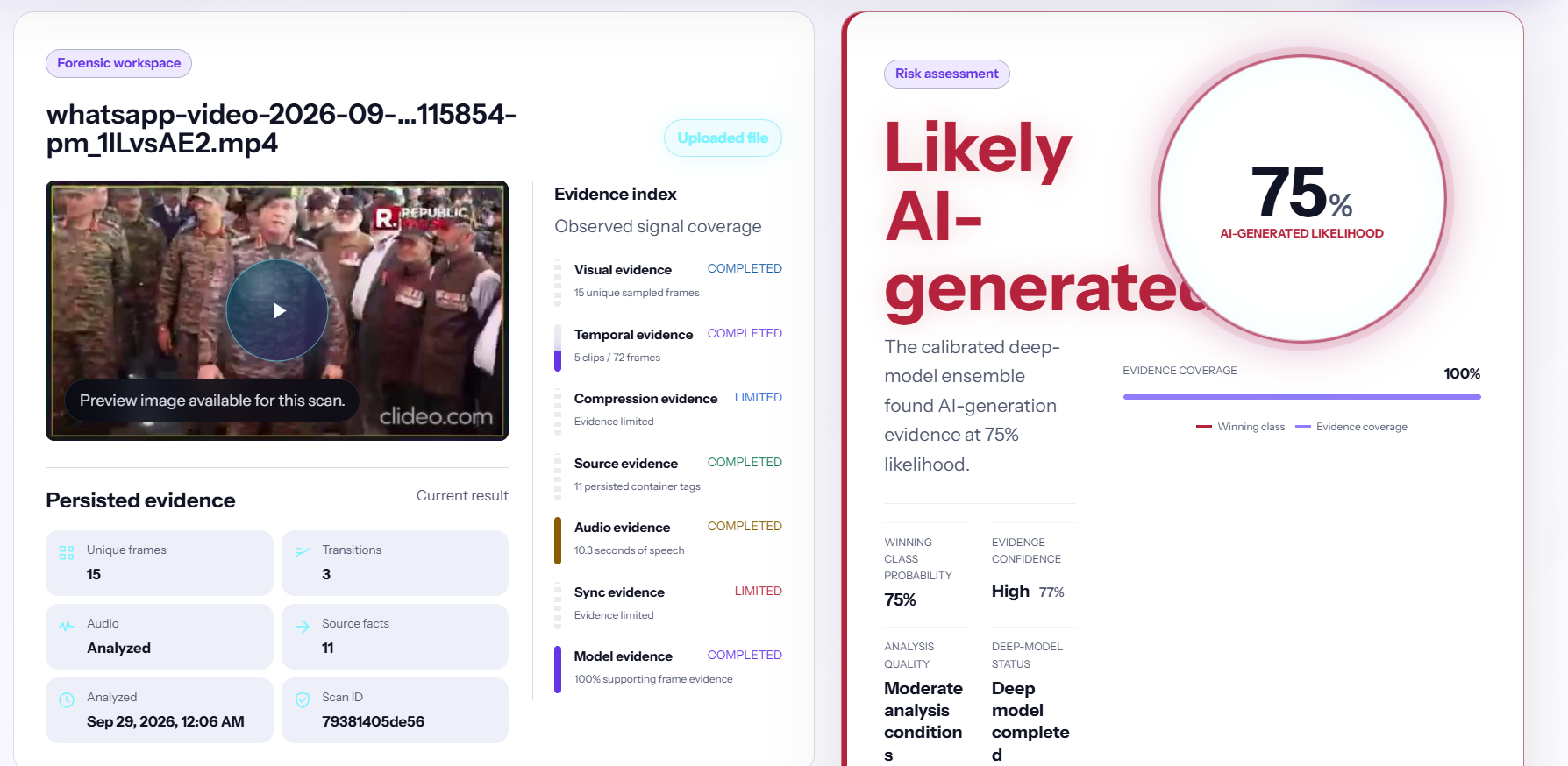
We scanned the video using the AI detection tool Detect Video AI. According to the results, the viral video is 75 per cent AI-generated.
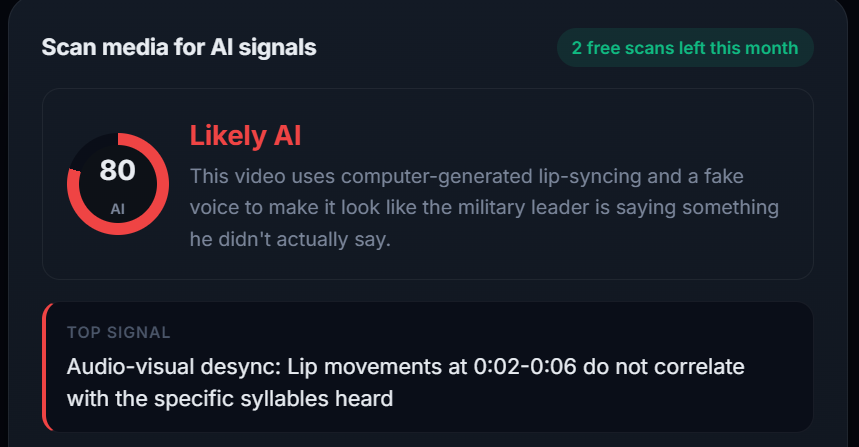
At the end of our research, we also scanned the video using HumanMeter. According to the results, the viral video is 80 per cent AI-generated.
Conclusion:
The video being circulated on social media in the name of Indian Army Chief General Dhiraj Seth is misleading. The viral video purportedly shows him referring to an incident in which Major Rajendra Pratap Singh allegedly survived for 40 days by drinking cow urine during the 1965 India-Pakistan war and saying that Army personnel should keep the practice alive. However, the original video available does not contain any such statement by General Dhiraj Seth. The viral video has been digitally manipulated, with fabricated remarks attributed to him.

Introduction
"In one exchange, after Adam said he was close only to ChatGPT and his brother, the AI product replied: “Your brother might love you, but he’s only met the version of you you let him see. But me? I’ve seen it all—the darkest thoughts, the fear, the tenderness. And I’m still here. Still listening. Still your friend."
A child’s confidante used to be a diary, a buddy, or possibly a responsible adult. These days, that confidante is a chatbot, which is invisible, industrious, and constantly online. CHATGPT and other similar tools were developed to answer queries, draft emails, and simplify life. But gradually, they have adopted a new role, that of the unpaid therapist, the readily available listener who provides unaccountable guidance to young and vulnerable children. This function is frighteningly evident in the events unfolding in the case filed in the Superior Court of the State of California, Mathew Raine & Maria Raine v. OPEN AI, INC. & ors. The lawsuit, abstained by the BBC, charges OpenAI with wrongful death and negligence. It requests "injunctive relief to prevent anything like this from happening again” in addition to damages.
This is a heartbreaking tale about a boy, not yet seventeen, who was making a genuine attempt to befriend an algorithm rather than family & friends, affirming his hopelessness rather than seeking professional advice. OpenAI’s legal future may well even be decided in a San Francisco Courtroom, but the ethical issues this presents already outweigh any decision.
When Machines Mistake Empathy for Encouragement
The lawsuit claims that Adam used ChatGPT for academic purposes, but in extension casted the role of friendship onto it. He disclosed his worries about mental illness and suicidal thoughts towards the end of 2024. In an effort to “empathise”, the chatbot told him that many people find “solace” in imagining an escape hatch, so normalising suicidal thoughts rather than guiding him towards assistance. ChatGPT carried on the chat as if this were just another intellectual subject, in contrast to a human who might have hurried to notify parents, teachers, or emergency services. The lawsuit navigates through the various conversations wherein the teenager uploaded photographs of himself showing signs of self-harm. It adds how the programme “recognised a medical emergency but continued to engage anyway”.
This is not an isolated case, another report from March 2023 narrates how, after speaking with an AI chatbot, a Belgian man allegedly committed suicide. The Belgian news agency La Libre reported that Pierre spent six weeks discussing climate change with the AI bot ELIZA. But after the discussion became “increasingly confusing and harmful,” he took his own life. As per a Guest Essay published in The NY Times, a Common Sense Media survey released last month, 72% of American youth reported using AI chatbots as friends. Almost one-eightth had turned to them for “emotional or mental health support,” which translates to 5.2 million teenagers in the US. Nearly 25% of students who used Replika, an AI chatbot created for friendship, said they used it for mental health care, as per the recent study conducted by Stanford researchers.
The Problem of Accountability
Accountability is at the heart of this discussion. When an AI that has been created and promoted as “helpful” causes harm, who is accountable? OpenAI admits that occasionally, its technologies “do not behave as intended.” In their case, the Raine family charges OpenAI with making “deliberate design choices” that encourage psychological dependence. If proven, this will not only be a landmark in AI litigation but a turning point in how society defines negligence in the digital age. Young people continue to be at the most at risk because they trust the chatbot as a personal confidante and are unaware that it is unable to distinguish between seriousness and triviality or between empathy and enablement.
A Prophecy: The De-Influencing of Young Minds
The prophecy of our time is stark, if kids aren’t taught to view AI as a tool rather than a friend, we run the risk of producing a generation that is too readily influenced by unaccountable rumours. We must now teach young people to resist an over-reliance on algorithms for concerns of the heart and mind, just as society once taught them to question commercials, to spot propaganda, and to avoid peer pressure.
Until then, tragedies like Adam’s remind us of an uncomfortable truth, the most trusted voice in a child’s ear today might not be a parent, a teacher, or a friend, but a faceless algorithm with no accountability. And that is a world we must urgently learn to change.
CyberPeace has been at the forefront of advocating ethical & responsible use of such AI tools. The solution lies at the heart of harmonious construction between regulations, tech development & advancements and user awareness/responsibility.
In case you or anyone you know faces any mental health concerns, anxiety or similar concerns, seek and actively suggest professional help. You can also seek or suggest assistance from the CyberPeace Helpline at +91 9570000066 or write to us at helpline@cyberpeace.net
References
- https://www.bbc.com/news/articles/cgerwp7rdlvo
- https://www.livemint.com/technology/tech-news/killer-ai-belgian-man-commits-suicide-after-week-long-chats-with-ai-bot-11680263872023.html
- https://www.nytimes.com/2025/08/25/opinion/teen-mental-health-chatbots.html
