#FactCheck - Viral Video Claiming Snowfall Near Ambience Mall in Gurugram Is Misleading
A video circulating widely on social media claims to show snowfall near Ambience Mall in Gurugram, Haryana. The clip is being shared alongside assertions that Gurugram witnessed snowfall for the first time in its history amid a severe cold wave in January 2026. However, an research by Cyber Peace Foundation has found the claim to be misleading. Our verification reveals that the viral video is not recent and has been available online since March 2023.
The Claim
On 14 January 2026, a Facebook user shared the video with the caption,“Something truly unbelievable happened today — Gurgaon witnessed snowfall for the first time in its history!”Through this post, the user implied that the visuals showed snowfall near Ambience Mall during the ongoing cold wave.link and screeshot
- https://www.instagram.com/reel/DTfS9X9DyBo/?utm_source=ig_embed&ig_rid=239ddaf7-ec53-4b1d-8f3b-a5e39540b3ee
- https://archive.ph/JVjHf

Fact Check:
To verify the claim, we conducted a detailed search using relevant keywords but found no credible media reports or official statements to support it. Although Gurugram’s temperature dropped to 0.6 degrees Celsius amid an IMD-issued cold wave warning, there is no evidence to suggest that the city experienced snowfall or hail. As of January 16, 2026, weather records and official sources confirm that no such weather event occurred in Gurugram.
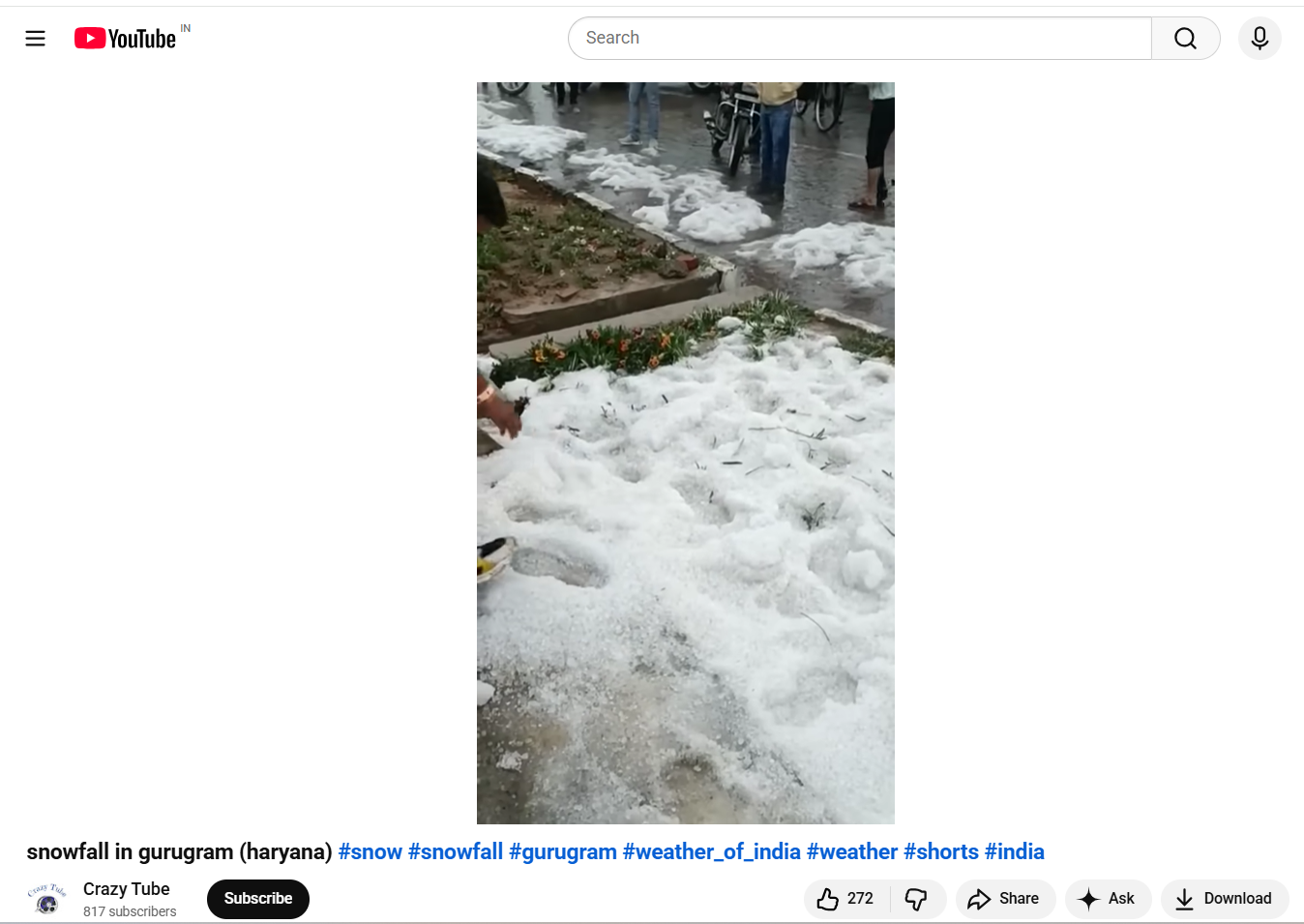
A reverse image search of keyframes extracted from the viral clip traced the same footage to a video uploaded on the YouTube channel Crazy Tube on March 21, 2023. This establishes that the video has been in circulation for nearly three years. In the original upload, the person filming clearly mentions that the visuals were recorded near a toll plaza, further indicating that the clip is unrelated to the recent weather conditions in Gurugram. Link and Screen Shot
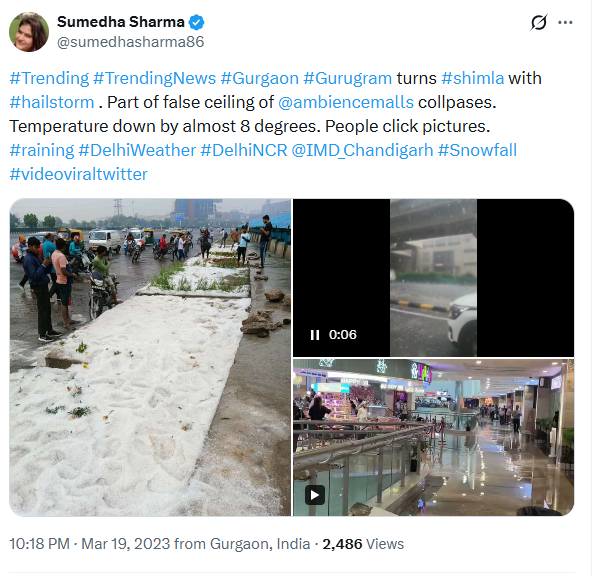
We also came across an X (formerly Twitter) post from March 19, 2023, which featured images similar to those seen in the viral video. The post described the visuals as being from a hailstorm in Gurugram, indicating that the content predates the current weather conditions and is unrelated to the recent cold wave.
Conclusion:
The video is old and predates January 2026, and has been on the internet at least since March 2023. While Gurugram recorded a low of 0.6 degrees Celsius amid an IMD cold wave warning, the city did not experience snowfall or hail as of 16 January 2026. News reports from March 2023 confirm heavy rain and hail in Delhi and adjoining areas, including parts of Gurugram, but there is no evidence of snowfall in January 2026. Hence, the claim made in the post is MISLEADING.
Related Blogs
.webp)
Introduction
Autonomous transportation, smart cities, remote medical care, and immersive augmented reality are just a few of the revolutionary applications made possible by the global rollout of 5G technology. However, along with this revolution in connectivity, a record-breaking rise in vulnerabilities and threats has emerged, driven by software-defined networks, growing attack surfaces, and increasingly complex networks. As work on next-generation 6G networks accelerates, with commercialisation starting in 2030, security issues are piling up, including those related to AI-driven networks, terahertz communications, and quantum computing attacks. For a nation like India, poised to become a global technological leader, next-generation network procurement is not merely a technical necessity but a strategic imperative. Initiatives such as India-UK collaboration on telecom security in recent years say a lot about how international alliances are the order of the day to address these challenges.
Why Cybersecurity in 5G and 6G Networks is Crucial
With the launch of global 5G services and the rapid introduction of 6G technologies, the telecom sector is seeing a fundamental transformation. Besides expanding connectivity, future networks are also creating the building blocks for networked and highly intelligent environments. With its ultra-high speed of 10 Gbps, network slicing, and ultra-low latency, 5G provides new capabilities that are perfectly suited for mission-critical applications such as telemedicine, autonomous vehicles, and industrial IoT. Sixth-generation wireless technology is still in development, and it will be approximately one hundred times faster than fifth-generation. Here are a few drawbacks and challenges:
- Decentralised Infrastructure (edge computing nodes): Increased number of entry points for attack.
- Virtual Network Functions (VNFs): Greater vulnerability to configuration issues and software exploitation.
- Billions of IoT devices with different security states, thus forming networks that are more difficult to secure.
Although these challenges are unparalleled, the advancement in technology also creates new opportunities.
Understanding the Cyber Threat Landscape for 5G and 6G
The move to 5G and the upgrade to 6G open great opportunities, but also open doors for new cybersecurity risks. Open RAN usage offers flexibility and vendor selection but exposes the supply chain to untested third-party components and attacks. SBA security vulnerabilities can be exploited to disrupt vital network services, resulting in outages or data breaches. Similarly, widespread adoption of edge computing to reduce latency creates multiple entry points for an attacker to target. Compounding the problem is the explosion of IoT device connections through 5G, which, if breached, can fuel massive botnets capable of conducting massive distributed denial-of-service (DDoS) attacks.
Challenges in 6G
- AI-Powered Cyberattacks: AI-native 6G networks are susceptible to adversarial machine learning attacks, data model poisoning, both for security and for traffic optimisation.
- Quantum Threats: Post-quantum cryptography may be required if quantum computing renders current encryption algorithms outdated.
- Privacy Concerns with Digital Twins: 6G may result in creating enormous privacy and data protection issues in addition to offering real-time virtual replicas of the physical world.
- Cross-Border Data Flow Risks: Secure interoperability frameworks and standardised data sovereignty are essential for the worldwide rollout of 6G.
A Critical Step Toward Secure Telecom: The India-UK Partnership
India's recent foray with the UK reflects its active role in shaping the future of telecom security. Major points of the UK-India Telecom Roundtable are:
- MoU between SONIC Labs and C-DOT: Dedicated to Open RAN and AI integration security in 4G/5G deployments. This will offer supply chain diversity without sacrificing resilience.
- Research Partnerships for 6G: Partnerships with UK institutions like CHEDDAR (Cloud & Distributed Computing Hub) and the University of Glasgow 6G Research Centre are focused on developing AI-driven network security solutions, green 6G, and quantum-resistant design.
- Telecom Cybersecurity Centres of Excellence: Constructing two-way CoEs for telecom cybersecurity, ethical AI, and digital twin security models.
- Standardisation Efforts: Joint contribution to ITU for the creation of IMT-2030 standards, in a way that cybersecurity-by-design principles are integrated into worldwide 6G specifications.
- Future Initiatives:
- Application of privacy-enhancing technologies (PETs) for cross-sectoral data usage.
- Secure quantum communications to be used for satellite and submarine cable connections.
- Encouragement of native telecommunication stacks for strategic independence.
Global Policy and Regulatory Aspects
- India's Bharat 6G Vision: India will lead the global standardisation process in the Bharat 6G Alliance with a vision of inclusive, secure, and sustainable connectivity.
- International Harmonisation:
- 3GPP and ITU's joint effort towards standardisation of 6G security.
- Cross-border privacy and cybersecurity compliance system designs to enable secure flows of data.
- Cyber Diplomacy for Telecom Security: Cross-border sharing of information architectures, threat intelligence sharing, and coordinated incident response schemes are essential to 6G security resilience globally.
Building a Secure and Resilient Future for 5G and 6G
Establishing a safe and future-proof 5G and 6G environment should be an end-to-end effort involving governments, industry, and technology vendors. Security should be integrated into the underlying architecture of the networks and not an afterthought feature to be optionally provided. Active engagement in international bodies to establish homogeneous security and privacy standards across geographies is also required. Public-private partnerships, including academia partnerships, will be the driver for innovation and the creation of advanced protection mechanisms. Simultaneously, creating a competent talent pool to manage AI-based threat analysis, quantum-resistant cryptography, and next-generation cryptographic methods will be required to combat the advanced menace of new telecom technologies.
Conclusion
Given 6G on the way and 5G technologies already changing global connections, cybersecurity needs to continue to be a key focus. The partnership between India and the UK serves as an example of why the safe rise of tomorrow's networks depends on global collaboration, AI-driven security measures, plus quantum preparedness. The world can unleash the potential for transformation of 5G and 6G through combining security by design, supporting international standards, and encouraging innovation via cooperation. This will result in an online future that is not only quick and egalitarian but also solid and trustworthy.
References:
- https://www.pib.gov.in/PressReleasePage.aspx?PRID=2105225
- https://www.itu.int/en/ITU-R/study-groups/rsg5/rwp5d/imt-2030/pages/default.aspx
- https://dot.gov.in/sites/default/files/Bharat%206G%20Vision%20Statement%20-%20full.pdf
- https://www.gsma.com/solutions-and-impact/technologies/security/wp-content/uploads/2024/07/FS.40-v3.0-002-19-July.pdf
%20(2).webp)
Introduction
Digitalization in India has been a transformative force, India is also marked as the second country in the world in terms of active internet users. With this adoption of digitalization and technology, the country is becoming a digitally empowered society and knowledge-based economy. However, the number of cyber crimes in the country has also seen a massive spike recently with the sophisticated cyber attacks and manipulative techniques being used by cybercriminals to lure innocent individuals and businesses.
As per recent reports, over 740,000 cybercrime cases were reported to the I4C, in the first four months of 2024, which raises serious concern on the growing nature of cyber crimes in the country. Recently Prime Minister Modi in his Mann Ki Baat address, cautioned the public about a particular rising cyber scam known as ‘digital arrest’ and highlighted the seriousness of the issue and urged people to be aware and alert about such scams to counter them. The government has been keen on making efforts to reduce and combat cyber crimes by introducing new measures and strengthening the regulatory landscape governing cyberspace in India.
Indian Cyber Crime Coordination Centre
Indian Cybercrime Coordination Centre (I4C) was established by the Ministry of Home Affairs (MHA) to provide a framework and eco-system for law enforcement agencies (LEAs) to deal with cybercrime in a coordinated and comprehensive manner. I4C handles the ‘National Cyber Crime Reporting Portal’ (https://cybercrime.gov.in) and the 1930 Cyber Crime Helpline. Recently at the Indian Cyber Crime Coordination Centre (I4C) Foundation Day celebration, Union Home Minister Amit Shah launched the Cyber Fraud Mitigation Centre (CFMC), Samanvay platform (Joint Cybercrime Investigation Facilitation System), 'Cyber Commandos' program and Online Suspect Registry as efforts to combat the cyber crimes, establish cyber resilence and awareness and strengthening capabilities of law enforcement agencies.
Regulatory landscape Governing Cyber Crimes
Information Technology Act, 2000 (IT Act) and the rules made therein, the Intermediary Guidelines, Digital Personal Data Protection Act, 2023 and Bhartiya Nyay Sanhita, 2023 are the major legislation in India governing Cyber Laws.
CyberPeace Recommendations
There has been an alarming uptick in cybercrimes in the country highlighting the need for proactive approaches to counter these emerging threats. The government should prioritise its efforts by introducing robust policies and technical measures to reduce cybercrime in the country. The law enforcement agencies' capabilities must be strengthened with advanced technologies to deal with cyber crimes especially considering the growing sophisticated nature of cyber crime tactics used by cyber criminals.
The netizens must be aware of the manipulative tactics used by cyber criminals to target them. Social media companies must also implement robust measures on their respective platforms to counter and prevent cyber crimes. Coordinated approaches by all relevant authorities, including law enforcement, cybersecurity agencies, and regulatory bodies, along with increased awareness and proactive engagement by netizens, can significantly reduce cyber threats and online criminal activities.
References
- https://www.statista.com/statistics/1499739/india-cyber-crime-cases-reported-to-i4c/#:~:text=Cyber%20crime%20cases%20registered%20by%20I4C%20India%202019%2D2024&text=Over%20740%2C000%20cases%20of%20cyber,related%20to%20online%20financial%20fraud
- https://www.deccanherald.com/india/parliament-panel-to-examine-probe-agencies-efforts-to-tackle-cyber-crime-illegal-immigration-3270314
- https://pib.gov.in/PressReleaseIframePage.aspx?PRID=2003158

Introduction
In today's era of digitalised community and connections, social media has become an integral part of our lives. A large number of teenagers are also active and have their accounts on social media. They use social media to connect with their friends and family. Social media offers ease to connect and communicate with larger communities and even showcase your creativity. On the other hand, it also poses some challenges or issues such as inappropriate content, online harassment, online stalking, misuse of personal information, abusive and dishearted content etc. There could be unindented consequences on teenagers' mental health by such threats or overuse of social media. The data shows some teens spend hours a day on social media hence it has a larger impact on them whether we notice it or not. Social media addiction and its negative repercussions such as overuse of social media by teens and online threats and vulnerabilities is a growing concern that needs to be taken seriously by social media platforms, regulatory policies and even user's responsibilities. Recently Colorado and California led a joint lawsuit filed by 33 states in the U.S. District Court for the Northern District of California against meta on the concern of child safety.
Meta and concern of child users safety
Recently Meta, the company that owns Facebook, Instagram, WhatsApp, and Messenger, has been sued by more than three dozen states for allegedly using features to hook children to its platforms. The lawsuit claims that Meta violated consumer protection laws and deceived users about the safety of its platforms. The states accuse Meta of designing manipulative features to induce young users' compulsive and extended use, pushing them into harmful content. However, Meta has responded by stating that it is working to provide a safer environment for teenagers and expressing disappointment in the lawsuit.
According to the complaint filed by the states, Meta “designed psychologically manipulative product features to induce young users’ compulsive and extended use" of platforms like Instagram. The states allege that Meta's algorithms were designed to push children and teenagers into rabbit holes of toxic and harmful content, with features like "infinite scroll" and persistent alerts used to hook young users. However, meta responded with disappointment with a lawsuit stating that meta working productively with companies across the industry to create clear, age-appropriate standards for the many apps.
Unplug for sometime
Overuse of social media is associated with increased mental health repercussions along with online threats and risks. Social media’s effect on teenagers is driven by factors such as inadequate sleep, exposure to cyberbullying and online threats and lack of physical activity. Its admitted that social media can help teens feel more connected to their friends and their support system and showcase their creativity to the online world. However, social media overuse by teens is often linked with underlying issues that require attention. To help teenagers, encourage them for responsible use and unplug from social media for some time, encourage them to get outside in nature, do physical activities, and express themselves creatively.
Understanding the threats & risks
- Psychological effects
- Addiction: Excessive use of social media will lead to procrastination and excessively using social media can lead to physical and psychological addiction because it triggers the brain's reward system.
- Mental Conditions Associated: Excessively using social media can be harmful for mental well-being which can also lead to depression and anxiety, self-consciousness and may also lead to social anxiety disorder.
- Eyes, Carpal tunnel syndrome: Excessive spending time on screen may lead to put a real strain on your eyes. Eye problems caused by computer/phone screen use fall under computer vision syndrome (CVS). Carpal tunnel syndrome is caused by pressure on the median nerve.
- Cyberbullying: Cyberbullying is one of the major concerns faced in online interactions on social media. Cyberbullying takes place using the internet or other digital communication technology to bully, harass, or intimidate others and it has become a major concern of online harassment on popular social media platforms. Cyberbullying may include spreading rumours or posting hurtful comments. Cyberbullying has emerged as a phenomenon that has a socio-psychological impact on the victims.
- Online grooming: Online grooming is defined as the tactics abusers deploy through the internet to sexually exploit children. The average time for a bad actor to lure children into his trap is 3 minutes, which is a very alarming number.
- Ransomware/Malware/Spyware: Cybercrooks impose threats such as ransomware, malware and spyware by deploying malicious links on social media. This poses serious cyber threats, and it causes consequences such as financial losses, data loss, and reputation damage. Ransomware is a type of malware which is designed to deny a user or organisation access to their files on the computer. On social media, cyber crooks post malicious links which contain malware, and spyware threats. Hence it is important to be cautious before clicking on any such suspicious link.
- Sextortion: Sextortion is a crime where the perpetrator threatens the victim and demands ransom or asks for sexual favours by threatening the victim to expose or reveal the victim’s sexual activity. It is a kind of sexual blackmail, it may take place on social media and youngsters are mostly targeted. The cyber crooks also misuse the advanced AI Deepfake technology which is capable of creating realistic images or videos which in actuality are created by machine algorithms. Deepfakes technology since easily accessible, is misused by fraudsters to commit various crimes including sextortion or deceiving and scamming people through fake images or videos which look realistic.
- Child sexual abuse material(CSAM): CSAM is inappropriate or illicit content which is prohibited by the laws and regulatory guidelines. Child while using the internet if encounters age-restricted or inappropriate content which may be harmful to them child. Through regulatory guidelines, internet service providers are refrained from hosting the CSAM content on the websites and blocking such inappropriate or CSAM content.
- In App purchases: The teen user also engages in-app purchases on social media or online gaming where they might fall into financial fraud or easy money scams. Where fraudster targets through offering exciting job offers such as part-time job, work-from-home job, small investments, liking content on social media, and earning money out of this. This has been prevalent on social media and fraudsters target innocent people ask for their personal and financial information, and commit financial fraud by scamming people on the pretext of offering exciting offers.
Safety tips:
To stay safe while using social media teens or users are encouraged to follow the best practices and stay aware of the online threats. Users must keep in regard to the best practices. Such as;
- Safe web browsing.
- Utilising privacy settings of your social media accounts.
- Using strong passwords and enabling two-factor authentication.
- Be careful about what you post or share.
- Becoming familiar with the privacy policy of the social media platforms.
- Being selective of adding unknown users to your social media network.
- Reporting any suspicious activity to the platform or relevant forum.
Conclusion:
Child safety is a major concern on social media platforms. Social media-related offences such as cyberstalking, hacking, online harassment and threats, sextortion, and financial fraud are seen as the most occurring cyber crimes on social media. The tech giants must ensure the safety of teen users on social media by implementing and adopting the best mechanisms on the platform. CyberPeace Foundation is working towards advocating for a Child-friendly SIM to protect from the illicit influence of the internet and Social Media.
References:
- https://www.scientificamerican.com/article/heres-why-states-are-suing-meta-for-hurting-teens-with-facebook-and-instagram/
- https://www.nytimes.com/2023/10/24/technology/states-lawsuit-children-instagram-facebook.html