
The Right to be Forgotten | How Delhi HC rewrote the India’s Digital Privacy Landscape
Introduction
In an extensive order of 144 pages passed on May 29, 2026, Justice Sachin Datta of the Delhi High Court inter alia affirmed the right of an acquitted or discharged person to reinstate their digital identity. In a batch of more than 30 petitions relating to acquittals, family dispute cases, quashed criminal cases, and parties to proceedings, the petitioners argued that court documents and accusations, having lost their purpose, have kept occupying the search engine, leading to infringement of dignity, privacy, and career and personal life of these individuals. Citing Article 21 of the Indian Constitution as its foundation, the court affirmed that a right to life and personal liberty also includes a right to privacy and to leave behind failed proceedings and adopted wide de-indexing policies, including, where necessary, global de-indexing, thereby ushering in India's "right to be forgotten."
The Constitutional Argument: Article 21 and the Digital Self
The constitutional basis of the right to be forgotten in India rests on the landmark nine-judge bench ruling in Justice K.S. Puttaswamy v. Union of India. In 2017, the Supreme Court ruled privacy to be a fundamental right under Article 21 of the Constitution and stated informational privacy is a facet of personal liberty. The Supreme Court observed that individuals have an interest in determining how the information concerning them is gathered, disseminated, and accessed.
Building upon this precedent, Justice Sachin Datta held that the right to be forgotten flows naturally from the constitutional guarantee of informational privacy. The judgment represents one of the most significant judicial applications of the Puttaswamy principles, particularly in the context of search engines and online judicial records. Noting the absence of a fully operational statutory framework despite the enactment of the Digital Personal Data Protection Act, 2023, the court exercised its constitutional jurisdiction to protect individuals from enduring digital harm caused by continued public accessibility of outdated or irrelevant personal information.
INDIAN APPLICATION OF THE GLOBAL PRECEDENT
Tracing back the genesis of this right, it lies in the worldwide jurisdiction on privacy, especially the European Court of Justice's landmark ruling of 2014 in Google Spain SL v. AEPD and Mario Costeja Gonzlez, where it ruled that it is within one's power to ask search engines to de-list links that show personal information that is found to be outdated or irrelevant. This led to a legislated right to erasure by the inclusion of Article 17 in the General Data Protection Regulation (GDPR), creating the right throughout the EU. India, on the other hand, saw a slow process of evolution when it came to this right. The Madras High Court acknowledged the right to be forgotten partially in 2021 when it directed a petitioner's name to be deleted from an acquittal judgment, which was affirmed by a Division Bench in 2024. Nevertheless, the above were merely judgments confined to the facts of a particular case. However, the decision of the Delhi High Court dated May 2026 proves to be the benchmark in laying down a comprehensive constitutional framework under Article 21 with guiding principles on when a request for de-linking would be entertained and, if warranted, would be extended throughout the world.
Anatomy of the Framework by the Delhi High Court
While Justice Sachin Datta’s ruling recognizes the right to be forgotten, its actual import lies in devising an operative framework. The Court noted that it would maintain judicial records indefinitely in keeping with open justice principles, but an individual's name may not act as a perennial search key with respect to private entities' search engines. Thus, courts will be allowed to de-index judicial records (except their legal reasoning, findings, and ratio decidendi, which will continue to be accessible) from the names appearing therein from search engines and legal databases. While personally identifying data will be obfuscated, the underlying legal reasoning will not be rendered unusable, as access to unredacted records will continue to be available to courts, parties, and authorities. Such orders are also possible to be effective internationally, rendering avoidance difficult. However, the right cannot be absolute, as it is largely unavailable for convicted individuals (particularly if convicted of offenses against women or children or crimes of breach of trust). Courts must pass a proportionality test in considering the balance between privacy and the public right to know. By stating that masking information has an impact on discoverability, not access, it achieves a reconciliation between informational privacy and open justice so that acquitted accused are not held hostage to past accusations forever in the online age.
The Road to Implementation
However, the judgment presents a thick knot of practical issues, the solution to which may take considerable time to untangle. How will petitions for masking orders be filed by those who need them? Will there be a prescribed form? How will legal database systems such as Indian Kanoon and SCC Online operationalize name-based de-indexing while keeping their vast archives usable for lawyers? More significantly, what kind of legal force will global directions for de-indexing hold over those search engines whose main servers lie outside of Indian territory?
This is not to say the judgment isn't important. It simply presents a predictable, almost mundane set of issues that all ambitious pronouncements on constitutional rights face when translated into the world of administration issues that came up even when the EU was first struggling with enforcing the GDPR in 2018. India now has its framework, and the details of its implementation will undoubtedly come through future rounds of litigation, guidelines, and perhaps even legislation.
What remains abundantly clear, though, is the message conveyed by the Delhi High Court that digital permanency is a crime, especially when it causes the most incriminating of a person's legal actions to follow them perpetually, even long after they have been given due process by the system. As Justice Datta eloquently put it, privacy in the digital age is 'not about secrecy but about an individual's control over the dissemination of personal information.' "Now an element of constitutional law in India, the verdict is a declaration that will resonate long beyond the thirty-odd petitions that called it into being.
Conclusion
The ultimate finding of the 2026 right-to-be-forgotten judgment in Delhi High Court reinforces human dignity in the digital era. The Court has acknowledged the need for acquittals and exonerations to have meaningful implications offline, ensuring an individual is not eternally punished through online searches for alleged wrongdoing. Building on the right to privacy established by K.S. Puttaswamy v. Union of India, informational privacy now stands at the core of constitutional guarantees, and India joins the nations establishing precedents to balance openness with dignity.

Related Blogs

Introduction
The Ministry of Electronics and Information Technology (MeitY) issued an advisory on March 1 2024, urging platforms to prevent bias, discrimination, and threats to electoral integrity by using AI, generative AI, LLMs, or other algorithms. The advisory requires that AI models deemed unreliable or under-tested in India must obtain explicit government permission before deployment. While leveraging Artificial Intelligence models, Generative AI, software, or algorithms in their computer resources, Intermediaries and platforms need to ensure that they prevent bias, discrimination, and threats to electoral integrity. As Intermediaries are required to follow due diligence obligations outlined under “Information Technology (Intermediary Guidelines and Digital Media Ethics Code)Rules, 2021, updated as of 06.04.2023”. This advisory is issued to urge the intermediaries to abide by the IT rules and regulations and compliance therein.
Key Highlights of the Advisories
- Intermediaries and platforms must ensure that users of Artificial Intelligence models/LLM/Generative AI, software, or algorithms do not allow users to host, display, upload, modify, publish, transmit, store, update, or share unlawful content, as per Rule 3(1)(b) of the IT Rules.
- The government emphasises intermediaries and platforms to prevent bias or discrimination in their use of Artificial Intelligence models, LLMs, and Generative AI, software, or algorithms, ensuring they do not threaten the integrity of the electoral process.
- The government requires explicit permission to use deemed under-testing or unreliable AI models, LLMs, or algorithms on the Indian internet. Further, it must be deployed with proper labelling of potential fallibility or unreliability. Further, users can be informed through a consent popup mechanism.
- The advisory specifies that all users should be well informed about the consequences of dealing with unlawful information on platforms, including disabling access, removing non-compliant information, suspension or termination of access or usage rights of the user to their user account and imposing punishment under applicable law. It entails that users are clearly informed, through terms of services and user agreements, about the consequences of engaging with unlawful information on the platform.
- The advisory also indicates measures advocating to combat deepfakes or misinformation. The advisory necessitates identifying synthetically created content across various formats, advising platforms to employ labels, unique identifiers, or metadata to ensure transparency. Furthermore, the advisory mandates the disclosure of software details and tracing the first originator of such synthetically created content.
Rajeev Chandrasekhar, Union Minister of State for IT, specified that
“Advisory is aimed at the Significant platforms, and permission seeking from Meity is only for large platforms and will not apply to startups. Advisory is aimed at untested AI platforms from deploying on the Indian Internet. Process of seeking permission , labelling & consent based disclosure to user about untested platforms is insurance policy to platforms who can otherwise be sued by consumers. Safety & Trust of India's Internet is a shared and common goal for Govt, users and Platforms.”
Conclusion
MeitY's advisory sets the stage for a more regulated Al landscape. The Indian government requires explicit permission for the deployment of under-testing or unreliable Artificial Intelligence models on the Indian Internet. Alongside intermediaries, the advisory also applies to digital platforms that incorporate Al elements. Advisory is aimed at significant platforms and will not apply to startups. This move safeguards users and fosters innovation by promoting responsible AI practices, paving the way for a more secure and inclusive digital environment.
References
- https://regmedia.co.uk/2024/03/04/meity_ai_advisory_1_march.pdf
- https://economictimes.indiatimes.com/tech/technology/govts-ai-advisory-will-not-apply-to-startups-mos-it-rajeev-chandrasekhar/articleshow/108197797.cms?from=mdr
- https://www.meity.gov.in/writereaddata/files/Advisory%2015March%202024.pdf

Executive Summary:
A video is going viral on social media with the claim that the protests and unrest at Lovely Professional University (LPU) over the alleged rape of a female student were linked to the nephew of Union Home Minister Amit Shah. The viral video purportedly shows a police officer telling the media that the involvement of an alleged relative of Amit Shah had surfaced in the case and that a police team had been sent to Delhi to arrest him. However, CyberPeace Research found that the original video has been digitally manipulated using AI and is being circulated with a misleading claim.
Claim:
The post caption reads: “Breaking Punjab Police officials have confirmed that Amit Shah’s nephew was involved in the LPU (Lovely Professional University) incident, which took place in Room No. 116 of GH3 Hostel. Officials say they have sent a special team to arrest him.” In the viral video, a police officer is purportedly heard telling the media: “We are receiving information that the person who committed this crime was a BJP worker and a relative of the Home Minister. This incident took place in Room 116 of GH3 Hostel. But now the Punjab Police is fully alert and an FIR has been registered. We will take action. The boy is currently in Delhi, but our teams have been sent there.
https://x.com/SSLawat_INC/status/2104794508311540147
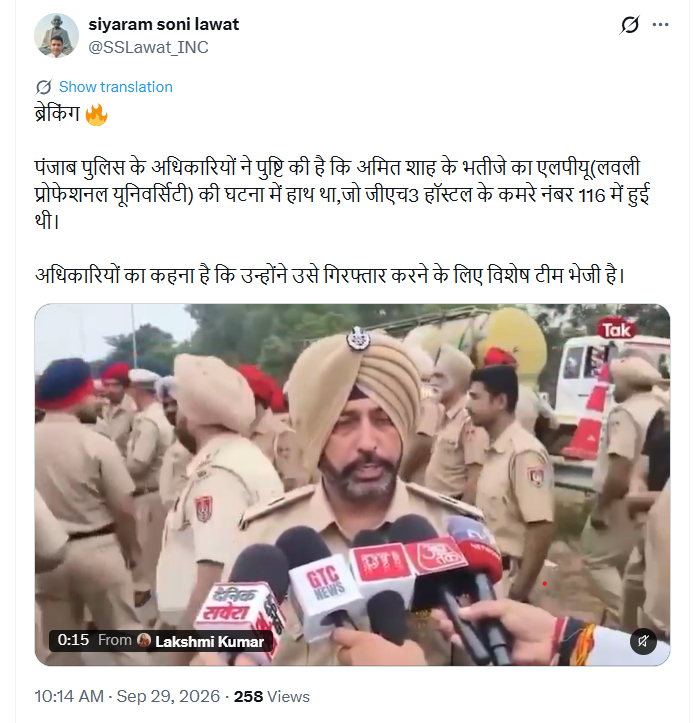
Fact Check:
To verify the viral video claiming that the nephew of Union Home Minister Amit Shah was named as an accused in the LPU case in Punjab, we conducted a Google search using relevant keywords. During the search, we did not find any credible media reports in which the Punjab Police had made such a statement. Since the video carries the ‘Crime Tak’ logo, we checked the channel’s YouTube account. During our research, we found the original version of the viral video uploaded on the ‘Crime Tak’ YouTube channel on September 27. We found that the police officer seen in the video is Phagwara SP Major Singh. In the original video available on the ‘Crime Tak’ YouTube channel, SP Major Singh does not mention any involvement of Amit Shah’s relative. Instead, while speaking about the protests at LPU and rumours surrounding an alleged rape and suicide, he says that the police have not received any concrete information or complaint regarding the matter. He further states that if students provide any complaint or credible information, the police will take appropriate action as per the medical examination and investigation process.
https://www.youtube.com/watch?v=UY7cE0S65-k

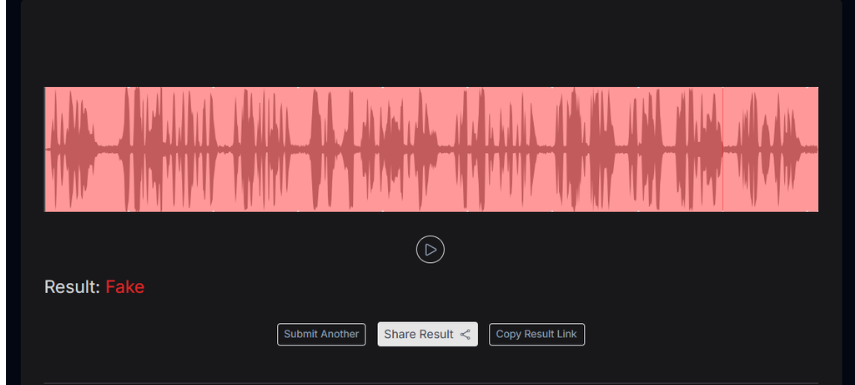
Since the police officer in the original video did not make any statement about Amit Shah’s nephew, it became clear that the viral video had been manipulated. To further verify this, we analyzed the audio in the video using the AI detection tool Resemble AI. The tool identified the voice of the police officer in the video as fake.
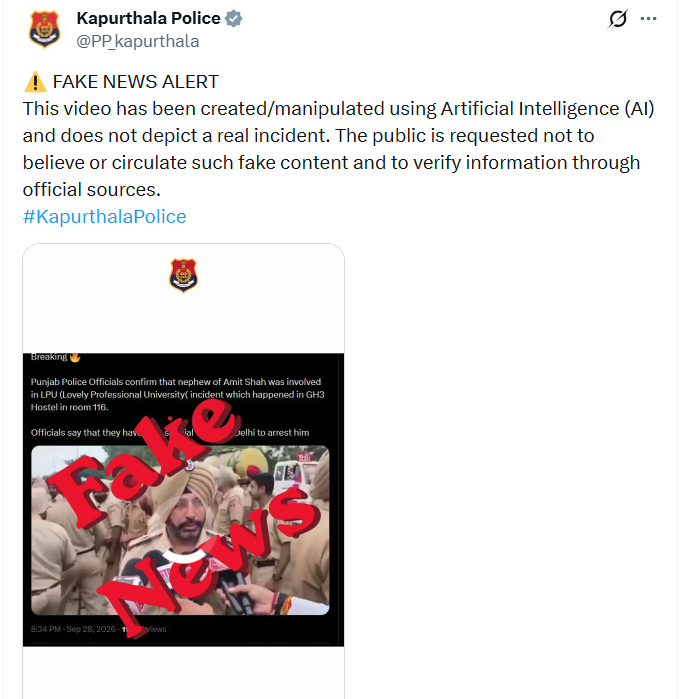
The Kapurthala Police posted on its official X handle on September 29, 2026, describing the video as fake.
Conclusion:
The evidence gathered during our research confirms that the video of a Punjab Police officer allegedly accusing Amit Shah’s relative has been digitally manipulated using AI. In the original video, the Punjab Police officer did not make any such statement while responding to questions from the media.

Introduction
In 2019 India got its bill on Data protection in the form of the Personal Data Protection Bill 2019. This bill focused on digital rights and duties pertaining to data privacy. However, the bill was scrapped by the Govt in mid-2022, and a new bill was drafted, Successor bill was introduced as the Digital Personal Data Protection Bill, 2022 on 18th November 2022, which was made open for public comments and consultations and now the bill is expected to be tabled at the parliament in the Monsoon session.
What is DPDP, 2022?
Digital Personal Data Protection Bill, is the lasted draft regulation for data privacy in India. The bill has been essentially focused towards data protection by companies and the keep aspect of Puttaswamy judgement of data privacy as a fundamental right has been upheld under the scope of the bill. The bill comes after nearly 150 recommendations which the parliamentary committee made when the PDP, 2019 was scrapped.
The bill highlights the following keen aspects-
- Data Fiduciary- The entity (an individual, company, firm, state, etc.) which decides the purpose and means of processing an individual’s personal data.
- Data Principle- The individual to whom personal data is related.
- Processing- The entire cycle of operations that can be carried out concerning personal data.
- Gender Neutrality- For the first time in India’s legislative history, “her” and “she” have been used to refer to individuals irrespective of gender.
- Right to Erase Data- Data principals will have the right to demand the erasure and correction of data collected by the data fiduciary.
- Cross-border data transfer- The bill allows cross-border data after an assessment of relevant factors by the Central Government.
- Children’s Rights- The bill guarantees the right to digital privacy under the protection of parents/guardians.
- Heavy Penalties- The bill enforces heavy penalties for non-compliance with the provisions, not exceeding Rs 500 crore.
Data Protection Board
The bill lays down provisions for setting up a Data Protection Board. This board will be an independent body acting solely on the factors of data privacy and protection of the data principles and maintaining compliance by data fiduciaries. The board will be headed by a chairperson of essential and relevant qualifications, and members and various other officials shall assist him/her under the board. The board will serve grievance redressal to the data principles and can conduct investigation, inquiry, proceeding, and pass orders equivalent to a Civil court. The proceeding will be undertaken on the principle of natural justice, and the aggrieved can file an appeal to the High Court of appropriate jurisdiction.
Global Comparison
Many countries have data protection laws that regulate the processing of personal data. Some of the notable examples include:
- European Union: The EU’s General Data Protection Regulation (GDPR) is one of the world’s most comprehensive data protection laws. It regulates public and private entities’ processing of personal data and gives individuals a wide range of rights over their personal data.
- United States: The US has several data protection laws that apply to specific sectors or types of data, such as health data (HIPAA) or financial data (Gramm-Leach-Bliley Act). However, there is no comprehensive federal data protection law in the US.
- Japan: Japan’s Personal Information Protection Act (PIPA) regulates the handling of personal data by private entities and gives individuals certain rights over their personal data.
- Australia: Australia’s Privacy Act 1988 regulates the handling of personal data by public and private entities and gives individuals certain rights over their personal data.
- Brazil: Brazil’s General Data Protection Law (LGPD) regulates the processing of personal data by public and private entities and gives individuals certain rights over their personal data. It also imposes heavy fines and penalties on entities that violate the provisions of the law.
Overall, while there are some similarities in data protection laws across countries, there are also significant differences in scope, applicability, and enforcement. It is important for organisations to understand the data protection laws that apply to their operations and take appropriate steps to comply with these laws.
Parliamentary Asscent
The case of violation of the privacy policy by WhatsApp at the Hon’ble Supreme Court resulted in a significant advocacy for Data privacy as a fundamental right, and it was held that, as suggested otherwise in the privacy policy, Whatsapp was sharing its user’s data with Meta. This massive breach of trust could have led to data mismanagement affecting thousands of Indian users. The Hon’ble Supreme Court has taken due consideration of data privacy and its challenges in India and asked the Govt to table the bill in Parliament. The bill will be tabled for discussion in the monsoon session. The Supreme Court has set up a constitutional bench to check the bill’s scope, extent and applications and provide its judicial oversight. The constitution bench of Justices KM Joseph, Ajay Rastogi, Aniruddha Bose, Hrishikesh Roy and CT Ravikumar has fixed the matter for hearing in August in order to enforce the potential changes and amendments in the act post the parliamentary discussion.
Conclusion
India is the world’s largest democracy, so the crucial aspects of passing laws and amendments have always been followed by the government and kept under check by the judiciary. The discussion over bills is a crucial part of the democratic process, and bills as important as Digital Personal Data Protection need to be discussed and analysed thoroughly in both houses of Parliament to ensure the govt passes a sustainable and efficient law.
