
The 'Rent Boyfriend' Trap: Inside India's Newest Loneliness-Targeted Cyber Scam
Introduction
On August 8, 2026, Hyderabad Police Commissioner V.C. Sajjanar posted an unusual warning on X: colourful posters offering a "handsome guy" to join you for coffee or a movie at 50% off: it was not a quirky dating startup but a calculated cyber fraud. Within hours, the "Rent Boyfriend" alert had gone viral, pulling back the curtain on a scam that blends India's growing loneliness economy, classic confidence tricks, and AI-generated imagery. Here is what's actually happening, why it works, and how to protect yourself.
A Trend Growing Fast: In India and Worldwide
Paid-companionship culture itself isn't new. "Rent a friend" services began in Japan and later China, where apps let people hire a company for a movie, a walk, or a family event without romantic or sexual expectations. The idea reached India as early as 2018, when Mumbai's "Rent A Guy" app began recruiting men for casual outings; by 2022, similar pages like "Toy Boy" and "Hire a Friend" had spread to Bengaluru, and Valentine's Day 2025 saw ₹389 "rent a boyfriend" posters plastered across the city. Fraudsters have now hijacked this recognisable, socially normalised idea and weaponised it: the Hyderabad ads promised specific packages, ₹499 for a coffee date, ₹1,249 for a movie, ₹1,999 for a wedding, and ₹4,499 for ten hours collected via QR codes and wallets, then vanished. The underlying numbers show why this template is so attractive to criminals. Complaints filed on India's National Cyber Crime Reporting Portal jumped from roughly 4.5 lakh in 2021 to about 2.3 million by 2026, and the country now logs an estimated 4,000-plus cybercrime complaints a day. Globally, romance and "confidence fraud" are some of the costliest online crimes: the FBI's Internet Crime Complaint Center recorded 23,159 romance-fraud complaints in 2025 worth $929.3 million, which is a 38% jump over 2024, while the UK logged over £102 million in losses and Australia and Canada reported tens of millions more. Crucially, IC3's 2025 report flagged AI as an accelerant for the first time, attributing roughly $19 million in romance-scam losses directly to AI-generated profiles, images and chat exactly the "AI-generated photographs" Hyderabad Police say the Rent Boyfriend network used.
Case Studies
The Rent Boyfriend network is one data point in a wider, well-documented pattern in India:
- Hyderabad, August 2026: Fraudsters ran Instagram, Telegram and Facebook pages using stock or AI-generated photos of "attractive men", collected advance payments and security deposits, and then blocked victims, the case that prompted this advisory.
- Jaipur, 2026: A honey-trap and extortion ring allegedly used AI-manipulated videos and images to blackmail a businessman out of nearly ₹90 lakh, with police examining how far synthetic media was used to fabricate compromising content.
- Mumbai: A gang was arrested for cheating a woman out of ₹16.18 lakh in gold and cash after promising to "reunite" her with a lost partner, a variant that exploits the same emotional vulnerability through a different pretext.
- Gujarat, 2025: A social media influencer with over 10 lakh followers was arrested for allegedly honey-trapping and blackmailing a builder, illustrating how organised such rackets have become.
These sit alongside a global backdrop where FBI data shows confidence and romance fraud disproportionately drains people over 60 (63% of US losses in 2025) even as India's version increasingly targets young women and students, a sign the tactic is being localised for different demographics rather than disappearing.
Why It Works: The Psychology of Loneliness and Grooming
Researchers who study romance-fraud victims consistently find that loneliness, a tendency toward idealised romantic beliefs, and a need for social connection are the strongest predictors of victimisation. Scammers exploit this through a well-rehearsed grooming arc: rapid, excessive flattery ("love bombing") to create instant intimacy; mirroring the target's interests and values to seem like a perfect match; gently discouraging outside opinions so doubts don't surface; and only then introducing a financial ask, framed as something small and reasonable — a booking fee or a security deposit precisely because it feels low-stakes compared to a direct cash demand. The "package" pricing in the Rent Boyfriend ads (₹499 for coffee, scaling up to ₹4,499) mimics legitimate e-commerce, which lowers a target's guard further. Once payment is made and blocked, many victims feel too embarrassed to report it — a shame response researchers and police repeatedly flag as the biggest reason such scams are under-reported.
Red Flags and What To Do?
Red flags to watch for:
- Companionship or dating offers with attractive stock/AI-style photos and steep "discounts"
- Contact only through DMs, with no verifiable business identity, address or reviews.
- Requests for advance payment, "security deposits", or booking fees via UPI/QR code before any service is delivered.
- Reluctance to do a video call or a video call that looks slightly off (a common AI/deepfake tell).
- Pressure to move fast, share personal photos, or keep the interaction secret from friends and family.
Precautions:
- Never send money to confirm a booking with an unverified individual or page.
- Avoid sharing personal photographs, phone numbers, addresses or financial details with strangers online.
- Don't meet anyone in person whom you've only interacted with through such ads.
- Parents should stay engaged with what their children see and who they talk to on social media.
If you suspect a scam or have lost money: Don't panic and don't pay more to "fix" it. Stop all contact, save screenshots and payment records, and call the 1930 cybercrime helpline or file a complaint at cybercrime.gov.in immediately — reporting within the first "golden hour" significantly improves the chance of freezing transferred funds before they're withdrawn.
The Government, Platform and Legal Angle
India already has legal tools for this, though enforcement lags the pace of the fraud. Cheating by personation online is punishable under Section 66D of the IT Act, 2000 (up to three years' imprisonment plus fine), often paired with Section 66C on identity theft; the Bharatiya Nyaya Sanhita's cheating provisions (replacing IPC Sections 420/419) apply where money is dishonestly induced. Under the IT (Intermediary Guidelines) Rules, 2021, platforms like Instagram, Facebook and Telegram must appoint a grievance officer, acknowledge complaints within 24 hours, and take down unlawful content within 36 hours of a court or government notification obligation. Hyderabad's cybercrime wing can invoke to force the removal of these ad networks. Larger "significant social media intermediaries" carry added duties around traceability and proactive monitoring.
The gap is upstream: platforms currently do little to verify who is running a commercial-sounding page before it reaches thousands of users, and AI-generated "profile" images are not systematically flagged. A stronger response would combine faster platform-side KYC for pages soliciting payment, proactive detection of AI-generated advertising imagery, and continued expansion of the 1930 golden-hour fund-freezing mechanism paired with public advisories like Hyderabad's, which remain one of the fastest ways to blunt a scam before it scales.
Conclusion
Loneliness is not something anyone should be ashamed of, but it is exactly what these networks are built to exploit. No genuine companionship service needs an advance QR payment before you've even met the person.
Sources
- Deccan Herald — Hyderabad Police Commissioner cautions young women over 'rent boyfriend' offers
- Republic World — 'Rent Boyfriend' Offers On Social Media?
- Newsdrum — What is 'Rent Boyfriend' trap?
- IndiaSpend — How India's Cyber Crime Incidence Is Rising
- FBI IC3 2025 Annual Report Brochure

Related Blogs

Executive Summary
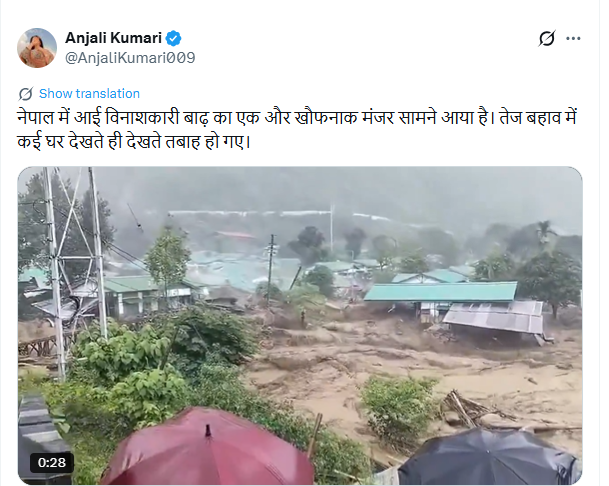
A video showing several houses being swept away by floodwaters is being shared on social media, claiming that it shows flooding in the Rasuwa area of Nepal. Research done by the CyberPeace research wing found that the video is not from Nepal, but is from the floods that occurred in Keyi Panyor district of Arunachal Pradesh in June.
Claim
The video was shared on X with the caption: “Another horrifying scene from the devastating floods in Nepal has emerged. Several houses were destroyed within moments by the strong current.”
https://x.com/anjalikumari009/status/2093257147094335652
FactCheck
During our research of the video being shared as footage of floods in Nepal’s Rasuwa area, we conducted a reverse image search using keyframes and found a longer version of the video posted on an X account on June 24, 2026. The caption accompanying the video identified it as footage of a flash flood and the resulting devastation in Nipko Colony, Possa, in Arunachal Pradesh’s Keyi Panyor district, on June 24.
https://x.com/NagaZapu/status/2069747140608331962

During the research, we also found videos of the flooding in Nipko Colony uploaded on several social media accounts from Arunachal Pradesh on June 24. These posts contained visuals matching those seen in the viral video.
https://www.facebook.com/reel/977442025167230

Additionally, we found a video report uploaded on June 24, 2026, on the Facebook account of a media outlet from Arunachal Pradesh. The report featured footage of the flooding in Nipko Colony. In the audio accompanying the video, the person recording the footage can also be heard describing the devastation caused by the floods.
https://www.facebook.com/reel/1571580381035813

Additionally, we found visuals matching those in the viral video in a 4-minute-35-second video posted on the Press Trust of India’s X account on June 24, 2026. According to media reports, around three people were killed in the floods in Nipko Colony, while approximately 18 houses were swept away.
https://x.com/PTI_News/status/2069747746525835341

Conclusion
The evidence gathered during our research clearly establishes that the video being shared as footage of the floods in Nepal’s Rasuwa area is actually from the floods that struck Keyi Panyor district in Arunachal Pradesh on June 24.
Executive Summary
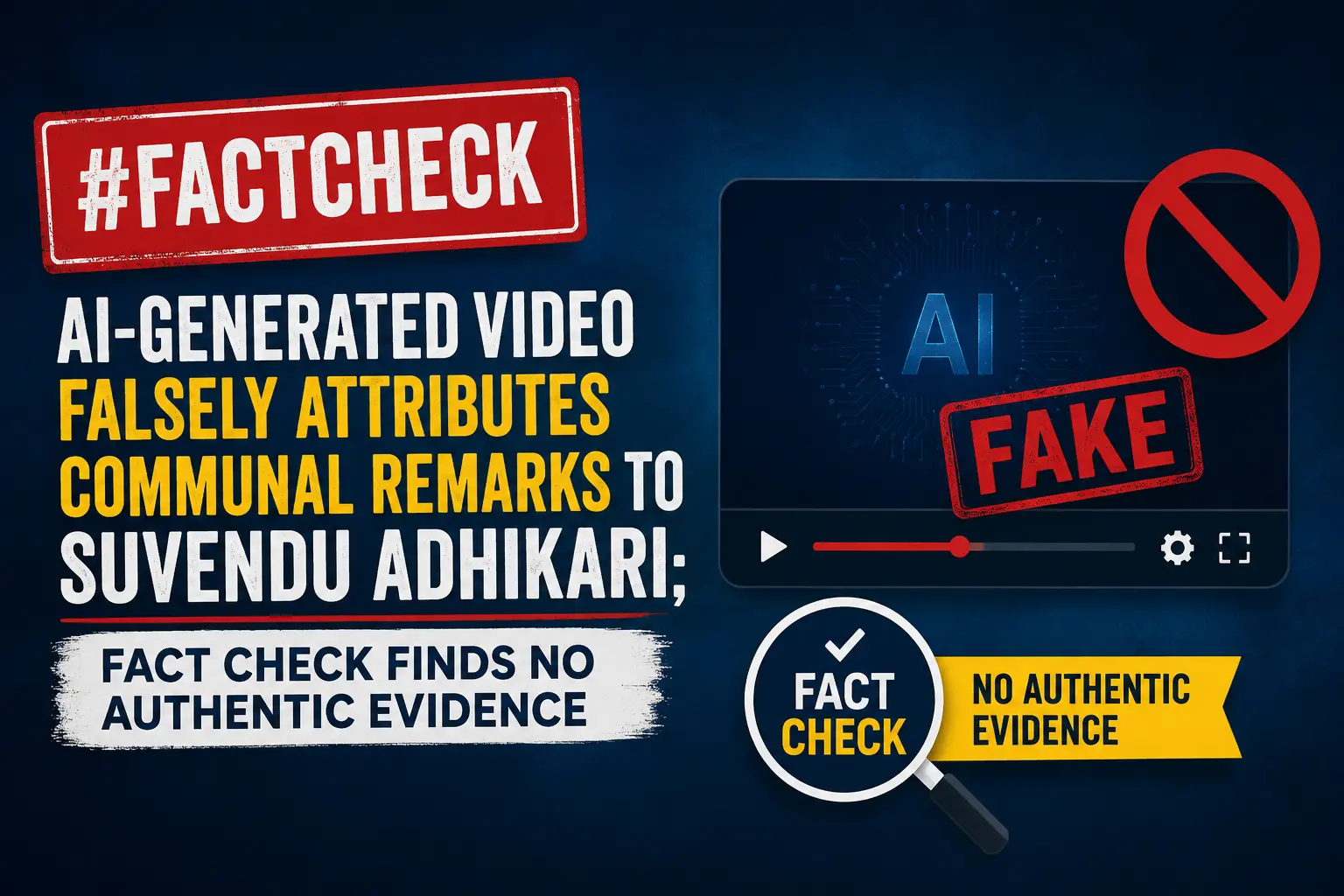
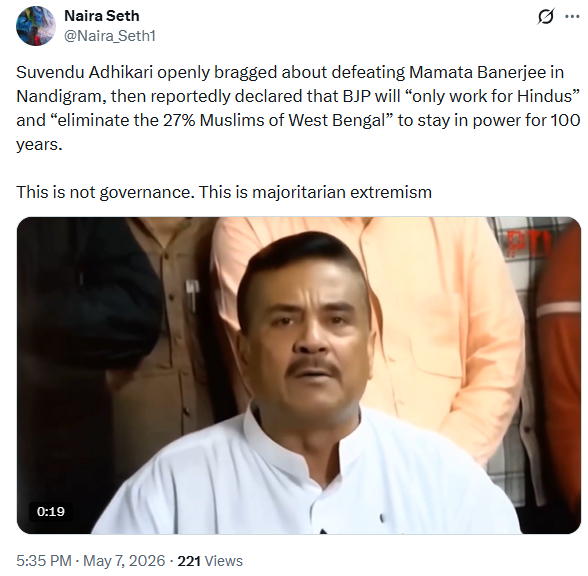
A video circulating on social media falsely claims to show West Bengal leader Suvendu Adhikari making inflammatory and communal remarks. In the viral clip, he is allegedly heard saying that if elected, his party would “work only for Hindus” and “eliminate the 27% Muslim population in West Bengal,” while also claiming that the BJP would remain in power for over 100 years. CyberPeace Research Wing research found that the viral video, which allegedly shows West Bengal leader Suvendu Adhikari making a statement about eliminating the Muslim population in West Bengal to ensure long-term BJP rule, is AI-generated and not real.
Claim
An X user (@Naira_Seth1) shared the clip alleging it reflects “majoritarian extremism disguised as politics,” suggesting that Suvendu Adhikari made communally charged and unconstitutional statements.
Fact Check
A detailed analysis of the video shows clear signs of manipulation. The person appearing in the latter part of the clip does not match Suvendu Adhikari.
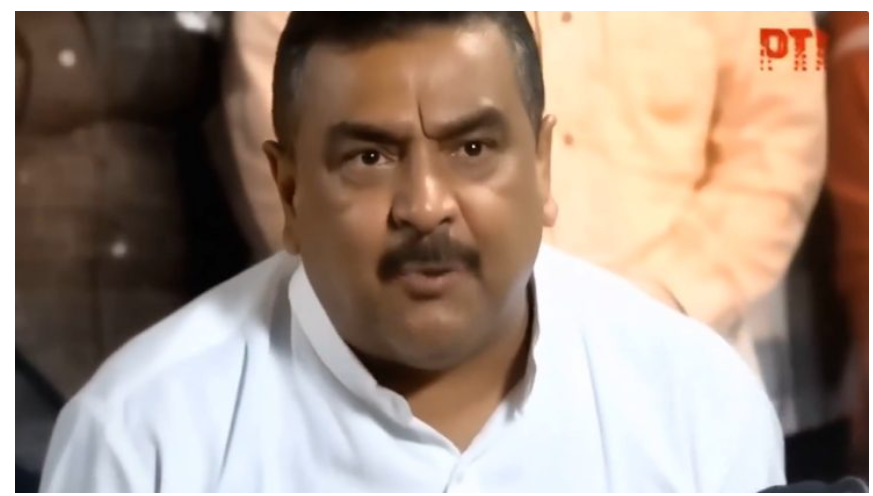
Additionally, the video was tested using an AI detection tool (Hive Moderation), which indicated a 98.8% probability of AI-generated content, particularly around the 0:25 timestamp.
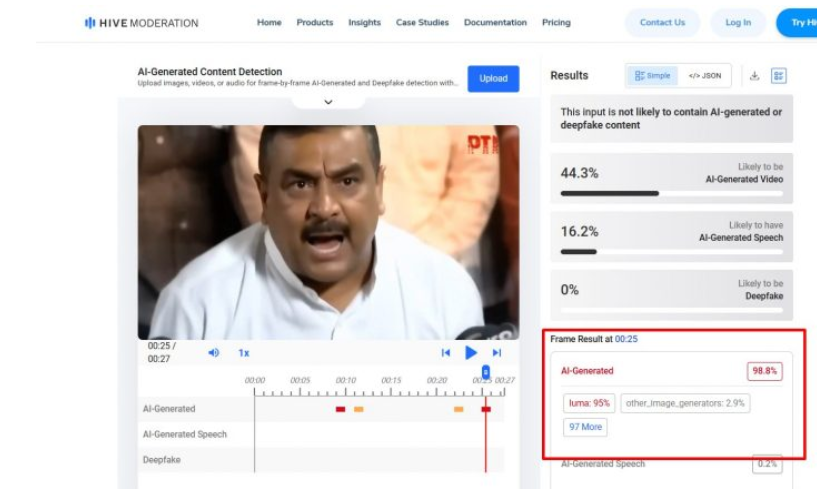
Further verification through reverse image search of key frames led to an original press byte of Suvendu Adhikari posted by PTI News on May 6. In that authentic video, he is seen speaking about taking strict legal action against criminals, with no mention of any religious community or communal statements.
https://x.com/PTI_News/status/2052020784152068114?s=20

Conclusion
The viral video allegedly showing Suvendu Adhikari making communal remarks is AI-generated and misleading. The original footage confirms that no such statements were made, and the clip has been digitally manipulated to spread misinformation.
.webp)
Introduction
The link between social media and misinformation is undeniable. Misinformation, particularly the kind that evokes emotion, spreads like wildfire on social media and has serious consequences, like undermining democratic processes, discrediting science, and promulgating hateful discourses which may incite physical violence. If left unchecked, misinformation propagated through social media has the potential to incite social disorder, as seen in countless ethnic clashes worldwide. This is why social media platforms have been under growing pressure to combat misinformation and have been developing models such as fact-checking services and community notes to check its spread. This article explores the pros and cons of the models and evaluates their broader implications for online information integrity.
How the Models Work
- Third-Party Fact-Checking Model (formerly used by Meta) Meta initiated this program in 2016 after claims of extraterritorial election tampering through dis/misinformation on its platforms. It entered partnerships with third-party organizations like AFP and specialist sites like Lead Stories and PolitiFact, which are certified by the International Fact-Checking Network (IFCN) for meeting neutrality, independence, and editorial quality standards. These fact-checkers identify misleading claims that go viral on platforms and publish verified articles on their websites, providing correct information. They also submit this to Meta through an interface, which may link the fact-checked article to the social media post that contains factually incorrect claims. The post then gets flagged for false or misleading content, and a link to the article appears under the post for users to refer to. This content will be demoted in the platform algorithm, though not removed entirely unless it violates Community Standards. However, in January 2025, Meta announced it was scrapping this program and beginning to test X’s Community Notes Model in the USA, before rolling it out in the rest of the world. It alleges that the independent fact-checking model is riddled with personal biases, lacks transparency in decision-making, and has evolved into a censoring tool.
- Community Notes Model ( Used by X and being tested by Meta): This model relies on crowdsourced contributors who can sign up for the program, write contextual notes on posts and rate the notes made by other users on X. The platform uses a bridging algorithm to display those notes publicly, which receive cross-ideological consensus from voters across the political spectrum. It does this by boosting those notes that receive support despite the political leaning of the voters, which it measures through their engagements with previous notes. The benefit of this system is that it is less likely for biases to creep into the flagging mechanism. Further, the process is relatively more transparent than an independent fact-checking mechanism since all Community Notes contributions are publicly available for inspection, and the ranking algorithm can be accessed by anyone, allowing for external evaluation of the system by anyone.
CyberPeace Insights
Meta’s uptake of a crowdsourced model signals social media’s shift toward decentralized content moderation, giving users more influence in what gets flagged and why. However, the model’s reliance on diverse agreements can be a time-consuming process. A study (by Wirtschafter & Majumder, 2023) shows that only about 12.5 per cent of all submitted notes are seen by the public, making most misleading content go unchecked. Further, many notes on divisive issues like politics and elections may not see the light of day since reaching a consensus on such topics is hard. This means that many misleading posts may not be publicly flagged at all, thereby hindering risk mitigation efforts. This casts aspersions on the model’s ability to check the virality of posts which can have adverse societal impacts, especially on vulnerable communities. On the other hand, the fact-checking model suffers from a lack of transparency, which has damaged user trust and led to allegations of bias.
Since both models have their advantages and disadvantages, the future of misinformation control will require a hybrid approach. Data accuracy and polarization through social media are issues bigger than an exclusive tool or model can effectively handle. Thus, platforms can combine expert validation with crowdsourced input to allow for accuracy, transparency, and scalability.
Conclusion
Meta’s shift to a crowdsourced model of fact-checking is likely to have bigger implications on public discourse since social media platforms hold immense power in terms of how their policies affect politics, the economy, and societal relations at large. This change comes against the background of sweeping cost-cutting in the tech industry, political changes in the USA and abroad, and increasing attempts to make Big Tech platforms more accountable in jurisdictions like the EU and Australia, which are known for their welfare-oriented policies. These co-occurring contestations are likely to inform the direction the development of misinformation-countering tactics will take. Until then, the crowdsourcing model is still in development, and its efficacy is yet to be seen, especially regarding polarizing topics.
References
- https://www.cyberpeace.org/resources/blogs/new-youtube-notes-feature-to-help-users-add-context-to-videos
- https://en-gb.facebook.com/business/help/315131736305613?id=673052479947730
- http://techxplore.com/news/2025-01-meta-fact.html
- https://about.fb.com/news/2025/01/meta-more-speech-fewer-mistakes/
- https://communitynotes.x.com/guide/en/about/introduction
- https://blogs.lse.ac.uk/impactofsocialsciences/2025/01/14/do-community-notes-work/?utm_source=chatgpt.com
- https://www.techpolicy.press/community-notes-and-its-narrow-understanding-of-disinformation/
- https://www.rstreet.org/commentary/metas-shift-to-community-notes-model-proves-that-we-can-fix-big-problems-without-big-government/
- https://tsjournal.org/index.php/jots/article/view/139/57
