
Lost ₹50 Lakh or More to Online Fraud? Delhi Police Has a Unit Built for Exactly That
Introduction
Most people who lose money to an online scam do the same thing first. They stare at the bank message and try to work out whether it can still be undone. Sometimes it can, but only if the right people move within hours. In Delhi, once the amount crosses ₹50 lakh, those people sit in a unit most residents have never heard of: the Intelligence Fusion and Strategic Operations unit, known as IFSO.
The scale explains why it exists. Delhi residents lost close to ₹1,000 crore to cyber fraud in 2025, after roughly ₹1,100 crore in 2024, and police counted at least 376 cases in 2025 in which a single victim lost more than ₹50 lakh. Investment scams, boss impersonation and "digital arrest" calls, in which fraudsters pose as police, CBI or courier officials and convince a victim that they are under investigation, topped the list.
Where IFSO came from
IFSO's roots go back to February 2019, when the then Union Home Minister inaugurated the National Cyber Forensic Lab alongside a Delhi Police cybercrime unit called CyPAD. CyPAD was later renamed IFSO, and for years it worked inside the Special Cell, the force's counter-terror and organised crime wing. On 3 December 2025, an order approved by the Commissioner of Police made it a standalone unit, with all its personnel reporting directly to a Deputy Commissioner of Police (IFSO). By then the city also had dedicated cyber police stations in all 15 districts, which matters for what follows.
Who takes which case
Delhi Police sorts cyber fraud by the amount lost.

The split came with a change that matters to ordinary victims. From 1 November 2025, anyone who has lost ₹1 lakh or more can have an e-FIR registered at the Integrated Help Desk of any police station in the capital, down from a ₹10 lakh threshold earlier. Smaller losses still go through the 1930 helpline and the national portal. In practice, then, the amount decides who takes the case after you report, not which door you walk through.
What IFSO actually does
It chases the money, fast. Stolen funds rarely stay put. They hop through chains of "mule" accounts within minutes. When a victim reports and supplies transaction details, IFSO starts what police call lien marking, asking banks to put a hold on the money. According to the unit's DCP, Delhi Police managed to hold nearly 20 per cent of defrauded funds in 2025, almost double the share in 2024.
It works across state lines and borders. In October 2026, IFSO was reported to have broken a syndicate with handlers in Cambodia and other Southeast Asian countries, arresting 11 people. In the same operation, working with Andhra Pradesh Police, it helped secure ₹7.25 crore from the ₹10.25 crore taken from a 79-year-old man in Vijayawada, and put a hold on a further ₹1.96 crore. The network was linked to 78 complaints on the National Cyber Crime Reporting Portal, across several states, involving about ₹73 crore.
It tries to intervene before the money is gone. Reports describe a financial monitoring wing that identifies potential victims while a scam is still unfolding. In one round of interventions it reportedly helped prevent about ₹1.53 crore in losses across five states, including an elderly man held in fear by a "digital arrest" for 14 days.
It brings the forensic muscle. Reporting describes IFSO as home to a cybercrime lab whose services are available to police forces in other states, which is part of why complex, multi-state cases land with it.
If it happens to you or someone you know
Time is the one thing you cannot get back, so the order matters.
- Call the national cyber helpline, 1930, immediately, and tell your bank at the same time.
- File the complaint on cybercrime.gov.in. In Delhi, if the loss is ₹1 lakh or more, you can also have an e-FIR registered at any police station's help desk.
- Keep everything: transaction IDs, account numbers, the scammer's phone numbers, screenshots, chats, call logs. Do not delete the app or the conversation.
- Do not pay anyone who offers to recover your money for a fee. Delhi Police advice is blunt: do not join online investment groups, do not install unknown .apk files, and do not transfer money without verification.
Why the First Hour Counts
Picture the money after a scam. It rarely sits in one place. Within hours it is usually split across several “mule” accounts, then withdrawn or pushed onward, sometimes into crypto. That is the whole reason 1930 exists.
The helpline is run by the Indian Cyber Crime Coordination Centre under the Home Ministry, around the clock. When you call, the details go into a system called CFCFRMS, which alerts whichever bank or wallet is holding the money at that moment and asks it to freeze the amount before it moves again. Under a procedure issued on 2 January 2026, the call itself is handled by the police of your own state.
The numbers are large. By 30 June 2026, the Home Ministry told the Lok Sabha, more than ₹11,158 crore had been “saved” across over 32.80 lakh complaints. Read that word carefully, though: “saved” means held by banks, not handed back. Getting it back is a separate step, and a Money Restoration Module, live since April 2026, was built to speed that up.
A change to watch: D4C
On Tuesday, 25 August 2026, the Delhi Government approved a new body, the Delhi Cyber Crime Coordination Centre (D4C), meant to be the nodal agency for cyber fraud under the Commissioner of Police, with a command centre at Police Headquarters on Jai Singh Road working around the clock. Hindi reporting at the time said IFSO would be merged into it. IFSO's investigation wing, the digital investigation lab, the training and awareness centre, the 1930 helpline control room in Haiderpur and a Fraud Mitigation Centre, where bank representatives are to sit alongside police, would all come under D4C, and the 15 district cyber stations would work to its directions. English coverage noted that how the two bodies relate had not been fully explained.
For a victim the advice does not change: report first through 1930 or the portal, and let the system route the case. What may change is the name on the door.
The takeaway
Policing can claw money back only while it is still traceable, and that window is measured in hours. IFSO's record shows what a specialist unit can do inside it. The rest of the work belongs to the rest of us: verify before paying, report early, and never be embarrassed to call 1930.
References
- https://www.tribuneindia.com/news/delhi/delhi-police-lowers-e-fir-threshold-for-cyber-fraud-cases-to-1-lakh/
- https://www.tribuneindia.com/news/delhi/delhiites-lose-rs-1000-crore-to-cyber-frauds-in-2025/amp
- https://thepatriot.in/crime/over-7000-arrested-in-delhi-polices-biggest-cybercrime-crackdown-86937
- https://www.theweek.in/wire-updates/national/2025/12/04/des90-dl-ifso-separation.html
- https://www.thestatesman.com/cities/delhi/delhi-police-busts-digital-arrest-syndicate-with-foreign-links-11-arrested-rs-7-25-crore-saved-1503650650.html
- https://www.newshubonline.com/delhi-police-foil-cyber-fraud-attempts-worth-%E2%82%B91-53-crore-across-five-states-rescue-senior-citizens-from-digital-arrest-scams/
- https://www.bwpoliceworld.com/article/delhi-police-will-now-host-d4c-instead-of-ifso-to-tackle-cybercrime-621038
- https://www.saahassamachar.in/big-action-on-cyber-fraud-in-delhi-new-d4c-center-will-work-24-hours
- https://aninews.in/news/national/general-news/delhi-police-d4c-to-have-dedicated-unit-for-school-bomb-threat-emails-online-crimes-against-women-and-children20260831103631/

Related Blogs

What is Juice Jacking?
We all use different devices during the day, but they converge to a common point when the battery runs out, the cables and adaptors we use to charge the devices are daily necessities for everyone. These cables and adaptors have access to the only port in the phones and hence are used for juice-jacking attacks. Juice jacking is when someone installs malware or spyware software in your device using an unknown charging port or cable.
How does juice jacking work?
We all use phones and gadgets, like I-phones, smartphones, Android devices: and smartwatches, to simplify our lives. But one thing common in it is the charging cables or USB ports, as the data and power supply pass through the same port/cable.
This is potentially a problem with devastating consequences. When your phone connects to another device, it pairs with it (ports/cables) and establishes a trusted relationship. That means the devices can exchange data. During the charging process, the USB cord opens a path into your device that a cybercriminal can exploit.
There is a default setting in the phones where data transfer is disabled, and the connections which provide the power are visible at the end. For example, in the latest models, when you plug your device into a new port or a computer, a question is pooped asking whether the device is trusted. The device owner cannot see what the USB port connects to in case of juice jacking. So, if you plug in your phone and someone checks on the other end, they may be able to transfer data between your device and theirs, thus leading to a data breach.
A leading airline was recently hacked into, which caused delayed flights across the country. When investigated, it was found that malware was planted in the system by using a USB port, which allowed the hackers access to critical data to launch their malware attack.
FBI’s Advisory
Federal Bureau of Investigation and other Interpol agencies have been very critical of cybercriminals. Inter-agency cooperation has improved the pace of investigation and chances of apprehending criminals. In a tweet by the FBI, the issue of Juice Jakcking was addressed, and public places like airports, railways stations, shopping malls etc., are pinpointed places where such attacks have been seen and reported. These places offer easy access to charging points for various devices, which are the main targets for bad actors. The FBI advises people not to use the charging points and cables at airports, railways stations and hotels and also lays emphasis upon the importance of carrying your own cable and charger.
Tips to protect yourself from juice jacking
There are a few simple and effective tips to keep your smart devices smart, such as –
- Avoid using public charging stations: The best way to protect yourself and your devices is to avoid public charging stations it’s always a good habit to charge your phones in your car, at home, and in offices when not in use.
- Using a wall outlet is a safer option: If it’s too urgent for you to use a public station, try to use wall outlets rather than poles because data can’t get easily transferred.
- Use other methods/modes of charging: If you are travelling, carrying a power bank is always safe, as it is easy to carry.
- Software security: – It’s always advised to update your phone’s software regularly. Once connected to the charging station, lock your device. This will prevent it from syncing or transferring data.
- Enable Airplane mode while charging: If you need to charge your phone from an unknown source in a public area, it is advisable to put the phone on airplane mode or switch it off to prevent anyone from gaining access to your device through any open network.
However, many mobile phones (including iPhones) turn on automatically when connected to power. As a result, your mileage may vary. This is an effective safeguard if your phone does not turn on automatically when connected to power.
Conclusion
As of present, juice-jacking attacks are less frequent. While not the most common type of attack today, the number of occurrences is expected to rise as smartphone gadget usage and penetration are rising across the globe. Our cyber safety and security are in our hands, and hence protecting them is our paramount digital duty. Always remember we see no harm in charging ports, but that doesn’t mean that the possibility of a threat can be ruled out completely. With the increased use of ports for charging, earphones, and data transfer, such crimes will continue and evolve with time. Thus, it is essential to counter these attacks by sharing knowledge and awareness of such crimes and reporting them to competent authorities to eradicate the menace of cybercriminals from our digital ecosystem.

Executive Summary:
Amid the ongoing conflict between the United States, Israel, and Iran, a video circulating widely on social media claims to show American soldiers kneeling and surrendering to Iranian forces. In the clip, several soldiers appear to be sitting on their knees in front of armed personnel, creating the impression that they have been captured on the battlefield.
The video is being shared with the claim that the Iranian military has taken US soldiers prisoner during the war.
However, an research by the CyberPeace found that the claim is false. The viral clip is not authentic and has been generated using artificial intelligence. There is no credible evidence to support the claim that American soldiers have been captured by Iranian forces.
Claim
A Facebook user named “News Tick” shared the video on March 12, 2026, claiming that Iran had released footage of captured US soldiers. In the clip, the soldiers can be seen kneeling while armed personnel stand around them, giving the scene a highly dramatic appearance.

Fact Check
To verify the claim, we first searched the internet using relevant keywords. We found no credible reports from reputable news organizations confirming that US soldiers had been captured by Iran during the conflict. A closer examination of the video revealed several visual inconsistencies. The weapons carried by the soldiers appear unclear and oddly shaped. Additionally, the background looks unusually blurred and overly dramatic. The lighting and textures in the footage also appear artificial—common indicators of AI-generated visuals.
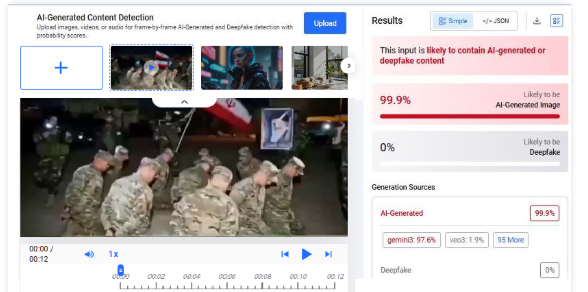
To confirm this suspicion, we analyzed the clip using multiple AI detection tools. The tool Hive Moderation indicated a 99% probability that the video was created using artificial intelligence.
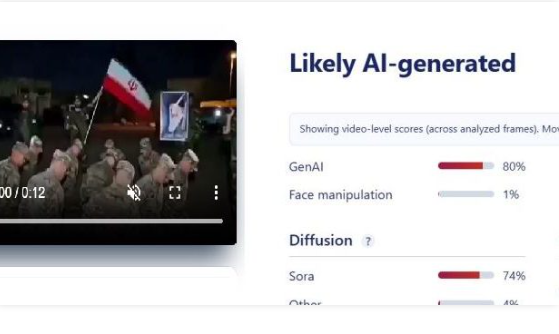
Further analysis using Sightengine also suggested that the video was likely AI-generated, estimating an 80% probability of AI creation.
Conclusion
Our research shows that the viral video claiming to depict American soldiers surrendering and being captured by Iranian forces is fake. The footage has been generated using AI and does not represent a real incident.

Introduction
The global food industry is vast and complex, influencing consumer behaviour, policy, and health outcomes worldwide. However, misinformation within this sector is pervasive, with significant consequences for public health and market dynamics. Misinformation can arise from various sources, including misleading marketing campaigns, unsubstantiated health claims, and misrepresentation of food production practices through public endorsement or otherwise. Nutrition misinformation is one such example. The promotion of false or unproven products for profit can lead to mislead consumers and affect their interests. Misleading claims and inaccurate information about the nutritional value of food products and processes are common claims. The misinformation created about food on the global stage distorts public understanding of nutrition, food safety, and environmental impacts, leading to significant consequences for public health, consumer trust, and the economy.
Rise of Nutritional Misinformation and Consumer Distrust
Health and nutrition-related misinformation is one of the most prevalent types in the food sector. Businesses frequently advertise their products as "natural" or "healthy" without providing sufficient data to back up these claims, tricking customers into buying goods that might be heavy in fat, sugar, or salt. Words like "superfood" are frequently used without supporting evidence from science, giving the impression that they are healthier.
Misinformation also impacts the sustainability and ethics of food production. Claims of "sustainable" or "ethical" sourcing are frequently exaggerated or fabricated, leaving consumers unaware of the true environmental and social costs associated with certain products.
This lack of clarity is not only observed in general food trends but also within organisations meant to provide trustworthy information. There has been significant criticism, directed at the International Food Information Council (IFIC), for their alleged promotion of nutrition-based misinformation to safeguard the interests of large food corporations, resulting in potentially compromising public health. The preemptive claims that IFIC made about the nutritive claims have been questioned by the National Institutes of Health, USA in November 2022. They reported in their study that IFIC promotes food and beverage company interests and undermines the accurate dissemination of scientific evidence related to diet and health. This was in support of the objective of the study, which was to determine whether, there have been many claims that the nutritional value of certain foods or diets may be manipulated to favour business goals, leaving consumers misinformed about what constitutes a truly healthy diet.
Another source of misinformation is the growing ‘Free-From’ fad. The “free-from” label in the US is a food category of products that claim to be free from certain ingredients or chemicals. It has been steadily growing by 7% annually. These labels often tout products as healthier due to a simpler ingredient list. Although seemingly harmless, transparency in ingredient disclosure is often obscured in the 'free-from' trend. This can lead to consumer distrust in the long run, making them hesitant.
The Harmful Effects of Food Misinformation
The effects of misinformation about nutrition and food safety can directly affect public health.
Consumers unknowingly may accept false claims or avoid certain foods without scientific basis and adopt harmful dietary habits, potentially leading to malnutrition or other health problems. By the time the realisation sets in about being misled, their trust is eroded not only towards such companies but also towards the regulators. This distrust can lead to declining consumer confidence and disrupt market stability.
Some food-related misinformation downplays the environmental impact that certain food production practices have. An example of such a situation is the promotion of meat alternatives as being entirely eco-friendly without considering all environmental factors. This can mislead consumers and obscure the complex environmental effects of food production systems.
Misinformation can distort consumer purchasing habits, potentially leading to a reduced demand for certain products and unfair competition. The sufferers in this case are the small-scale producers who suffer disproportionately, while the large corporations might use this misinformation to maintain their dominance in the market. Regulatory checks, open communication, and public education campaigns are needed to combat mis/disinformation in the global food sector and enable consumers to make decisions that are sustainable, healthful and informed.
CyberPeace Recommendations
- Unfair trade practices like providing misleading information or unchecked claims on food products should be better addressed by the regulators. Companies must provide clear, transparent and accurate information about their products as mandated under the Food Safety and Standards (Advertising and Claims) Regulations, 2018. This information should include the true origins, production methods, and nutritional content on their labels.
- Promotions of initiatives and investments by public health organisations and food authorities towards educating consumers and improving food literacy should encouraged.
- Regulating social media endorsement is also crucial to prevent the spread of misinformation and unchecked claims. Without proper due diligence on product details, influencers may unknowingly mislead their audience, causing potential harm.
- The Social Media Platforms can partner with nutritionists, dietitians, and other health professionals who are content creators, as they can help in understanding and promoting accurate, science-based nutrition information and debunk any misleading claims.
- Campaigns should be encouraged to spread public awareness about the harms of food-related misleading claims or trends. Emphasis should be on evidence-based nutritional guidance. The ongoing research towards food safety, nutrition, and true information should be actively communicated to keep the public informed. Combating food misinformation requires more robust regulations, improved transparency, and heightened consumer awareness and vigilance.
References
- https://timesofindia.indiatimes.com/india/label-claims-on-packaged-food-could-be-misleading-icmr/articleshow/110053363.cms
- https://www.outlookindia.com/hub4business/empowering-change-freedom-food-alliance-takes-on-global-food-industry-misinformation
- https://insightsnow.com/misinformation-hurting-food-business/
- https://www.ncbi.nlm.nih.gov/pmc/articles/PMC9618198/pdf/12992_2022_Article_884.pdf
