
Left Behind or Sold Out: India's Public Schools Face an AI Trap
Introduction
India's education system faces a sharp policy bind, where both inaction and rushed adoption hurt government school students. Holding back leaves them without sought-after digital skills, while deploying AI prematurely into under-resourced classrooms creates fresh harms. Either the state lags in implementing AI and fails to equip its students with sought-after competencies or it naively deploys AI to poorly equipped government schools. Internalised AI is already commonplace at private institutions. Simultaneously, government schools are battling with even basic connectivity. There are therefore four key areas of failure that overlap within the classroom; the growing digital divide, fundamental educational shortfalls, a lack of oversight in the grey area of India's data legislation and persistent gender disparity.
Infrastructural Gaps and the role of EdTech Matthew Effect
Private schools are already integrating generative AI organically through existing smart classrooms, home broadband access, and AI-enabled tutoring and writing tools, while government schools lack infrastructure for absorption, leading to EdTech Matthew Effect (the rich get richer and the poor get poorer), therefore if the state restricts introduction of AI in class rooms, government school will become increasingly obsolete given the skill market. MIT learning scientist Justin Reich coined the EdTech Matthew Effect to describe how new classroom tools consistently widen existing achievement gaps rather than closing them. UDISE+ 2025–26 records 24.72 crore students across 14.67 lakh schools with a 24:1 PTR, but secondary dropout sits at 9.5% and only 67.4% of schools have internet. While well-funded private schools increasingly use advanced AI tools in daily learning, most under-resourced rural government schools lack the hardware and connectivity to participate.
Conversely, if AI is rushed into classes, there is a higher risk of cognitive offloading given there is already a within-grade learning variability (eg. Grade 8 student performs at a Grade 4 math level,). In fact, 54.2 percent of rural Class 8 pupils are still unable to complete a basic Class 4 division question (ASER 2024). Economists Lant Pritchett and Amanda Beatty demonstrated that instructing pupils who have not adequately grasped basic concepts using sophisticated teaching technology does not result in effective learning. Subsequently, pupils engage in cognitive offloading - relying on technology to avoid exerting their own cognitive capacity in order to develop key memory systems. A controlled study undertaken at a US high school evidenced this trend. Students utilising an open-access GPT-4 bot attained 48 percent better results on practice papers but performed 17 percent worse than non-AI users on in-class, closed book assessments post-removal of the bot.
Girls face an even steeper barrier. Among 14-to-16-year-olds, 36 percent of boys own a smartphone compared to just 27 percent of girls, meaning female students rely far more on supervised school access to learn technology (ASER 2024). Even when a rural household owns a shared phone, families often monitor girls' screen time and restrict their usage in ways boys rarely experience. Girls have few safe spaces outside school to experiment with digital tools. If government schools either ban AI outright or leave access unguided outside class hours, girls lose their only structured, secure environment to build these skills.
Lastly given that Section 9 of DPDP Act, scheduled to come into force on May 13, 2027, EdTech vendors aggressively exploit this lag to lock schools into their ecosystems, map student profiles, and harvest behavioral training data before heavy statutory penalties become enforceable, as schools also prefer license free modals to reduce costs, creating a problem for the data protection front for children. They seek to entrench themselves within schools, analyse and profile pupils, and collect behavioural learning information prior to the commencement of stringent legal repercussions. Simultaneously, financially constrained state schools are highly motivated to participate in free trials of EdTech solutions so as to economise. Consequently, they unwittingly surrender valuable information including pupils' typing, response delay and error data. Significantly,Under Section 1(2) of the Digital Personal Data Protection Act, 2023, provisions take effect in phases through Central Government notifications. Following the notification of the DPDP Rules, an 18-month transition window pushes Section 9's enforcement to May 13, 2027. Until that date, obligations requiring verifiable parental consent, bans on behavioral tracking of children, and Data Protection Board penalties of up to ₹200 crore remain legally inactive.
Both free apps and testing platforms allow companies to obtain individuals' mobile numbers and recognise areas of educational underperformance. Following extensive parent petitions, the National Commission for Protection of Child Rights (NCPCR) in December 2022 convened a meeting with the CEO of EdTech provider BYJU'S, Byju Raveendran, regarding allegations that the firm had accessed children's mobile data and adopted aggressive sales methods to encourage parents to subscribe to costly services. BYJU'S categorically stated that it had never purchased student data. Moreover, even absent third party data middlemen, free EdTech apps automatically record pupils' test results, video viewing history and parents' mobile details within internal analysis tools. Sales personnel can then precisely identify households sufficiently concerned about their child's educational performance to subscribe to premium services. Generative AI platforms intensify this information extraction process, converting all classroom prompts into proprietary training material.
Conclusion
India's public school system cannot afford policy paralysis or a reckless rush into generative AI. Excluding AI entirely widens the skill gap between private and government school students. Yet rolling out unlicensed commercial chatbots without guardrails accelerates cognitive offloading, deepens gender disparities, and exposes millions of children to behavioral profiling ahead of the May 13, 2027 DPDP enforcement deadline. Unless policymakers address all four pressures together—infrastructure readiness, foundational learning, equitable access for girls, and strict child data protection—government schools will stay trapped between technological obsolescence and commercial exploitation.
References
- https://www.erudit.org/en/journals/jtl/2022-v16-n1-jtl06989/1088957ar.pdf
- https://www.dpdpa.com/dpdpa2023/chapter-2/section9.html
- https://www.meity.gov.in/static/uploads/2024/06/2bf1f0e9f04e6fb4f8fef35e82c42aa5.pdf
- https://asercentre.org/aser-2024/
- https://www.gsma.com/gender-gap-2024/
- https://www.ndtv.com/india-news/byjus-target-phone-numbers-of-kids-threatens-parents-child-rights-body-3624864

Related Blogs

Executive Summary
A video is being shared on social media showing a little girl crying while holding onto a pole amid muddy water covering a road. The video is being shared with the claim that it shows the situation during the recent floods in Nepal. A research by CyberPeace’s Research Wing found the viral claim to be false. Our research revealed that the viral video is AI-generated and is being shared with a misleading claim.
Claim:
A user on the social media platform Instagram shared the viral video with the caption: “The situation in Nepal looks extremely frightening after the floods. Floodwater has covered the area, and the frightened face of a little girl amid the water is moving everyone emotionally. Seeing the innocent girl’s condition in this difficult situation has raised concerns among people.”
https://www.instagram.com/reels/DctRY9OF0Th/

Fact Check
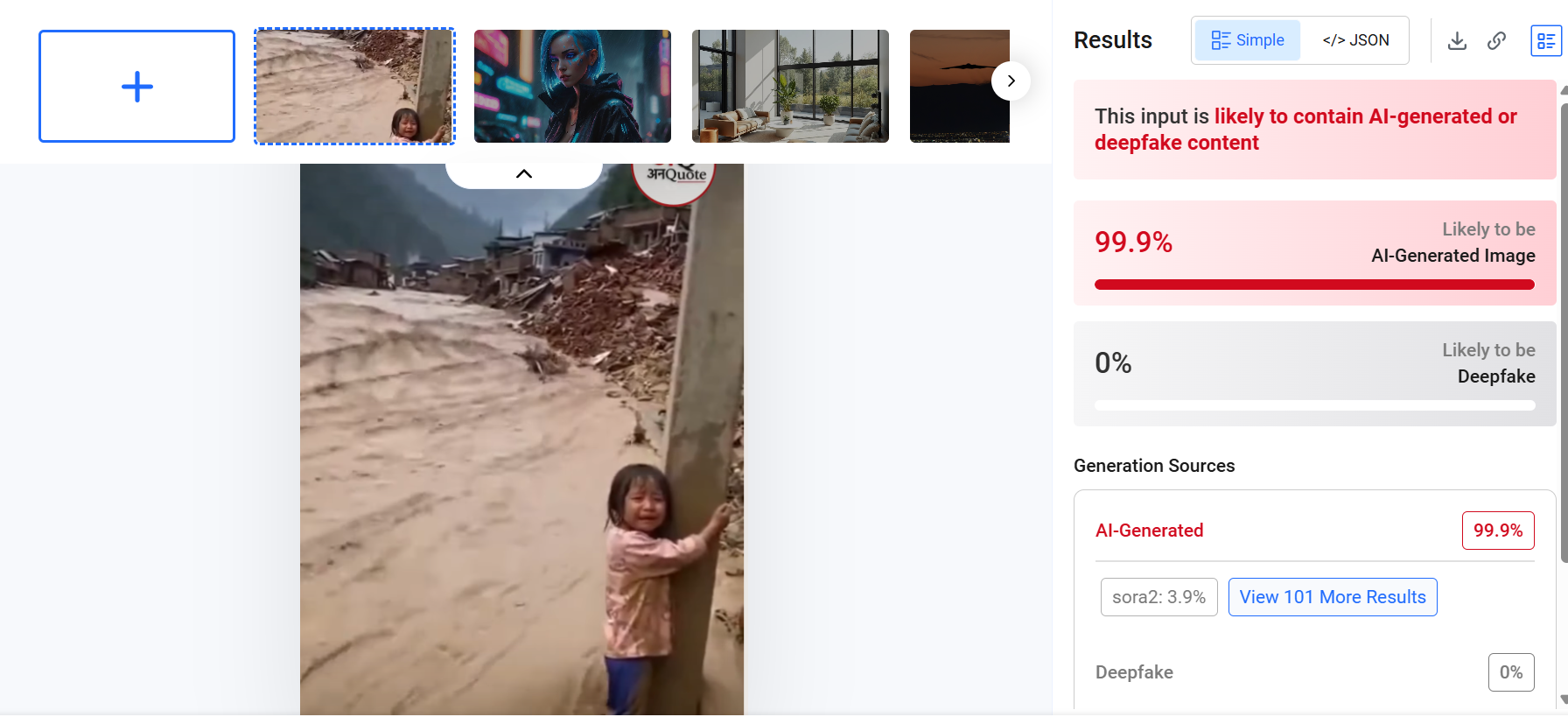
A reverse image search of keyframes from the viral video on Google did not yield any credible media reports related to the video. Upon closely examining the viral video, we suspected that it might be AI-generated. We subsequently scanned the video using the AI detection tool Hive Moderation. According to the results, the video has a 99 percent probability of being AI-generated.
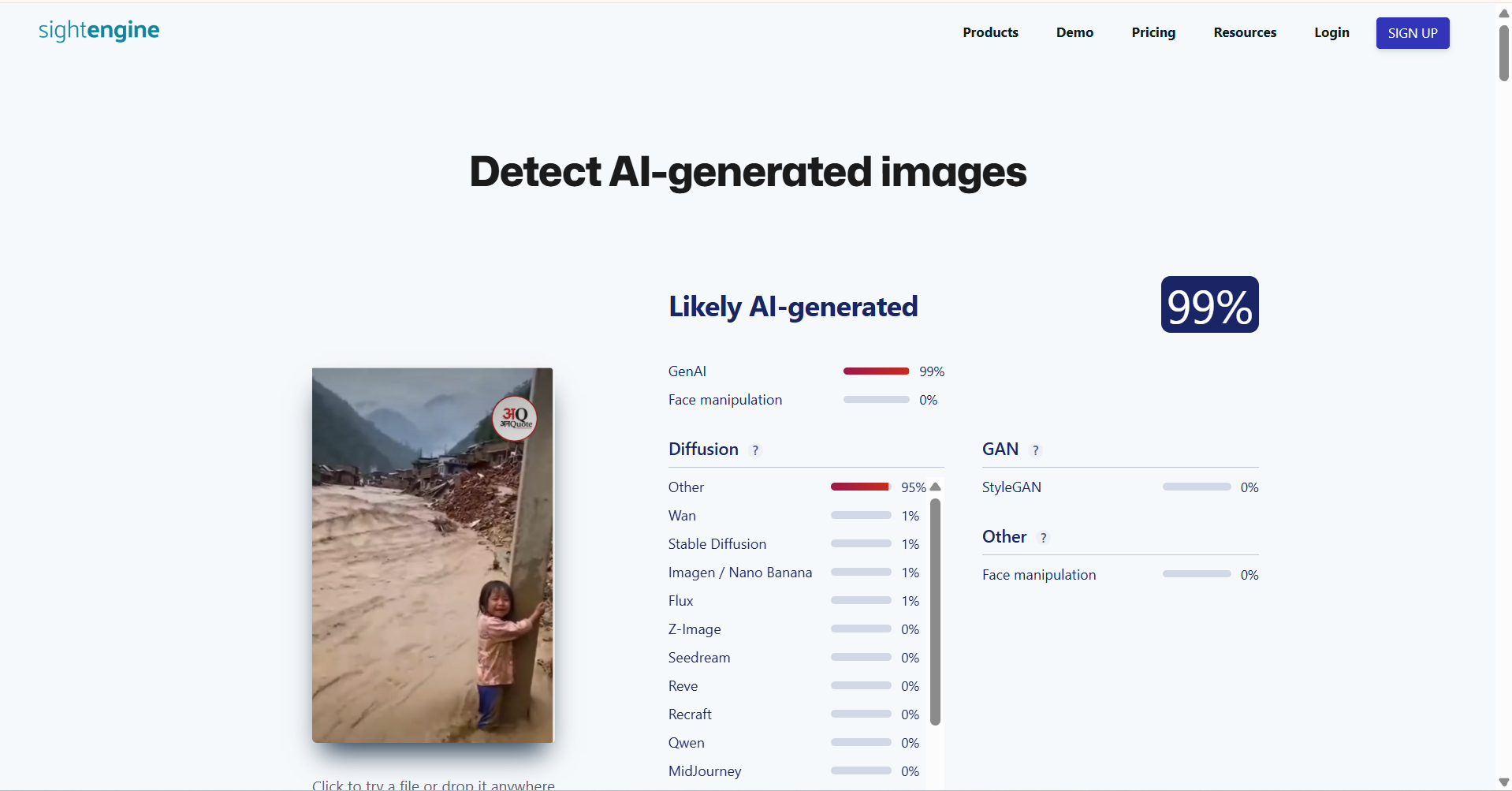
As part of the next step of ourresearch, we scanned the viral video using another AI detection tool, Sightengine. According to the results, the video has a 99 percent probability of being AI-generated.
Conclusion
Our research found that the viral video is AI-generated and is being shared with a misleading claim.
Executive Summary
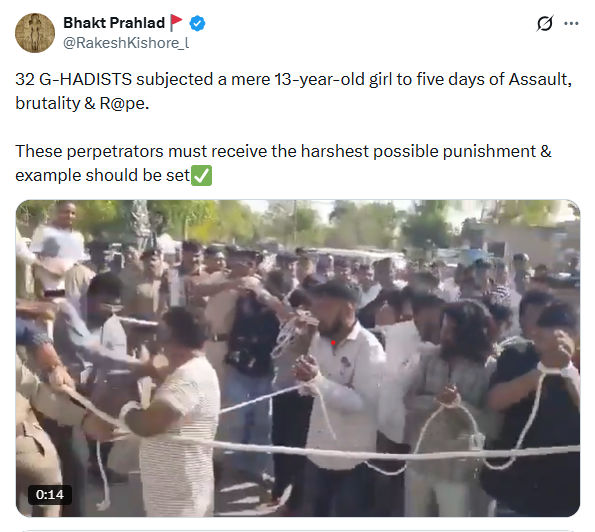
Amid nationwide outrage over the gang-rape of a 13-year-old minor in Sriganganagar, Rajasthan, a video is circulating on social media. The clip shows police officers tying the hands of several accused individuals and parading them publicly on the streets. Users sharing the video claim that these are the culprits from the Sriganganagar case being beaten by the police.
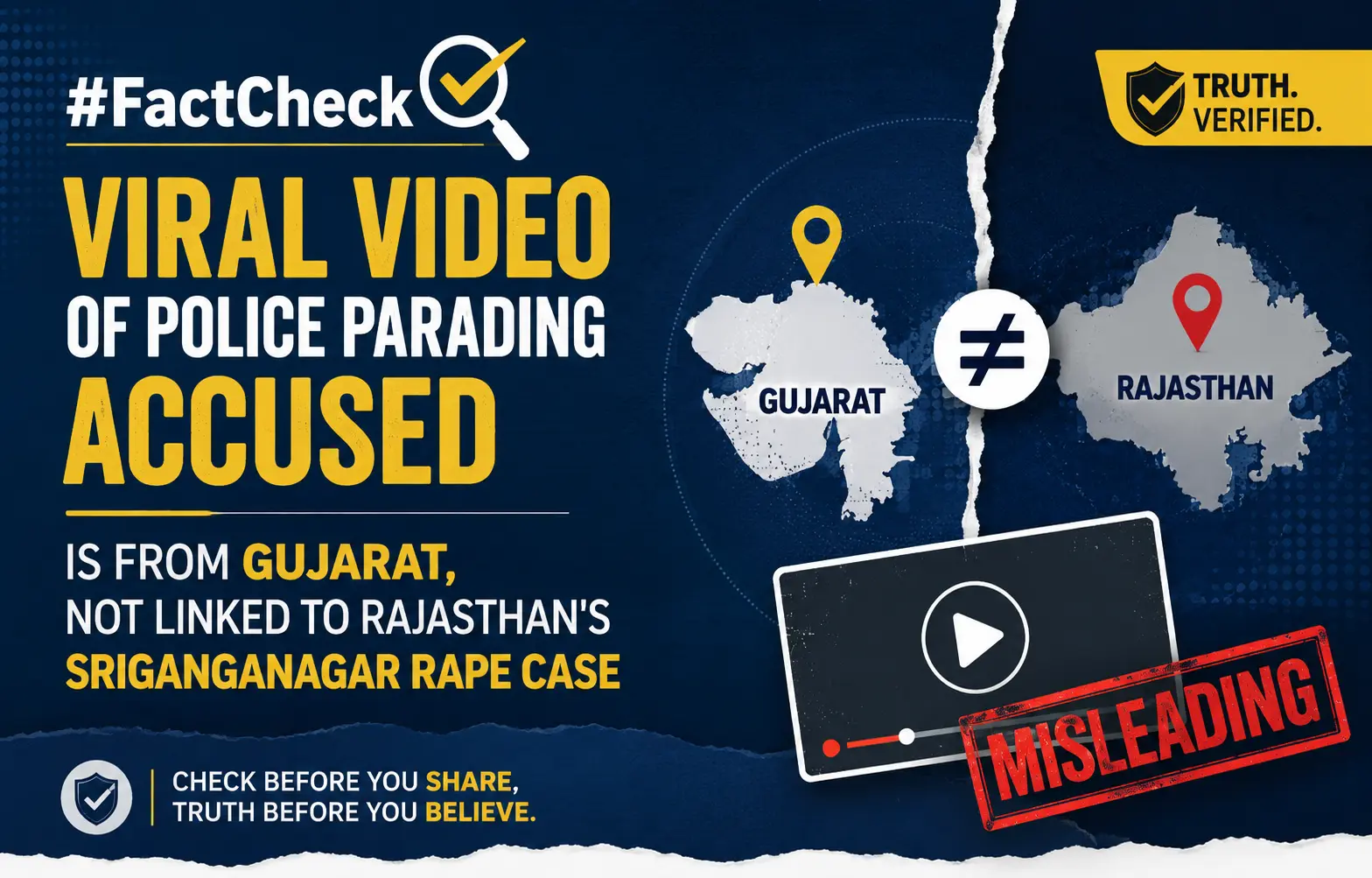
A fact-check by the CyberPeace Research Wing found this claim to be misleading. The viral video has no connection to the Rajasthan incident; it actually depicts a separate event from Patan, Gujarat, dating back to March 2026.
The Claim
On July 7, 2026, a user on X (formerly Twitter) shared the video with the caption: "32 jihadis assaulted, brutalized, and raped a 13-year-old girl for five days. These criminals must get the harshest punishment to set an example."
https://x.com/RakeshKishore_l/status/2074400280352084129
Fact Check
To verify the viral claim, keyframes from the video were extracted and analysed using Google Lens for reverse image search. During the research, we found a report published by NDTV on March 19, 2026, which carried visuals matching the viral video. The report link and screenshot are provided below:
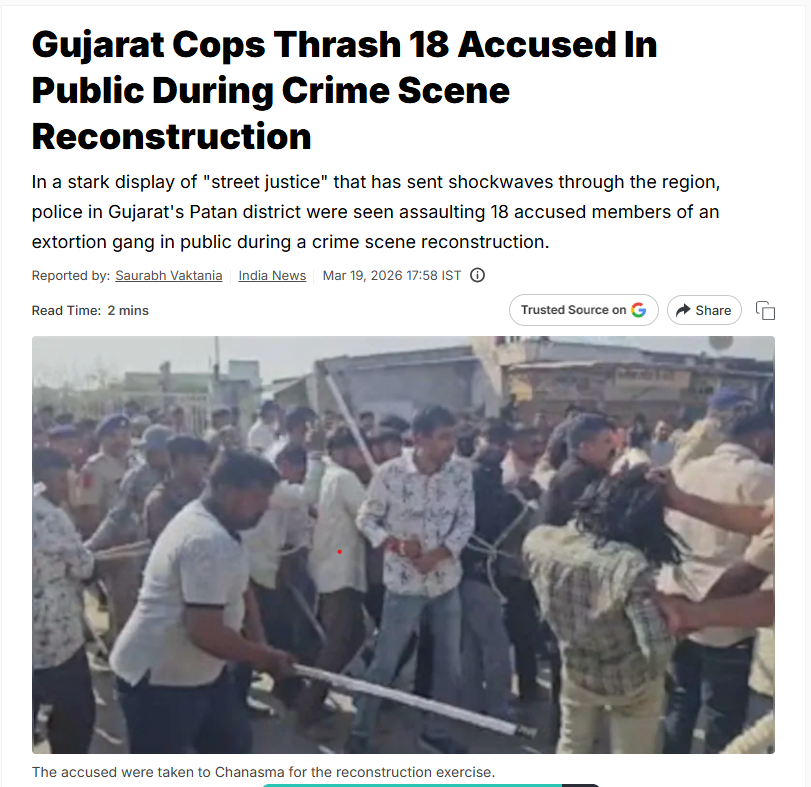
According to the NDTV report, a video showing police personnel publicly assaulting 18 alleged accused persons in Gujarat’s Patan district had surfaced. The incident was reported to have taken place during a crime scene reconstruction exercise.
The report stated that the accused, allegedly linked to an extortion gang, were taken to Chanasma for the reconstruction process. During the exercise, police personnel were seen assaulting them. Witnesses claimed that the accused were paraded through areas where they had allegedly created fear among locals.
The accused were reportedly linked to the alleged Jhiliya gang. The incident occurred days after a violent clash in which members of the same group allegedly attacked a police team, forcing officers to retreat from the spot.
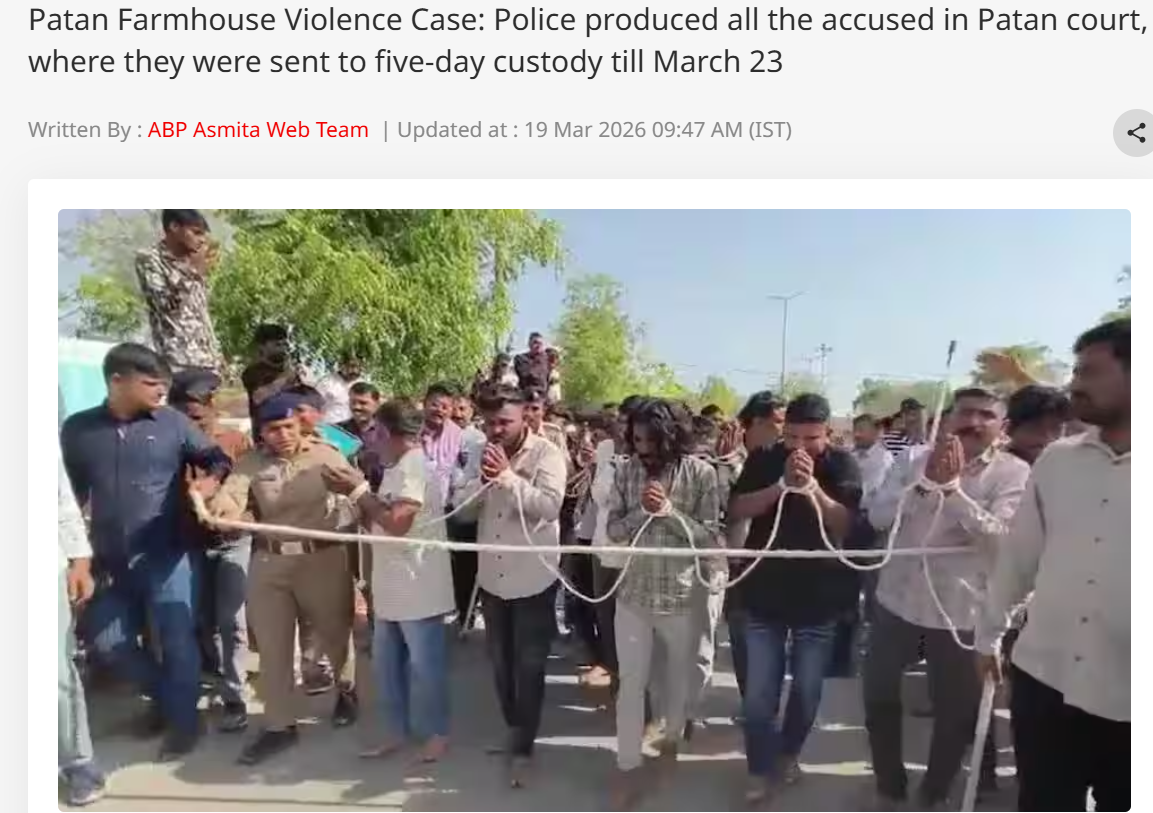
During further research, we found a report published by ABP Asmita on March 19, 2026. According to the report, the incident was linked to an old dispute over temple donations.
The report stated that the accused were produced before a court, which sent them to five days of police custody until March 23, 2026. The report link and screenshot are provided below:
Conclusion
The research found that the viral video is not related to the alleged gang rape case in Sri Ganganagar, Rajasthan. The video is being shared with a false context. The footage actually belongs to a separate incident from Gujarat’s Patan district reported in March 2026.

Introduction
We were all stunned and taken aback when multiple photos of streets in the U.S. surfaced with heavily drugged individuals loosely sitting on the streets, victims of a systematically led drug operation that has recently become a target of the Trump-led “tariff” war, which he terms as a war on drug cartels. The drug is a synthetic opioid, fentanyl, which is highly powerful and addictive. The menace of this drug is found in a country that has Wall Street and the largest and most powerful economy globally. The serious implications of drug abuse are not about a certain economy; instead, it has huge costs to society in general. The estimated cost of substance misuse to society is more than $820 billion each year and is expected to continue rising.
On June 26, the International Day against Drug Abuse and Illicit Trafficking is observed globally. However, this war is waged daily for millions of people, not on streets or borders, but in bloodstreams, behind locked doors, and inside broken homes. Drug abuse is no longer a health crisis; it is a developmental crisis. The United Nations Office on Drugs and Crime has launched a campaign against this organised crime that says, “Break the Cycle’ attributing to the fact that de-addiction is hard for individuals.
The Evolving Drug Crisis: From Alleyways to Algorithms
The menace of Drug abuse and illicit trafficking has also taken strides in advancement, and what was once considered a street-side vice has made its way online in a faceless, encrypted, and algorithmically optimised sense. The online drug cartels operate in the shadows and often hide in plain sight, taking advantage of the privacy designed to benefit individuals. With the help of darknet markets, cryptocurrency, and anonymised logistics, the drug trade has transformed into a transnational, tech-enabled industry on a global scale. In an operation led by the U.S. Department of Justice’s Joint Criminal Opiod and Darknet Enforcement (JCODE) and related to Operation RapTor, an LA apartment was only to find an organised business centre that operated as a hub of one of the most prolific methamphetamine and cocaine distributors in the market. Aaron Pinder, Unit Chief of the FBI Hi-Tech Organised Crime Unit, said in his interview, “The darknet vendors that we investigate, they truly operate on a global scale.” On January 11, 2025, during the Regional Conference on “Drug Trafficking and National Security,” it was acknowledged how cryptocurrency, the dark web, online marketplaces, and drones have made drug trafficking a faceless crime. Reportedly, there has been a seven-fold increase in the drugs seized from 2004-14 to 2014-24.
India’s Response: Bridging Borders, Policing Bytes
India has been historically vulnerable due to its geostrategic placement between the Golden Crescent (Afghanistan-Iran-Pakistan) and Golden Triangle (Myanmar-Laos-Thailand), and confronts a fresh danger from “click-to-consume’ narcotics. Although India has always adopted a highly sensitised approach, it holds an optimistic future outlook for the youth. Last year, to commemorate the occasion of International Day against Drug Abuse and Illicit Trafficking, the Department of Social Justice & Empowerment organised a programme to engage individuals for the cause. The Indian authorities are often seen coming down heavily on the drug peddlers and cartels, and to aid the cause, the Home Minister Amit Shah inaugurated the new office complex of the NCB’s Bhopal zonal unit and extension of the MANAS-2 helpline to all 36 states and UTs. The primary objectives of this step are to evaluate the effectiveness of the Narcotics Coordination Mechanism (NCORD), assess the progress of states in fighting drug trafficking, and share real-time information from the National Narcotics Helpline ‘MANAS’ portal with the Anti-Narcotics Task Force (ANTF) of states and UTs.
The United Nation’s War on Narcotics: From Treaties to Technology
The United Nations Office on Drugs and Crime (UNODC) is leading the international response. It offers vital data, early warning systems, and technical support to the states fighting the drug problem. The UNODC incorporates cooperation in cross-border intelligence, overseeing the darknet activities, encouraging the treatment and harm reduction, and using anti-money laundering mechanisms to stop financial flows. India has always pledged its support to the UN led activities, and as per reports dated 26th March, 2025, India chaired the prestigious UN-backed Commission on Narcotic Drugs (CND) meeting held in vienna, wherein India highlighted the importance of opioids for medical purposes as well as the nation’s notable advancements in the field.
Resolution on June 26: From Commemoration to Commitment
Let June 26 be more than a date on the calendar- let it echo as a call to action, a day when awareness transforms into action, and resolve becomes resistance. On this day, CyberPeace resolves the following:
- To treat addicts as victims rather than criminals and to pitch for reforms to provide access to reasonably priced, stigma-free rehabilitation.
- To integrate anti-drug awareness into digital literacy initiatives and school curricula in order to teach frequently and early.
- To demand responsibility and accountability from online marketplaces and delivery services that unwittingly aid traffickers
- To tackle the demand side through employment, mental health services, and social protection, particularly for at-risk youth.
References
- https://www.gatewayfoundation.org/blog/cost-of-drug-addiction/#:~:text=The%20estimated%20cost%20for%20substance,Alcohol%3A%20%24249%20billion
- https://www.unodc.org/unodc/en/drugs/index-new.html
- https://www.fbi.gov/news/stories/global-operation-targets-darknet-drug-trafficking
- https://www.thehindu.com/news/national/dark-web-crypto-drones-emerge-as-challenges-in-fight-against-drug-trafficking-amit-shah/article69088383.ece
- https://www.pib.gov.in/PressReleaseIframePage.aspx?PRID=2028704
- https://www.newindianexpress.com/nation/2025/Mar/26/in-a-first-india-chairs-un-forum-on-narcotics-pledges-to-improve-access-to-pain-relief-and-palliative-care
