
India Raises the Alarm -How AI is rewiring the Cyber Threat Landscape
Introduction
The advent of frontier AI has significantly widened the range of actors who can launch cyberattacks, extending beyond state actors with immense capabilities or organized professional cybercriminal rings. In its most critical advisory, CIAD-2026-0020, titled "Defending against frontier AI-driven cyber risks," which was released on April 26, 2026, the Indian Computer Emergency Response Team (CERT-In) officially stated that AI can now carry out autonomous cyber activities of unprecedented scale and speed. The advisory highlights that these frontier AI models can perform automated reconnaissance, phishing, malware creation, vulnerability identification, and social engineering with minimal human involvement, thus "lowering the barrier to orchestrating complex cyber attacks." The risks that such AI models pose are not restricted to state actors and corporate entities anymore and also extend to MSMEs, public organizations, and individuals.
India’s Escalating Cybercrisis
The Indian digital economy has been developing at a very fast pace, but the same cannot be said about its cybersecurity. Having a base of over 850 million internet users and a digital payment sector that records a massive 22,495 crore in monthly transaction volumes, coupled with the fastest-growing cloud sector in the world, India continues to remain a lucrative prey for cybercriminals. There were over 265 million attempts reported in the last year, 2025, alone, where close to 46% of all incidents detected were in enterprises with fewer than 1,000 employees, a very grave reality for MSMEs. MHA confirmed there were 28.15 lakh reported cybercrime complaints in 2025 as compared to 2024, with a jump of 24%. In this worsening environment the advisory is a breakthrough in Indian cyber governance. Where previously advisories covered only conventional threats like phishing and malware, the new warning names frontier agentic AI systems as autonomous multipliers of threats, capable of conducting operations at scale and speed with significantly reduced human oversight.
What is “Frontier AI” and why does it matter?
CERT-In’s decision to adopt the term "Frontier AI" is deliberate and meaningful. The advisory’s scope is a new category of agentic AI, which moves well beyond traditional chatbot-style AI, having the capacity to reason, plan, perform multiple actions in a single task autonomously, and carry out complicated tasks with minimal or no human guidance. CERT-In highlights that these tools now possess the capabilities that were "previously carried out by a coordinated team of skilled cybersecurity professionals." The advisory clearly flags the risk that these advanced models have the capability to generate malicious code, conduct network scans, probe systems for vulnerabilities, and even orchestrate intricate multi-stage cyberattacks in a single session. Their capacity to analyse a vast number of source code libraries to identify vulnerabilities, even unknown zero-day ones, and then develop proof-of-concept exploits at high speed. This means that the historical lead time to turn a vulnerability discovery into an exploit tool has reduced from weeks to just hours.
Six Core Threat Vectors identified by CERT-In
- AI-driven Automatic Zero-Day Discovery: AI-based solutions discover zero-day vulnerabilities and automatically create exploits in minutes, reducing the time taken by defenders.
- AI-driven Autonomous Reconnaissance: AI-driven agents scan cloud infra, APIs, and enterprise networks and outline attack vectors.
- AI-driven phishing & deepfakes: Multilingual, highly targeted phishing emails, deepfake audio, and deepfake voice/video calls bring sophistication to social engineering.
- Deepfake Financial Fraud: AI creates deepfake executives for high-value money transfers. For example, reports have indicated crore-level fund loss cases in India.
- AI-powered Autonomous Attack Chains: Advanced AI models are able to automatically perform multiple malicious stages like privilege escalation, lateral movement, data exfiltration, and data extraction.
- Cascading failures of interconnected systems: A single AI-supported security breach can have catastrophic domino effects on connected digital systems and critical infrastructures.
Why are MSMEs a target?
CERT-In’s warning is specifically targeted toward the weakness of the Indian MSMEs. Contributing almost 30% to India's GDP and employing over 110 million individuals, most MSMEs have failed to adequately prepare themselves against contemporary cyber threats. While a large corporation would have a full-time cybersecurity team, a security operation centre, and frequent vulnerability assessments, the majority of MSMEs lack such infrastructure due to budget constraints, out-of-date software, etc. This lack of security has proved to be quite disadvantageous for smaller businesses, as India was identified as one of the top global targets for cyberattacks, where approximately 46% of the total breaches worldwide targeted organizations having fewer than 1000 employees. The advisory claims that frontier AI systems have significantly increased the threats, for the skills necessary to carry out advanced cyberattacks have dramatically decreased. Ransomware, phishing and data exfiltration can be executed by even unsophisticated attackers. The aftermath could result in critical financial, operational, and compliance impact on these MSMEs.
The Global Context
These developments seem to validate CERT-In's warning about threats posed by frontier AI. In its 2026 State of Cybersecurity Report, ISACA listed AI-related threats as the top concern of cybersecurity professionals; 61% of those surveyed reported generative AI/large language models as the top technology trend impacting cyber risk. Worryingly, in 2026 only 7% were confident in their organizations' defenses against ransomware. Check Point Software's Cyber Security Report 2026 corroborates this; in 2025 the report stated that in a single year, the trend of combined social engineering-based campaigns with automated operational execution has risen considerably. In all phases of the lifecycle of a cyberattack reconnaissance, social engineering, and tactical decision-making AI is being applied. KPMG is warning of deepfake-enabled fraud now "spreading at a faster rate than that experienced at the beginning of the phishing era, which is currently still the leading type of attack in the world."
CERT-In Recommendations
For Large Organisations:
- The use of security monitoring, threat detection, and log analysis should be increased.
- DDoS protection systems and multi-factor authentication (MFA) should be implemented on all internet-facing devices and assets.
- Critical security patches should be installed within 24 hours of release.
- Old VPN and remote-access infrastructure should be updated or replaced.
- AI-driven cyber drills and incident response simulations should be regularly performed.
For MSMEs:
- Software and security updates should be automatically enabled on all devices and systems.
- MFA should be enabled on organisational accounts and sensitive platforms.
- MSMEs should utilize MSSPs for specialized support and monitoring.
- Detailed inventories of IT assets and system logs should be kept for fast incident response.
- Staff should be educated about identifying AI-generated phishing, deepfakes, and scams.
For Individuals:
- Independent communication channels should be used to verify any dubious message or money request.
- Software from unverified sources or unauthorised channels should not be downloaded.
- The use of strong and unique passwords along with MFA wherever possible should be enforced.
From Advisory to Action
The May 2026 cybersecurity road map released by CERT-In signals a departure from identification of threats to enabling operations against frontier AI-led cyber threat landscapes. This initiative builds on their April advice and delineates a clearly articulated three-phase roadmap comprising immediate cyber readiness, AI governance controls, and deep integration of AI-driven defenses. It also provides for the establishment of a focused AI Cyber Defense Center and various multisector governance provisions. A prominent area is the increased threat of impersonation via deepfakes, and companies are encouraged to institute executive verification procedures prior to approving high-value transactions. The framework also emphasizes the establishment of an AI asset register requiring formal accounting and governance of all AI systems utilized in an enterprise. Meanwhile, CERT-In also recognizes the twin-use nature of frontier AI: for every threat, the same technology can bolster security with automated threat detection, phishing, and log analysis in real time. However, the deployment of state-of-the-art defenses is uneven, especially with MSMEs, where there isn’t the requisite domain expertise and funding for this infrastructure. Accordingly, the road map puts the emphasis on immediate and stronger cyber hygiene, compulsory incident reporting, enhancing AI literacy, and proper implementation of the Digital Personal Data Protection Act for long-term security investment and resilience.
Conclusion
The CERT-In advisory CIAD-2026-0020 signifies a vital acknowledgment of AI's transformational impact on the cybersecurity ecosystem. Capabilities formerly exclusive to elite state actors are being deployed by low-skilled users, leveraging state-of-the-art frontier AI tools. India’s MSMEs, enterprises, and digital citizens are experiencing a rapidly accelerating threat milieu. In this context, the CERT-In advisory and the ensuing blueprint can no longer be dismissed as ordinary government pronouncements but as critical operational imperatives. It is the country’s ability over the next few years to shore up its collective cyber resilience to the ever-increasing scale and sophistication of AI-powered attacks that will prove crucial.
References:
- https://www.cert-in.org.in/s2cMainServlet?pageid=PUBVLNOTES02&VLCODE=CIAD-2026-0020
- https://www.zeebiz.com/technology/news-cert-in-flags-high-severity-ai-cyber-risks-amid-claude-mythos-concerns-394448
- https://www.business-standard.com/technology/tech-news/cert-in-warning-ai-scams-frontier-models-mythos-gpt-5-5-what-it-means-126042800988_1.html
- https://www.businesswire.com/news/home/20251020612551/en/
- https://corporate.indiamart.com/2025/07/29/staying-ahead-of-cyber-threats/
- https://kpmg.com/kpmg-us/content/dam/kpmg/pdf/2025/deepfakes-real-threat.pdf

Related Blogs
Introduction
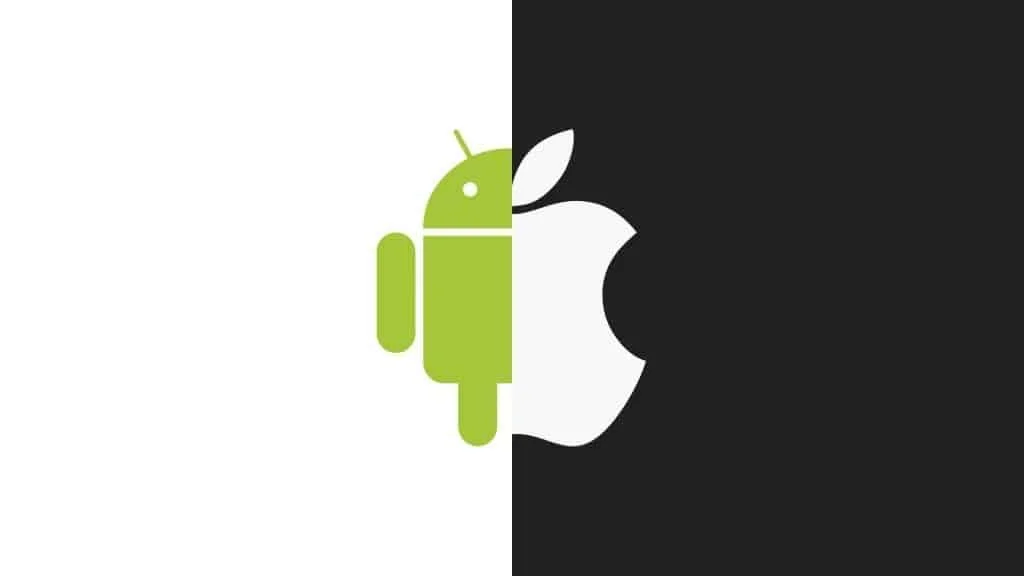
The world has been surfing the wave of technological advancements and innovations for the past decade, and it all pins down to one device – our mobile phone. For all mobile users, the primary choices of operating systems are Android and iOS. Android is an OS created by google in 2008 and is supported by most brands like – One+, Mi, OPPO, VIVO, Motorola, and many more and is one of the most used operating systems. iOS is an OS that was developed by Apple and was introduced in their first phone – The iPhone, in 2007. Both OS came into existence when mobile phone penetration was slow globally, and so the scope of expansion and advancements was always in favor of such operating systems.
The Evolution
iOS
Ever since the advent of the iPhone, iOS has seen many changes since 2007. The current version of iOs is iOS 16. However, in the course of creating new iOS and updating the old ones, Apple has come out with various advancements like the App Store, Touch ID & Face ID, Apple Music, Podcasts, Augmented reality, Contact exposure, and many more, which have later become part of features of Android phone as well. Apple is one of the oldest tech and gadget developers in the world, most of the devices manufactured by Apple have received global recognition, and hence Apple enjoys providing services to a huge global user base.
Android
The OS has been famous for using the software version names on the food items like – Pie, Oreo, Nougat, KitKat, Eclairs, etc. From Android 10 onwards, the new versions were demoted by number. The most recent Android OS is Android 13; this OS is known for its practicality and flexibility. In 2012 Android became the most popular operating system for mobile devices, surpassing Apple’s iOS, and as of 2020, about 75 percent of mobile devices run Android.
Android vs. iOS
1. USER INTERFACE
One of the most noticeable differences between Android and iPhone is their user interface. Android devices have a more customizable interface, with options to change the home screen, app icons, and overall theme. The iPhone, on the other hand, has a more uniform interface with less room for customization. Android allows users to customize their home screen by adding widgets and changing the layout of their app icons. This can be useful for people who want quick access to certain functions or information on their home screen. IOS does not have this feature, but it does allow users to organize their app icons into folders for easier navigation.
2. APP SELECTION
Another factor to consider when choosing between Android and iOS is the app selection. Both platforms have a wide range of apps available, but there are some differences to consider. Android has a larger selection of apps overall, including a larger selection of free apps. However, some popular apps, such as certain music streaming apps and games, may be released first or only available on iPhone. iOS also has a more curated app store, meaning that all apps must go through a review process before being accepted for download. This can result in a higher quality of apps overall, but it can also mean that it takes longer for new apps to become available on the platform. iPhone devices tend to have less processing power and RAM. But they are generally more efficient in their use of resources. This can result in longer battery life, but it may also mean that iPhones are slower at handling multiple tasks or running resource-intensive apps.
3. PERFORMANCE
When it comes to performance, both Android and iPhone have their own strengths and weaknesses. Android devices tend to have more processing power and RAM. This can make them faster and more capable of handling multiple tasks simultaneously. However, this can also lead to Android devices having shorter battery life compared to iPhones.
4. SECURITY
Security is an important consideration for any smartphone user, and Android and iPhone have their own measures to protect user data. Android devices are generally seen as being less secure than iPhones due to their open nature. Android allows users to install apps from sources other than the Google Play Store, which can increase the risk of downloading malicious apps. However, Android has made improvements in recent years to address this issue. Including the introduction of Google Play Protect, which scans apps for malware before they are downloaded. On the other hand, iPhone devices have a more closed ecosystem, with all apps required to go through Apple‘s review process before being available for download. This helps reduce the risk of downloading malicious apps, but it can also limit the platform’s flexibility.
Conclusion
The debate about the better OS has been going on for some time now, and it looks like it will get more comprehensive in the times to come, as netizens go deeper into cyberspace, they will get more aware and critical of their uses and demands, which will allow them to opt for the best OS for their convenience. Although the Andriod OS, due to its integration, stands more vulnerable to security threats as compared to iOS, no software is secure in today’s time, what is secure is its use and application hence the netizen and the platforms need to increase their awareness and knowledge to safeguard themselves and the wholesome cyberspace.

Executive Summary
A video circulating on social media claims that Iran’s new Supreme Leader Mojtaba Khamenei has passed away, with users attributing the claim to American sources. However, research by the CyberPeace found the claim to be false. Our research confirms that Mojtaba Khamenei is alive and in good health.
Claim
A Facebook user shared the viral video, claiming that Iran’s new Supreme Leader Mojtaba Khamenei had died.

Fact Check
To verify the claim, we conducted keyword searches on Google but found no credible media reports confirming his death. Further research led us to a report published on April 10, 2026, by ABP News. According to the report, amid discussions around a ceasefire, Mojtaba Khamenei issued a statement saying that Iran does not seek war with the United States or Israel, but as a nation, it must defend its rights.

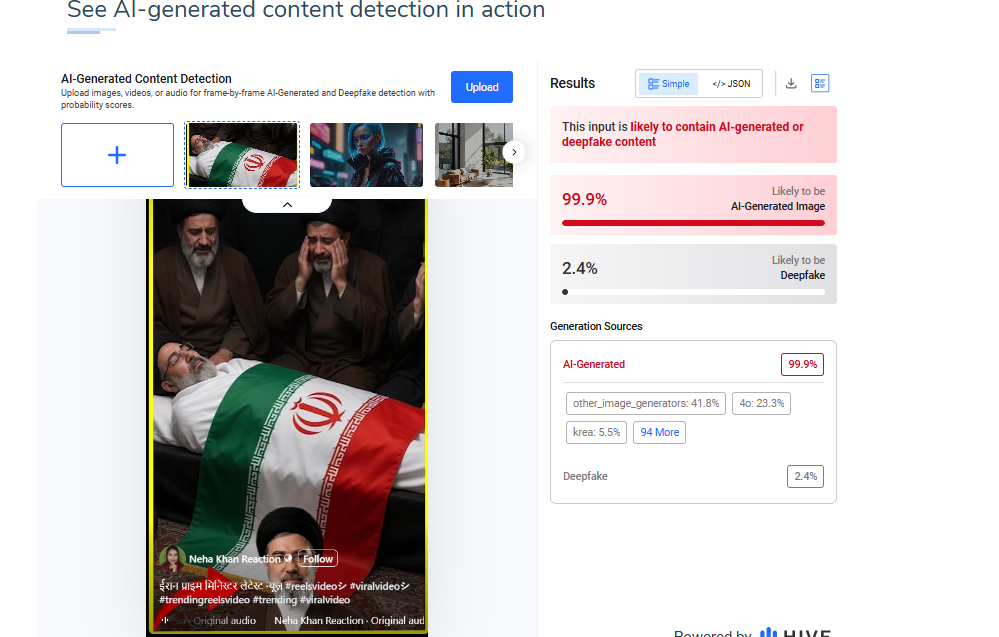
Additionally, the image used in the viral video was analyzed using the AI detection tool HIVE Moderation. The results indicated a 99% probability that the image is AI-generated.
Conclusion
The viral claim is false and misleading. There is no credible evidence to suggest that Mojtaba Khamenei has died. On the contrary, recent verified reports confirm that he is alive and has even issued public statements on ongoing geopolitical developments. The widespread circulation of this claim appears to be driven by misinformation, amplified through social media without verification. The use of AI-generated visuals further adds to the confusion, making the content appear authentic at first glance.
Introduction
The rapid rise of AI tools has reshaped how health content spreads on platforms like Instagram Reels and YouTube Shorts. These sub-minute videos promise quick fixes for weight loss, glowing skin, or reduced anxiety, often delivered through polished visuals and confident AI-generated voiceovers. The result feels highly personalised, as if the advice is tailored to each viewer, even though it is usually generic and widely recycled.
Short-form videos tend to compress complex health topics into “one tip” solutions, such as drinking a specific detox drink daily or following a single workout for rapid fat loss. While appealing, this oversimplification removes essential context, including individual health conditions, long-term risks, and scientific nuance. For example, viral diet trends or fitness hacks may work for some but can be ineffective or even harmful for others.
Algorithms play a major role in amplifying such content. Videos that promise dramatic transformations or instant results are more likely to gain engagement, which pushes them to wider audiences. Repeated exposure then builds familiarity, making the advice seem more credible over time. Audiences often trust this content due to its clean presentation, authoritative tone, and frequent repetition. However, the risks include misinformation, unrealistic expectations, and potential harm from unverified practices. To approach such content critically, viewers should cross-check claims with credible medical sources, avoid relying on single tip solutions, and remember that real health advice is rarely one size fits all.
The Illusion of Personalisation
AI-generated health content often mimics personalisation through:
- Synthetic voiceovers that designers created to match different age groups through their voice output, which speak specifically to people who are 20 years old and younger.
- The script development process uses data that tracks currently popular search terms.
- Viewers can interpret information through visual elements, which show changes between two different states.
The process of "personalisation" uses generalised data that does not match individual health profiles to create targeted results. The videos fail to provide a medical assessment because they do not consider:
- Existing medical conditions
- Hereditary differences
- Personal habits and the impact of surrounding conditions
The users will think that general medical advice applies to their personal health needs, which will lead them to use this advice inappropriately.
Short-Form Content and Oversimplification
Short-form videos have time limitations, which result in reduced complex medical information development into basic medical stories. The typical patterns of evaluation include these two patterns of evaluation include:
- “One-tip solutions” (e.g., “Drink this before bed to burn fat”)
- Binary framing (“good vs bad foods”)
- The process of eliminating all disclaimers and side effects information
For example, the three diet methods here the three diet methods here
- Viral detox drinks that make the claim to "flush toxins" from the body
- Extreme calorie-cutting diet hacks
- Fitness shortcuts that guarantee users will see results within days
The content demonstrates a pattern of disregarding essential human body operation rules that include both metabolic patterns and human body operation over extended periods of time.
Algorithmic Amplification and Virality
The recommendation algorithms used by Instagram and YouTube deliver their most important results through three main factors, which include:
- Engagement (likes, shares, watch time)
- Retention rates
- Emotional or aspirational triggers
Health-related content that claims to deliver:
- Immediate body changes
- Needs minimal work from viewers
- Results in extreme physical changes
Attractive health-related content that displays extreme physical changes through quick transformations. The system produces a continuous cycle during which:
- Misleading content gains traction
- Algorithms amplify it further
- More creators replicate similar formats using AI tools
The system produces a secondary result that favours content that people share instead of content that has authentic credibility.
Why Do Users Trust AI-Generated Health Content?
Several psychological and technological factors contribute to trust:
- Professional Aesthetics - AI tools generate high-quality visual content together with authentic voiceover performance and expert-level script documentation, which replicates professional communication methods.
- Repetition and Familiarity - When people encounter identical recommendations multiple times, their belief in those recommendations increases through the illusory truth effect.
- Authority Signals
- Medical terminology serves as a standard term
- Medical professionals appear in stock footage through lab coat visuals
- The narrator delivers information through an assertive speaking style
- Perceived Personal Relevance - Algorithmic targeting makes users feel the content is "meant for them.
Real-World Examples of Viral Trends
The typical types of health misinformation that artificial intelligence systems spread through their enhanced capabilities include:
- Diet Trends: Keto shortcuts, extreme intermittent fasting variants
- Fitness Hacks: Spot reduction exercises (scientifically unsupported)
- Supplement Advice: Unverified claims about vitamins or herbal products
- Mental Health Tips: Oversimplified coping strategies that lack clinical evidence
The statement that drinking warm lemon water will detox your liver continues to be popular despite the fact that the liver has natural self-detoxification abilities.
Risks and Public Health Implications
The widespread consumption of such content creates multiple dangers, which include:
1. Physical Health Risks
- Nutritional deficiencies from extreme diets
- Injury from improper exercise techniques
- Delayed medical consultation
2. Psychological Impact
- Unrealistic body image expectations
- Anxiety due to conflicting advice
3. Misinformation Ecosystem
- The public loses confidence in evidence-based medicine
- Unverified or pseudoscientific practices spread throughout society
Regulatory and Ethical Concerns
The increase of AI-generated health materials connects to more extensive problems, which include:
- Who is responsible for the content
- Who is responsible for the platform
- How AI systems show their inner workings to users
Most platforms today do not have strict systems that can:
- Verify medical claims
- Display which health advice comes from artificial intelligence
- Punish users who spread false information multiple times
The absence of regulations allows misleading information to spread without consequences.
A CyberPeace Perspective: Building Digital Health Resilience
The problem needs complete involvement from several parties to create effective solutions that protect both online security and data integrity.
For Users
- Users should confirm claims by using trustworthy medical resources, which include the WHO and peer-reviewed studies.
- People should avoid using "quick solutions" until they receive guidance from certified experts.
- Users should exercise caution when they encounter content that does not include necessary warning signs.
For Platforms
- Platforms should implement systems that enable users to identify AI-generated content.
- Platforms should decrease the visibility of health information that contains false statements.
- Platforms should support authentic health content producers who have been validated.
For Policymakers
- Policymakers should create standards that govern AI-produced medical content.
- Policymakers need to enhance initiatives that teach people about the health information available online.
For Content Creators
- Content creators must show how they implement AI technologies.
- They should stay away from making claims that either go beyond what is needed or state things as absolute truth.
Conclusion
AI-generated health tips on short-form video platforms create complex research conditions that involve three scientific fields: technology, psychology and public health. The tools provide equal access to information, yet create higher risks for people to believe false information when they use the tools without responsible usage.
The challenge requires organisations to maintain user safety through accurate information management while providing users with transparent digital health services. The growing dependence of users on algorithm-based content requires educational institutions to develop students' critical thinking abilities and digital skills to minimise negative effects from AI-driven communication methods.
References
- https://pmc.ncbi.nlm.nih.gov/articles/PMC12924558/
- https://academic.oup.com/heapro/article/40/2/daaf023/8100645
- https://pmc.ncbi.nlm.nih.gov/articles/PMC12673052/
- https://www.frontiersin.org/journals/public-health/articles/10.3389/fpubh.2025.1713794/full
- https://www.who.int/teams/digital-health-and-innovation/digital-channels/combatting-misinformation-online
- https://link.springer.com/article/10.1186/s12982-025-00777-2
- https://www.washingtonpost.com/health/2026/04/21/chatbot-medical-advice-accurate/
