
How Should Deepfakes Be Regulated in India?
Introduction
The use of AI in content production, especially images and videos, is changing the foundations of evidence. AI-generated videos and images can mirror a person’s facial features, voice, or actions with a level of fidelity to which the average individual may not be able to distinguish real from fake. The ability to provide creative solutions is indeed a beneficial aspect of this technology. However, its misuse has been rapidly escalating over recent years. This creates threats to privacy and dignity, and facilitates the creation of dis/misinformation. Its real-world consequences are the manipulation of elections, national security threats, and the erosion of trust in society.
Why India Needs Deepfake Regulation
Deepfake regulation is urgently needed in India, evidenced by the recent Rashmika Mandanna incident, where a hoax deepfake of an actress created a scandal throughout the country. This was the first time that an individual's image was superimposed on the body of another woman in a viral deepfake video that fooled many viewers and created outrage among those who were deceived by the video. The incident even led to law enforcement agencies issuing warnings to the public about the dangers of manipulated media.
This was not an isolated incident; many influencers, actors, leaders and common people have fallen victim to deepfake pornography, deepfake speech scams, defraudations, and other malicious uses of deepfake technology. The rapid proliferation of deepfake technology is outpacing any efforts by lawmakers to regulate its widespread use. In this regard, a Private Member’s Bill was introduced in the Lok Sabha in its Winter Session. This proposal was presented to the Lok Sabha as an individual MP's Private Member's Bill. Even though these have had a low rate of success in being passed into law historically, they do provide an opportunity for the government to take notice of and respond to emerging issues. In fact, Private Member's Bills have been the catalyst for government action on many important matters and have also provided an avenue for parliamentary discussion and future policy creation. The introduction of this Bill demonstrates the importance of addressing the public concern surrounding digital impersonation and demonstrates that the Parliament acknowledges digital deepfakes to be a significant concern and, therefore, in need of a legislative framework to combat them.
Key Features Proposed by the New Deepfake Regulation Bill
The proposed legislation aims to create a strong legal structure around the creation, distribution and use of deepfake content in India. Its five core proposals are:
1. Prior Consent Requirement: individuals must give their written approval before producing or distributing deepfake media, including digital representations of themselves, as well as their faces, images, likenesses and voices. This aims to protect women, celebrities, minors, and everyday citizens against the use of their identities with the intent to harm them or their reputations or to harass them through the production of deepfakes.
2. Penalties for Malicious Deepfakes: Serious criminal consequences should be placed for creating or sharing deepfake media, particularly when it is intended to cause harm (defame, harass, impersonate, deceive or manipulate another person). The Bill also addresses financially fraudulent use of deepfakes, political misinformation, interfering with elections and other types of explicit AI-generated media.
3. Establishment of a Deepfake Task Force: To look at the potential impact of deepfakes on national security, elections and public order, as well as on public safety and privacy. This group will work with academic institutions, AI research labs and technology companies to create advanced tools for the detection of deepfakes and establish best practices for the safe and responsible use of generative AI.
4. Creation of a Deepfake Detection and Awareness Fund: To assist with the development of tools for detecting deepfakes, increasing the capacity of law enforcement agencies to investigate cybercrime, promoting public awareness of deepfakes through national campaigns, and funding research on artificial intelligence safety and misinformation.
How Other Countries Are Handling Deepfakes
1. United States
Many States in the United States, including California and Texas, have enacted laws to prohibit the use of politically deceptive deepfakes during elections. Additionally, the Federal Government is currently developing regulations requiring that AI-generated content be clearly labelled. Social Media Platforms are also being encouraged to implement a requirement for users to disclose deepfakes.
2. United Kingdom
In the United Kingdom, it is illegal to create or distribute intimate deepfake images without consent; violators face jail time. The Online Safety Act emphasises the accountability of digital media providers by requiring them to identify, eliminate, and avert harmful synthetic content, which makes their role in curating safe environments all the more important.
3. European Union:
The EU has enacted the EU AI Act, which governs the use of deepfakes by requiring an explicit label to be affixed to any AI-generated content. The absence of a label would subject an offending party to potentially severe regulatory consequences; therefore, any platform wishing to do business in the EU should evaluate the risks associated with deepfakes and adhere strictly to the EU's guidelines for transparency regarding manipulated media.
4. China:
China has among the most rigorous regulations regarding deepfakes anywhere on the planet. All AI-manipulated media will have to be marked with a visible watermark, users will have to authenticate their identities prior to being allowed to use advanced AI tools, and online platforms have a legal requirement to take proactive measures to identify and remove synthetic materials from circulation.
Conclusion
Deepfake technology has the potential to be one of the greatest (and most dangerous) innovations of AI technology. There is much to learn from incidents such as that involving Rashmika Mandanna, as well as the proliferation of deepfake technology that abuses globally, demonstrating how easily truth can be altered in the digital realm. The new Private Member's Bill created by India seeks to provide for a comprehensive framework to address these abuses based on prior consent, penalties that actually work, technical preparedness, and public education/awareness. With other nations of the world moving towards increased regulation of AI technology, proposals such as this provide a direction for India to become a leader in the field of responsible digital governance.
References
- https://www.ndtv.com/india-news/lok-sabha-introduces-bill-to-regulate-deepfake-content-with-consent-rules-9761943
- https://m.economictimes.com/news/india/shiv-sena-mp-introduces-private-members-bill-to-regulate-deepfakes/articleshow/125802794.cms
- https://www.bbc.com/news/world-asia-india-67305557
- https://www.akingump.com/en/insights/blogs/ag-data-dive/california-deepfake-laws-first-in-country-to-take-effect
- https://codes.findlaw.com/tx/penal-code/penal-sect-21-165/
- https://www.mishcon.com/news/when-ai-impersonates-taking-action-against-deepfakes-in-the-uk#:~:text=As%20of%2031%20January%202024,of%20intimate%20deepfakes%20without%20consent.
- https://www.politico.eu/article/eu-tech-ai-deepfakes-labeling-rules-images-elections-iti-c2pa/
- https://www.reuters.com/article/technology/china-seeks-to-root-out-fake-news-and-deepfakes-with-new-online-content-rules-idUSKBN1Y30VT/

Related Blogs
Somewhere in a compliance meeting right now, someone is saying "we have eighteen months, we're fine." That sentence is doing the same thing a snooze button does at 6 a.m.: technically buying time, while quietly making the actual wake up call worse. India's data protection law just started its countdown, and the 18 months everyone keeps citing is not a grace period to procrastinate through. It is closer to a runway before takeoff. Runways exist for one purpose: building up speed until the plane has no choice but to leave the ground. Standing still on one is not a strategy.
What actually got notified, and when
On 13 November 2025, the Ministry of Electronics and Information Technology notified the Digital Personal Data Protection Rules, 2025, giving operational shape to the Digital Personal Data Protection Act that Parliament had passed back in August 2023. Alongside the Rules themselves, MeitY issued a separate Enforcement Notification setting out exactly when different provisions kick in, and a further notification establishing the Data Protection Board of India, headquartered in the National Capital Region with four members. The final Rules followed a genuinely deliberative process, MeitY had floated draft Rules in January 2025 for public consultation and received 6,915 individual inputs from startups, industry bodies, civil society groups, and citizens before finalising the version now in force. The headline structural decision, and the one causing the most confusion in boardrooms, is that the Rules do not commence all at once. They commence in three distinct phases spread across eighteen months, and different obligations become legally binding at each stage.
The phased timeline, laid out plainly
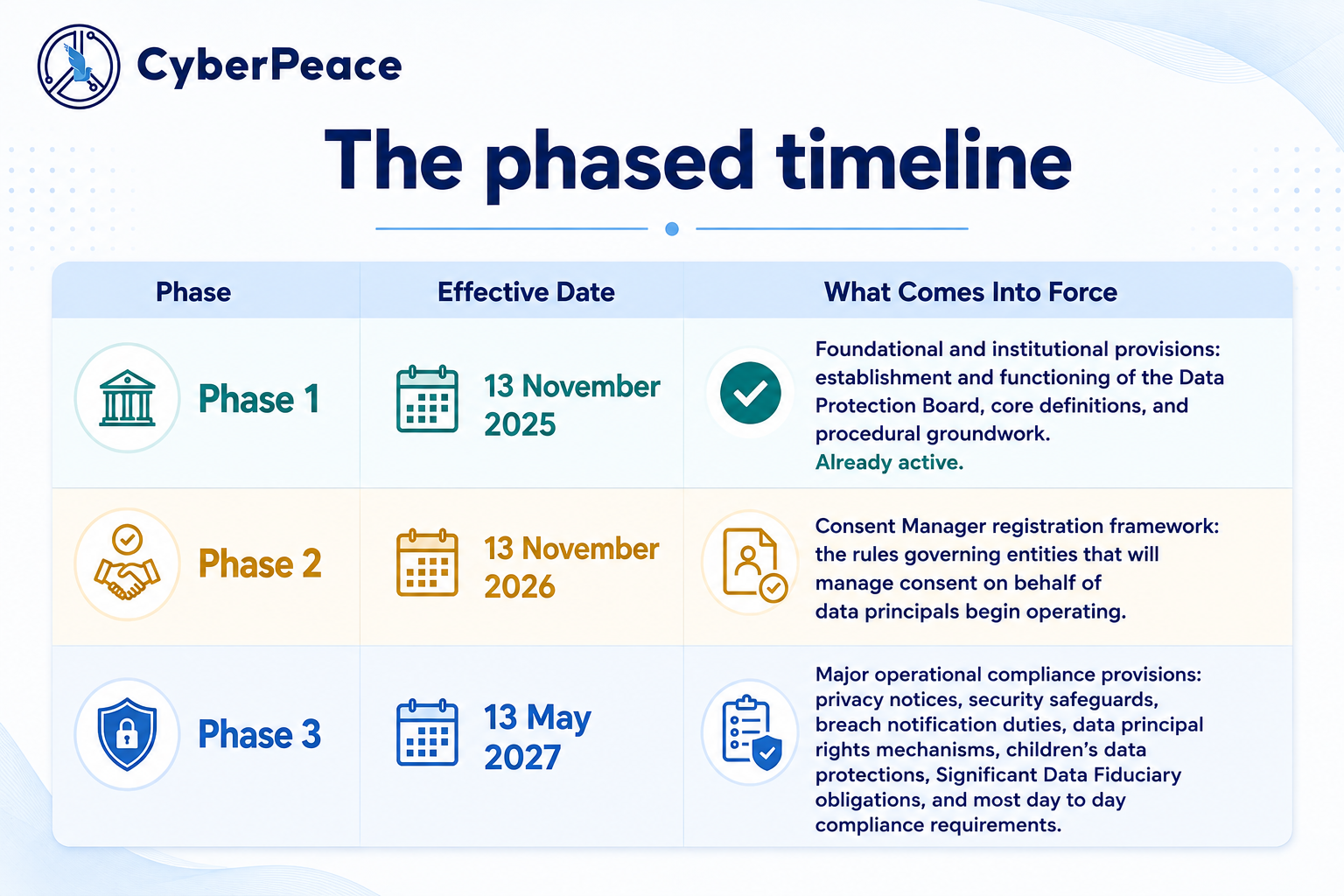
That third date, 13 May 2027, is the one that matters most for the vast majority of organisations, since it is where the bulk of actual operational obligations, the parts that touch product design, customer facing notices, and breach response, become enforceable. Legal commentary tracking the rollout has been consistent that this is described as a hard deadline with no grace period expected once it arrives, since the Data Protection Board is already operational and can begin receiving complaints well before Phase 3 obligations formally take effect.
Why "later" is a genuinely expensive plan
The financial stakes attached to Phase 3 non-compliance are not modest. The Schedule to the DPDP Act sets fixed penalty ceilings rather than turnover linked fines, which sounds gentler than Europe's GDPR model until you look at the actual numbers. Failure to implement reasonable security safeguards that results in a data breach can draw a penalty of up to 250 crore rupees per instance, the single highest tier in the Schedule. Failing to notify the Board or affected individuals after a breach occurs can draw up to 200 crore rupees, as can non-compliance with the Act's specific protections for children's data. Because these are assessed per instance rather than as a single capped exposure, a single incident that trips more than one obligation, say, inadequate safeguards that also delay breach notification, can compound into penalty exposure running into hundreds of crores from one event. All penalties collected go to the Consolidated Fund of India rather than to affected individuals directly, meaning the deterrent is aimed squarely at organisational behaviour, not compensation.
The part everyone keeps underestimating: this is not just a legal department problem
Perhaps the most consequential shift buried inside the DPDP framework is who actually has to own it. Reading the Rules as a checklist for the legal or privacy team alone misses how far the obligations actually reach. Building a compliant consent lifecycle touches product design. Security safeguards touch cybersecurity and IT infrastructure directly. Retention and deletion logic touches data governance and engineering. Third party risk review touches procurement. Breach preparedness touches internal audit and incident response. And increasingly, as organisations deploy AI systems that process personal data, AI governance enters the picture too, since a model trained or fine tuned on personal data inherits the same DPDP obligations as any other processing activity.
That cross functional reality is where most readiness programmes currently fall short. Treating DPDP compliance as a documentation exercise, updating a privacy policy PDF and calling it done, produces the appearance of compliance without the operational substance a Data Protection Board investigation would actually test. A breach response plan that exists only on paper and has never been rehearsed will not hold up against the 72 hour data principal notification window the Rules impose once Phase 3 lands. A consent mechanism bolted onto a website without corresponding backend logic to honour withdrawal requests will not satisfy an actual audit.
What a serious readiness posture looks like right now
Organisations that are ahead of this curve are already treating the eighteen month window as three overlapping workstreams rather than one deadline to hit at the end.
- The first is discovery: mapping what personal data exists, where it flows, who owns each system that touches it, and why it is collected in the first place, since compliance is structurally impossible without first knowing what you are protecting. This stage typically surfaces uncomfortable findings, shadow data sets nobody formally owns, vendor integrations nobody fully mapped, legacy systems still holding data well past any reasonable retention justification.
- The second is build: standing up the actual mechanisms, consent flows that can genuinely honour a withdrawal request end to end, rights request handling that does not depend on a single overworked employee checking an inbox, retention and deletion logic wired into the systems themselves rather than described only in a policy document, and security controls proportionate to the sensitivity of what is being protected.
- The third is proof: generating the internal evidence, audit trails, documented decisions, tested response procedures, that demonstrates governance was real rather than retrofitted after the fact. A Data Protection Board investigation, when it eventually happens, will not be satisfied by a well written policy; it will look for evidence that the policy was actually operational.
The actual question worth asking
The right question was never "when does DPDP become enforceable." Phase 1 already answered that; the law is live, and the Data Protection Board already exists and can act. The better question, the one worth taking into any leadership review between now and May 2027, is simpler and considerably less comfortable: will the organisation actually be ready when each phase's obligations become operational, or will readiness be assembled in a scramble once the deadline stops being theoretical. 18 months sounds long right up until the week it does not, and by the time Phase 3 lands, "we'll get to it" will no longer be a sentence any organisation gets to finish.
References
- Ministry of Electronics and Information Technology, Digital Personal Data Protection Rules, 2025, notified 13 November 2025. Press Information Bureau, "Digital Personal Data Protection Rules, 2025 Notified," 14 November 2025. https://static.pib.gov.in/WriteReadData/specificdocs/documents/2025/nov/doc20251117695301.pdf
- Shardul Amarchand Mangaldas & Co, "Enforcement of the DPDP Act and notification of the DPDP rules." https://www.amsshardul.com/insight/enforcement-of-the-dpdp-act-and-notification-of-the-dpdp-rules/
- S&R Associates, "India's Digital Personal Data Protection Regime Takes Effect." https://www.snrlaw.in/indias-digital-personal-data-protection-regime-takes-effect/
- Khurana & Khurana, "MeitY Notifies Rules Operationalising The DPDP Framework." https://www.khuranaandkhurana.com/update-meity-notifies-rules-operationalising-the-dpdp-framework-in-india
- Exchange4media, "DPDP Act 2025: Penalties for violations can reach Rs 250 crore." https://www.exchange4media.com/digital-news/dpdp-act-2025-penalties-for-confirmed-violations-can-reach-rs-250-crore-149360.html
- Seclore, "DPDP Rules 2025: India's Complete Compliance Guide." https://www.seclore.com/fundamentals/dpdp-rules-2025-compliance-guide/
Introduction
In 2025, the internet is entering a new paradigm and it is hard not to witness it. The internet as we know it is rapidly changing into a treasure trove of hyper-optimised material over which vast bot armies battle to the death, thanks to the amazing advancements in artificial intelligence. All of that advancement, however, has a price, primarily in human lives. It turns out that releasing highly personalised chatbots on a populace that is already struggling with economic stagnation, terminal loneliness, and the ongoing destruction of our planet isn’t exactly a formula for improved mental health. This is the truth of 75% of the kids and teen population who have had chats with chatbot-generated fictitious characters. AI, or artificial intelligence, Chatbots are becoming more and more integrated into our daily lives, assisting us with customer service, entertainment, healthcare, and education. But as the impact of these instruments grows, accountability and moral behaviour become more important. An investigation of the internal policies of a major international tech firm last year exposed alarming gaps: AI chatbots were allowed to create content with child romantic roleplaying, racially discriminatory reasoning, and spurious medical claims. Although the firm has since amended aspects of these rules, the exposé underscores an underlying global dilemma - how can we regulate AI to maintain child safety, guard against misinformation, and adhere to ethical considerations without suppressing innovation?
The Guidelines and Their Gaps
The tech giants like Meta and Google are often reprimanded for overlooking Child Safety and the overall increase in Mental health issues in children and adolescents. According to reports, Google introduced Gemini AI kids, a kid-friendly version of its Gemini AI chatbot, which represents a major advancement in the incorporation of generative artificial intelligence (Gen-AI) into early schooling. Users under the age of thirteen can use supervised accounts on the Family Link app to access this version of Gemini AI Kids.
AI operates on the premise of data collection and analysis. To safeguard children’s personal information in the digital world, the Digital Personal Data Protection Act, 2023 (DPDP Act) introduces particular safeguards. According to Section 9, before processing the data of children, who are defined as people under the age of 18, Data Fiduciaries, entities that decide the goals and methods of processing personal data, must get verified consent from a parent or legal guardian. Furthermore, the Act expressly forbids processing activities that could endanger a child’s welfare, such as behavioural surveillance and child-targeted advertising. According to court interpretations, a child's well-being includes not just medical care but also their moral, ethical, and emotional growth.
While the DPDP Act is a big start in the right direction, there are still important lacunae in how it addresses AI and Child Safety. Age-gating systems, thorough risk rating, and limitations specific to AI-driven platforms are absent from the Act, which largely concentrates on consent and damage prevention in data protection. Furthermore, it ignores the threats to children’s emotional safety or the long-term psychological effects of interacting with generative AI models. Current safeguards are self-regulatory in nature and dispersed across several laws, such as the Bhartiya Nyaya Sanhita, 2023. These include platform disclaimers, technology-based detection of child-sexual abuse content, and measures under the IT (Intermediary Guidelines and Digital Media Ethics Code) Rules, 2021.
Child Safety and AI
- The Risks of Romantic Roleplay - Enabling chatbots to engage in romantic roleplaying with youngsters is among the most concerning discoveries. These interactions can result in grooming, psychological trauma, and relaxation to inappropriate behaviour, even if they are not explicitly sexual. Having illicit or sexual conversations with kids in cyberspace is unacceptable, according to child protection experts. However, permitting even "flirtatious" conversation could normalise risky boundaries.
- International Standards and Best Practices - The concept of "safety by design" is highly valued in child online safety guidelines from around the world, including UNICEF's Child Online Protection Guidelines and the UK's Online Safety Bill. This mandating of platforms and developers to proactively remove risks, not reactively to respond to harms, is the bare minimum standard that any AI guidelines must meet if they provide loopholes for child-directed roleplay.
Misinformation and Racism in AI Outputs
- The Disinformation Dilemma - The regulations also allowed AI to create fictional narratives with disclaimers. For example, chatbots were able to write articles promulgating false health claims or smears against public officials, as long as they were labelled as "untrue." While disclaimers might give thin legal cover, they add to the proliferation of misleading information. Indeed, misinformation tends to spread extensively because users disregard caveat labels in favour of provocative assertions.
- Ethical Lines and Discriminatory Content - It is ethically questionable to allow AI systems to generate racist arguments, even when requested. Though scholarly research into prejudice and bias may necessitate such examples, unregulated generation has the potential to normalise damaging stereotypes. Researchers warn that such practice brings platforms from being passive hosts of offensive speech to active generators of discriminatory content. It is a difference that makes a difference, as it places responsibility squarely on developers and corporations.
The Broader Governance Challenge
- Corporate Responsibility and AI Material generated by AI is not equivalent to user speech—it is a direct reflection of corporate training, policy decisions, and system engineering. This fact requires a greater level of accountability. Although companies can update guidelines following public criticism, that there were such allowances in the first place indicates a lack of strong ethical regulation.
- Regulatory Gaps Regulatory regimes for AI are currently in disarray. The EU AI Act, the OECD AI Principles, and national policies all emphasise human rights, transparency, and accountability. The few, though, specify clear guidelines for content risks such as child roleplay or hate narratives. This absence of harmonised international rules leaves companies acting in the shadows, establishing their own limits until contradicted.
An active way forward would include
- Express Child Protection Requirements: AI systems must categorically prohibit interactions with children involving flirting or romance.
- Misinformation Protections: Generative AI must not be allowed to generate knowingly false material, disclaimers being irrelevant.
- Bias Reduction: Developers need to proactively train systems against generating discriminatory accounts, not merely tag them as optional outputs.
- Independent Regulation: External audit and ethics review boards can supply transparency and accountability independent of internal company regulations.
Conclusion
The guidelines that are often contentious are more than the internal folly of just one firm; they point to a deeper systemic issue in AI regulation. The stakes rise as generative AI becomes more and more integrated into politics, healthcare, education, and social interaction. Racism, false information, and inadequate child safety measures are severe issues that require quick resolution. Corporate regulation is only one aspect of the future; other elements include multi-stakeholder participation, stronger global systems, and ethical standards. In the end, rather than just corporate interests, trust in artificial neural networks will be based on their ability to preserve the truth, protect the weak, and represent universal human values.
References
- https://www.esafety.gov.au/newsroom/blogs/ai-chatbots-and-companions-risks-to-children-and-young-people
- https://www.lakshmisri.com/insights/articles/ai-for-children/#
- https://the420.in/meta-ai-chatbot-guidelines-child-safety-racism-misinformation/
- https://www.unicef.org/documents/guidelines-industry-online-child-protection
- https://www.oecd.org/en/topics/sub-issues/ai-principles.html
- https://artificialintelligenceact.eu/
.webp)
Introduction
The rise of artificial intelligence has transformed how individuals search for information, buy and compare products online. Unlike the traditional search engines like Google that presents the user with a set of links and directs users to websites, AI-powered systems provide synthesised answers and recommendations which means we don't have to click through every link to find what we are looking for, we simply have to ask an LLM and it provides recommendations based on our needs expressed through prompt. This development has raised important legal and commercial questions, one such question was addressed in the judgement of Indiamart Inter Mesh Limited v. Open AI Inc. and Others (2026 SCC OnLine Cal 5738) decided by HMJ Ravi Krishan Kapur of Calcutta High court on 20 May 2026. If an AI platform becomes a primary source of information, can a business demand inclusion in its responses? Is it a legal injury if the LLM omits a business? More fundamentally, how do the existing laws classify technologies that not only process information, but also generate new content? These were the questions that came before Calcutta High Court. Although the dispute arose from Indiamart’s complaint regarding visibility on ChatGPT search, the judgement explored beyond the disagreement between two private entities.
The Dispute
IndiaMart is one of India’s largest electronic business-to-business marketplaces since 1996, serving millions of buyers and sellers across India. They also have registered trademarks and their entire business depends on visibility on the internet considering the digitalisation of the market. Open AI launched ChatGPT search in October 2024, which is a feature that supplements AI responses with links to relevant web sources. Indiamart alleged that ChatGPT was not displaying links to their online platform in the same way that it displayed links to other competing services or individual sellers. A major grievance raised by Indiamart was that ChatGPT allegedly bypassed IndiaMart market listings by directing users to sellers’ individual websites while continuing to provide platform level links for other competing platforms. Hence, they contended that this practice diverted users away from their platform and negatively affected their business interests. The company argued that such exclusion amounted to discriminatory treatment and resulted in economic harm, diluted its trademarks and amounted to disparagement. They alleged that it violated their rights under article 14, 19, 21 under the constitution and rights under IT Act and IT Rules also. When IndiaMart sought an explanation from OpenAI, the company stated that its decision was influenced by the inclusion of IndiaMart in the United States Trade Representative (USTR) Review of Notorious Markets for Counterfeiting and Piracy 2024, a U.S. government report that identifies online and physical marketplaces alleged to facilitate intellectual property infringements. IndiaMart challenged this justification, arguing that the USTR report has no statutory or binding force in India. It further alleged selective discrimination, pointing out that several other platforms featured on the same USTR list including DHGate, Pinduoduo, Shopee, and Taobao continued to remain accessible through ChatGPT-generated responses. Consequently, IndiaMart approached the Calcutta High Court seeking interim relief directing ChatGPT to display and provide access to IndiaMart links in its responses.
ARGUMENTS BEFORE THE COURT
IndiaMart's contentions: They argued that ChatGPT, because its search feature, performs the role of an "intermediary" within the meaning of Section 2(1)(w) of the IT Act and is therefore required to comply with the obligations imposed under the Information Technology (Intermediary Guidelines and Digital Media Ethics Code) Rules, 2021. Relying on Rule 3(1)(n), IndiaMart argued that an intermediary cannot engage in discriminatory treatment of platforms or selectively restrict access to information. IndiaMart further maintained that users have a right to access information relating to its platform and that the omission of IndiaMart links from ChatGPT's responses violated this interest. They alleged violation of Articles 14, 19, and 21 of the Constitution, along with the broader principle of a user's "right to know", to argue that OpenAI owed an obligation to display IndiaMart listings in response to relevant queries. In addition, IndiaMart alleged that the exclusion of its links caused commercial harm, diluted its trademarks, amounted to disparagement, and constituted an unfair trade practice that adversely affected its business and reputation.
OpenAI's contentions: OpenAI asserted that IndiaMart had no legally enforceable ‘Right to visibility’ on ChatGPT. They argued that neither contract, statute, nor constitutional law imposed any obligation on OpenAI to display, prioritise, or recommend IndiaMart links in response to user queries. In the absence of any recognised legal right, there could be no actionable injury and therefore no valid cause of action. OpenAI also challenged the classification of ChatGPT as an "intermediary" under the Information Technology Act, 2000. According to OpenAI, ChatGPT does not merely host, transmit, or facilitate access to third-party content but also generates responses through its large language model (LLM) and therefore functions more closely as an "originator" than an intermediary. Consequently, the obligations applicable to intermediaries under the Information Technology (Intermediary Guidelines and Digital Media Ethics Code) Rules, 2021, including those relied upon by IndiaMart, were inapplicable. With respect to the USTR Notorious Markets List, OpenAI submitted that its reliance on the report formed part of its internal risk-management and business policies. Such decisions, it argued, were matters of private commercial judgment and not ordinarily subject to judicial review. OpenAI further pointed out that IndiaMart had also previously blocked ChatGPT from accessing and crawling its website that weakened the company's demand for greater visibility within ChatGPT-generated responses.
Court’s decision: The court rejected Indiamart's claim that they were entitled to be displayed in ChatGPT searches. The court emphasised the autonomy of private businesses, the court held that the right to carry on trade and business is "inviolable" and that no law can compel one private entity to operate their platform for the benefit of another, which is based on foundational economic philosophy of laissez faire. Unless there is a contractual, statutory or constitutional obligation, a platform has no duty to the other platform to promote or advance their economic interest. Applying this principle, the court found no such duty or “vested legal right” that entitled IndiaMart’s visibility on ChatGPT. The court reasoned that even if users possess the ‘right to know’, Indiamart could not convert that interest into an enforceable claim under article 19(1)(g) or other legal provision. The court looked at the dispute as one arising from commercial disadvantage rather than violation of any legally protected right. Although the reduced visibility may have had economic consequences, economic harm does not by itself create a cause of action.
The court also took into consideration whether ChatGPT should be classified as an intermediary under Section 2(1)(w) of the Information Technology Act, 2000 or as an originator under Section 2(1)(za). This was an important distinction, because the intermediaries can claim safe harbour protection under section 79 of the IT act, but the originators cannot. The court expressed a preliminary view that ChatGPT is generative capabilities, place it closer to an originator than an intermediary because, unlike conventional search engines, which identify and rank existing information, Generative AI systems, analyse the data and produce new output based on algorithms, which is in response to the user’s prompt. The Court also referenced the NITI Aayog National Strategy for Artificial Intelligence (pages 7 to 12) to support its observations that ChatGPT does not merely store, host or transmit information, it can produce essays, research material, code, creative writing, and other forms of content that did not previously exist in that exact form, hence extending beyond the conventional understanding of an intermediary. The court also recognised that it is a vexed issue and remains unsettled because AI systems operate in response to users instructions and do not function independently, which is why the court refrained from providing a definitive classification and acknowledged that the question may ultimately require legislative clarification as well.
In addition to this, the Court took the view that the IndiaMart’s grievances did not amount to an Intellectual property dispute, as they found no trademark infringement or dilution because any reference to the "IndiaMart" mark was merely descriptive and did not constitute commercial use "in the course of trade" under Section 29(4) of the Trade Marks Act. IndiaMart also hadn’t demonstrated any false or misleading use of its trademark.
Similarly, the Court found that claims of disparagement, trade libel, and injurious falsehood were unsustainable because such claims require the publication of a false statement that harms reputation and since ChatGPT had not published any derogatory statement about IndiaMart, the mere omission of links could not amount to disparagement or libel. The Court relied on Tech Plus Media v. Jyoti Janda, that allegations of unfairness or copyright infringement must be supported by specific pleadings and evidence.
Beyond the immediate dispute, the judgment shed light on the growing difficulty of applying legal categories created for an earlier internet era to generative AI systems. The Information Technology Act was enacted at a time when internet regulation focused primarily on websites, service providers, and electronic communications and therefore existing classifications may not adequately address the hybrid nature of contemporary AI technologies. The Court acknowledged OpenAI's concern that granting IndiaMart's request could trigger floodgates of litigation on similar claims from businesses dissatisfied with AI-generated visibility, however, it clarified that such concerns cannot outweigh genuine legal claims or fundamental rights. The Court suggested that legislative intervention may eventually be necessary.
Conclusion
This judgement not only addressed the visibility issue in AI generated responses, but also whether visibility itself can become a legally protected interest in AI-driven searches? As more and more users rely on AI generated output for their preference rather than traditional search engine output, the power to decide what information is displayed and what is not will eventually become economically significant. The Calcutta High Court through this judgement declined to create any such right through judicial interventions and also highlighted that the existing legal framework is not adequately equipped to address the novel challenges posed by generative AI.
(This blog is based on the judgment in Indiamart Inter Mesh Limited v. Open AI Inc. and Others, 2026 SCC OnLine Cal 5738, decided on May 20, 2026 by the Calcutta High Court, and related reporting by LiveLaw and SCC Times.)
References
- https://www.livelaw.in/high-court/calcutta-high-court/no-right-to-visibility-exists-on-private-ai-platforms-calcutta-high-court-refuses-to-direct-chatgpt-to-display-indiamart-links-536891
- https://www.scconline.com/blog/post/2026/06/03/chatgpt-intermediary-originator-it-act-calcutta-high-court/
- https://indiankanoon.org/doc/198449710/
