
#FactCheck -Viral Claim of Alcohol Ban in West Bengal by Amit Shah Is Fake, No Such Announcement Made
Executive Summary
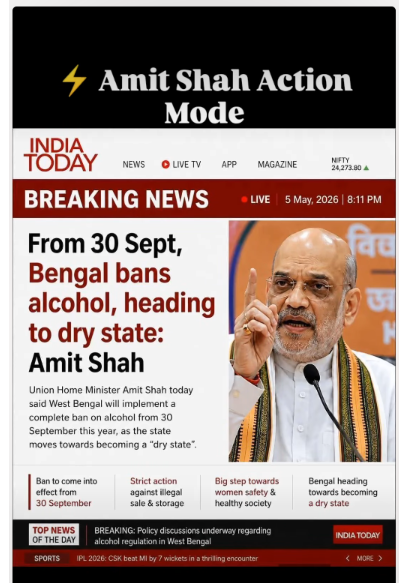
A graphic featuring Union Home Minister Amit Shah is being widely shared on social media, claiming that he has announced a complete ban on alcohol in West Bengal from September 30. The post further suggests that the state will move towards becoming a dry state. Notably, this claim surfaced soon after the BJP’s victory in the West Bengal Assembly elections. CyberPeace Research Wing research has found the viral claim to be false. Our research confirms that Home Minister Amit Shah has not made any such announcement.
Claim:
On Instagram, a user shared a viral graphic on May 8, 2026, alleging that Amit Shah announced a complete ban on alcohol in West Bengal starting September 30. The post link and archived version are provided below:
- https://www.instagram.com/reel/DYDy13zINV5/
- https://archive.ph/mYpZS
Fact Check
To verify the claim, we conducted a keyword-based search on Google. However, we did not find any credible media reports supporting the viral claim. Since the graphic carried the logo of India Today, we also checked the official website, YouTube channel, and social media handles of India Today. However, no matching report or graphic was found.
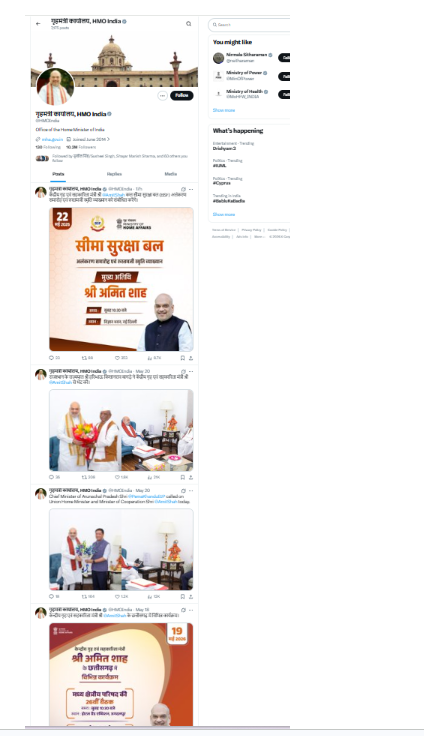
In the final step, we reviewed the official X account of the Ministry of Home Affairs. Even there, no statement or report confirming the viral claim was found. The relevant link is provided below:
- https://x.com/HMOIndia
Conclusion:
Our research confirms that Home Minister Amit Shah has made no such announcement regarding a complete alcohol ban in West Bengal.

Related Blogs

Introduction:
With the rapid advancement in technologies, vehicles are also being transformed into moving data centre. There is an introduction of connectivity, driver assistance systems, advanced software systems, automated systems and other modern technologies are being deployed to make the experience of users more advanced and joyful. Software plays an important role in the overall functionality and convenience of the vehicle. For example, Advanced technologies like keyless entry and voice assistance, censor cameras and communication technologies are being incorporated into modern vehicles. Addressing the cyber security concerns in the vehicles the Ministry of Road Transport and Highways (MoRTH) has proposed standard Cyber Security and Management Systems (CSMS) rules for specific categories of four-wheelers, including both passenger and commercial vehicles. The goal is to protect these vehicles and their functions against cyber-attacks or vulnerabilities. This move will aim to ensure standardized cybersecurity measures in the automotive industry. These proposed standards will put forth certain responsibilities on the vehicle manufacturers to implement suitable and proportional measures to secure dedicated environments and to take steps to ensure cyber security.
The New Mandate
The new set of standards requires automobile manufacturers to install a new cybersecurity management system, which will be inclusive of protection against several cyberattacks on the vehicle’s autonomous driving functions, electronic control unit, connected functions, and infotainment systems. The proposed automotive industry standards aim to fortify vehicles against cyberattacks. These standards, expected to be notified by early next month, will apply to all M and N category vehicles. This includes passenger vehicles, goods carriers, and even tractors if they possess even a single electronic control unit. The need for enhanced cybersecurity in the automotive sector is palpable. Modern vehicles, equipped with advanced technologies, are highly prone to cyberattacks. The Ministry of Road Transport and Highways has thus taken a precautionary measure to safeguard all new-age commercial and private vehicles against cyber threats and vulnerabilities.
Cyber Security and Management Systems (CSMS)
The proposed standards by the Ministry of Road Transport and Highways (MoRTH) clarify that CSMS refers to a systematic risk-based strategy that defines organisational procedures, roles, and governance to manage and mitigate risks connected with cyber threats to vehicles, eventually safeguarding them from cyberattacks. According to the draft regulations, all manufacturers will be required to install a cyber security management system in their vehicles and provide the government with a certificate of compliance at the time of vehicle type certification.
Electrical vehicle charging system
Electric vehicle charging stations could also be susceptible and prone to cyber threats and vulnerabilities, which significantly requires to have in place standards to prevent them. It is highlighted that the Indian Computer Emergency Response Team (CERT-In), a designated authority to track and monitor cybersecurity incidents in India, had received reports of vulnerabilities in products and applications related to electric vehicle charging stations. Electric cars or vehicles becoming increasingly popular as the world shifts to green technology. EV owners may charge their cars at charging points in convenient spots. When you charge an EV at a charging station, data transfers between the car, the charging station, and the company that owns the device. This trail of data sharing and EV charging stations in many ways can be exploited by the bad actors. Some of the threats may include Malware, remote manipulation, and disturbing charging stations, social engineering attacks, compromised aftermarket devices etc.
Conclusion
Cyber security is necessary in view of the increased connectivity and use of software systems and other modern technologies in vehicles. As the automotive industry continues to adopt advanced technologies, it will become increasingly important that organizations take a proactive approach to ensure cybersecurity in the vehicles. A balanced approach between technology innovation and security measures will be instrumental in ensuring the cybersecurity aspect in the automotive industry. The recent proposed policy standard by the Ministry of Road Transport and Highways (MoRTH) can be seen as a commendable step to make the automotive industry cyber-resilient and safe for everyone.
References:
- https://economictimes.indiatimes.com/news/india/road-transport-ministry-proposes-uniform-cyber-security-system-for-four-wheelers/articleshow/105187952.cms
- https://www.financialexpress.com/business/express-mobility-cybersecurity-in-the-autonomous-vehicle-the-next-frontier-in-mobility-3234055/
- https://www.gktoday.in/morth-proposes-uniform-cyber-security-standards-for-four-wheelers/
- https://cybersecurity.att.com/blogs/security-essentials/the-top-8-cybersecurity-threats-facing-the-automotive-industry-heading-into-2023

Executive Summary
A video allegedly showing Bollywood actor Shah Rukh Khan supporting and expressing his intention to join the so-called ‘Cockroach Janta Party’ (CJP) is being widely shared on social media.In the viral clip, Shah Rukh Khan can allegedly be heard saying:“Friends, the common people of this country are now fully awakened, and the storm of Cockroach Janta Party on social media has become so huge that its name is echoing everywhere… In just a few days, it has gained more than 15 million followers on Instagram… and honestly, I too will soon join the Cockroach Janta Party…”
However, CyberPeace Research Wing investigation found the claim to be false. The voice heard in the viral clip is AI-generated.
Claim
The viral video is being shared with the claim that actor Shah Rukh Khan publicly endorsed the ‘Cockroach Janta Party’ (CJP) and announced that he would soon join the movement.
- https://archive.is/wWueV

Fact Check
To verify the authenticity of the viral video, we first searched the internet using relevant keywords. However, we found no credible media reports, interviews, or posts from Shah Rukh Khan’s official social media accounts mentioning any support for the ‘Cockroach Janta Party’. Notably, if a major actor like Shah Rukh Khan had publicly supported any political or social media movement, it would have received widespread media coverage.
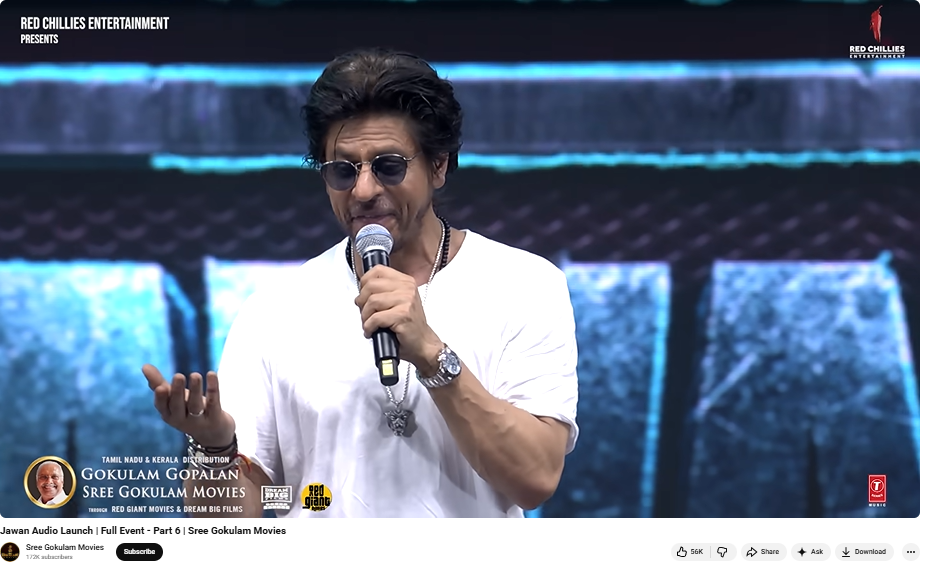
We then analysed key frames from the viral clip using Google Lens. During the investigation, we found an original video uploaded on September 10, 2023, on the YouTube channel of Sri Gokulam Movies. The footage was from the audio launch event of the film Jawan, where Shah Rukh Khan appeared in the same outfit seen in the viral clip.
वीडियो के डिस्क्रिप्शन में लिखा गया है, “शाहरुख़ In the original video, Shah Rukh Khan is seen speaking about the film, its cast, music, and his experience during the event. At no point does he mention the ‘Cockroach Janta Party’. The video description states that Shah Rukh Khan and the film’s team attended the audio launch event of Jawan in Chennai, where he praised music composer Anirudh Ravichander and thanked artists from the Tamil film industry. Additionally, the online trend related to the ‘Cockroach Janta Party’ emerged only in May 2026, whereas the original video is nearly three years old.
During the investigation, we also found several media reports covering the Jawan audio launch event, showing Shah Rukh Khan in the same attire as seen in the viral clip. For instance, a report published by Hindustan Times extensively covered the Chennai event, confirming that the viral footage was taken from the promotional event of the film.

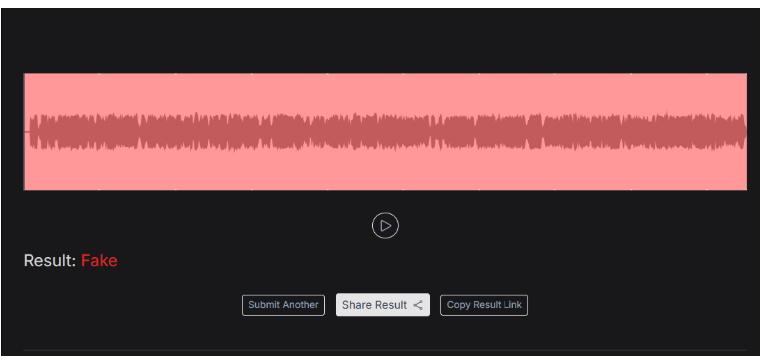
To further examine the audio in the viral clip, we analysed it using the AI detection tool Resemble AI. The tool flagged the voice in the video as likely fake and AI-generated.
Conclusion
The investigation clearly shows that the claim about Shah Rukh Khan supporting or joining the ‘Cockroach Janta Party’ (CJP) is false. The viral video is actually from the 2023 audio launch event of the film Jawan, while the audio added to the clip has been generated using AI.

Executive Summary
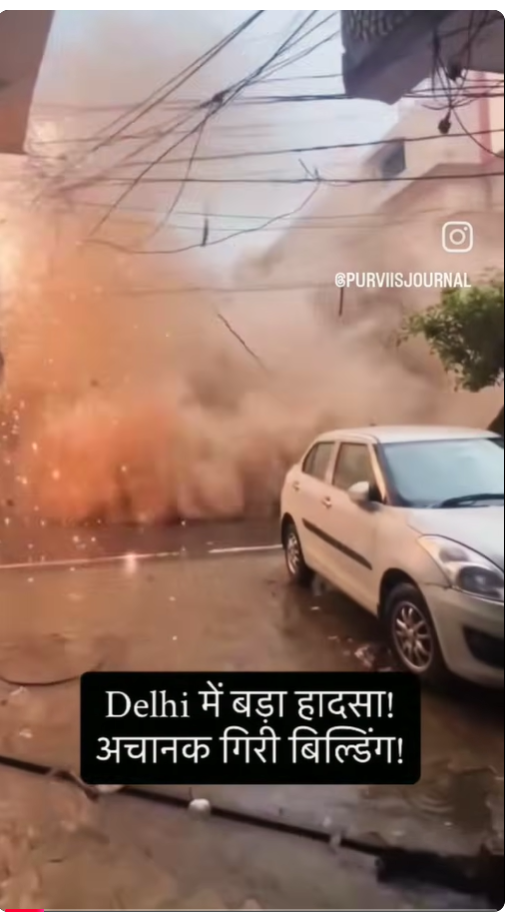
A video showing a building collapse is going viral on social media. It is being shared as footage of a tragic incident that took place in Satya Niketan, Delhi. The video is accompanied by claims that it shows the building collapse in Satya Niketan. However, a research by CyberPeace’s Research Wing found that the viral video is not from the incident in Satya Niketan, Delhi. The research revealed that the video is actually from Moradabad, Uttar Pradesh, where a building collapsed on September 5, 2026. Clear similarities were found between the viral video and visuals from the incident in Moradabad. This confirms that an old video is being shared on social media with a false context, linking it to the incident in Satya Niketan, Delhi.
Claim:
A user shared the viral video on YouTube with the caption: “Major accident in Delhi! A five-storey building collapsed.”
https://www.youtube.com/shorts/1qeW-pFoMd4
Fact Check
While investigating the viral video, we conducted a reverse image search using its keyframes. This led us to the same video, which was uploaded on an Instagram account on September 5, 2026. The text visible in the video identified the location as Moradabad, Uttar Pradesh.
https://www.instagram.com/p/Dc54OW2SOh3/

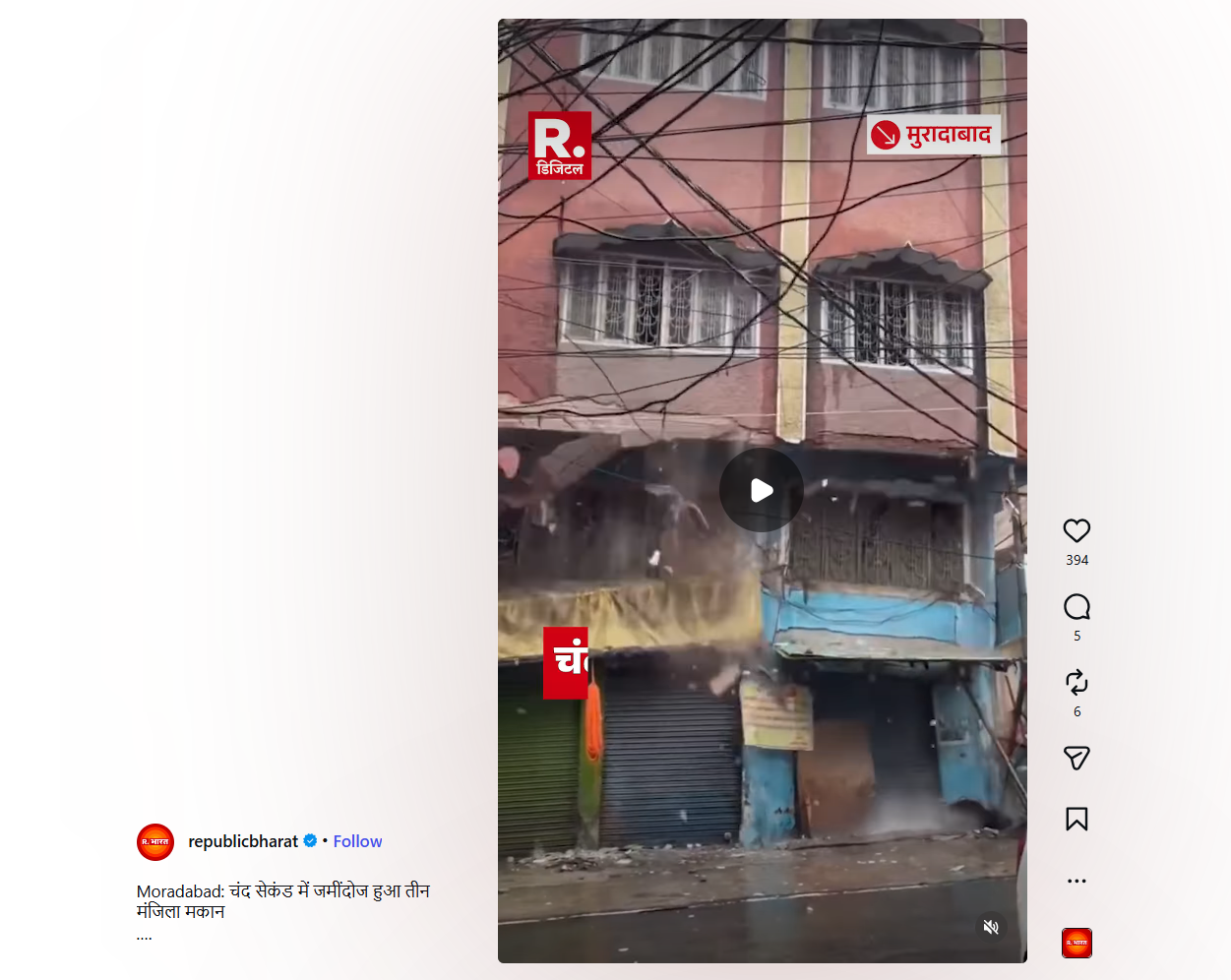
In the next stage of our research, we found the video on Republic Bharat’s Instagram channel, where it was also identified as being from Moradabad.
https://www.instagram.com/reels/Dc8XTlpgaRL/
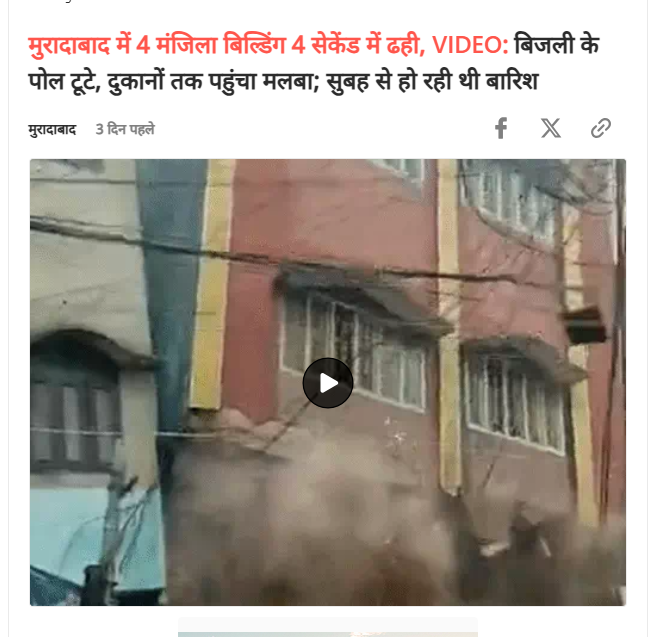
Based on the information gathered above, a keyword search led us to a report published by Dainik Bhaskar on September 5, 2026. The report also contained visuals matching those seen in the viral video. According to the Dainik Bhaskar report, on September 5, 2026, a four-storey dilapidated building collapsed in the Mughalpura area of Moradabad amid heavy rain, triggering panic in the area. However, the administration had sealed the building a day earlier after assessing its condition. The incident took place at around 3 p.m. The building was owned by a man named Sarfaraz Ali.
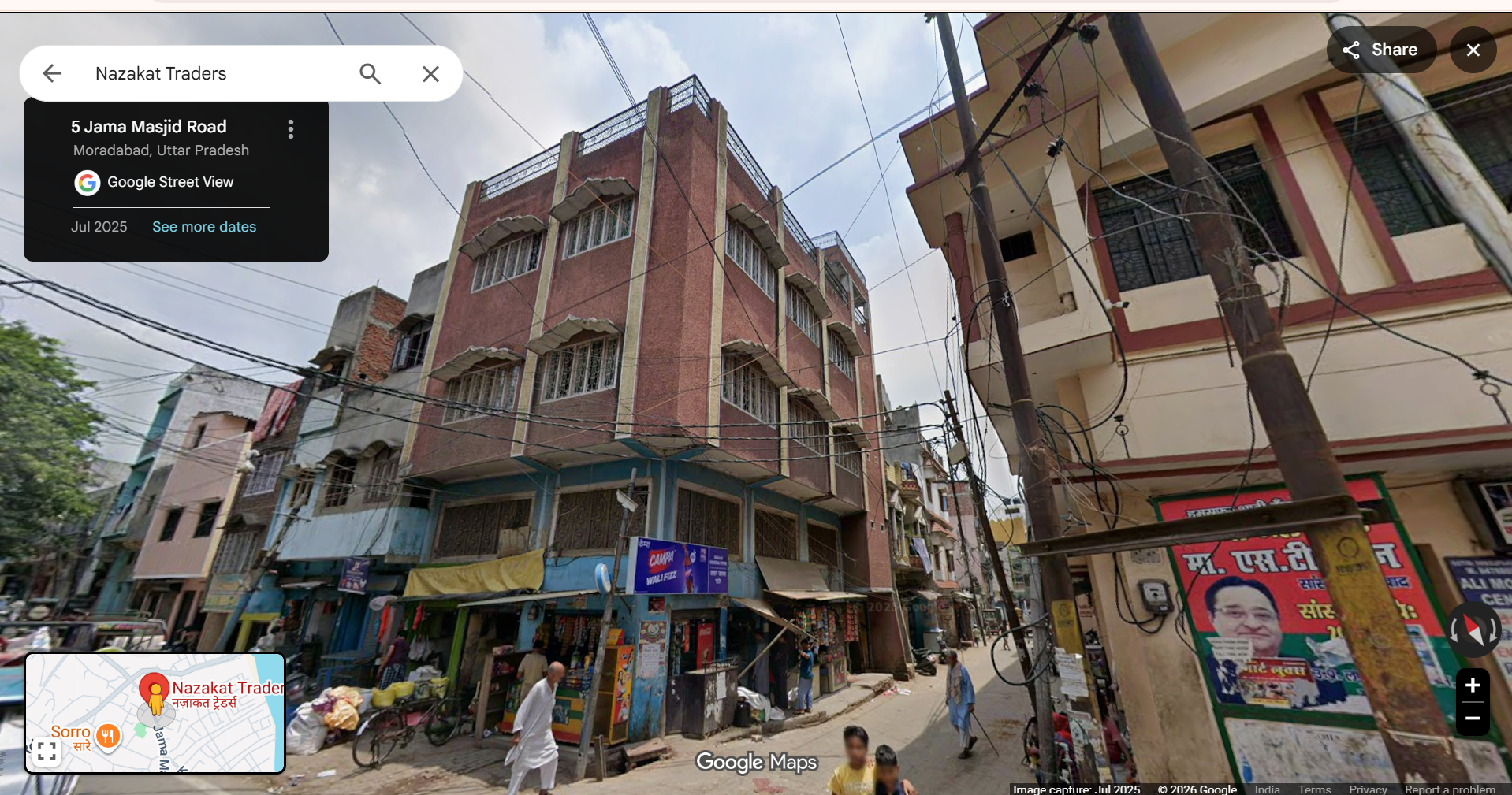
In our research, we also tried to geolocate the building seen collapsing in the viral video. We found that the building was located near Guiyan Bagh on Jama Masjid Road in Moradabad. The location can be seen in the image below.
Conclusion
The evidence gathered during our research clearly establishes that the video being circulated as footage of the tragic building collapse in Satya Niketan, Delhi, is not from Delhi. Our findings show that the viral video actually captures the collapse of a dilapidated four-storey building in the Mughalpura area of Moradabad, Uttar Pradesh, on September 5, 2026, amid heavy rainfall. The video was traced to multiple sources that identified the location as Moradabad, and further verification through media reports and geolocation confirmed that the visuals correspond to the same incident. Therefore, the viral video is being shared with a false context by incorrectly linking an incident in Moradabad to the building collapse in Satya Niketan, Delhi.
