
e-Zero FIR: Accelerating Cybercrime Response to Build a Cyber-Secure Bharat
Introduction
Cyber financial offences in India have experienced an alarming surge both in terms of frequency and complexity. Be it phishing attacks or organised fraud syndicates, the nation has been facing a spurt in online financial threats, which leave the victims at their mercy because of procedural lags on the part of law enforcement agencies. To counter this, the Government of India has stepped up measures to create a Cyber-Secure Bharat, focusing on speedy resolution, accountability, and digital empowerment. A key move in this direction is the introduction of the e-Zero FIR initiative, brought forth by the Ministry of Home Affairs (MHA) with Union Home Minister Amit Shah at the helm. This newly developed digital-first system is expected to revolutionise the way cyber financial crimes, particularly those that result in high monetary losses, are handled and investigated.
What Is the e-Zero FIR Initiative?
The e-Zero FIR program is a technology-based platform that enables the automated registration of Zero FIRs for value cyber financial crimes. Led by the Indian Cybercrime Coordination Centre (I4C), Ministry of Home Affairs, the programme is now piloted in Delhi and aims to fill a pressing lacuna: the time lag involved in transitioning cybercrime complaints to First Information Reports (FIRs).
Complaints of financial frauds worth more than ₹10 lakh, reported through the National Cybercrime Reporting Portal (NCRP) or helpline number 1930, will be automatically turned into e-Zero FIRs under this scheme. Such electronic FIRs are directed to the e-Crime Police Station in Delhi, regardless of jurisdiction, and then relayed to the corresponding territorial cybercrime unit. Complainants can visit the cybercrime Police Station within 3 days and get the Zero FIR converted into a regular FIR.
Key Features of the Initiative
- Pilot Implementation in Delhi
Launched as a pilot project in Delhi, it will later serve as the first use case for the national rollout. The success of the pilot will determine its implementation in other states and Union Territories.
- Seamless Digital Integration
The project provides strong back-end integration between:
- NCRP (National Cybercrime Reporting Portal)
- e-FIR System (Delhi Police)
- CCTNS (Crime and Criminal Tracking Network & Systems – NCRB)
This integrated model enables complaints to pass smoothly between platforms and agencies.
- Zero FIR Auto-Registration and Routing
Now, for complaints lodged through 1930 or the National Cyber Crime Reporting Portal related to financial losses exceeding the threshold of ₹10 lakh, the system will automatically register a Zero FIR to the e-Crime Police Station of Delhi and then route it to the concerned territorial cybercrime police station, triggering immediate case processing.
- Victim-Centric Conversion Mechanism
Complainants are given 3 days from the time of filing to physically report to the police station and transform the e-Zero FIR into a conventional regular FIR under Section 173 (1) and 1(ii) of the newly enacted Bhartiya Nagrik Suraksha Sanhita (BNSS). This ensures legal redress is quicker and easier.
Impact and Significance: The CyberPeace View
The e-Zero FIR system is a significant change in India's cybercrime enforcement, offering quicker response times and improved recovery opportunities. Cyber fraud reported within the "golden hour" can boost recovery levels of financial fraud. The system also eliminates jurisdictional barriers and procedural bottlenecks, making it more victim-friendly. Union Home Minister Amit Shah emphasised the initiative's alignment with Prime Minister Narendra Modi's vision of a digitally resilient India. The system is a scalable national model of tech-based policing supported by organised digital workflows. The initiative allows for real-time analysis of fraud graphs and detection of fraud syndicates through identification and device-based clustering. This is a step towards more automated, context-aware cyber policing, focusing on AI, identity graphs, and velocity to prevent crimes. The system is a step towards a next-generation cyber law enforcement strategy, focusing on AI, identity graphs, and velocity.
Conclusion
The roll-out of the e-Zero FIR program is a turning point in India's battle against cybercrime. By marrying automation with inter-agency coordination and easy-to-use mechanisms, the government has eradicated one of the major stumbling blocks for victims, the delay in taking legal action. Though its pilot phase targets high-value financial frauds in Delhi, its potential for having a countrywide impact is vast. With digital transactions on the upswing and frauds getting more cunning, efforts like these are the key to making a safe, responsive, and victim-centric cyber environment. CyberPeace commends and welcomes this important move towards establishing a Cyber-Secure Bharat, wherein all citizens can make digital transactions with confidence.
References
- https://www.pib.gov.in/PressReleasePage.aspx?PRID=2129715
- https://www.mha.gov.in/en
- https://cybercrime.gov.in/
- https://www.ncrb.gov.in/
- https://economictimes.indiatimes.com/wealth/save/new-e-zero-fir-govt-launches-pilot-for-swift-action-against-cybercrimes-how-it-can-help-you/articleshow/121314437.cms?from=mdr

Related Blogs

In the vast, uncharted territories of the digital world, a sinister phenomenon is proliferating at an alarming rate. It's a world where artificial intelligence (AI) and human vulnerability intertwine in a disturbing combination, creating a shadowy realm of non-consensual pornography. This is the world of deepfake pornography, a burgeoning industry that is as lucrative as it is unsettling.
According to a recent assessment, at least 100,000 deepfake porn videos are readily available on the internet, with hundreds, if not thousands, being uploaded daily. This staggering statistic prompts a chilling question: what is driving the creation of such a vast number of fakes? Is it merely for amusement, or is there a more sinister motive at play?
Recent Trends and Developments
An investigation by India Today’s Open-Source Intelligence (OSINT) team reveals that deepfake pornography is rapidly morphing into a thriving business. AI enthusiasts, creators, and experts are extending their expertise, investors are injecting money, and even small financial companies to tech giants like Google, VISA, Mastercard, and PayPal are being misused in this dark trade. Synthetic porn has existed for years, but advances in AI and the increasing availability of technology have made it easier—and more profitable—to create and distribute non-consensual sexually explicit material. The 2023 State of Deepfake report by Home Security Heroes reveals a staggering 550% increase in the number of deepfakes compared to 2019.
What’s the Matter with Fakes?
But why should we be concerned about these fakes? The answer lies in the real-world harm they cause. India has already seen cases of extortion carried out by exploiting deepfake technology. An elderly man in UP’s Ghaziabad, for instance, was tricked into paying Rs 74,000 after receiving a deep fake video of a police officer. The situation could have been even more serious if the perpetrators had decided to create deepfake porn of the victim.
The danger is particularly severe for women. The 2023 State of Deepfake Report estimates that at least 98 percent of all deepfakes is porn and 99 percent of its victims are women. A study by Harvard University refrained from using the term “pornography” for creating, sharing, or threatening to create/share sexually explicit images and videos of a person without their consent. “It is abuse and should be understood as such,” it states.
Based on interviews of victims of deepfake porn last year, the study said 63 percent of participants talked about experiences of “sexual deepfake abuse” and reported that their sexual deepfakes had been monetised online. It also found “sexual deepfake abuse to be particularly harmful because of the fluidity and co-occurrence of online offline experiences of abuse, resulting in endless reverberations of abuse in which every aspect of the victim’s life is permanently disrupted”.
Creating deepfake porn is disturbingly easy. There are largely two types of deepfakes: one featuring faces of humans and another featuring computer-generated hyper-realistic faces of non-existing people. The first category is particularly concerning and is created by superimposing faces of real people on existing pornographic images and videos—a task made simple and easy by AI tools.
During the investigation, platforms hosting deepfake porn of stars like Jennifer Lawrence, Emma Stone, Jennifer Aniston, Aishwarya Rai, Rashmika Mandanna to TV actors and influencers like Aanchal Khurana, Ahsaas Channa, and Sonam Bajwa and Anveshi Jain were encountered. It takes a few minutes and as little as Rs 40 for a user to create a high-quality fake porn video of 15 seconds on platforms like FakeApp and FaceSwap.
The Modus Operandi
These platforms brazenly flaunt their business association and hide behind frivolous declarations such as: the content is “meant solely for entertainment” and “not intended to harm or humiliate anyone”. However, the irony of these disclaimers is not lost on anyone, especially when they host thousands of non-consensual deepfake pornography.
As fake porn content and its consumers surge, deepfake porn sites are rushing to forge collaborations with generative AI service providers and have integrated their interfaces for enhanced interoperability. The promise and potential of making quick bucks have given birth to step-by-step guides, video tutorials, and websites that offer tools and programs, recommendations, and ratings.
Nearly 90 per cent of all deepfake porn is hosted by dedicated platforms that charge for long-duration premium fake content and for creating porn—of whoever a user wants, and take requests for celebrities. To encourage them further, they enable creators to monetize their content.
One such website, Civitai, has a system in place that pays “rewards” to creators of AI models that generate “images of real people'', including ordinary people. It also enables users to post AI images, prompts, model data, and LoRA (low-rank adaptation of large language models) files used in generating the images. Model data designed for adult content is gaining great popularity on the platform, and they are not only targeting celebrities. Common people are equally susceptible.
Access to premium fake porn, like any other content, requires payment. But how can a gateway process payment for sexual content that lacks consent? It seems financial institutes and banks are not paying much attention to this legal question. During the investigation, many such websites accepting payments through services like VISA, Mastercard, and Stripe were found.
Those who have failed to register/partner with these fintech giants have found a way out. While some direct users to third-party sites, others use personal PayPal accounts to manually collect money in the personal accounts of their employees/stakeholders, which potentially violates the platform's terms of use that ban the sale of “sexually oriented digital goods or content delivered through a digital medium.”
Among others, the MakeNude.ai web app – which lets users “view any girl without clothing” in “just a single click” – has an interesting method of circumventing restrictions around the sale of non-consensual pornography. The platform has partnered with Ukraine-based Monobank and Dublin’s BetaTransfer Kassa which operates in “high-risk markets”.
BetaTransfer Kassa admits to serving “clients who have already contacted payment aggregators and received a refusal to accept payments, or aggregators stopped payments altogether after the resource was approved or completely freeze your funds”. To make payment processing easy, MakeNude.ai seems to be exploiting the donation ‘jar’ facility of Monobank, which is often used by people to donate money to Ukraine to support it in the war against Russia.
The Indian Scenario
India currently is on its way to design dedicated legislation to address issues arising out of deepfakes. Though existing general laws requiring such platforms to remove offensive content also apply to deepfake porn. However, persecution of the offender and their conviction is extremely difficult for law enforcement agencies as it is a boundaryless crime and sometimes involves several countries in the process.
A victim can register a police complaint under provisions of Section 66E and Section 66D of the IT Act, 2000. Recently enacted Digital Personal Data Protection Act, 2023 aims to protect the digital personal data of users. Recently Union Government issued an advisory to social media intermediaries to identify misinformation and deepfakes. Comprehensive law promised by Union IT minister Ashwini Vaishnav will be able to address these challenges.
Conclusion
In the end, the unsettling dance of AI and human vulnerability continues in the dark web of deepfake pornography. It's a dance that is as disturbing as it is fascinating, a dance that raises questions about the ethical use of technology, the protection of individual rights, and the responsibility of financial institutions. It's a dance that we must all be aware of, for it is a dance that affects us all.
References
- https://www.indiatoday.in/india/story/deepfake-porn-artificial-intelligence-women-fake-photos-2471855-2023-12-04
- https://www.hindustantimes.com/opinion/the-legal-net-to-trap-peddlers-of-deepfakes-101701520933515.html
- https://indianexpress.com/article/opinion/columns/with-deepfakes-getting-better-and-more-alarming-seeing-is-no-longer-believing/

Introduction
In an era expounded by rapid communications and live coverage of global affairs, users often encounter misinformation continuously, and it has emerged as a huge challenge. Misinformation is false or inaccurate information, believed to be true, and shared without any intention to deceive. On the other hand, disinformation refers to false information that is intended to mislead, especially with set propaganda. It steadily affects all aspects of life and can even lead to a profound impact on geopolitics, international relations, wars, etc. When modern media announces “breaking news,” it captures attention and keeps viewers engaged. In the rush for television rating points, information may be circulated without proper fact-checking. This urgency can result in the spread of unverified claims and the elevation of irrelevant details, while truly important issues are overlooked. Such practices can distort public understanding and impact strategic political decisions.
Misinformation and Fake News in Recent History
The phenomenon of misinformation is not limited to isolated incidents but has become a recurring feature of political events around the globe. This business has increasingly become visible in recent political history, where it has not only sensationalised the general public but also affected international relations and democratic outcomes. For example, during Slovakia’s elections in 2023, the country experienced a major surge of online misinformation. Over 365,000 misleading posts were posted on social media platforms, majorly influencing public opinion and leading to challenges for voters. A lot of this content was amplified by political leaders. The media's rush to deliver content sometimes makes it easier for false narratives to dominate the public sphere, shaping voter opinions and undermining informed political discourse.
Current Geopolitical Interference by Misinformation
In the recent Hamas-Israel conflict, manipulated images and unverified reports complicated diplomacy. Such campaigns distort facts, complicate humanitarian responses, and escalate conflicts. This growing trend shows how misinformation now acts as a weapon of war, exploiting media urgency and undermining international stability.
Indo–Pak Conflict Exaggeration
The India-Pakistan conflict is a long-dragged and complex issue in South Asia. It has been continuously dragged from traditional to contemporary media. But in recent tensions and war situations media raised serious concerns about misinformation. Live media coverage can sometimes mislead the public with speculative information. The live coverage continuously addressed it as breaking news and escalated excitement and fear, distorting the reality on the ground. Moreover, the real-time reporting of sensitive military activities like mock drills, blackouts, troop movements, air strikes, etc., interfered with strategic operations. Such reporting may lead to obstructing decision-making processes and placing operational missions at risk. Later Defence Ministry called it out in one of their X posts. Such media-driven exaggeration causes mass hysteria, and eventually, emotional and patriotic sentiments are evoked.
Legal and Political Recommendations
The intersection of media urgency and national security may have serious geopolitical repercussions if not managed with legal and ethical restrictions. International Frameworks like UNESCO‘s Guidelines for regulating Digital Platforms, 2023, and the Digital Services Act, 2022, regulate and govern digital platforms.
Despite the existence of international and national guidelines, there remains an urgent need to strengthen cyber laws by imposing strict penalties and compensation mechanisms for the dissemination of unverified information. Media outlets must also refrain from indiscriminately labelling every report as “breaking news.” Since the modern media deals in digital data, the protection of strategic state movements should be regulated with checks and balances.
Ethical considerations should be maintained during the publication or streaming of any information. Media should have self-regulations to fact-check and publish only authorised and double-verified information.
Given the borderless nature of the internet and the rapid, global spread of misinformation, international cooperation is imperative. Addressing the challenges posed by cross-border mis/disinformation requires a shared understanding and coordinated response among states at the global level.
References
- https://pam.int/wp-content/uploads/2024/10/EN-Background-paper-on-disinformation-and-fake-news-Jan-2024.pdf
- https://papers.ssrn.com/sol3/papers.cfm?abstract_id=3172349
- https://www.unesco.org/sites/default/files/medias/fichiers/2023/04/draft2_guidelines_for_regulating_digital_platforms_en.pdf
- https://commission.europa.eu/strategy-and-policy/priorities-2019-2024/europe-fit-digital-age/digital-services-act_en
Executive Summary
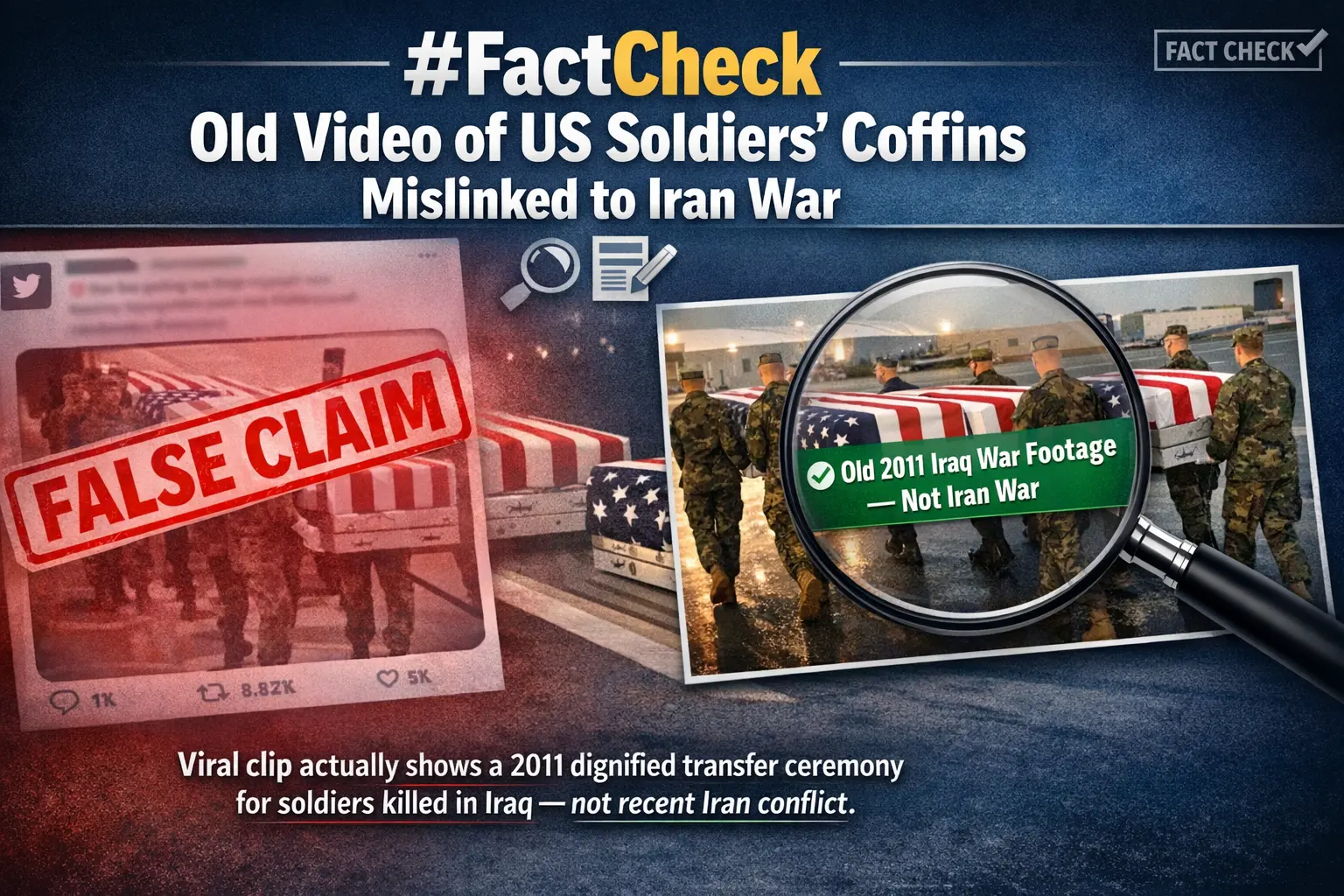
A video is being widely shared on social media showing soldiers carrying coffins with full military honours. Users are claiming that the footage shows the bodies of American soldiers who were killed in the war with Iran being brought back to the United States.
However, research by the CyberPeacefound the viral claim to be misleading. Our research revealed that the video has no connection to the recent Iran-Israel conflict. The footage actually dates back to December 2025, when an Islamic State gunman in Syria killed two US soldiers and a US civilian.
Following that incident, the bodies of the victims were transported with military honours, and the ceremony was recorded in the viral video. The clip is now being circulated online with a false claim.
Claim
On March 1, 2026, an Instagram user shared the viral video claiming that it shows the bodies of American soldiers returning to the US after being killed in the war against Iran. The caption of the post reads: “Bodies of American soldiers martyred against Iran are returning to the United States. War always brings destruction, which we are now witnessing.”
The link to the post and its archived version can be seen below.

Fact check
To verify the claim, we extracted key frames from the viral video and performed a reverse image search using Google Lens. During the search, we found the full version of the video in a report published by BBC on December 18, 2025. This confirms that the footage predates the current developments.

According to the BBC report, US President Donald Trump attended a dignified transfer ceremony for two members of the US National Guard and a US civilian who were killed in Syria. The somber ceremony took place at Dover Air Force Base in Delaware, United States. The US Central Command (Centcom) stated that the two soldiers and a civilian interpreter were killed in an ambush carried out by an Islamic State (IS) gunman in Syria. The US Army identified the two soldiers as Sgt. Edgar Brian Torres-Tovar (25) of Des Moines and Sgt. William Nathaniel Howard (29) of Marshalltown. A US civilian interpreter, Ayad Mansoor Sakat, was also killed in the attack. Officials said that three other service members were injured during the attack, and the gunman was engaged and killed. Syria’s state media also reported that two Syrian security personnel were injured in the incident.
Further research led us to a report published on the News Nation YouTube channel on December 18, 2025, which also featured the same footage related to the incident.

Conclusion
Our research found that the viral video is not related to the recent Iran-Israel conflict. The footage dates back to December 2025, when two US soldiers and a US civilian were killed in an Islamic State attack in Syria. The video shows the dignified transfer of their remains and is now being shared on social media with a misleading claim.
