
Debunking the Viral Claim of Free Travel Service for Women at Night
Introduction
In the age of social media, the news can spread like wildfire. A recent viral claim contained that police have started a nationwide scheme of free travel service for women at night. It stated that any woman who is alone and cannot find a vehicle to go home between 10 PM and 06 AM can contact the provided numbers and request a free vehicle. The viral message further contained the request to share and forward this information to everyone to get the women to know about the free vehicle service offered by police at night. However, upon fact check the claim was found to be misleading.
Social Impact of Misleading Information
The fact that such misleading information gets viral at a fast speed is because of its ability to impact and influence people through emotional resonance. Especially during a time when women's safety is a topic discussed in media sensationalism due to recently highlighted rape or sexual violence incidents, such fake viral claims often spark widespread public concern, causing emotional resonance to people and they unknowingly share or forward such messages in the spike of emotional and sensational appeal contained in such messages. The emotional nature of these viral texts often overrides scepticism, leading to immediate sharing without verification.
Such nature of viral messages often tends to bring people to protest, raise awareness and create support networks, but in spite of emotional resonance people get targeted by misinformation and become the unintended superspreaders of fake news fueled by emotional and social media-driven reactions. Women’s safety in society is a sensitive topic and when people discover such viral claims to be misleading and fake, it often hurts the sentiments of society leading to significant social impacts, including distrust in social media, unnecessary panic and confusion.
CyberPeace Policy Vertical Advisory for Social Media Users
- Think before Sharing: All netizens must practice caution while sharing anything and double-check its authenticity before sharing/forwarding or reposting it on your social media stories.
- Don't be unintended superspreaders of Misinformation: Misinformation with emotional resonance and widespread sharing by netizens can lead to them becoming "superspreaders of misinformation" and making it viral quickly. Hence you must avoid such unintended consequences by following the best practices of being vigilant and informed by reliable sources.
- Exercise vigilance and scepticism: It is important that netizens exercise vigilance and they build cognitive abilities to recognise the red flags of misleading information. You can do so by following the official communication channels, looking for any discrepancy in the content of susceptible information and double-checking its authenticity before sharing it with anyone.
- Verify the information from official sources: Follow the official communication channels of concerned authorities for any kind of information, circulars, notifications etc. In case of finding any piece of information to be susceptible or misleading, intimate it to the relevant authority and the fact-checking organizations.
- Stay in touch with expert organizations: Cybersecurity experts and civil society organisations possess the unique blend of large-scale impact potential and technical expertise. Netizens can stay updated about recent developments in the tech-policy sphere and learn about internet best practices, and measures to counter misinformation through methods such as prebunking, debunking and more.
Connect with CyberPeace
As an expert organisation, we have the ability to educate and empower huge numbers, along with the skills and policy acumen needed to be able to not just make people aware of the problem but also teach them how to solve it for themselves. At CyberPeace we regularly produce fact-check reports, blogs & advisories, and insights on prebunking & debunking measures and capacity-building programs with the aim of empowering netizens at the heart of our initiatives. CyberPeace has established the largest network of CyberPeace Corps volunteers globally. These volunteers play a crucial role in assisting victims, raising awareness, and promoting proactive measures.
References:

Related Blogs
Executive Summary
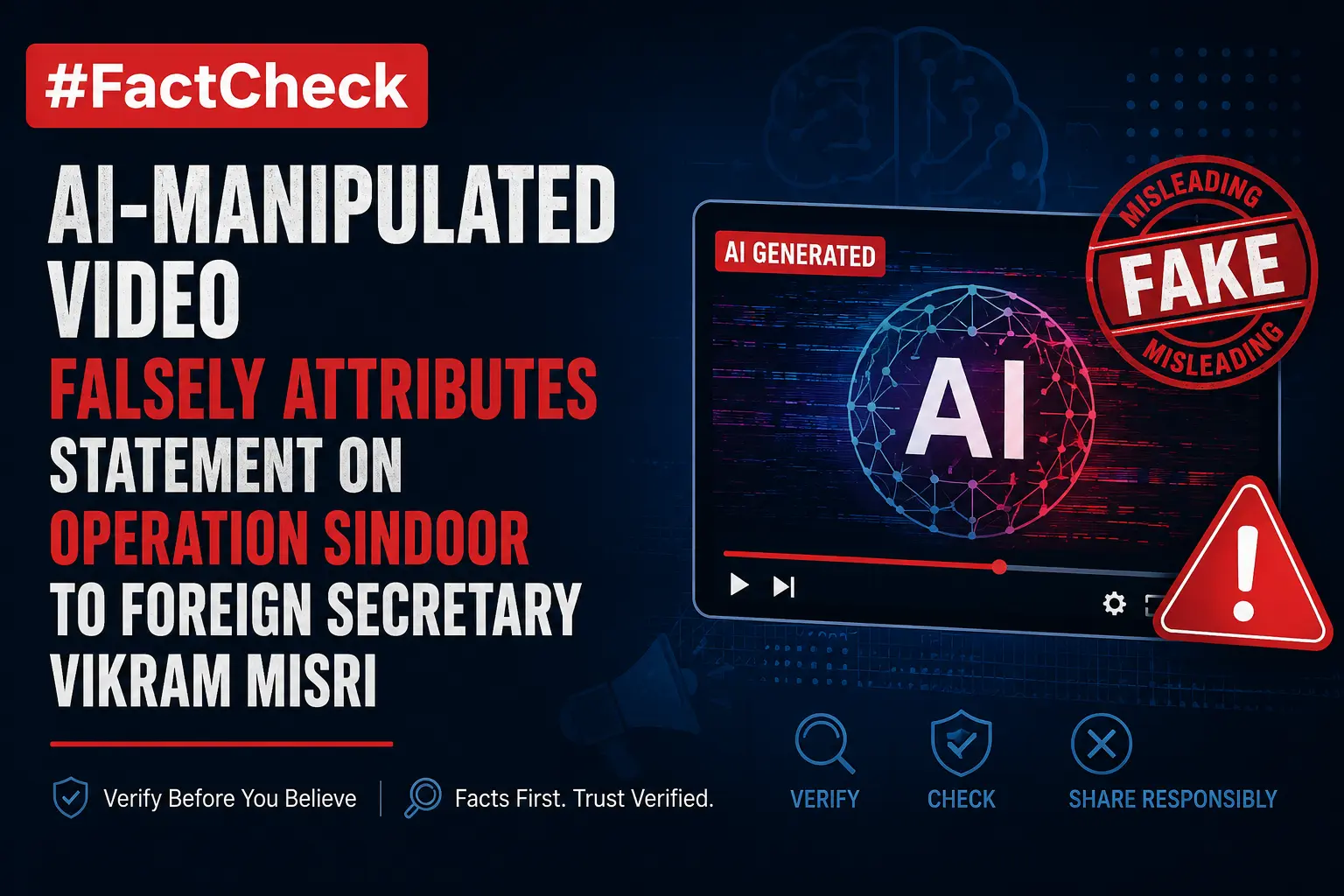
A video of Foreign Secretary Vikram Misri speaking to a reporter is being circulated on social media with the claim that he said the Indian government was forced to publicly acknowledge the soldiers killed during Operation Sindoor due to political pressure from the families of the deceased. Research conducted by the CyberPeace Research Wing found that the viral video had been manipulated using artificial intelligence (AI). Vikram Misri's voice was artificially cloned, meaning the audio heard in the clip is not genuine but has been generated and altered using AI technology.
Claim
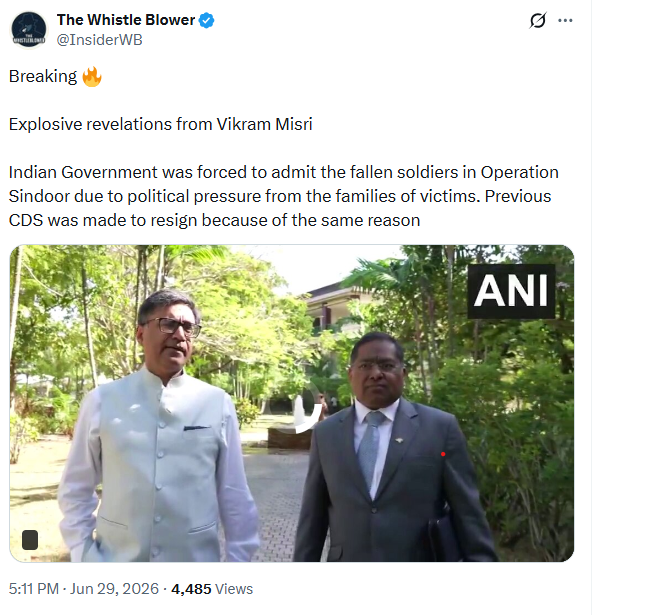
The video was shared on X (formerly Twitter) with the following caption: "Breaking. Explosive revelations from Vikram Misri. Indian Government was forced to admit the fallen soldiers in Operation Sindoor due to political pressure from the families of victims. Previous CDS was made to resign because of the same reason."
https://x.com/InsiderWB/status/2071642756125008031
Fact Check
We conducted a reverse image search using Google Lens, which led us to a video uploaded on The Tribune's verified YouTube channel that matched the viral clip. In the original video, Vikram Misri clarified that the Government of India neither officially participated in, supported, nor was involved in any event related to India-Pakistan dialogue. He further stated that the government had taken no cognisance of such private events and that the retired dignitaries and diplomats present were expressing their personal views, not speaking on behalf of the Government of India.
https://www.youtube.com/watch?v=wCrv0Vcgp28

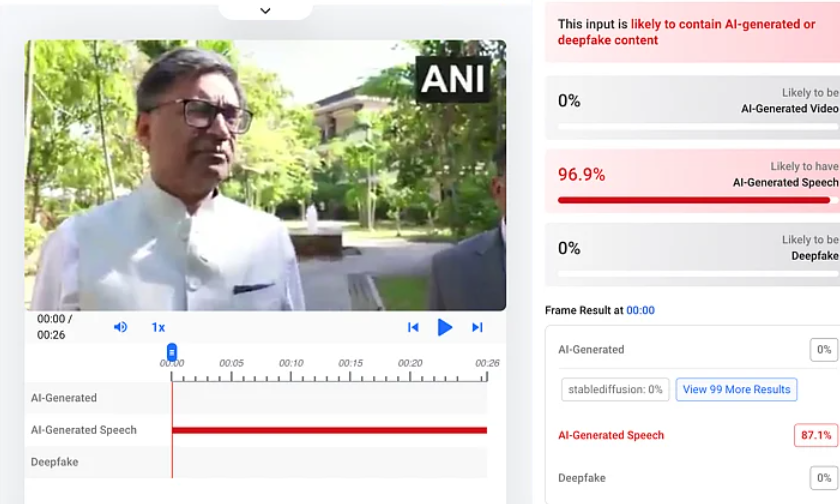
Since we found no evidence that Vikram Misri had ever made the statements attributed to him in the viral clip, we analysed the video using Hive Moderation's AI-generated content detection tool. The analysis indicated that the viral video is 96 per cent AI-generated.
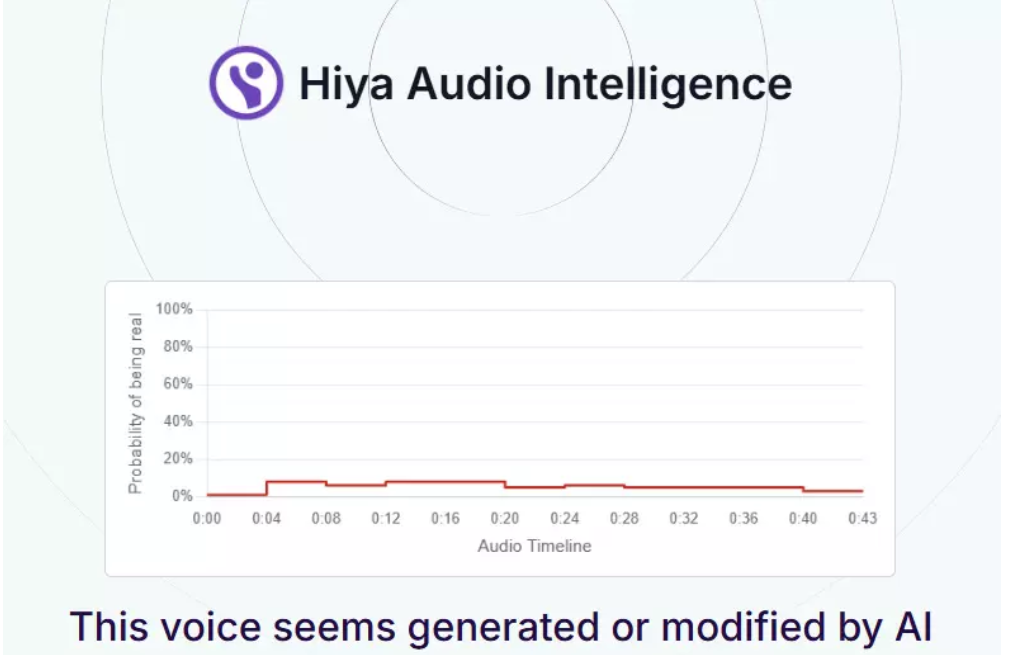
To further verify the claim, we analysed the audio using Hiya Audio Intelligence. The tool concluded that the voice in the viral video appears to have been generated or modified using artificial intelligence.
Conclusion
The viral video is misleading. Our research found that the video of Foreign Secretary Vikram Misri had been manipulated using artificial intelligence. He never made any statement claiming that the Indian government disclosed the names of soldiers killed during Operation Sindoor due to pressure from their families. Therefore, the viral claim is false.
![Securing Digital Banking: RBI Mandates Migration to [.]bank[.]in Domains](https://cdn.prod.website-files.com/64b94adadbfa4c824629b337/6818602cfbcc953fcae859a1_POLICY%20TEAM%20COVER%20PAGES%20-21%20(1).webp)
Introduction
The Reserve Bank of India (RBI) has mandated banks to switch their digital banking domains to 'Bank.in' by October 31, 2025, as part of a strategy to modernise the sector and maintain consumer confidence. The move is expected to provide a consistent and secure interface for online banking, as a response to the increasing threats posed by cybercriminals who exploit vulnerabilities in online platforms. The RBI's directive is seen as a proactive measure to address the growing concerns over cybersecurity in the banking sector.
RBI Circular - Migration to '.bank.in' domain
The official circular released by the RBI dated April 22, 2025, read as follows:
“It has now been decided to operationalise the ‘. bank.in’ domain for banks through the Institute for Development and Research in Banking Technology (IDRBT), which has been authorised by National Internet Exchange of India (NIXI), under the aegis of the Ministry of Electronics and Information Technology (MeitY), to serve as the exclusive registrar for this domain. Banks may contact IDRBT at sahyog@idrbt.ac.in to initiate the registration process. IDRBT shall guide the banks on various aspects related to application process and migration to new domain.”
“All banks are advised to commence the migration of their existing domains to the ‘.bank.in’ domain and complete the process at the earliest and in any case, not later than October 31, 2025.”
CyberPeace Outlook
The Reserve Bank of India's directive mandating banks to shift to the 'Bank.in' domain by October 31, 2025, represents a strategic and forward-looking measure to modernise the nation’s digital banking infrastructure. With this initiative, the RBI is setting a new benchmark in cybersecurity by creating a trusted, exclusive domain that banks must adopt. This move will drastically reduce cyber threats, phishing attacks, and fake banking websites, which have been major sources of financial fraud. This fixed domain will simplify verification for consumers and tech platforms to more easily identify legitimate banking websites and apps. Furthermore, a strong drop in online financial fraud will have a long-term effect by this order. Since phishing and domain spoofing are two of the most prevalent forms of cybercrime, a shift to a strictly regulated domain name system will remove the potential for lookalike URLs and fraudulent websites that mimic banks. As India’s digital economy grows, RBI’s move is timely, essential, and future-ready.
References

Introduction
Google Play has announced its new policy which will ensure trust and transparency on google play by providing a new framework for developer verification and app details. The new policy requires that new developer accounts on Google Play will have to provide a D-U-N-S number to verify the business. So when an organisation will create a new Play Console developer account the organisation will need to provide a D-U-N-S number. Which is a nine-digit unique identifier which will be used to verify their business. The new google play policy aims to enhance user trust. And the developer will provide detailed developer details on the app’s listing page. Users will get to know who is behind the app which they are installing.
Verifying Developer Identity with D-U-N-S Numbers
To boost security the google play new policy requires the developer account to provide the D-U-N-S number when creating a new Play Console developer account. The D-U-N-S number assigned by Dun & Bradstreet will be used to verify the business. Once the developer creates his new Play Console developer account by providing a D-U-N-S number, Google Play will verify the developer’s details, and he will be able to start publishing the apps. Through this step, Google Play aims to validate the business information in a more authentic way.
If your organisation does not have a D-U-N-S number, you may check on or request for it for free on this website (https://www.dnb.com/duns-number/lookup.html). The request process for D-U-N-S can take up to 30 days. Developers are also required to keep the information up to date.
Building User Trust with Enhanced App Details
In addition to verifying developer identities in a more efficient way, google play also requires that developer provides sufficient app details to the users. There will be an “App Support” section on the app’s store listing page, where the developer will display the app’s support email address and even can include their website and phone number for support.
The new section “About the developer” will also be introduced to provide users with verified identity information, including the developer’s name, address, and contact details. Which will make the users more informed about the valuable information of the app developers.
Key highlights of the Google Play Polic
- Google Play came up with the policy to keep the platform safe by verifying the developers’ identity and it will also help to reduce the spread of malware apps and help the users to make confident informed decisions about the apps they download. Google Play announced the policy by expanding its developer verification requirement to strengthen Google Play as a platform and build user trust. When you create a new Play Console Developer account and choose organisation as your account type you will now need to provide a D-U-N-S number.
- Users will get detailed information about the developers’ identities and contact information, building more transparency and encouraging responsible app development practices.
- This policy will enable the users to make informed choices about the apps they download.
- The new “App support” section will provide enhanced communication between users and developers by displaying support email addresses, website and support phone numbers, streamlining the support process and user satisfaction.
Timeline and Implementation
The new policy requirements for D-U-N-S numbers will start rolling out on 31 August 2023 for all new Play Console developer accounts. The “About the developer” section will be visible to users as soon as a new app is published. and In October 2023, existing developers will also be required to update and verify their existing accounts to comply with the new verification policy.
Conclusion
Google Play’s new policy will aim to enhance the more transparent app ecosystem. This new policy will provide the users with more information about the developers. Google Play aims to establish a platform where users can confidently discover and download apps. This new policy will enhance the user experience on google play in terms of a reliable and trustworthy platform.
