
Britain's Military Drone Cameras Were Sending Data to China | Here Is What the Breach Actually Reveals
Introduction
Military equipment used by elite special forces is supposed to be the most tightly secured hardware a country owns, the last place anyone would expect a hidden flaw in its parts supply chain to slip through undetected. Yet that is precisely where one surfaced this August, when The Telegraph, revealed that cameras fitted to the Royal Navy's K3 Scout surveillance drones, equipment used by Britain's Royal Marines and closely associated with the Special Boat Service, the United Kingdom's elite maritime special forces unit, had been secretly transmitting signals to an internet address inside China. The United Kingdom's Ministry of Defence stripped the affected cameras of all internet connectivity the moment the transmissions were discovered, and has spent the days since insisting no sensitive data actually left the country. That distinction, between what was taken and what was exposed, is where this incident becomes genuinely worth examining.
What was actually found, and what was not
The K3 Scout is an 8.4 metre uncrewed surface vessel built by Kraken Technology Group, a British defence manufacturer based in Fareham, Hampshire, capable of reaching 55 knots and remaining at sea for up to 30 days. The Royal Navy purchased roughly 20 of these vessels under Project Beehive, a £12 million programme designed to fold autonomous systems into frontline maritime operations quickly, and the Royal Marines' Coastal Forces Squadron and 47 Commando have operated the fleet since March 2026.
A routine cyber vulnerability assessment, not an external tip off or an adversarial intrusion, is what caught the problem. Investigators found the electro-optical and infrared cameras mounted on the vessels sending what the industry calls heartbeat communications, routine signals a connected device sends simply to confirm it is powered on and functioning, to an IP address located in China. Kraken did not manufacture the cameras in house; the company sourced them from a third party supplier that had reportedly given assurances about their security, assurances the heartbeat traffic now calls directly into question.
Every source, including the UK Ministry of Defence itself, confirms the cameras were sending signals to an IP address in China. What remains unconfirmed is which company actually manufactured the compromised camera components. Neither The Telegraph nor the Ministry of Defence has publicly named the specific camera manufacturer, and an unverified social media claim allegedly identifying a Canadian supplier has since been disputed by that company, with no confirmation from official sources tying it to the incident as of now.
Crucially, the UK Ministry of Defence has been consistent on one point across every statement it has issued: its investigation found no evidence that classified information, government systems, or mission critical data were accessed, compromised, or transmitted outside the country. That is a meaningful distinction, and one worth taking at face value rather than dismissing as reflexive reassurance, since heartbeat signals by design carry connectivity status rather than payload content. But security researchers who reviewed the case have been equally consistent in noting that even metadata this thin has value to a watching adversary. Knowing when and where a piece of specialised military hardware is powered on and actively connected can itself function as a targeting signal, revealing patterns of deployment, operational tempo, and geographic presence without a single classified file ever leaving the device.
Why this particular fleet matters
The timing sharpens the concern considerably. A defence source cited in reporting on the story indicated the K3 Scout fleet was being considered as part of a future British contribution to securing freedom of navigation in the Strait of Hormuz, where the United Kingdom has already deployed a warship amid discussions of a multinational security mission. Equipment destined for a contested, strategically sensitive waterway having any unexplained data path back to a systemic rival's territory is not a detail that stays confined to a procurement footnote. The vessels were also tested during a NATO exercise in the Baltic Sea in 2025, meaning any compromised telemetry pattern could theoretically have been observed by the very alliance partners Britain was demonstrating the technology to.
The deeper issue is structural rather than incidental. Modern military hardware, however elite the unit operating it, is rarely built end to end by a single trusted manufacturer. Cameras, sensors, chipsets, and firmware routinely pass through several tiers of suppliers before reaching a finished platform, and each tier is a potential point where the chain of custody and verification can quietly break down. Kraken's own assurances about its camera supplier illustrate exactly how that failure propagates: a manufacturer can act in good faith, rely on a vendor's word, and still end up fielding compromised hardware, because the vulnerability was never introduced at the assembly stage but several layers upstream, in components whose ultimate origin was never fully audited.
CyberPeace View | A wider principle worth naming
There is a broader ethical and legal frame worth applying here, one that extends beyond ordinary cybersecurity practice into the territory international humanitarian law occupies. The core distinction that law draws, between combatants and protected persons, between military objectives and civilian life, depends fundamentally on operators having accurate, uncompromised situational awareness. A surveillance platform is not merely a piece of hardware; it is the sensory apparatus through which decisions with real consequences for human life get made in contested environments. If the integrity of that apparatus cannot be guaranteed, the reliability of everything built on top of it, target verification, proportionality assessments, distinction between combatant and civilian, is quietly weakened at its foundation. This is not a claim that the K3 Scout breach itself caused harm; the Ministry of Defence's own findings suggest it did not. It is a reminder that supply chain integrity in military sensing equipment is not simply a procurement or cybersecurity concern sitting apart from the laws of armed conflict. It sits underneath them, because a compromised sensor is, in a very real sense, a compromised judgment further down the chain.
Where India fits into this story
India has been grappling with functionally the same problem for years, and its response offers a useful point of comparison. Reporting dating back to 2023 revealed that Indian defence officials had quietly barred domestic drone manufacturers from using components sourced from countries sharing a land border with India, an unmistakable, if unstated, reference to China, citing exactly the kind of vulnerability now playing out in Britain's fleet, compromised communication functions, cameras, and operating software capable of leaking intelligence. That policy has hardened considerably since. Earlier this year, the Ministry of Defence in New Delhi finalised a stringent framework requiring that drones procured from domestic manufacturers contain no Chinese origin components or electronics at all, and at least one major drone order was placed on hold after allegations surfaced that the supplier had used Chinese parts despite those restrictions.
The commercial consequence of that caution has been real and acknowledged openly by industry figures; sourcing components outside China raises costs, given that up to 70 percent of the global drone supply chain has historically run through Chinese manufacturing. But India appears to have concluded, well ahead of this particular British incident becoming public, that the cost of auditing and diversifying a supply chain is lower than the cost of fielding compromised sensing equipment inside sensitive military operations. Indian firms have responded by building propulsion, avionics, and camera systems in house specifically to close this gap, treating component provenance as a first order design question rather than an afterthought bolted on after a breach forces the issue. Seen from that vantage point, the K3 Scout episode reads less like a uniquely British failure and more like a case study in a risk India's own defence establishment had already priced in.
Lessons from the breach
A few conclusions follow fairly directly from how this incident unfolded. First, routine cyber vulnerability assessments work, and this case is arguably an argument for doing more of them, more often, rather than a sign that current practice failed; the breach was caught internally, before any confirmed operational harm occurred. Second, a manufacturer's own assurances about a component supplier are not a substitute for independent verification, since Kraken's good faith reliance on its camera vendor's word is precisely where this vulnerability slipped through. Third, and most durably, defence procurement increasingly needs to treat component provenance as inseparable from operational security, not as a compliance checkbox to be satisfied once at contract signing. India's multi-year pivot toward auditing and localising sensitive component supply chains, imperfect and costly as it has been, points toward the direction other defence establishments will likely be pushed in as more incidents like this one surface. The K3 Scout breach did not, on the evidence available, compromise a single mission. What it compromised was the assumption that hardware assurances alone are sufficient, and that assumption was never going to survive close scrutiny forever.
References
- LBC, "Spy cameras on Navy drones used by UK's elite special forces sending signals to China as security fears grow." https://www.lbc.co.uk/article/royal-navy-spy-drones-sending-signals-to-china-5Hjdfpm_2/
- Defence Blog, "Royal Navy naval drone cameras secretly sent data to China." https://defence-blog.com/royal-navy-naval-drone-cameras-secretly-sent-data-to-china/
- The National Interest, "The Royal Navy's Spy Drones May Have Been Spying for China, Too." https://nationalinterest.org/blog/buzz/royal-navys-spy-drones-may-have-been-spying-for-china-too-sa-081026
- Kyiv Post, "UK Navy Drone Camera Components Were Secretly Communicating With China." https://www.kyivpost.com/post/82061
- The Defense News, "UK's Royal Navy K3 Scout Drone Cameras Found Sending Data to an IP Address in China." https://www.thedefensenews.com/UKs-Royal-Navy-K3-Scout-Drone-Cameras-Found-Sending-Data-to-an-IP-Address-in-China/
- The Jerusalem Post, "UK drones sent data to China, raising US, European fears on Chinese components." https://www.jpost.com/international/article-905191
- Firstpost, "UK military drones fitted with Chinese cameras found sending data to Beijing: Report." https://www.firstpost.com/world/uk-military-drones-fitted-with-chinese-cameras-found-sending-data-to-beijing-report-14037075.html
- Firstpost, "UK deploys warship to West Asia amid plans for multinational Hormuz security mission." https://www.firstpost.com/world/uk-deploys-warship-to-west-asia-amid-plans-for-multinational-hormuz-security-mission-ws-e-14009471.html
- Reuters via Inquirer.net, "India bars makers of military drones from using Chinese parts." https://newsinfo.inquirer.net/1813810/india-bars-makers-of-military-drones-from-using-chinese-parts
- The Print, "Amid concerns about use of Chinese parts in drones, Army general urges industry to be transparent." https://theprint.in/defence/amid-concerns-about-use-of-chinese-parts-in-drones-army-general-urges-industry-to-be-transparent/2305866/
- idrw.org, "India Unveils Drone Security Framework to Eliminate Chinese Components and Strengthen UAV Cyber Defences." https://idrw.org/india-unveils-drone-security-framework-to-eliminate-chinese-components-and-strengthen-uav-cyber-defences/
- The Week, "The hidden weakness in India's military drones: Zen Technologies says it has fixed the Chinese problem." https://www.theweek.in/news/defence/2026/07/09/the-hidden-weakness-in-indias-military-drones-zen-technologies-says-it-has-fixed-the-chinese-problem.html

Related Blogs

Executive Summary:
A video is being widely circulated on social media in connection with the relief and rescue operations following the devastating floods in Nepal. The video shows security personnel rescuing a girl trapped under debris and later giving her soup. The video is being shared with the claim that security personnel rescued a girl who had been buried under mud three days after the disaster in Timure village of Nepal’s Rasuwa district. A research by CyberPeace Research Wing found the viral claim to be false. Our research revealed that the viral video does not depict a real incident but is AI-generated.
Claim:
A user on social media platform X (formerly Twitter) shared the viral video with the caption: “Nepal: It was nothing short of a miracle to witness this. After three days, death had to retreat and life emerged victorious. A six-year-old girl, who had been buried under the disaster debris for three days, was rescued by Nepal’s security forces. The incident took place in Timure village of Nepal’s Rasuwa district. Six-year-old Manisha was pulled out alive after being buried under debris caused by floods and landslides.”
https://x.com/AjitSinghRathi/status/2094306889001742826?s=20

Fact Check:
A close examination of the viral video revealed several inconsistencies, raising suspicions that the video was AI-generated. We then scanned the viral video using the AI detection tool Hive Moderation. According to the results, there is a 77 per cent likelihood that the viral video is AI-generated.

As part of our research, we scanned the video using the AI detection tool Wasitai. According to the results, the viral video is AI-generated.

Conclusion:
Our research found the viral claim to be false. Our findings revealed that the viral video does not depict a real incident but is AI-generated.

Executive Summary
A video is being widely circulated on social media by Pakistani users as propaganda against the Indian Army. In the video, a man can be seen being beaten by a group of women in the middle of a road. Based on the viral video, it is being claimed that in Phuket, Thailand, Lieutenant General Rajiv Kiran Sahni, DG EME of the Indian Army, was thrashed by "ladyboys" after he allegedly harassed them and refused to pay the full amount.
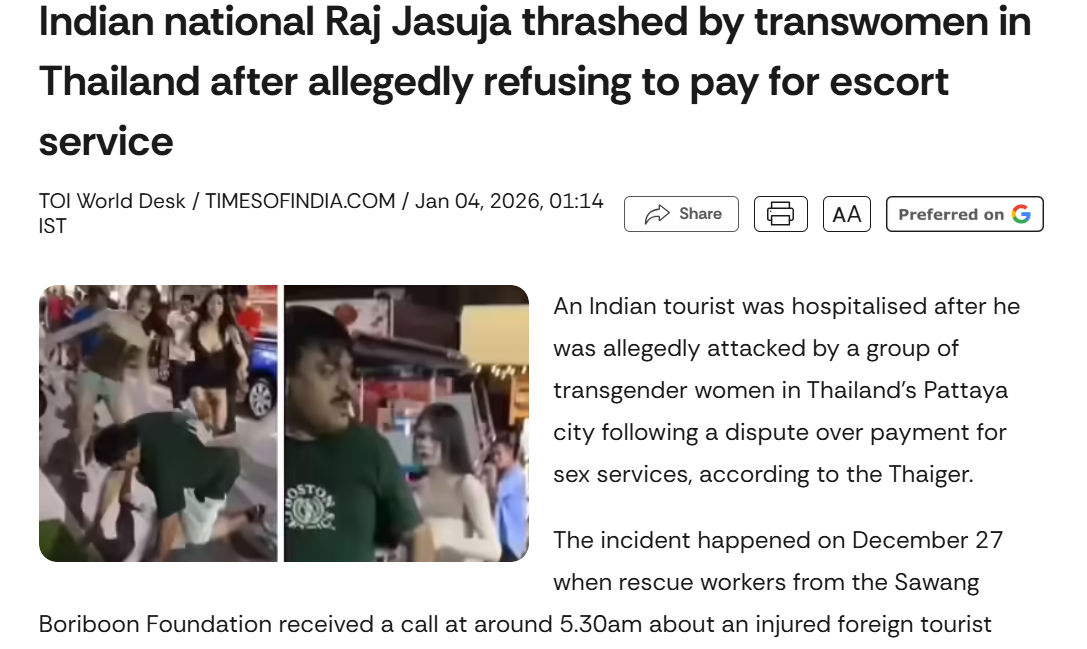
Research by the CyberPeace Research Wing found the viral claim to be misleading and baseless. The viral video has no connection with Lieutenant General Rajiv Kiran Sahni (DG EME) of the Indian Army. According to credible media reports obtained during the research, this incident took place in Pattaya, Thailand, in December 2025, where a dispute over payment allegedly broke out between an Indian tourist named Raj Jasuja and some transgender women (ladyboys). Subsequently, the tourist was assaulted.
Claim:
A Pakistani website shared the viral video claiming that Indian Army Lieutenant General Rajiv Kiran Sahni (DG EME) was publicly thrashed in Phuket, Thailand, by ladyboys after he harassed them and refused to pay the full amount.

Meanwhile, on the social site X (formerly Twitter), a user shared the viral video and wrote, “Indian Army Lt Gen Rajiv Kiran Sahni, DG EME, thrashed by Thai ladyboys in Phuket after harassing them and refusing to pay full amount. They think they can bully and oppress people everywhere like Christians in Manipur, but Thailand showed them the reality.”
https://x.com/uthmanrumi2025/status/2061554209036898369

Fact Check:
To investigate the claim made with the viral video, we conducted a reverse search of the video's keyframes. During this process, we found a report by The Times of India. The report, published on January 4, 2026, stated that “According to 'The Thaiger', an Indian tourist was hospitalized in Pattaya, Thailand. It is alleged that a group of transgender women attacked him following a dispute over payment for escort services. The incident occurred on December 27, when rescue workers from the Sawang Boriboon Foundation received a call around 5:30 AM regarding an injured foreign tourist near the beachside entrance of Walking Street. According to the rescue workers who found the victim, he was identified as 52-year-old Indian national Raj Jasuja. Injury marks were clearly visible on his face and the back of his head. He was given first aid before being taken to the hospital for further treatment. A 19-year-old Thai witness, Pongpol Boonchid, told police and rescue workers that the fight began when Raj was seen arguing with a transgender sex worker near the entry gate of Walking Street. The row escalated as both began chasing and hitting each other. According to the witness, the transgender woman then called several of her friends, who arrived and collectively attacked the Indian tourist. It is believed the fight started over money, as the tourist reportedly did not pay the full amount agreed upon for the services. Raj has not made any public statement regarding the incident.”
Furthermore, another report by The Indian Express, published on January 5, 2026, stated regarding the incident: “A group of transgender women allegedly beat up an Indian tourist in Pattaya, Thailand, according to a local media report. The dispute reportedly arose over non-payment of fees for sex services. In a viral video from December 27, three transgender women are seen hitting the 52-year-old man with slippers. The situation worsened when the man refused to pay the requested amount and tried to leave the spot in a car. The transgender women accused the man of not paying. Subsequently, he was allegedly kicked and punched, after which emergency responders intervened. According to a report by 'The Thaiger', the man suffered injuries to his face and the back of his head. He was given first aid on the spot and later taken to Pattamaku Hospital for further treatment. A Thai eyewitness told rescue workers that he saw the man arguing with a transgender sex worker near the entrance of the famous 'Walking Street' area. The witness stated that the argument turned into a physical altercation, with both parties reportedly chasing and hitting each other, after which others joined in, turning it into a group attack. According to the report, the witness further claimed the dispute occurred because the Indian tourist allegedly did not pay the full amount fixed for sexual services. Thai police said they would ask the man to file a formal complaint once he fully recovers.”

Conclusion:
Our research found the viral claim to be misleading and baseless. The viral video has no connection with Lieutenant General Rajiv Kiran Sahni (DG EME) of the Indian Army. According to credible media reports, the incident occurred in Pattaya, Thailand, where in December 2025, an Indian tourist named Raj Jasuja had a dispute over payment with some transgender women (ladyboys), leading to the assault.

Introduction
Today, on the International Day of UN Peacekeepers, we honour the brave individuals who risk their lives to uphold peace in the world’s most fragile and conflict-ridden regions. These peacekeepers are symbols of hope, diplomacy, and resilience. But as the world changes, so do the arenas of conflict. In today’s interconnected age, peace and safety are no longer confined to physical spaces—they extend to the digital realm. As we commemorate their service, we must also reflect on the new frontlines of peacekeeping: the internet, where misinformation, cyberattacks, and digital hate threaten stability every day.
The Legacy of UN Peacekeepers
Since 1948, UN Peacekeepers have served in over 70 missions, protecting civilians, facilitating political processes, and rebuilding societies. From conflict zones in Africa to the Balkans, they’ve worked in the toughest terrains to keep the peace. Their role is built on neutrality, integrity, and international cooperation. But as hybrid warfare becomes more prominent and digital threats increasingly influence real-world violence, the peacekeeping mandate must evolve. Traditional missions are now accompanied by the need to understand and respond to digital disruptions that can escalate local tensions or undermine democratic institutions.
The Digital Battlefield
In recent years, we’ve seen how misinformation, deepfakes, online radicalisation, and coordinated cyberattacks can destabilise peace processes. Disinformation campaigns can polarise communities, hinder humanitarian efforts, and provoke violence. Peacekeepers now face the added challenge of navigating conflict zones where digital tools are weaponised. The line between physical and virtual conflict is blurring. Cybersecurity has gone beyond being just a technical issue and is now a peace and security issue as well. From securing communication systems to monitoring digital hate speech that could incite violence, peacekeeping must now include digital vigilance and strategic digital diplomacy.
Building a Culture of Peace Online
Safeguarding peace today also means protecting people from harm in the digital space. Governments, tech companies, civil society, and international organisations must come together to build digital resilience. This includes investing in digital literacy, combating online misinformation, and protecting human rights in cyberspace. Peacekeepers may not wear blue helmets online, but their spirit lives on in every effort to make the internet a safer, kinder, and more truthful place. The role of youth, educators, and responsible digital citizens has never been more crucial. A culture of peace must be cultivated both offline and online.
Conclusion: A Renewed Pledge for Peace
On this UN Peacekeepers’ Day, let us not only honour those who have served and sacrificed but also renew our commitment to peace in all its dimensions. The world’s conflicts are evolving, and so must our response. As we support peacekeepers on the ground, let’s also become peacebuilders in the digital world, amplifying truth, rejecting hate, and building safer, inclusive communities online. Peace today is not just about silencing guns but also silencing disinformation. The call for peace is louder than ever. Let’s answer it, both offline and online.
