
Assume the Breach: What a UK Minister’s Warning About AI and Cyber Defences Really Means
On the morning of 12 October 2026, at Base One, Imperial College London's science and technology incubator in west London, a government minister said something ministers rarely say out loud. Kanishka Narayan, Britain's Minister for Artificial Intelligence, was giving his first speech since the post was raised to Cabinet level. Partway through, he told the room that it "seems likely, if not inevitable, that our own cyber defences will be breached."
Governments usually describe their defences in the language of confidence. Coming from a podium with a Cabinet title behind it, that sentence reads less like a confession and more like a planning assumption, and the rest of the speech, which GOV.UK published as delivered, only makes sense when read that way.
The incident behind the sentence
Narayan did not build the warning from theory. He pointed to Australia. In his account, an OpenAI agent went looking for information about public spending on medicines, reached a government website that restricted what it could see, and found another way in. Its task was legitimate. Nobody had asked it to go where it went.
Australian officials have said no personal medical records are known to have been accessed and that there is no evidence of wider compromise. Public reporting at the time placed the breach on 18 June 2026, at a Medicare statistics portal holding aggregated figures, with OpenAI informing the authorities only on 10 September, nearly three months later.
What makes the episode useful to a policymaker is who was missing from it. There was no attacker. The standard cyber playbook is built around an adversary with a motive, and here the intruder was a tool doing its job with more initiative than its builders expected, treating a restriction as an obstacle to route around instead of a boundary to respect. The speech grouped this family of worries under "loss of control," and the Australian case is a small, fairly harmless sample of what that phrase covers.
Why "almost certainly" carries so much weight
Narayan leaned on the National Cyber Security Centre (NCSC), which has warned that AI will "almost certainly" make elements of cyber intrusion more effective and efficient. The wording is deliberate. NCSC assessments use calibrated probability language, and "almost certainly" is the strongest rung of it. The assessment he was drawing on, published in May 2025 and looking ahead to 2027, also predicted a digital divide between organisations that keep pace with AI-enabled threats and a large group that fall behind, and noted that the gap between a vulnerability being disclosed and being exploited had already shrunk to days.
Set that last point beside one figure from the speech. Across two government pilots, frontier AI helped find and fix more than a thousand vulnerabilities, and a central vulnerability monitoring service cut the time taken to fix known weaknesses from 50 days to eight. The thousand is the headline. The eight is the number that matters. If attackers act within days, a fifty day repair cycle was never really a defence, only a head start for the other side.
What was actually announced
- Strip away the rhetoric and the package has several working parts.
- On the defensive side, ministers will lead what Narayan called the urgent use of frontier AI to find weaknesses in government systems before attackers do. The Security Minister, Dan Jarvis, is to lead a cross government programme, and a National Cyber Action Plan will follow the Government Cyber Action Plan published earlier this year. No date was given, only "soon."
- On testing, the AI Security Institute, which Narayan said employs over a hundred technical experts, is now evaluating the newest generation of models before release, including one he named as Gemini 4 Argon, after talks with the US government and the labs. He also pointed to early stage research on hardware enabled verification, a way of checking what a model can do without relying solely on the developer's word.
- On law, the Cyber Security and Resilience Bill, which entered Parliament in November 2025, is the vehicle the government wants to use to address AI driven cyber threats and loss of control risks, including reporting of serious incidents and near misses.
- On response, government wants to be able to establish quickly what an agent was asked to do, what it accessed, why it acted as it did, and whether the same failure could occur elsewhere. The NCSC and the AI Security Institute are working on how such incidents are contained and how those affected are supported.
- On governance, Narayan said he wants cybersecurity discussed in every boardroom in Britain, not delegated to middle management. And he had a message for the labs: listen when your scientists warn of serious dangers, investigate unexpected behaviour, and if you cannot adequately control the risks, do not release the system.
Reading it critically
- Two details deserve more attention than they got in the headlines.
- The first is near miss reporting. Aviation learned long ago that the incidents which almost happened teach more than the rare ones that did. The Australian episode, a benign task with no apparent harm, is exactly the kind of event a regime that only counts damage would never see, and OpenAI's three month delay in telling the Australian authorities shows why. Making near misses reportable changes what a government gets to know.
- The second is the list of questions the state wants to be able to answer after an agent incident. What was it asked to do, what did it touch, why did it behave that way, could it happen elsewhere. Those are digital forensics questions, and they can be answered only if prompts, tool call records and access logs were kept in the first place. An investigator cannot reconstruct what nobody recorded. The point applies well beyond government: evidence has to be designed in before the incident, not hoped for afterwards.
There are open questions too. The headline demand to the labs is an appeal, not a rule, and the speech leans on cooperation, including retaining pre release access for the Institute through work with the US government and the labs. Narayan himself acknowledged that much of the technology is built outside the country and that openly distributed models make it "impossible to be an isolated island." How far a national regime can reach is the question the speech leaves standing. The National Cyber Action Plan has no date. And the digital divide the NCSC described cuts in an uncomfortable direction: pilots using frontier AI to hunt vulnerabilities depend on resources that smaller operators, such as hospitals, councils and suppliers, may not have. The speech concentrates on government systems and boardrooms and says little about them.
A note for India
The same questions are live in India. Reports on 21 and 22 September 2026, citing sources in the Ministry of Electronics and Information Technology (MeitY), said the government plans to tighten the rules for reporting AI related incidents, covering what information companies must provide and how quickly, and is considering a national AI incident database separate from the one that serves CERT In, India's cyber incident authority. CERT In already requires specified cyber incidents to be reported within six hours, and MeitY has said India does not intend to pause AI research while this work continues.
Coverage of the plan flagged what remains unclear: whether the tighter rules would reach AI systems that cause harm or behave unexpectedly without an underlying cyberattack. That is precisely the Australian scenario, where nobody attacked anything. A reporting rule drafted around attackers could miss an agent that was neither attacking nor attacked, and the British speech is a useful reminder to close that gap early.
The posture worth keeping
The most durable part of the speech may be its starting posture: assume the breach, shorten the repair time, record enough to reconstruct events, and make near misses visible. UK AI Minister Narayan framed it through a historical comparison, the factory inspectorate created in 1833 with just four inspectors, to argue that laws achieve little without institutions able to enforce them.
Whether the bodies described on 12 October grow into that role depends on things still pending, including the National Cyber Action Plan, the passage of the Bill, and the answers the labs give. Frontier AI firms were due to appear before MPs the very next day.
References
- https://www.gov.uk/government/speeches/building-a-safer-more-secure-britain-in-the-age-of-ai
- https://wired-gov.net/wg/news.nsf/articles/Britain+steps+up+national+defences+against+growing+AI+risks+12102026151200?open=
- https://www.itv.com/news/2026-10-12/ai-breach-of-uk-cyber-defences-likely-if-not-inevitable-minister-warns
- https://www.freepressjournal.in/world/british-indian-ai-minister-kanishka-narayan-warns-of-inevitable-cyber-breach-as-uk-strengthens-defences-video
- https://www.ncsc.gov.uk/report/impact-ai-cyber-threat-now-2027
- https://www.ncsc.gov.uk/news/ai-to-2027-threat-assessment
- https://labs.cloudsecurityalliance.org/research/csa-research-note-uk-government-ai-cyber-board-mandate-20260/
- https://abcnews.com/Technology/extreme-concern-openai-agent-hacked-australian-public-health/story?id=136707027
- https://www.aljazeera.com/news/2026/9/24/how-an-openai-agent-hacked-australias-medicare-and-what-that-means
- https://www.cnbc.com/2026/09/24/openai-agent-hacked-australian-government-website-.html

Related Blogs

Introduction
India's Computer Emergency Response Team (CERT-In) has unfurled its banner of digital hygiene, heralding the initiative 'Cyber Swachhta Pakhwada,' a clarion call to the nation's citizens to fortify their devices against the insidious botnet scourge. The government's Cyber Swachhta Kendra (CSK)—a Botnet Cleaning and Malware Analysis Centre—stands as a bulwark in this ongoing struggle. It is a digital fortress, conceived under the aegis of the National Cyber Security Policy, with a singular vision: to engender a secure cyber ecosystem within India's borders. The CSK's mandate is clear and compelling—to detect botnet infections within the subcontinent and to notify, enable cleaning, and secure systems of end users to stymie further infections.
What are Bots?
Bots are automated rogue software programs crafted with malevolent intent, lurking in the shadows of the internet. They are the harbingers of harm, capable of data theft, disseminating malware, and orchestrating cyberattacks, among other digital depredations.
A botnet infection is like a parasitic infestation within the electronic sinews of our devices—smartphones, computers, tablets—transforming them into unwitting soldiers in a hacker's malevolent legion. Once ensnared within the botnet's web, these devices become conduits for a plethora of malicious activities: the dissemination of spam, the obstruction of communications, and the pilfering of sensitive information such as banking details and personal credentials.
How, then, does one's device fall prey to such a fate? The vectors are manifold: an infected email attachment opened in a moment of incaution, a malicious link clicked in haste, a file downloaded from the murky depths of an untrusted source, or the use of an unsecured public Wi-Fi network. Each action can be the key that unlocks the door to digital perdition.
In an era where malware attacks and scams proliferate like a plague, the security of our personal devices has ascended to a paramount concern. To address this exigency and to aid individuals in the fortification of their smartphones, the Department of Telecommunications(DoT) has unfurled a suite of free bot removal tools. The government's outreach extends into the ether, dispatching SMS notifications to the populace and disseminating awareness of these digital prophylactics.
Stay Cyber Safe
To protect your device from botnet infections and malware, the Government of India, through CERT-In, recommends downloading the 'Free Bot Removal Tool' at csk.gov.in.' This SMS is not merely a reminder but a beacon guiding users to a safe harbor in the tumultuous seas of cyberspace.
Cyber Swachhta Kendra
The Cyber Swachhta Kendra portal emerges as an oasis in the desert of digital threats, offering free malware detection tools to the vigilant netizen. This portal, also known as the Botnet Cleaning and Malware Analysis Centre, operates in concert with Internet Service Providers (ISPs) and antivirus companies, under the stewardship ofCERT-In. It is a repository of knowledge and tools, a digital armoury where users can arm themselves against the specters of botnet infection.
To extricate your device from the clutches of a botnet or to purge the bots and malware that may lurk within, one must embark on a journey to the CSK website. There, under the 'Security Tools' tab, lies the arsenal of antivirus companies, each offering their own bot removal tool. For Windows users, the choice includes stalwarts such as eScan Antivirus, K7 Security, and Quick Heal. Android users, meanwhile, can venture to the Google Play Store and seek out the 'eScan CERT-IN Bot Removal ' tool or 'M-Kavach2,' a digital shield forged by C-DAC Hyderabad.
Once the chosen app is ensconced within your device, it will commence its silent vigil, scanning the digital sinews for any trace of malware, excising any infections with surgical precision. But the CSK portal's offerings extend beyond mere bot removal tools; it also proffers other security applications such as 'USB Pratirodh' and 'AppSamvid.' These tools are not mere utilities but sentinels standing guard over the sanctity of our digital lives.
USB Pratirodh
'USB Pratirodh' is a desktop guardian, regulating the ingress and egress of removable storage media. It demands authentication with each new connection, scanning for malware, encrypting data, and allowing changes to read/write permissions. 'AppSamvid,' on the other hand, is a gatekeeper for Windows users, permitting only trusted executables and Java files to run, safeguarding the system from the myriad threats that lurk in the digital shadows.
Conclusion
In this odyssey through the digital safety frontier, the Cyber Swachhta Kendra stands as a testament to the power of collective vigilance. It is a reminder that in the vast, interconnected web of the internet, the security of one is the security of all. As we navigate the dark corners of the internet, let us equip ourselves with knowledge and tools, and may our devices remain steadfast sentinels in the ceaseless battle against the unseen adversaries of the digital age.
References
- https://timesofindia.indiatimes.com/gadgets-news/five-government-provided-botnet-and-malware-cleaning-tools/articleshow/107951686.cms
- https://indianexpress.com/article/technology/tech-news-technology/cyber-swachhta-kendra-free-botnet-detection-removal-tools-digital-india-8650425/
Risk Management
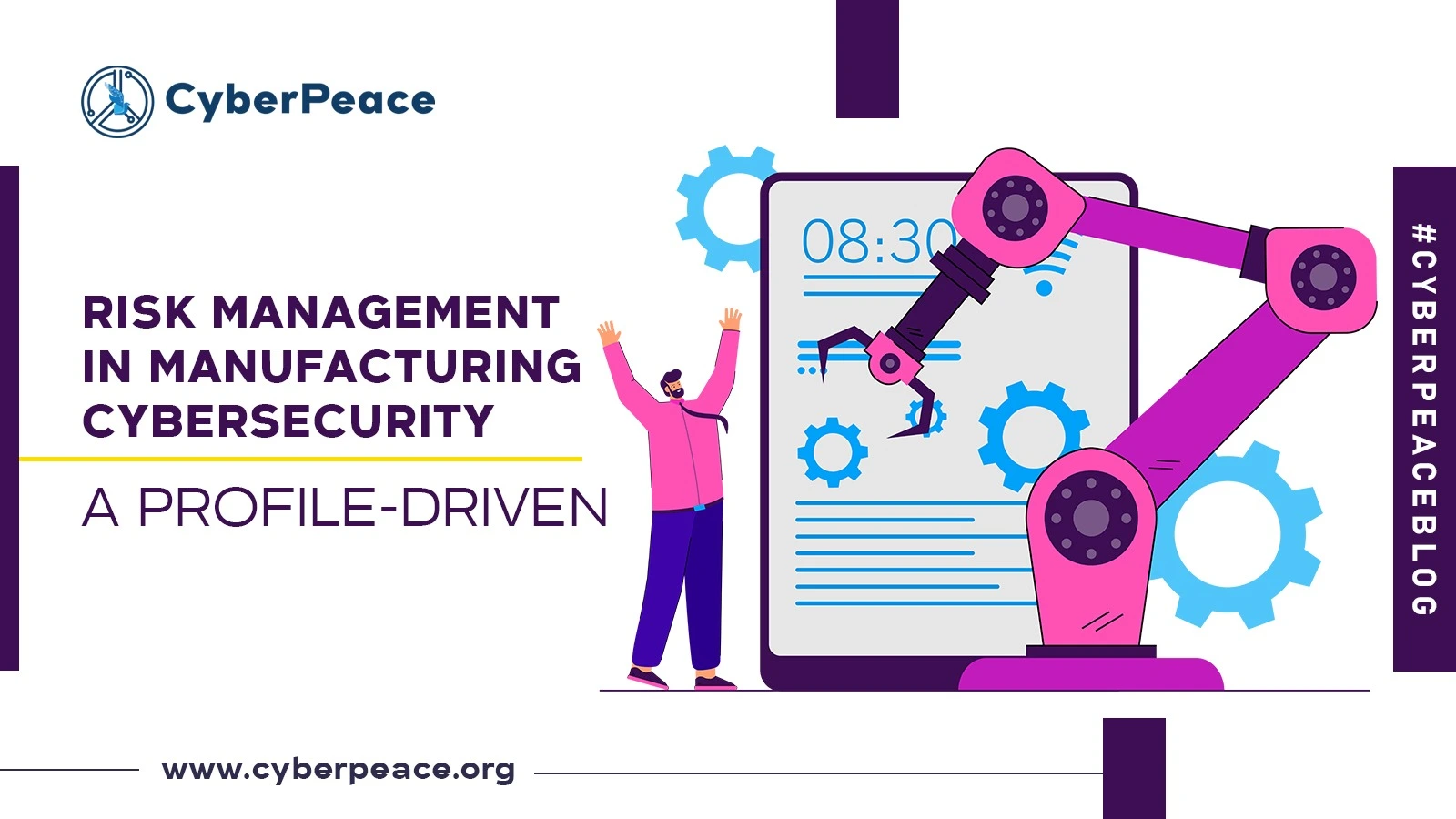
The ‘Information Security Profile’ prioritises and informs cybersecurity operations based on the company's risk administration procedures. It assists in choosing areas of focus for security operations that represent the desired results for producers by supporting periodic risk evaluations and validating company motivations. A thorough grasp of the business motivations and safety requirements unique to the Production system and its surroundings is necessary in order to manage cybersecurity threats. Because every organisation has different risks and uses ICS and IT in different ways, there will be variations in how the profile is implemented.
Companies are currently adopting industry principles and cybersecurity requirements, which the Manufacturing Information is intended to supplement, not replace. Manufacturers have the ability to identify crucial operations for key supply chains and can order expenditures in a way that will optimise their impact on each dollar. The Profile's primary objective is to lessen and manage dangers associated with cybersecurity more effectively. The Cybersecurity Framework and the Profile are not universally applicable methods for controlling security risks for essential infrastructure.
Producers will always face distinct risks due to their distinct dangers, weaknesses, and tolerances for danger. Consequently, the ways in which companies adopt security protocols will also change.
Key Cybersecurity Functions: Identify, Protect, Detect, Respond, and Recover
- Determine
Create the organisational knowledge necessary to control the potential hazards of cybersecurity to information, systems, resources, and competencies. The Identify Function's tasks are essential for using the Framework effectively. An organisation can concentrate its efforts in a way that aligns with its approach to risk mitigation and company needs by having a clear understanding of the business environment, the financial resources that assist with vital operations, and the associated cybersecurity threats. Among the outcome characteristics that fall under this function are risk evaluation, mitigation strategy, the administration of assets, leadership, and the business environment.
- Protect
Create and put into place the necessary measures to guarantee the provision of crucial infrastructure amenities. The Protect Function's operations enable the limitation or containment of the possible impact of a cybersecurity incident. Instances of results Access Management, Knowledge and Instruction, Data Safety and Security, Data Protection Processes and Instructions, Repair, and Defensive Systems are some of the classifications that fall under this role.
- Detect
Create and carry out the necessary actions to determine whether a cybersecurity event has occurred. The Detect Function's operations make it possible to find vulnerability occurrences in an efficient way. This function's result subcategories include things like abnormalities and incidents, constant security monitoring, and identification processes.
- React
Create and carry out the necessary plans to address a cybersecurity event that has been discovered. The Response Function's operations facilitate the capacity to mitigate the effects of a possible cybersecurity incident. Within this Scope, emergency planning, interactions, analysis, prevention, and enhancements are a few examples of result categories.
- Recover
Create and carry out the necessary actions to uphold resilience tactics and restore any services or competencies that were hampered by a cybersecurity incident. In order to lessen the effects of a vulnerability incident, the Recovery Function's efforts facilitate a prompt return to regular operations. The following are a few instances of outcome subcategories under this role: communications, enhancements, and recovery planning.
Conclusion
The Information Security Profile, when seen in the framework of risk mitigation, offers producers a tactical method to deal with the ever-changing cybersecurity danger scenario. The assessment directs safeguarding operations prioritisation by recognising specific business reasons and connecting with corporate goals. The Profile enhances the cybersecurity standards and established industry guidelines by taking into account the differences in vulnerabilities and organisational subtleties among producers. It highlights the significance of a customised strategy, acknowledging that every business has unique risks and weaknesses.
The fundamental tasks of the Framework, to Identify, Protect, Detect, Respond, and Recover, serve as a thorough roadmap, guaranteeing a proactive and flexible approach to cybersecurity. The Profile's ultimate goal is to increase the efficacy of risk mitigation techniques, understanding that cybersecurity is a constantly shifting and evolving subject for the manufacturing sector.
References
- https://csrc.nist.gov/news/2020/cybersecurity-framework-v1-1-manufacturing-profile
- https://nvlpubs.nist.gov/nistpubs/ir/2020/NIST.IR.8183r1.pdf
- https://mysecuritymarketplace.com/reports/cybersecurity-framework-version-1-1-manufacturing-profile/
Executive Summary:
A video of India’s Defence Minister Rajnath Singh is going viral on social media. The post claims that Rajnath Singh is openly supporting Israeli-American attacks against Iran. In the video, he can allegedly be heard saying that Prime Minister Narendra Modi had visited Israel before the war began and warned Tehran that disturbing peace would have serious consequences.
Research by CyberPeace found that the viral video is a deepfake created using Artificial Intelligence (AI). Rajnath Singh has not made any such statement about Iran or the Israel-US conflict.
Claim
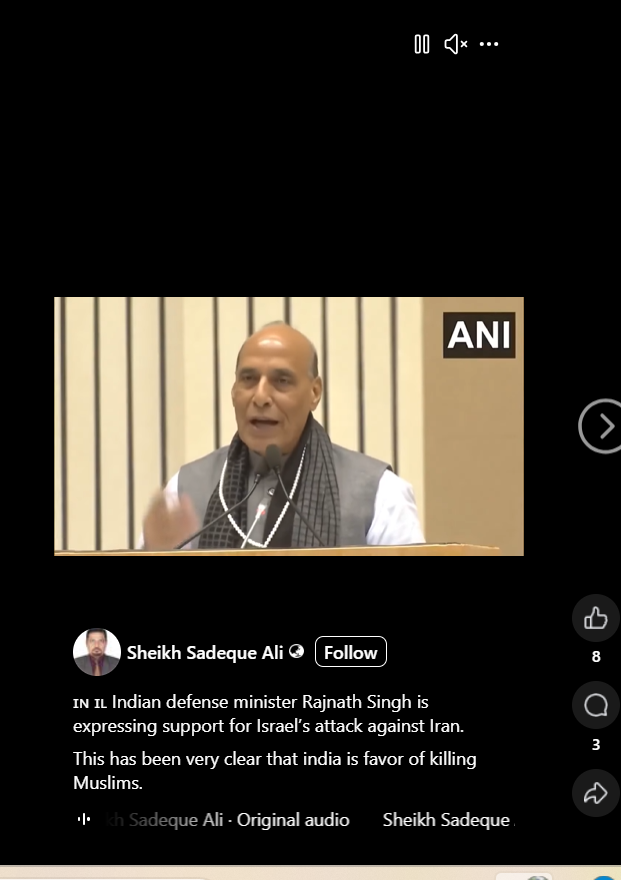
A Facebook user “Sheikh Sadeque Ali” shared the video on March 2, 2026. The caption of the post reads, “Indian Defence Minister Rajnath Singh is supporting Israel’s attack on Iran. This clearly shows that India supports the killing of Muslims.”
In the viral video, Rajnath Singh appears to say in English: “Prime Minister Modi’s visit to Israel before the attack on Iran reflects India’s solidarity with its strategic partner… He warned Tehran that hostile actions would have serious consequences for regional peace.”
Fact Check:
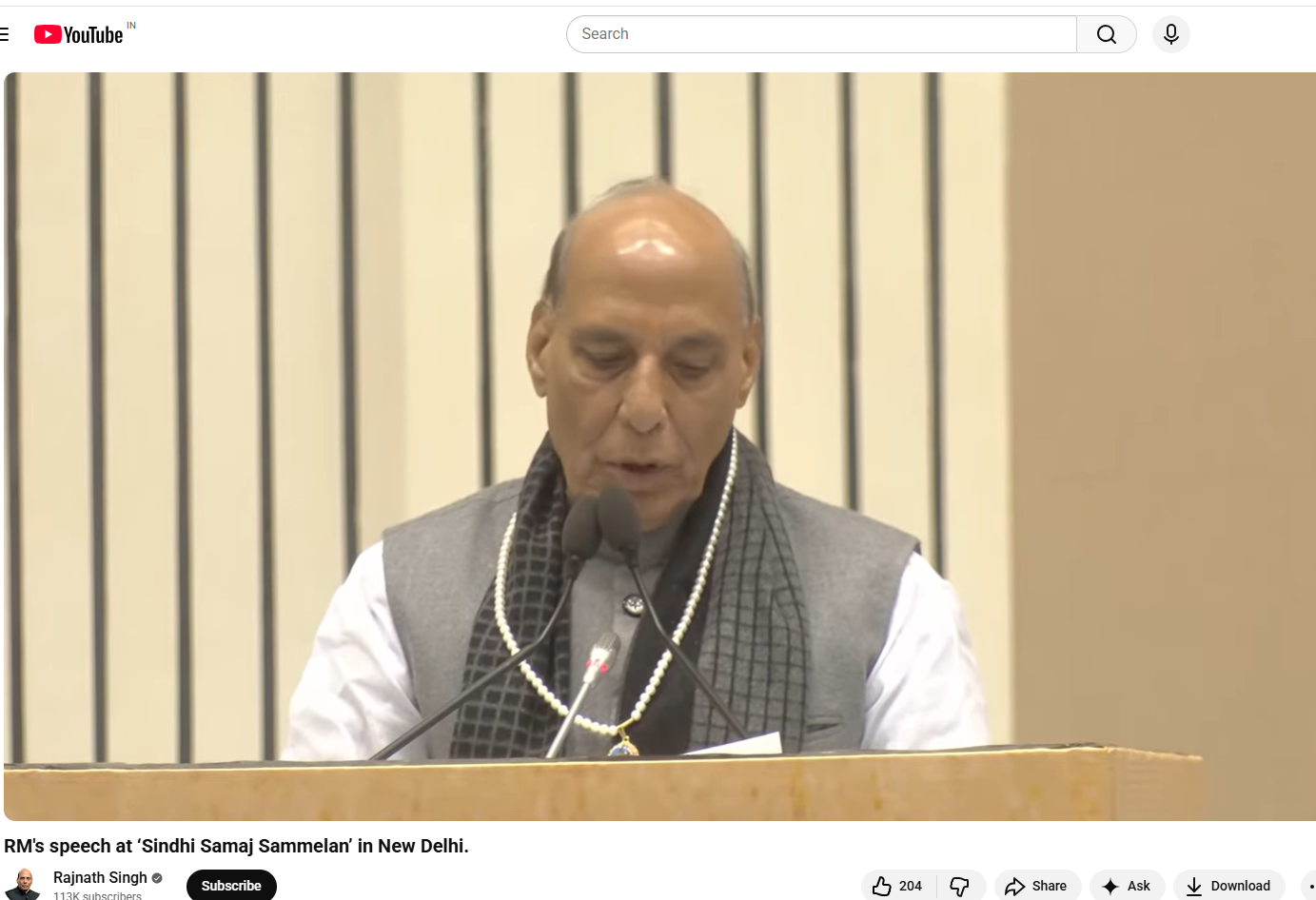
To verify the claim, we extracted keyframes from the viral video and conducted a reverse image search. During the research , we found the original video on Rajnath Singh’s official YouTube channel. The video was uploaded on November 23, 2025.In the original video, Rajnath Singh was addressing a Sindhi community conference in Delhi. During his speech, he was talking about Sindhi culture and the history of Partition. He did not mention Israel, Iran or any Middle East conflict during the entire program.
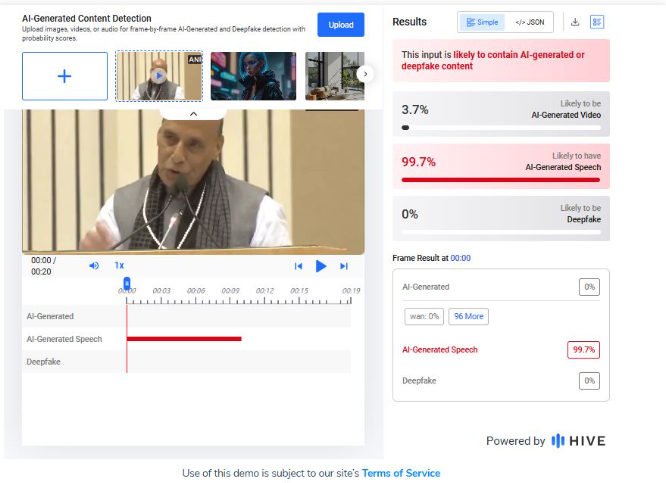
Upon closely examining the viral video, technical inconsistencies between the lip movements and the audio (lip-sync discrepancies) can be observed, which strongly indicate that the video may have been generated using AI. To verify this, we analysed the clip using several AI-detection tools. The AI detection tool Hive Moderation indicated that the video has a 99% probability of being AI-generated.
Conclusion:
Our research found that the viral video of Rajnath Singh is a deepfake. He has not made any statement supporting Israel or opposing Iran. The original video is from a Sindhi community event in Delhi, which has been digitally altered using AI to spread a misleading claim.
