
Post Session Report on Universal Acceptance and Multilingual Internet at Royal Global University under CyberPeace Center of Excellence (CCoE)
18th November 2022 CyberPeace Foundation in association with Universal Acceptance has successfully conducted the workshop on Universal Acceptance and Multilingual Internet for the students and faculties of Royal Global University under CyberPeace Center of Excellence (CCoE). CyberPeace Foundation has always been engaged towards the aim of spreading awareness regarding the various developments, avenues, opportunities and threats regarding cyberspace. The same has been the keen principle of the CyberPeace Centre of Excellence setup in collaboration with various esteemed educational institutes. We at CyberPeace Foundation would like to take the collaborations and our efforts to a new height of knowledge and awareness by proposing a workshop on UNIVERSAL ACCEPTANCE AND MULTILINGUAL INTERNET. This workshop was instrumental in providing the academia and research community a wholesome outlook towards the multilingual spectrum of internet including Internationalized domain names and email address Internationalization.
Date –18th November 2022
Time – 10:00 AM to 12:00 PM
Duration – 2 hours
Mode - Online
Audience – Academia and Research Community
Participants Joined- 130
Crowd Classification - Engineering students (1st and 4th year, all streams) and Faculties members
Organizer : Mr. Harish Chowdhary : UA Ambassador Moderator: Ms. Pooja Tomar, Project coordinator cum trainer
GuestSpeakers:Mr. Abdalmonem Galila, Abdalmonem: Vice Chair , Universal Acceptance Steering Group (UASG) ,Mr. Mahesh D Kulkarni: Director, Evaris Systems and Former Senior Director, CDAC, Government of India, Mr. Akshat Joshi, Founder Think Trans First session was delivered by Mr. Abdalmonem Galila, Abdalmonem: Vice Chair , Universal Acceptance Steering Group (UASG) “Universal Acceptance( UA) and why UA matters?”
- What is universal acceptance?
- UA is cornerstone to a digitally inclusive internet by ensuring all domain names and email addresses in all languages, script and character length.
- Achieving UA ensures that every person has the ability to navigate the internet.
- Different UA issues were also discussed and explained.
- Tagated systems by the UA and implication were discussed in detail.
Second Session was delivered by Mr. Akshat Joshi, Founder Think Trans on “Universal Acceptance to the IDNsand the economic Landscape”
- What is Universal Acceptance?
- The internet has had standards that allow people to use domain names and email addresses in their native scripts. Software developers need to bring their applications up-to-date so that consumers can use their chosen identity.
- A typical problem is that an IDN email address is not recognised by a website form as a valid email address.
- The importance of adopting IDNs z Enable citizens to use their own identity online (correct spelling, native language) z Relates to language, culture and content z Promotes local and regional content z Allows businesses and politicians to better target their messages.
Third session was delivered by Mr. Mahesh D Kulkarni, ES Director Evaris on the topic of “IDNs in Indian languages perspective- challenges and solutions”.
- The multilingual diversity of India was focused on and its impact.
- Most students were not aware of what Unicode, IDNS is and their usage.
- Students were briefed by giving real time examples on IDN, Domain name implementation using local language.
- In depth knowledge of and practical exposure of Universal Acceptance and Multilingual Internet has been served to the students.
- Tools and Resources for Domain Name and Domain Languages were explained.
- Languages nuances of Multilingual diversity of India explained with real time facts and figures.
- Given the idea of IDN Email,Homograph attack,Homographic variant with proper real time examples.
- Explained about the security threats and IDNA protocols.
- Given the explanation on ABNF.
- Explained the stages of Universal Acceptance.

Related Blogs

Introduction
Entrusted with the responsibility of leading the Global Education 2030 Agenda through the Sustainable Development Goal 4, UNESCO’s Institute for Lifelong Learning in collaboration with the Media and Information Literacy and Digital Competencies Unit has recently launched a Media and Information Literacy Course for Adult Educators. The course aligns with The Pact for The Future adopted at The United Nations Summit of the Future, September 2024 - asking for increased efforts towards media and information literacy from its member countries. The course is free for Adult Educators to access and is available until 31st May 2025.
The Course
According to a report by Statista, 67.5% of the global population uses the internet. Regardless of the age and background of the users, there is a general lack of understanding on how to spot misinformation, targeted hate, and navigating online environments in a manner that is secure and efficient. Since misinformation (largely spread online) is enabled by the lack of awareness, digital literacy becomes increasingly important. The course is designed keeping in mind that many active adult educators are yet to get an opportunity to hone their skills with regard to media and information through formal education. Self-paced, a total of 10 hours, this course covers basics such as concepts of misinformation and disinformation, artificial intelligence, and combating hate speech, and offers a certificate on completion.
CyberPeace Recommendations
As this course is free of cost, can be done in a remote capacity, and covers basics regarding digital literacy, all eligible are encouraged to take it up to familiarise themselves with such topics. However, awareness regarding the availability of this course, alongside who can avail of this opportunity can be further worked on so a larger number can avail its benefits.
CyberPeace Recommendations To Enhance Positive Impact
- Further Collaboration: As this course is open to adult educators, one can consider widening the scope through active engagement with Independent organisations and even Individual internet users who are willing to learn.
- Engagement with Educational Institutions: After launching a course, an interactive outreach programme and connecting with relevant stakeholders can prove to be beneficial. Since this course requires each individual adult educator to sign up to avail the course, partnering with educational universities, institutes, etc. is encouraged. In the Indian context, active involvement with training institutes such as DIET (District Institute of Education and Training), SCERT (State Council of Educational Research and Training), NCERT (National Council of Educational Research and Training), and Open Universities, etc. could be initiated, facilitating greater awareness and more participation.
- Engagement through NGOs: NGOs (focused on digital literacy) with a tie-up with UNESCO, can aid in implementing and encouraging awareness. A localised language approach option can be pondered upon for inclusion as well.
Conclusion
Though a long process, tackling misinformation through education is a method that deals with the issue at the source. A strong foundation in awareness and media literacy is imperative in the age of fake news, misinformation, and sensitive data being peddled online. UNESCO’s course launch garners attention as it comes from an international platform, is free of cost, truly understands the gravity of the situation, and calls for action in the field of education, encouraging others to do the same.
References
- https://www.uil.unesco.org/en/articles/media-and-information-literacy-course-adult-educators-launched
- https://www.unesco.org/en/articles/celebrating-global-media-and-information-literacy-week-2024
- https://www.unesco.org/en/node/559#:~:text=UNESCO%20believes%20that%20education%20is,must%20be%20matched%20by%20quality.
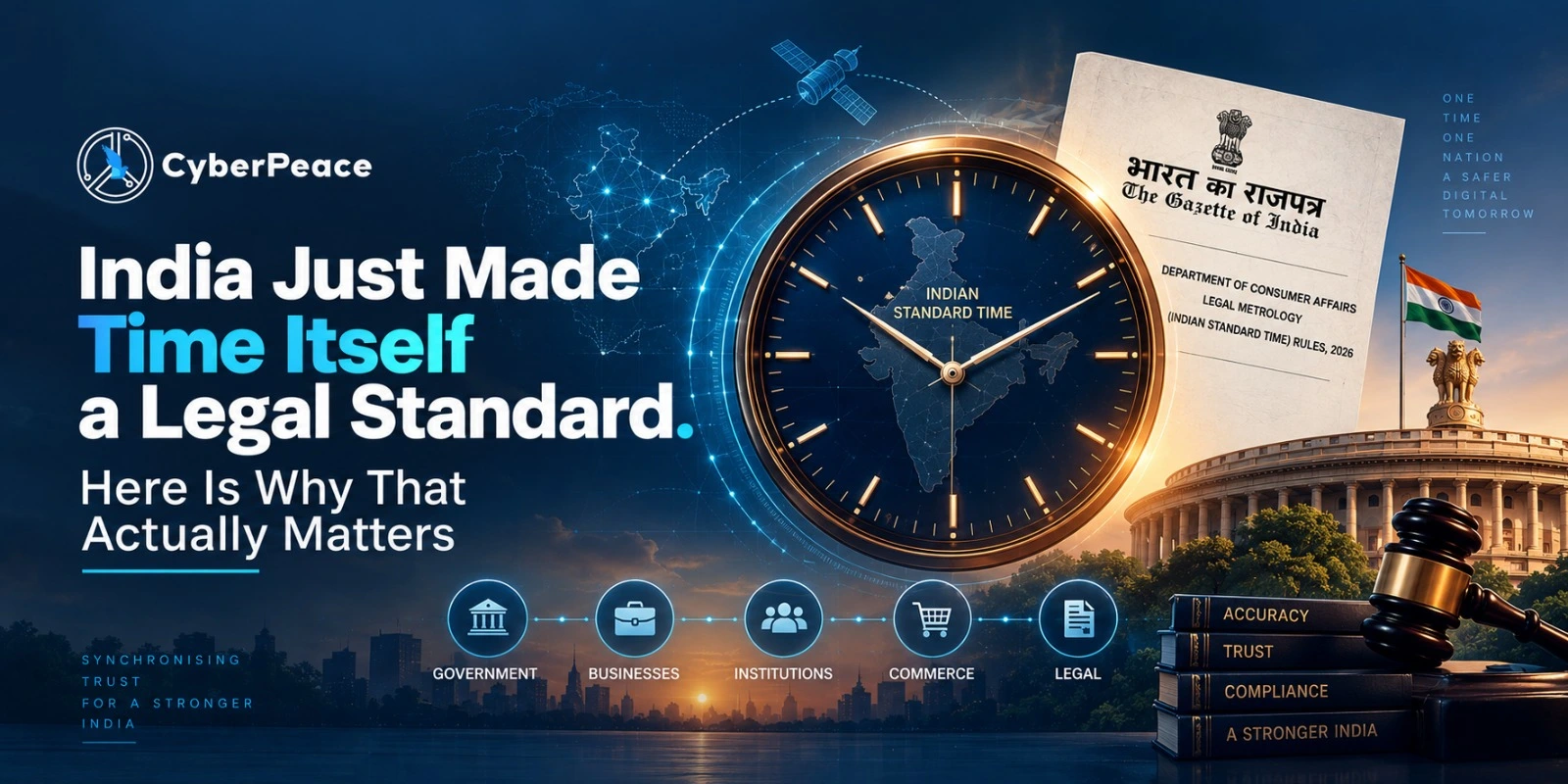
Most laws regulate what people do. This one regulates what clock everyone is doing it by, and once you sit with that idea for a moment, it stops sounding like a bureaucratic footnote and starts sounding like something genuinely foundational.
On 27 August 2026, India's Department of Consumer Affairs notified the Legal Metrology (Indian Standard Time) Rules, 2026, making Indian Standard Time the single legally binding reference for every legal, administrative, commercial, and official purpose across the country. The Rules will come into force 180 days after their publication in the Official Gazette, giving government departments, businesses, and institutions a compliance runway to align their systems before the requirement actually bites.
Why time needed a law at all
It might seem strange that a country needs legislation to tell everyone what time it is. India has used IST, a single time zone five and a half hours ahead of Coordinated Universal Time, since 1947. But using a time zone informally and legally mandating it as the sole authoritative reference for every official and commercial transaction are two very different things, and the gap between them is exactly where this rule lives.
The government's own reasoning, laid out in its official statement, centres on a shift most people experience daily without ever thinking about its plumbing. Banking and digital payments, telecommunications networks, railways, power grids, and government record systems all depend on accurate, synchronised time stamps to function correctly. When different systems quietly draw their time from different sources, even by fractions of a second, the resulting inconsistencies can affect the coordination and recording of transactions in ways that are invisible until something goes wrong. A trade executed on a stock exchange, a UPI payment cleared between banks, a railway signal handoff between two junctions, and an emergency service dispatch all depend on every clock in the chain agreeing with every other clock, and until now, India had no single rule compelling that agreement.
The quieter, more interesting part of the rule
Buried inside the announcement is a detail that matters more than the headline. The Rules do not simply declare IST the law of the land; they also authorise the use of NavIC, India's own satellite navigation system, alongside other approved domestic timing sources, as legitimate means of disseminating that time. The government's stated rationale is candid about the current state of affairs: several critical Indian systems presently draw their time from foreign satellite based sources, and building domestic timing infrastructure through NavIC and legal metrology laboratories is intended to reduce that dependence going forward.
That single sentence carries real weight once you consider how global positioning and timing systems actually work. Most of the world's precise digital time synchronisation ultimately traces back to GPS, the American satellite constellation, whose signals also happen to be notoriously easy to disrupt. GPS and other satellite navigation signals arrive at receivers on Earth as extremely weak radio transmissions, weak enough that they can be jammed with cheap equipment or spoofed, meaning an attacker broadcasts a counterfeit signal that mimics a legitimate one closely enough to fool a receiver into accepting false position or timing data. Researchers and government reports going back years have flagged that a large share of critical infrastructure sectors, power grids, financial markets, telecommunications, and transport among them, carry meaningful dependence on GPS derived timing, and a 2017 UK government assessment specifically warned that systematic satellite signal jamming could cause serious disruption to a country's financial, electricity, and communications systems all at once. Cybersecurity researchers have separately demonstrated proof of concept attacks where a deliberately falsified timing signal, rather than a falsified position, was enough to destabilise systems that assumed their clock could always be trusted.
Seen against that backdrop, embedding NavIC as an approved domestic timing source inside a legal metrology framework is not merely a nationalistic footnote about self reliance. It is a genuine resilience decision. A country that can generate, verify, and distribute its own trusted time signal, independent of a foreign satellite constellation that it does not control and cannot secure on its own, has a meaningfully smaller attack surface for an entire category of infrastructure disruption that rarely makes headlines until it actually happens.
Who actually built this, and why that composition matters
The drafting process itself offers a useful clue about how seriously this was treated. Reports on the rule making process indicate the Rules were shaped by a high powered inter ministerial committee chaired by the Secretary of Consumer Affairs, with representation from the National Physical Laboratory and the Indian Space Research Organisation for the underlying science and satellites, IIT Kanpur for engineering expertise, the National Informatics Centre and CERT In for network infrastructure and its security, the Securities and Exchange Board of India for financial market implications, and the Railways, Telecom, and Financial Services departments for the systems that will actually have to run on this new standard day to day. That is not a committee assembled around a single ministry's convenience; it is a committee assembled around the actual shape of the problem, spanning physics, engineering, finance, and network security together. As part of the broader One Nation, One Time initiative, a White Rabbit Technology based IST Dissemination Demonstration Network was already commissioned at the Regional Reference Standard Laboratory in Bengaluru back in July 2026, suggesting the infrastructure groundwork was underway well before the legal framework caught up to it.
What the 180 day window actually means in practice
It is worth being precise about what compliance actually requires here. This is not a deadline demanding new hardware overnight; for most organisations, it means auditing which internal systems currently reference time from an unverified or foreign source and ensuring they align with certified IST going forward, alongside institutions preparing to receive that certified time through the domestic infrastructure the government is simultaneously building out. The six month runway exists precisely because this touches an unusually wide spread of sectors at once, and forcing an abrupt cutover would create more operational risk than the rule is designed to remove.
The bigger picture
A rule about what time it is legally does not sound like cybersecurity news, and on the surface, it is not. But underneath the administrative language sits a genuinely forward looking recognition: as more of daily life, banking, communication, transport, and governance runs on systems that must agree, down to the second, on a shared reference point, the integrity of that reference point becomes critical infrastructure in its own right. India choosing to build, verify, and legally anchor its own trusted time source, rather than continuing to quietly rely on a foreign satellite system it cannot secure independently, is less about symbolism and more about closing a vulnerability most people never knew existed until they were asked to think about it.
References
- OpenGov Asia, "India Issues Rules to Standardise National Time Reference Systems." https://opengovasia.com/india-issues-rules-to-standardise-national-time-reference-systems/?c=us
- Daily Excelsior, "Centre notifies rules mandating IST as common time reference; 180 day window for compliance." https://www.dailyexcelsior.com/centre-notifies-rules-mandating-ist-as-common-time-reference-180-day-window-for-compliance/
- Greater Kashmir, "Department of Consumer Affairs notifies Legal Metrology Rules, 2026." https://www.greaterkashmir.com/national/department-of-consumer-affairs-notifies-legal-metrology-rules-2026-12454447
- Insights on India, "Legal Metrology (Indian Standard Time) Rules, 2026." https://www.insightsonindia.com/2026/08/31/legal-metrology-indian-standard-time-rules-2026/
- Blitz India Media, "Indian Standard Time Rules 2026: NavIC, Legal Metrology." https://blitzindiamedia.com/news/indian-standard-time-rules-2026-navic-legal-metrology/
- Observer Voice, "India Establishes Legal Framework for Standard Time." https://observervoice.com/india-establishes-legal-framework-for-standard-time-225958/
- The Live Nagpur, "Govt notifies rules to make IST the common time reference." https://thelivenagpur.com/2026/08/31/govt-notifies-rules-to-make-ist-the-common-time-reference/
- Safran Navigation and Timing, "GNSS Security and Cybersecurity: What are the Parallels?" https://safran-navigation-timing.com/gnss-security-and-cybersecurity-what-are-the-parallels/
- Safran Navigation and Timing, "Securing Critical Infrastructures from Jamming and Spoofing Cyberattacks." https://safran-navigation-timing.com/securing-critical-infrastructures-from-jamming-and-spoofing-cyberattacks/
- Combain, "The Silent Threat In The Sky: GPS Jamming, GPS Spoofing." https://combain.com/gps-jamming-spoofing/
Introduction
Over the last few years, several public data breaches in Venezuela have revealed a lack of cohesion and progress in its data privacy system and left many people susceptible to fraud, identity theft and long-term harm via the internet. It is clear from these data breaches that when organizations fail to adequately protect their data, both through cybersecurity failures and weak legal protections, they can lead to problems throughout an entire system through which all individuals in the system could potentially suffer.
Among the more notable breaches are the Movistar Venezuela data breach from 2025 and the Cashea App data leak from earlier this year. Each of these examples demonstrates to some extent how the absence of an adequate privacy regulatory scheme can worsen the results of a data breach.
The Movistar Breach: A Regulatory Warning (2025)
Venezuelan digital rights group VE Sin Filtro published a report late in April 2025, which found a database revealed to have been opened onto the internet containing personal information belonging to over 3.2 million Movistar customers. The initial breach contained personal, and confidential, data of Venezuelan citizens such as national identification numbers, full names, city of residence, and phone numbers which could have been exploited to commit identity theft, SIM-swap fraud, and targeted scams.
One significant issue with this situation was that Movistar failed to disclose the breach publicly or contact impacted customers at the time of the disclosure. As a result, there appears to be a significant gap in Sanctions / Other Means of Enforcing Security Countermeasures Laws. Since there are numerous countries that enforce GDPR-style regulations and as such, this matter should lead to a complete investigation and possible fines against those responsible but in Venezuela there is still a lack of accountability.
Cashea App Leak: A 2026 Data Shock
A second alleged data breach came to light in February of 2026. It involved a Venezuelan buy-now-pay-later (BNPL) fintech called Cashea App, which is typically heavily utilized domestically. Reports have circulated that threat actors have been offering a database, believed to hold more than 79 million transaction records. This is more than double the size and sensitivity of the data involved in the Movistar Breach.
According to reports, the leaked data included:
- Bank account details and payment methods
- Merchant profiles and internal business identifiers
- Detailed transaction histories with names, national ID numbers, timestamps, and installment data
This level of exposure goes far beyond basic identifiers. Financial transaction histories combined with personal identifiers enable sophisticated fraud, targeted social engineering, and long-term misuse of financial identities. As with the Movistar breach, no official acknowledgment or notification was issued by Cashea at the time of reporting, again underscoring Venezuela’s weak enforcement environment.
Why These Breaches Matter: The Legal Dimension
The incidents show us that there is a bigger problem with the way Venezuela has set up its framework for protecting data. For instance, the Venezuelan Constitution recognises the principles of data protection and privacy; however, these rights only exist in a theoretical manner; they lack implementing legislation, procedural clarity, and institutional enforcement.
Constitutional Basis of Data Protection
The Supreme Tribunal of Justice (TSJ) stated the core principles for protecting data are found in the Venezuelan Constitution. After the TSJ issued its 2011 ruling, Article 28 of the Venezuelan Constitution gives individuals the right to know what data the state has about them, how the state uses that data, and to correct or delete any harmful data. Article 60 of the Venezuelan Constitution protects individuals' privacy and restricts excessive data collection by the state.
The Constitutional Chamber also put into place additional guiding principles for how to protect personal data, including:
- The data subject must give prior informed and revocable consent.
- The purpose for which the data is collected must be specified and only the minimum amount of information necessary can be collected.
- The data collected must be accurate and of good quality.
- There are confidentiality obligations for third parties regarding the use of the data.
- It is the government's responsibility to put into place procedures and mechanisms to monitor compliance with the data protection laws.
- There are civil, criminal and administrative liabilities for individuals and legal entities that violate the data protection laws.
But, in a civil law country, when courts make rulings, they usually are persuasive only as opposed to being legally binding, and even constitutional rulings cannot be implemented until enabling legislation is passed.
Absence of a Comprehensive Data Protection Law
In contrast to the European Union's GDPR (General Data Protection Regulation), the United States' sectoral approach, and emerging Latin American data protection systems such as the ones in Brazil, Chile and Colombia, Venezuela has no independent data protection law. This lack of law leads to numerous types of uncertainty in the realm of data protection laws:
- No defined data controller or processor obligations
- No standardized lawful bases for processing
- No clear breach notification timelines
- No independent data protection authority
- No procedural pathway for individuals to seek redress
As a result, data protection in Venezuela is not treated as an independent legal discipline but instead becomes derivative, arising incidentally within constitutional litigation or sector-specific disputes.
Regulatory Fragmentation and Institutional Weakness
Due to the TSJ decisions made in 2011, there has been a lack of regulatory action taken in a systematic fashion and instead most actions have been done on a case by case basis as valid incidents arise. The National Cybersecurity Council was established in 2024; however, its function is to support the establishment of cybersecurity infrastructure and has no defined powers regarding the enforcement of privacy.
This creates a fragmented institutional landscape where:
- Authorities lack clear jurisdiction over privacy violations
- Companies face minimal compliance guidance
- Individuals struggle to understand or enforce their rights
The Movistar and Cashea incidents highlight how this fragmentation translates into practical impunity following major data exposures.
What’s Next? A Legal Opportunity for Reform
The repercussions of insufficient safeguards for data protection extend past the damage incurred to a person's privacy:
- Loss of trust in both financial and digital services
- Heightened likelihood of financial fraud and crime
- Lack of willingness from foreign companies to conduct business with Venezuela’s platforms.
- Long-term negative impact on the reputation of domestic companies.
- Possible inability to access cross-border transfer of data due to other jurisdictions’ decisions to restrict transfers into jurisdictions without cutting-edge enforcement of protections for privacy.
In a digital economy that increasingly requires robust data protection to function successfully, a lack of action to create strong protections will cause a significant economic impact.
Conclusion
Major data breaches such as the ones at Movistar in 2025 and Cashea App in 2026 show that constitutional privacy rights alone are insufficient without enforceable legal framework. Privacy laws must move from being just a principle to being a law that has institutions, procedures, and accountability to make sure the privacy of the users is protected.
Now with the global digital economy being so interconnected, not having regulations creates openings for vulnerabilities for people. If Venezuela hopes to protect their citizens, create an innovation-friendly environment, and compete in the global market, they must implement comprehensive data privacy reforms as soon as possible.
REFERENCES
- https://iapp.org/news/a/venezuela-data-breach-highlights-scattered-privacy-regulation
- https://www.apolocybersecurity.com/en/blog-posts/ciberataque-a-movistar-que-ha-pasado-a-quien-afecta-y-como-proteger-tus-datos
- https://darknetsearch.com/knowledge/news/en/cashea-app-data-leak-79m-records-exposed-in-venezuela/
- https://www.binance.com/en-IN/square/post/294369884695410
