
AI-Generated Health Tips on Reels - The Rise of Personalised Misinformation
Introduction
The rapid rise of AI tools has reshaped how health content spreads on platforms like Instagram Reels and YouTube Shorts. These sub-minute videos promise quick fixes for weight loss, glowing skin, or reduced anxiety, often delivered through polished visuals and confident AI-generated voiceovers. The result feels highly personalised, as if the advice is tailored to each viewer, even though it is usually generic and widely recycled.
Short-form videos tend to compress complex health topics into “one tip” solutions, such as drinking a specific detox drink daily or following a single workout for rapid fat loss. While appealing, this oversimplification removes essential context, including individual health conditions, long-term risks, and scientific nuance. For example, viral diet trends or fitness hacks may work for some but can be ineffective or even harmful for others.
Algorithms play a major role in amplifying such content. Videos that promise dramatic transformations or instant results are more likely to gain engagement, which pushes them to wider audiences. Repeated exposure then builds familiarity, making the advice seem more credible over time. Audiences often trust this content due to its clean presentation, authoritative tone, and frequent repetition. However, the risks include misinformation, unrealistic expectations, and potential harm from unverified practices. To approach such content critically, viewers should cross-check claims with credible medical sources, avoid relying on single tip solutions, and remember that real health advice is rarely one size fits all.
The Illusion of Personalisation
AI-generated health content often mimics personalisation through:
- Synthetic voiceovers that designers created to match different age groups through their voice output, which speak specifically to people who are 20 years old and younger.
- The script development process uses data that tracks currently popular search terms.
- Viewers can interpret information through visual elements, which show changes between two different states.
The process of "personalisation" uses generalised data that does not match individual health profiles to create targeted results. The videos fail to provide a medical assessment because they do not consider:
- Existing medical conditions
- Hereditary differences
- Personal habits and the impact of surrounding conditions
The users will think that general medical advice applies to their personal health needs, which will lead them to use this advice inappropriately.
Short-Form Content and Oversimplification
Short-form videos have time limitations, which result in reduced complex medical information development into basic medical stories. The typical patterns of evaluation include these two patterns of evaluation include:
- “One-tip solutions” (e.g., “Drink this before bed to burn fat”)
- Binary framing (“good vs bad foods”)
- The process of eliminating all disclaimers and side effects information
For example, the three diet methods here the three diet methods here
- Viral detox drinks that make the claim to "flush toxins" from the body
- Extreme calorie-cutting diet hacks
- Fitness shortcuts that guarantee users will see results within days
The content demonstrates a pattern of disregarding essential human body operation rules that include both metabolic patterns and human body operation over extended periods of time.
Algorithmic Amplification and Virality
The recommendation algorithms used by Instagram and YouTube deliver their most important results through three main factors, which include:
- Engagement (likes, shares, watch time)
- Retention rates
- Emotional or aspirational triggers
Health-related content that claims to deliver:
- Immediate body changes
- Needs minimal work from viewers
- Results in extreme physical changes
Attractive health-related content that displays extreme physical changes through quick transformations. The system produces a continuous cycle during which:
- Misleading content gains traction
- Algorithms amplify it further
- More creators replicate similar formats using AI tools
The system produces a secondary result that favours content that people share instead of content that has authentic credibility.
Why Do Users Trust AI-Generated Health Content?
Several psychological and technological factors contribute to trust:
- Professional Aesthetics - AI tools generate high-quality visual content together with authentic voiceover performance and expert-level script documentation, which replicates professional communication methods.
- Repetition and Familiarity - When people encounter identical recommendations multiple times, their belief in those recommendations increases through the illusory truth effect.
- Authority Signals
- Medical terminology serves as a standard term
- Medical professionals appear in stock footage through lab coat visuals
- The narrator delivers information through an assertive speaking style
- Perceived Personal Relevance - Algorithmic targeting makes users feel the content is "meant for them.
Real-World Examples of Viral Trends
The typical types of health misinformation that artificial intelligence systems spread through their enhanced capabilities include:
- Diet Trends: Keto shortcuts, extreme intermittent fasting variants
- Fitness Hacks: Spot reduction exercises (scientifically unsupported)
- Supplement Advice: Unverified claims about vitamins or herbal products
- Mental Health Tips: Oversimplified coping strategies that lack clinical evidence
The statement that drinking warm lemon water will detox your liver continues to be popular despite the fact that the liver has natural self-detoxification abilities.
Risks and Public Health Implications
The widespread consumption of such content creates multiple dangers, which include:
1. Physical Health Risks
- Nutritional deficiencies from extreme diets
- Injury from improper exercise techniques
- Delayed medical consultation
2. Psychological Impact
- Unrealistic body image expectations
- Anxiety due to conflicting advice
3. Misinformation Ecosystem
- The public loses confidence in evidence-based medicine
- Unverified or pseudoscientific practices spread throughout society
Regulatory and Ethical Concerns
The increase of AI-generated health materials connects to more extensive problems, which include:
- Who is responsible for the content
- Who is responsible for the platform
- How AI systems show their inner workings to users
Most platforms today do not have strict systems that can:
- Verify medical claims
- Display which health advice comes from artificial intelligence
- Punish users who spread false information multiple times
The absence of regulations allows misleading information to spread without consequences.
A CyberPeace Perspective: Building Digital Health Resilience
The problem needs complete involvement from several parties to create effective solutions that protect both online security and data integrity.
For Users
- Users should confirm claims by using trustworthy medical resources, which include the WHO and peer-reviewed studies.
- People should avoid using "quick solutions" until they receive guidance from certified experts.
- Users should exercise caution when they encounter content that does not include necessary warning signs.
For Platforms
- Platforms should implement systems that enable users to identify AI-generated content.
- Platforms should decrease the visibility of health information that contains false statements.
- Platforms should support authentic health content producers who have been validated.
For Policymakers
- Policymakers should create standards that govern AI-produced medical content.
- Policymakers need to enhance initiatives that teach people about the health information available online.
For Content Creators
- Content creators must show how they implement AI technologies.
- They should stay away from making claims that either go beyond what is needed or state things as absolute truth.
Conclusion
AI-generated health tips on short-form video platforms create complex research conditions that involve three scientific fields: technology, psychology and public health. The tools provide equal access to information, yet create higher risks for people to believe false information when they use the tools without responsible usage.
The challenge requires organisations to maintain user safety through accurate information management while providing users with transparent digital health services. The growing dependence of users on algorithm-based content requires educational institutions to develop students' critical thinking abilities and digital skills to minimise negative effects from AI-driven communication methods.
References
- https://pmc.ncbi.nlm.nih.gov/articles/PMC12924558/
- https://academic.oup.com/heapro/article/40/2/daaf023/8100645
- https://pmc.ncbi.nlm.nih.gov/articles/PMC12673052/
- https://www.frontiersin.org/journals/public-health/articles/10.3389/fpubh.2025.1713794/full
- https://www.who.int/teams/digital-health-and-innovation/digital-channels/combatting-misinformation-online
- https://link.springer.com/article/10.1186/s12982-025-00777-2
- https://www.washingtonpost.com/health/2026/04/21/chatbot-medical-advice-accurate/

Related Blogs

Introduction
In the new age of technologies the internet and social media continue to witness a surge in deepfake videos a technological phenomenon that blurs the line between reality and fiction. The string of deepfake videos of Bollywood actors and other famous personalities has raised serious concerns. While Prime Minister Narendra Modi spoke against the risks of artificial intelligence at the G20 Virtual Summit. The central government has recently announced that it will soon set up dedicated regulations to tackle this Menace. This will include holding social media platforms and creators responsible for their actions against the rules and regulations. Very often most people shy away from initiating a legal process or taking action while being victims of misuse of fast-paced tech but the government has announced its big support to the victims and promised to stand by complaints against deepfake videos especially this includes helping individuals to report the incidents and any violations by platforms.
Social media platforms to realign their policies as per the Indian laws
The Ministry of Electronics and Information Technology (MeitY) announced on 24th November 2023 that it will be giving social media platforms seven days time period to align their terms of service and other policies with Indian laws and regulations in order to address the issue of hosting of deepfakes on these platforms. All platforms must align and transform their terms of use with their users to be consistent with the 12 areas that are prohibited under rule 3(1)(b) of the Information Technology (IT) Rules, 2021.
The platforms will ensure harmonization and alignment of their terms & policies so that every user on every platform is aware that when they use a platform the platform intends to be a safe and trusted platform and the platform will not tolerate these 12 types of content or information that have been prohibited under the IT Act and the IT rules. The government approach is to collectively advocate for responsible and safe use of the Internet. The government has taken a proactive step in partnership with these social media platforms to ensure an era where such platforms will be a lot more responsible and a lot more responsive to the expectations under the law and more compliant.
Officer to be appointed under rule 7
As Deepfake Videos continue to surface on social media, the Government has geared up to curb such content online. Mr. Rajeev Chandrasekhar Minister of State, (Meity), stated that the government will soon appoint an officer to take appropriate action against deepfake videos. This statement came after the government meeting with industry stakeholders and important players held on 24 Nov 2023. He added that Meity and the government of India will nominate an officer under rule 7 (IT rules 2021) and will ensure full compliance expectations from all the platforms. An officer appointed under Rule 7, will be entrusted with building a mechanism where users can put in their complaints regarding deepfakes and MeitY may also assist such aggrieved users with filing FIRs in such cases. Mr. Rajeev Chandrasekhar, Minister of State, (Meity) also added that we will also be creating a platform where it will be very easy for netizens to bring to the attention of the government of India and notices of allegations or reports of violation of law by the platforms and the rule 7 officer will take that digital platform information and respond accordingly.
The Information Technology (Intermediary Guidelines and Digital Media Ethics Code) Rules, 2021 (updated as on 6.4.2023)
Rule 3(1)(b) states that intermediaries shall inform its rules and regulations, privacy policy and user agreement to the user and shall make reasonable efforts to ‘restrict’ the users from hosting, displaying, uploading, modifying, publishing, transmitting, store, update or sharing any information that is prohibited under this rule which also includes deepfake, misinformation, CSAM(Child sexual abusive material) etc. As per rule 3(2)(b) Intermediaries shall remove or disable access within 24 hours of receipt of complaints of contents that expose the private areas of individuals, show such individuals in full or partial nudity or in a sexual act or is in the nature of impersonation including morphed images etc.
Ongoing Efforts Ahead of Crucial Meeting with Tech Giants
Ahead of the government meeting with online platforms such as Google, Facebook, and YouTube on Friday, 24th November 2023, Mr. Rajeev Chandrasekhar Minister of State, (Meity) added that way back from October 2022 the government of India had been alerting them to the threat of misinformation and deepfakes which are part of misinformation. He further added that the current IT rules under the IT Act provide for adequate compliance requirements on their part to deal with deepfake.
Deepfake Misinformation
Misinformation powered by AI becoming an even more potent force to disrupt and to mislead and to create chaos and confusion at a scale and of a type that is deeply detrimental. Deepfakes in a very simple basic way is misinformation which is powered by or enhanced by AI. Video-based deepfake misinformation is more dangerous since it has a greater reach as video consumption today is the preferred choice by users on the internet.
Way forward
The Honorable Prime Minister has raised the issue that deep fakes are deeply disruptive they can create divisions and all kinds of disruptions in communities, in families and therefore misuse of deepfake technology is a very clear present danger to the safe and trusted internet.
The Government is on its way to draft a dedicated legislation dedicated to tackling deepfakes.
Even as we speak to a future regulation and a future law which is certainly required given that our IT Act is 23 years old. However current IT rules provide for compliance requirements by the platforms on misinformation patently false information and deepfakes. Followed by the recent government advisory on misinformation and deepfake.
Conclusion
Prime Minister alerting of the dangers of deepfakes online. The government is now in the process of starting to look very seriously into this issue and also issued guidelines for intermediaries and in a finite period of time it is hoped that the threat of deep fakes would actually no longer exist in in our system. The government made it clear that apart from people spreading deepfake videos, the platforms making them spread and not taking action will also be liable they are currently liable and will be even more so in future after new rules and regulations are brought in.
References:
- https://www.moneycontrol.com/news/technology/deepfakes-meity-gives-social-media-platforms-7-day-ultimatum-to-align-their-policies-to-indian-laws-and-regulations-11805521.html
- https://www.azbpartners.com/bank/amendments-to-the-information-technology-intermediary-guidelines-and-digital-media-ethics-code-rules-2021/#:~:text=Prior%20to%20the%20amendment%2C%20under%20Rule%203(1)
- https://www.drishtiias.com/daily-updates/daily-news-analysis/amendments-to-the-it-rules-2021
- https://youtu.be/zmI2ml1d_Es?feature=shared
- https://pib.gov.in/PressReleaseIframePage.aspx?PRID=1975445

Introduction
The Computer Emergency Response Team (CERT-in) is a nodal agency of the government established and appointed as a national agency in respect of cyber incidents and cyber security incidents in terms of the provisions of section 70B of the Information Technology (IT) Act, 2000. CERT-In has issued a cautionary note to Microsoft Edge, Adobe and Google Chrome users. Users have been alerted to many vulnerabilities by the government's cybersecurity agency, which hackers might use to obtain private data and run arbitrary code on the targeted machine. Users are advised by CERT-In to apply a security update right away in order to guard against the problem.
Vulnerability note
Vulnerability notes CIVN-2023-0361, CIVN-2023-0362 and CIVN-2023-0364 for Google Chrome for Desktop, Microsoft Edge and Adobe respectively, include more information on the alert. The problems have been categorized as high-severity issues by CERT-In, which suggests applying a security upgrade right now. According to the warning, there is a security risk if you use Google Chrome versions earlier than v120.0.6099.62 on Linux and Mac, or earlier than 120.0.6099.62/.63 on Windows. Similar to this, the vulnerability may also impact users of Microsoft Edge browser versions earlier than 120.0.2210.61.
Cause of the Problem
These vulnerabilities are caused by "Use after release in Media Stream, Side Panel Search, and Media Capture; Inappropriate implementation in Autofill and Web Browser UI, “according to the explanation in the issue note on the CERT-In website. The alert further warns that individuals who use the susceptible Microsoft Edge and Google Chrome browsers could end up being targeted by a remote attacker using these vulnerabilities to send a specially crafted request.” Once these vulnerabilities are effectively exploited, hackers may obtain higher privileges, obtain sensitive data, and run arbitrary code on the system of interest.
High-security issues: consequences
CERT-In has brought attention to vulnerabilities in Google Chrome, Microsoft Edge, and Adobe that might have serious repercussions and put users and their systems at risk. The vulnerabilities found in widely used browsers, like Adobe, Microsoft Edge, and Google Chrome, present serious dangers that might result in data breaches, unauthorized code execution, privilege escalation, and remote attacks. If these vulnerabilities are taken advantage of, private information may be violated, money may be lost, and reputational harm may result.
Additionally, the confidentiality and integrity of sensitive information may be compromised. The danger also includes the potential to interfere with services, cause outages, reduce productivity, and raise the possibility of phishing and social engineering assaults. Users may become less trusting of the impacted software as a result of the urgent requirement for security upgrades, which might make them hesitant to utilize these platforms until guarantees of thorough security procedures are provided.
Advisory
- Users should update their Google Chrome, Microsoft Edge, and Adobe software as soon as possible to protect themselves against the vulnerabilities that have been found. These updates are supplied by the individual software makers. Furthermore, use caution when browsing and refrain from downloading things from unidentified sites or clicking on dubious links.
- Make use of reliable ad-blockers and strong, often updated antivirus and anti-malware software. Maintain regular backups of critical data to reduce possible losses in the event of an attack, and keep up with best practices for cybersecurity. Maintaining current security measures with vigilance and proactiveness can greatly lower the likelihood of becoming a target for prospective vulnerabilities.
References

Executive Summary
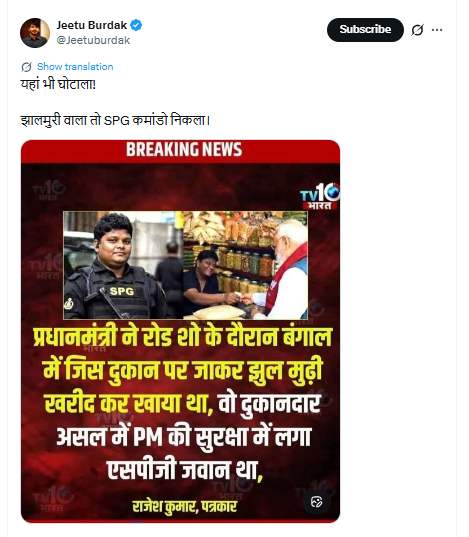
A collage of two images circulating on social media is falsely claiming that the street vendor who served jhalmuri to Prime Minister Narendra Modi during an election campaign in Jhargram was actually a personnel from the Special Protection Group (SPG). Research by the CyberPeace Research Wing found the claim to be false and misleading, indicating that it is being shared as part of election-related misinformation. The vendor and the SPG personnel seen in the viral collage are two different individuals.
Claim
An X (formerly Twitter) user, “@Jeetuburdak,” shared the viral collage on April 21, 2026, with the caption: “Another scam! The jhalmuri seller turned out to be an SPG commando.” The post quickly gained traction online.
Fact Check
A close examination of the two images used in the collage shows clear visual differences between the individuals. The person seen in SPG uniform does not match the street vendor who served food to the prime minister. Reverse image searches were conducted using multiple tools to trace the origin of the images. While no verifiable source was found linking the SPG personnel’s image to the vendor, several credible reports and videos featured the actual jhalmuri seller from the campaign event.
- https://x.com/ANI/status/2045859146508177911?s=20
- https://news24online.com/cities/kolkata/who-is-the-man-that-served-jhalmuri-to-pm-modi-know-his-daily-income-and-what-he-talked-about-with-pm/811123/
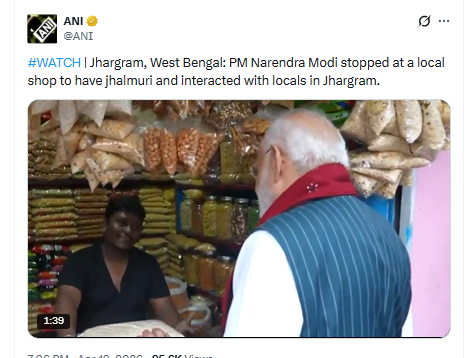
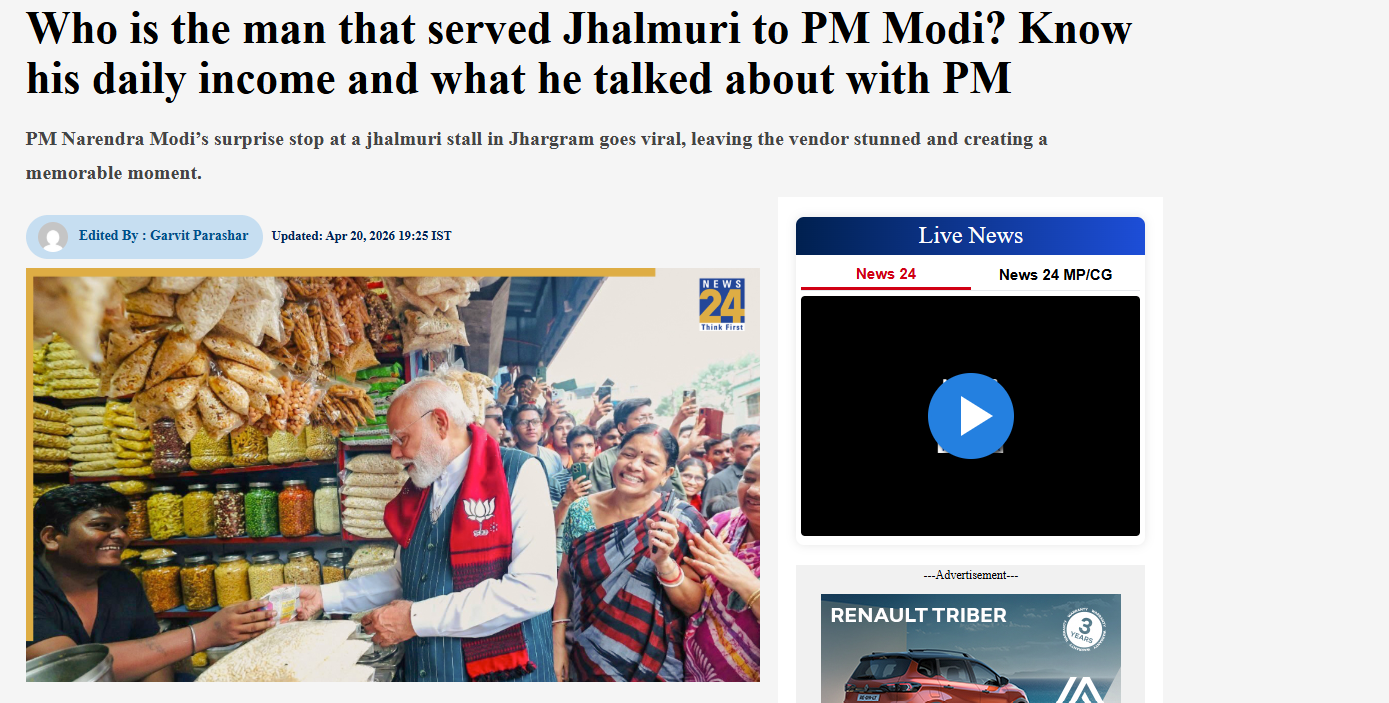
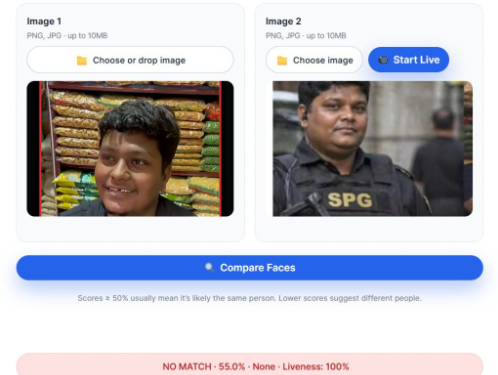
According to media reports, the prime minister briefly stopped at a roadside stall during the campaign in Jhargram and interacted with the vendor while enjoying jhalmuri. The vendor was later interviewed by multiple outlets, further confirming his identity as a local seller. Additionally, technical facial comparison analysis using online tools also indicated that the two individuals in the viral collage are not the same person.
Conclusion
The claim that the jhalmuri vendor was an SPG commando is false and misleading. The viral collage shows two different individuals, and there is no evidence to support the allegation.
