
AI-Driven Automation and the Future of Work in India - Jobs, Skills and Policy for a Changing Economy
Introduction
AI is transforming the way work is done and redefining the nature of jobs over the next decade. In the case of India, it is not just what duties will be taken over by machines, but how millions of employees will move to other sectors, which skills will become more sought-after, and how policy will have to change in response. This article relies on recent labour data of India's Periodic Labour Force Survey (PLFS, 2023-24) and discusses the vulnerabilities to disruption by location and social groups. It recommends viable actions that can be taken to ensure that risks are minimised and economic benefits maximised.
India’s Labour Market and Its Automation Readiness
According to India’s Periodic Labour Force Survey (PLFS), the labour market is changing and growing. Participation in the labour force improved to 60.1 per percent in 2023-24 versus 57.9 per cent the year before, and the ratio of the worker population also improved, signifying the increased employment uptake both in the rural and urban geographies (PLFS, 2023-24). There has also been an upsurge of female involvement. However, a big portion of the job market has been low-wage and informal, with most of the jobs being routine and thus most vulnerable to automation. The statistics indicate a two-tiered reality of the Indian labour market: an increased number of working individuals and a structural weakness.
AI-Driven Automation’s Impact on Tasks and Emerging Opportunities
AI-driven automation, for the most part, affects the task components of jobs rather than wiping out whole jobs. The most automatable tasks are routine and manual, and more recent developments in AI have extended to non-routine cognitive tasks like document review, customer query handling, basic coding and first-level decision-making. There are two concurrent findings of global studies. To start with, part of the ongoing tasks will be automated or expedited. Second, there will be completely new tasks and work positions around data annotation, the operation of AI systems, prompt engineering, algorithmic supervision and AI adherence (World Bank, 2025; McKinsey, 2017).
In the case of India, this change will be skewed by sector. The manufacturing, back-office IT services, retail and parts of financial services will see the highest rate of disruption due to the concentration of routine processes with the ease of technology adoption. In comparison, healthcare, education, high-tech manufacturing and AI safety auditing are placed to create new skilled jobs. NITI Aayog estimates huge returns in GDP with the adoption of AI but emphasises that India has to invest simultaneously in job creation and reskilling to achieve the returns (NITI Aayog, 2025).
Groups with Highest Vulnerability in the Transition to Automation
The PLFS emphasises that a large portion of the Indian population does not have any formal employment and that the social protection is minimal and formal training is not available to them. The risk of displacement is likely to be the greatest for informal employees, making up almost 90% of India’s labour force, who carry out low-skilled, repetitive jobs in the manufacturing and retail industry (PLFS, 2023-24). Women and young people in low-level service jobs also face a greater challenge of transition pressure unless the reskilling and placement efforts can be tailored to them. Meanwhile, major cities and urban centres are likely to have openings for most of the new skilled opportunities at the expense of an increasing geographic and social divide.
The Skills and Supply Challenge
While India’s education and research ecosystem is expanding, there remain significant gaps in preparing the workforce for AI-driven change. Given the vulnerabilities highlighted earlier, AI-focused reskilling must be a priority to equip workers with practical skills that meet industry needs. Short modular programs in areas such as cloud technologies, AI operations, data annotation, human-AI interaction, and cybersecurity can provide workers with employable skills. Particular attention should be given to routine-intensive sectors like manufacturing, retail, and back-office services, as well as to regions with high informal employment or lower access to formal training. Public-private partnerships and localised training initiatives can help ensure that reskilling translates into concrete job opportunities rather than purely theoretical knowledge (NITI Aayog, 2025)
The Way Forward
To facilitate the change process, the policy should focus on three interconnected goals: safeguarding the vulnerable, developing competencies on a large-scale level, and directing innovation towards the widespread ability to benefit.
- Protect the vulnerable through social buffers. Provide informal workers with social protection in the form of portable benefits, temporary income insurance based on reskilling, and earned training leave. While the new labour codes provide essential protections such as unemployment allowances and minimum wage standards, they could be strengthened by incorporating explicit provisions for reskilling. This would better support informal workers during job transitions and enhance workforce adaptability.
- Short modular courses on cloud computing, cybersecurity, data annotation, AI operations, and human-AI interaction should be planned through collaboration between public and private training providers. Special preference should be given to industry-certified certifications and apprenticeship-based placements. These apprenticeships should be made accessible in multiple languages to ensure inclusivity. Existing government initiatives, such as NASSCOM’s Future Skills Prime, need better outreach and marketing to reach the workforce effectively.
- Enhance local labour market mediators. Close the disparity between local demand and the supply of labour in the industry by enhancing placement services and government-subsidised internship programmes for displaced employees and encouraging firms to hire and train locally.
- Invest in AI literacy, AI ethics, and basic education. Democratise access to research and learning by introducing AI literacy in schools, increasing STEM seats in universities, and creating AI labs in the region (NITI Aayog, 2025).
- Encourage AI adoption that creates jobs rather than replaces them. Fiscal and regulatory incentives should prioritise AI tools that augment worker productivity in routine roles instead of eliminating positions. Public procurement can support firms that demonstrate responsible and inclusive deployment of AI, ensuring technology benefits both business and workforce.
- Supervise and oversee the transition. Use PLFS and real-time administrative data to monitor shrinking and expanding occupations. High-frequency labour market dashboards will allow making specific interventions in those regions in which the acceleration of displacement occurs.
Conclusion
The integration of AI will significantly impact the future of the Indian workforce, but policy will determine its effect on the labour market. The PLFS indicates increased employment but a structural weakness of informal and routine employment. Evidence from the Indian market and international research points to the fact that the appropriate combination of social protection, skills building and responsible technology implementation can change disruption into a path of upward mobility. There is a very limited window of action. The extent to which India will realise the productivity and GDP benefits predicted by national research, alongside the investments made in labour market infrastructure, remains uncertain. It is crucial that these efforts lead to the capture of gains and facilitate a fair and inclusive transition for workers.
References
- Annual Report Periodic Labour Force Survey (PLFS) JULY 2022 - JUNE 2023.
- Future Jobs: Robots, Artificial Intelligence, and Digital Platforms in East Asia and Pacific, World Bank.
- Jobs Lost, Jobs Gained: What the Future of Work Will Mean for Jobs, Skills, and Wages, McKinsey Global Institute
- Roadmap for Job Creation in the AI Economy, NITI Aayog
- India central bank chief warns of financial stability risks from growing use of AI, Reuters
- AI Cyber Attacks Statistics 2025, SQ Magazine.

Related Blogs

Introduction
Cyber financial offences in India have experienced an alarming surge both in terms of frequency and complexity. Be it phishing attacks or organised fraud syndicates, the nation has been facing a spurt in online financial threats, which leave the victims at their mercy because of procedural lags on the part of law enforcement agencies. To counter this, the Government of India has stepped up measures to create a Cyber-Secure Bharat, focusing on speedy resolution, accountability, and digital empowerment. A key move in this direction is the introduction of the e-Zero FIR initiative, brought forth by the Ministry of Home Affairs (MHA) with Union Home Minister Amit Shah at the helm. This newly developed digital-first system is expected to revolutionise the way cyber financial crimes, particularly those that result in high monetary losses, are handled and investigated.
What Is the e-Zero FIR Initiative?
The e-Zero FIR program is a technology-based platform that enables the automated registration of Zero FIRs for value cyber financial crimes. Led by the Indian Cybercrime Coordination Centre (I4C), Ministry of Home Affairs, the programme is now piloted in Delhi and aims to fill a pressing lacuna: the time lag involved in transitioning cybercrime complaints to First Information Reports (FIRs).
Complaints of financial frauds worth more than ₹10 lakh, reported through the National Cybercrime Reporting Portal (NCRP) or helpline number 1930, will be automatically turned into e-Zero FIRs under this scheme. Such electronic FIRs are directed to the e-Crime Police Station in Delhi, regardless of jurisdiction, and then relayed to the corresponding territorial cybercrime unit. Complainants can visit the cybercrime Police Station within 3 days and get the Zero FIR converted into a regular FIR.
Key Features of the Initiative
- Pilot Implementation in Delhi
Launched as a pilot project in Delhi, it will later serve as the first use case for the national rollout. The success of the pilot will determine its implementation in other states and Union Territories.
- Seamless Digital Integration
The project provides strong back-end integration between:
- NCRP (National Cybercrime Reporting Portal)
- e-FIR System (Delhi Police)
- CCTNS (Crime and Criminal Tracking Network & Systems – NCRB)
This integrated model enables complaints to pass smoothly between platforms and agencies.
- Zero FIR Auto-Registration and Routing
Now, for complaints lodged through 1930 or the National Cyber Crime Reporting Portal related to financial losses exceeding the threshold of ₹10 lakh, the system will automatically register a Zero FIR to the e-Crime Police Station of Delhi and then route it to the concerned territorial cybercrime police station, triggering immediate case processing.
- Victim-Centric Conversion Mechanism
Complainants are given 3 days from the time of filing to physically report to the police station and transform the e-Zero FIR into a conventional regular FIR under Section 173 (1) and 1(ii) of the newly enacted Bhartiya Nagrik Suraksha Sanhita (BNSS). This ensures legal redress is quicker and easier.
Impact and Significance: The CyberPeace View
The e-Zero FIR system is a significant change in India's cybercrime enforcement, offering quicker response times and improved recovery opportunities. Cyber fraud reported within the "golden hour" can boost recovery levels of financial fraud. The system also eliminates jurisdictional barriers and procedural bottlenecks, making it more victim-friendly. Union Home Minister Amit Shah emphasised the initiative's alignment with Prime Minister Narendra Modi's vision of a digitally resilient India. The system is a scalable national model of tech-based policing supported by organised digital workflows. The initiative allows for real-time analysis of fraud graphs and detection of fraud syndicates through identification and device-based clustering. This is a step towards more automated, context-aware cyber policing, focusing on AI, identity graphs, and velocity to prevent crimes. The system is a step towards a next-generation cyber law enforcement strategy, focusing on AI, identity graphs, and velocity.
Conclusion
The roll-out of the e-Zero FIR program is a turning point in India's battle against cybercrime. By marrying automation with inter-agency coordination and easy-to-use mechanisms, the government has eradicated one of the major stumbling blocks for victims, the delay in taking legal action. Though its pilot phase targets high-value financial frauds in Delhi, its potential for having a countrywide impact is vast. With digital transactions on the upswing and frauds getting more cunning, efforts like these are the key to making a safe, responsive, and victim-centric cyber environment. CyberPeace commends and welcomes this important move towards establishing a Cyber-Secure Bharat, wherein all citizens can make digital transactions with confidence.
References
- https://www.pib.gov.in/PressReleasePage.aspx?PRID=2129715
- https://www.mha.gov.in/en
- https://cybercrime.gov.in/
- https://www.ncrb.gov.in/
- https://economictimes.indiatimes.com/wealth/save/new-e-zero-fir-govt-launches-pilot-for-swift-action-against-cybercrimes-how-it-can-help-you/articleshow/121314437.cms?from=mdr

Executive Summary
A video featuring India’s External Affairs Minister S. Jaishankar is being widely circulated on social media with the claim that he urged US Secretary of State Marco Rubio and US President Donald Trump to hand over the “handlers” of the so-called “Cockroach Janata Party” to India. The viral post further alleges that Jaishankar described the organisation as a “Pakistani and Iranian proxy group.” CyberPeace Research Wing research found the viral claim to be fake. External Affairs Minister S. Jaishankar did not make any statement regarding the “Cockroach Party” or its alleged handlers during the press conference. The viral video has been edited and is being shared with a misleading claim.
Claim
A verified X (formerly Twitter) user shared the viral clip and claimed that during a joint press conference, Jaishankar said:“I request Marco Rubio and Trump to hand over the handlers of the Cockroach Party because they are Pakistani and Iranian proxy groups.”
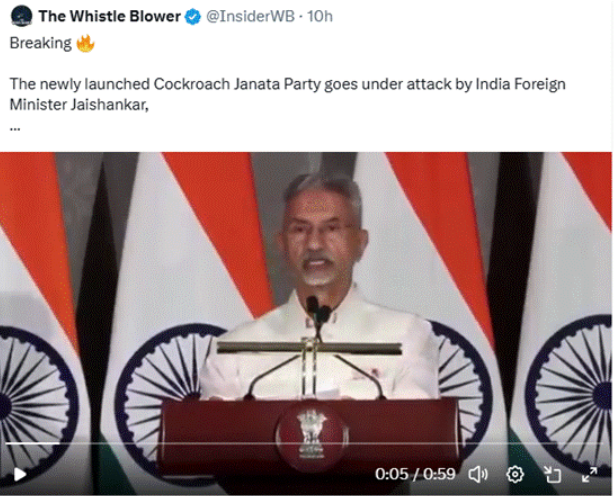
Fact Check
To verify the claim, we converted the viral clip into key frames and conducted a reverse image search. During the research, we found the original video uploaded on May 24, 2026, on the official YouTube channel of the Ministry of External Affairs.
The video was captioned:“Press conference of EAM Dr S Jaishankar and US Secretary of State Marco Rubio.”

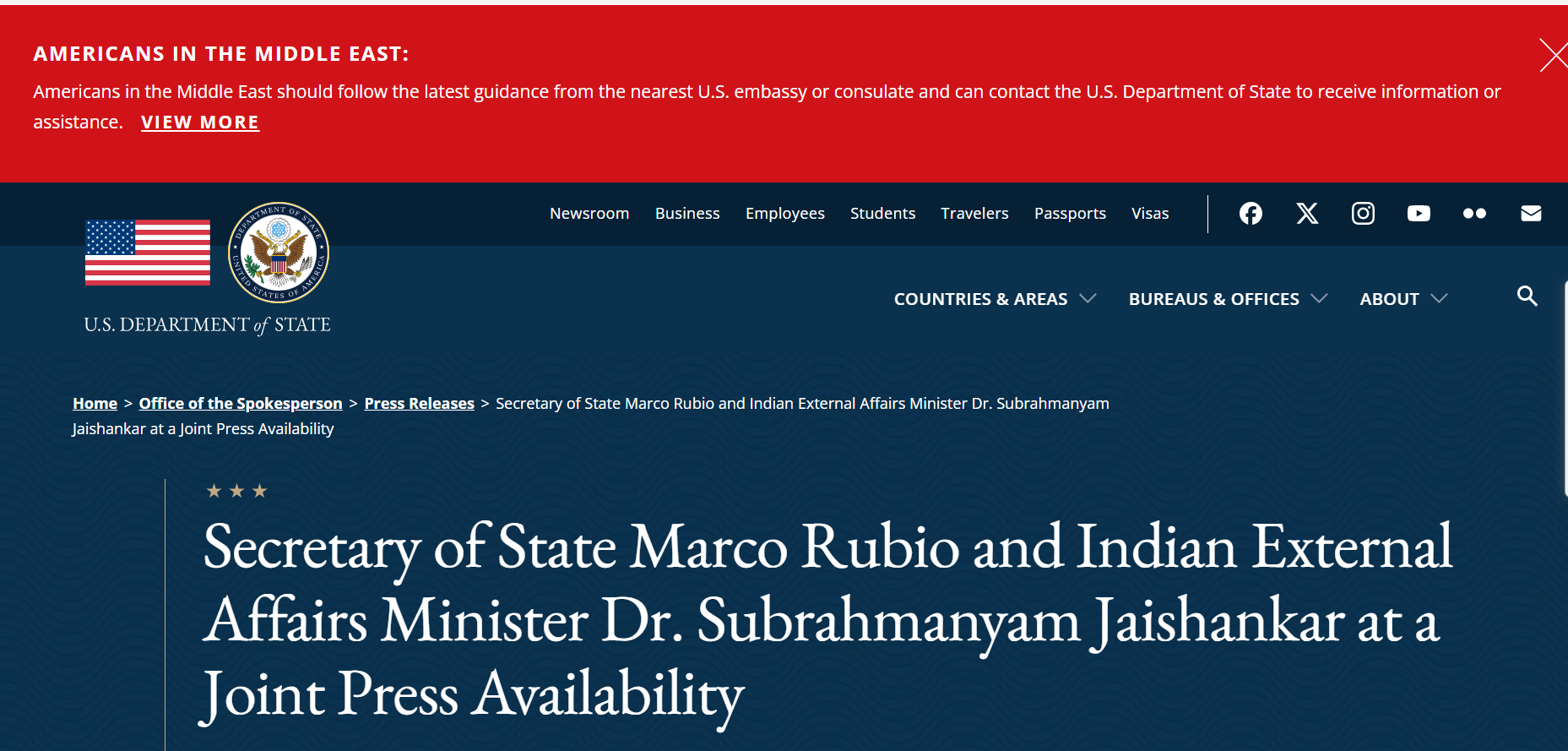
A review of the full press conference confirmed that Jaishankar made no mention of any “Cockroach Party,” its alleged handlers, or any Pakistani or Iranian proxy network. Further verification of the official transcripts published by both the Indian Ministry of External Affairs and the United States Department of State also found no references to the terms “Cockroach Party,” “handlers,” “Pakistani proxy,” or any statements matching the viral claim.
https://www.state.gov/releases/office-of-the-spokesperson/2026/05/secretary-of-state-marco-rubio-and-indian-external-affairs-minister-dr-subrahmanyam-jaishankar-at-a-joint-press-availability
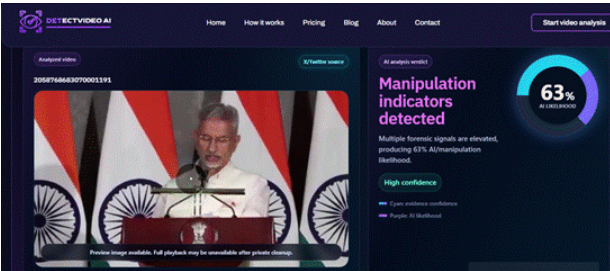
In the final stage of verification, the viral clip was analysed using an AI detection tool. The analysis suggested that the audio had been manipulated and that the video appeared to be edited. The tool indicated a 63 percent probability that the clip had been altered using AI-based editing techniques.
Conclusion
The research confirms that the viral claim is fake. S. Jaishankar did not make any statement regarding the “Cockroach Party” or its alleged handlers during the press conference. The viral clip has been edited and is being shared with misleading claims.

Executive Summary
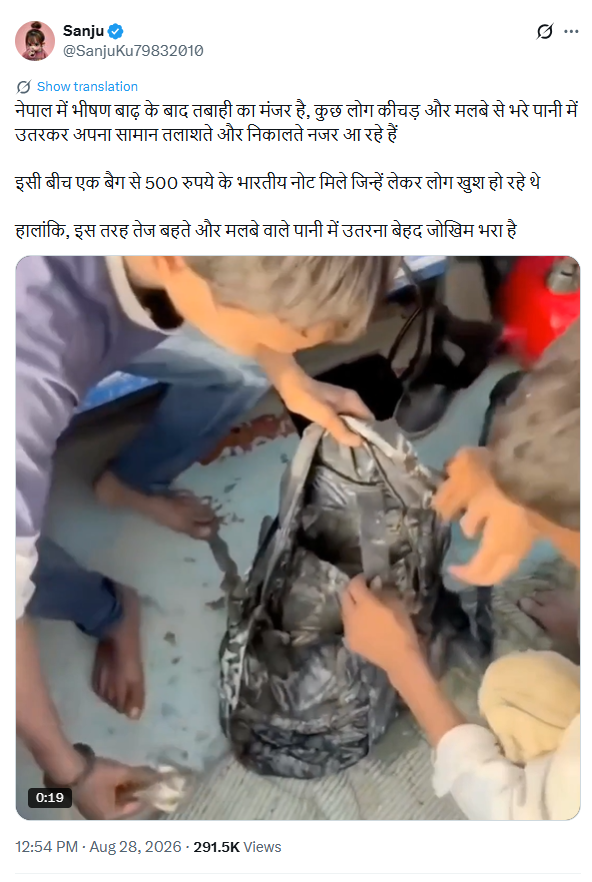
A video is going viral on social media with the claim that ₹500 Indian currency notes were found inside a bag during the floods in Nepal. A research by CyberPeace’s research wing found that the video is not from the recent floods in Nepal, but from Vrindavan in Uttar Pradesh. The video was uploaded on July 14 by an Instagram creator on their account. The 30-second video shows people travelling in a boat finding a bag floating in the water, from which several ₹500 currency notes are pulled out.
Claim:
The video has been shared on X with a caption claiming that Nepal is witnessing widespread destruction following severe floods, with people seen wading through muddy, debris-filled water to search for and recover their belongings. The caption further claims that people found a bag containing ₹500 Indian currency notes and were seen rejoicing over the discovery. It also cautions that entering fast-flowing, debris-filled floodwater is extremely dangerous.
https://x.com/SanjuKu79832010/status/2093238274206887946
Fact Check:
To verify the viral video claiming that a bag containing ₹500 Indian currency notes was found during the floods in Nepal, we conducted a reverse image search using keyframes from the footage. The search led us to a video uploaded on the Instagram account ‘parshuram_676’ on July 14, 2024.
https://www.instagram.com/p/Daw7aYJAjoc/

Additionally, we found the same boat seen in the viral video in several other videos uploaded on the same Instagram account.

Not only that, we also found several videos with visuals similar to those in the viral video uploaded on the same video creator’s Facebook account. The information provided on the Facebook account also lists Vrindavan, Uttar Pradesh, as the location.
https://www.facebook.com/profile.php?id=61567184794045

Conclusion:
The evidence gathered during our research clearly establishes that the video being circulated with the claim that ₹500 Indian currency notes were found inside a bag during the floods in Nepal was actually filmed by a video creator in Vrindavan, Uttar Pradesh.
