
Trust in Tech: AI Adoption at the Workplace and Quiet Quitting
Introduction
The rapid adoption of artificial intelligence (AI) tools and applications in companies has been largely presented as a groundbreaking development for enterprises. The potential for increased productivity and efficiently scaled companies eliminates repetitive tasks and builds a narrative that practically writes itself for executives. What has largely been ignored, however, is its effect on its users- the employees. Evidence from across the United States, United Kingdom, and continental Europe indicates an increase in psychological disengagement from work, along with an increase in the number of people who are actively sabotaging the very systems that companies have invested millions of dollars to implement, as a direct result of being forced to work with AI.
The Backdrop: Quiet Quitting
Quiet quitting is a form of employee disengagement wherein workers meet only the basic expectations of their job without. Gallup puts global employee engagement at just 21%. State of the Global Workplace 2026 report which analysed employee well-being across 160 countries reports that in India, employee and manager engagement has declined. Around 62% of workers describe themselves as not engaged, and another 17% are actively disengaged — not just drifting, but potentially pulling in the opposite direction. What does this mean for productivity? Gallup estimates this costs the global economy roughly $8.9 trillion in lost productivity each year, around 9% of world GDP. This is the workplace AI has entered into.
How AI Is Changing the Nature of Work
The promise was simpler work but employees report that the reality is often more of it. AI raises output expectations without necessarily reducing effort. Workers now lose the equivalent of 51 working days per year to technology friction, nearly two full months up 42% from 2025. Poorly integrated systems force employees to spend hours troubleshooting or correcting AI-generated outputs, adding cognitive load rather than removing it. Focus efficiency dropped to a three-year low of 60%, as collaboration time surged 34% and multitasking climbed 12%. AI is not eliminating work. It is transforming it into something more demanding and more fragmented. The psychological dimension is equally documented. TalentLMS research found that 54% of employees report persistent workplace unhappiness, with one in five experiencing it frequently or constantly. 29% report unmanageable workloads during this transition, and 15% do not clearly understand their role expectations in an AI-transformed workplace. When workers cannot see where they fit, withdrawal is a rational response.
Then there is the fear. IBM announced it would not replace roughly 7,800 back-office positions that could be handled by AI, framing it as natural attrition. Klarna said its AI assistant was doing the work of 700 full-time customer service agents. Dropbox laid off 16% of its workforce, with its CEO explicitly citing the need to “make room for AI.” AI was the leading cause of job cuts in March 2026 the first time that has happened since tracking began.
The Causal Link: AI Anxiety to Quiet Quitting
A peer-reviewed study published in March 2025 establishes the causal mechanism between forced AI adoption and employee disengagement. Conducted across 457 employees in Turkish SMEs, it found that AI anxiety does not directly compel people to resign. Instead, it triggers quiet quitting a form of progressive disengagement that functions as a precursor to departure. Drawing on Withdrawal Progression Theory, the study frames quiet quitting as a preliminary stage of turnover intention, where withdrawal progresses from mild detachment toward eventual exit. The integrated causal chain runs as follows: forced AI adoption creates work intensification and job anxiety, which produce burnout and loss of autonomy, which trigger psychological withdrawal, which precedes turnover. DHR Global’s Workforce Trends Report for 2026 found that overall employee engagement dropped from 88% to 64% in a single year. Crucially, 69% of C-suite leaders say their company has communicated clearly about AI’s impact on jobs but only 12% of entry-level staff agree. When the people most exposed to displacement are also the least informed about what is happening to their roles, disengagement is not a mystery. It is a response to a vacuum of information.
From Disengagement to Active Withdrawal
Quiet quitting is then a natural response. But what has emerged alongside it is something more active, and it is where the disengagement crisis tips into something organisations are unprepared for. The Writer and Workplace Intelligence survey of 2,400 knowledge workers found that 29% of employees admit to willfully withdrawing from their company’s AI strategy. Among Gen Z workers, that figure jumps to 44%. Active withdrawal takes several forms: entering proprietary data into public AI chatbots, using unapproved tools, outright refusing to engage with mandated platforms, and in some cases deliberately generating low-quality outputs to make the technology look ineffective. For Gen Z, the resistance has a structural logic. Junior roles in finance, law, and tech the traditional “learning by doing” rungs of the career ladder have declined by 32% since 2022. For a 22-year-old, AI is not a tool; it is a competitor that has already taken their first job. Workers who resist AI out of fear for their jobs are making themselves more vulnerable to the outcome they dread. 77% of executives say employees who refuse to become proficient in AI will not be considered for promotions or leadership roles, and 60% are considering cutting those who refuse to adopt it entirely.
Meanwhile, 75% of executives admit their company’s AI strategy is “more for show” than a meaningful guide to outcomes. Only 29% report significant ROI from generative AI, despite 97% claiming to have already deployed agents across their organisation. 39% of business leaders admit they made employees redundant as a result of deploying AI of whom 55% concede they made the wrong decisions about those redundancies. Organisations are moving fast, getting it wrong, and the cost is being absorbed by the workforce.
Conclusion
AI is not directly causing quiet quitting. However, AI is changing how we view working relationships; it will continue to result in predictable outcomes of poor execution of AI (i.e. passive to active disengagement) and radically change the way that we work, primarily by creating an increase in job demands, reducing autonomy, and raising worker anxiety without providing any transparency about future AI technology use. If AI continues to create a challenging work environment, it may lead to increased psychological detachment from work and ultimately result in productivity losses, possibly canceling out the very gains expected from AI integration. This globally rising disengagement from AI tools begets the question: is technology being deployed responsibly?
References
- https://www.gallup.com/workplace/349484/state-of-the-global-workplace.aspx
- https://www.walkme.com/news-releases/enterprises-lose-51-workdays-per-employee-to-technology-friction-annually-despite-record-ai-investment-walkme-global-study-of-3750-finds/.
- https://www.activtrak.com/resources/state-of-the-workplace/
- https://peoplemanagingpeople.com/employee-retention/quiet-cracking/
- https://www.webpronews.com/the-quiet-revolt-gen-z-workers-are-deliberately-undermining-ai-deployments-from-the-inside/
- https://www.uctoday.com/productivity-automation/44-of-gen-z-workers-are-sabotaging-your-enterprise-ai-rollout-the-problem-isnt-gen-z/
- https://pmc.ncbi.nlm.nih.gov/articles/PMC11939379/
- https://huntscanlon.com/workforce-trends-2026-leaders-confront-burnout-disengagement-and-ai-driven-change/
- https://fortune.com/2026/04/08/gen-z-workers-sabotage-ai-rollout-backlash/
- https://peoplemanagingpeople.com/employee-retention/quiet-cracking/
- https://www.hrgrapevine.com/us/content/article/2026-04-09-ai-adoption-is-tearing-companies-apart-says-new-report
- https://economictimes.indiatimes.com/news/new-updates/india-leads-in-workplace-disengagement-as-quiet-quitting-trend-rises-why-are-indians-mentally-checking-out-at-jobs/articleshow/130104773.cms?from=mdr

Related Blogs

Executive Summary:
A video that circulated on social media to show Iranian President Ebrahim Raisi inside a helicopter moments before the tragic crash on May 20, 2024, has equally been proven to be fake. The validation of information leaves no doubt, that the video was shot in January 2024, which showed Raisi’s visiting Nemroud Reservoir Dam project. As a means of verifying the origin of the video, the CyberPeace Research Team conducted reverse image search and analyzed the information obtained from the Islamic Republic News Agency, Mehran News, and the Iranian Students’ News Agency. Further, the associated press pointed out inconsistencies between the part in the video that went viral and the segment that was shown by Iranian state television. The original video is old and it is not related to the tragic crash as there is incongruence between the snowy background and the green landscape with a river presented in the clip.

Claims:
A video circulating on social media claims to show Iranian President Ebrahim Raisi inside a helicopter an hour before his fatal crash.


Fact Check:
Upon receiving the posts, in some of the social media posts we found some similar watermarks of the IRNA News agency and Nouk-e-Qalam News.

Taking a cue from this, we performed a keyword search to find any credible source of the shared video, but we found no such video uploaded by the IRNA News agency on their website. Recently, they haven’t uploaded any video regarding the viral news.
We closely analyzed the video, it can be seen that President Ebrahim Raisi was watching outside the snow-covered mountain, but in the internet-available footage regarding the accident, there were no such snow-covered mountains that could be seen but green forest.
We then checked for any social media posts uploaded by IRNA News Agency and found that they had uploaded the same video on X on January 18, 2024. The post clearly indicates the President’s aerial visit to Nemroud Dam.

The viral video is old and does not contain scenes that appear before the tragic chopper crash involving President Raisi.
Conclusion:
The viral clip is not related to the fatal crash of Iranian President Ebrahim Raisi's helicopter and is actually from a January 2024 visit to the Nemroud Reservoir Dam project. The claim that the video shows visuals before the crash is false and misleading.
- Claim: Viral Video of Iranian President Raisi was shot before fatal chopper crash.
- Claimed on: X (Formerly known as Twitter), YouTube, Instagram
- Fact Check: Fake & Misleading
Executive Summary
A video of Prime Minister Narendra Modi is being widely shared on social media with the claim that he is being “made up” or styled by a team, with users attempting to mock him using the footage. The clip is being circulated with misleading captions suggesting it shows the Prime Minister undergoing makeup and grooming by a dedicated team. CyberPeace Foundation Research Wing, in its research, found that the viral claim is false. In fact, the viral video is not recent, but from 2016. At that time, a statue of PM Modi was to be installed at Madame Tussauds Museum. A team of artists and experts visited the Prime Minister's residence to take measurements for the statue. This misleading claim has been circulating on social media for several years. We have previously fact-checked this claim and exposed the truth.
Claim
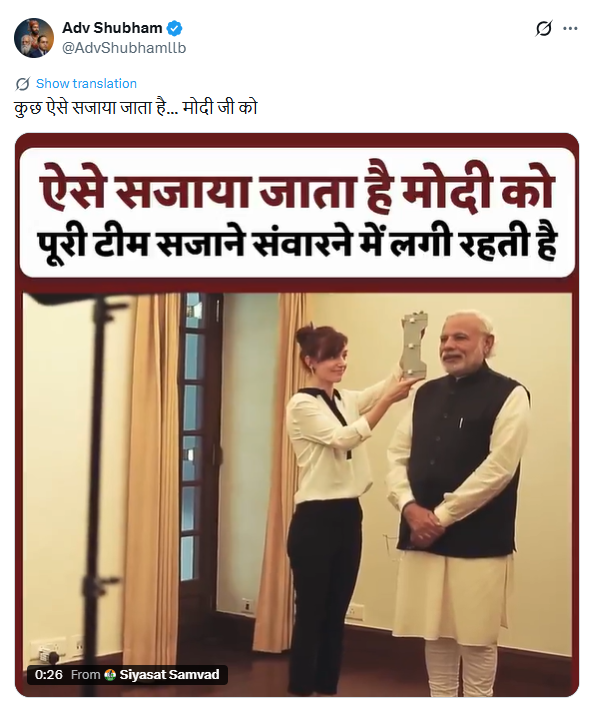
An X user named “Adv Shubham” shared the viral video on May 27, 2026, with the caption:“This is how Modi Ji is styled…”The post also claims that the Prime Minister is regularly “made up” by a team.
- https://x.com/AdvShubhamllb/status/2059682034289946746
- https://perma.cc/FVM9-PQBP
Fact Check
The viral video is not recent. It dates back to 2016 and is related to a completely different context. During the investigation, we found the same footage on the official YouTube channel of Madame Tussauds London, uploaded on March 16, 2016.

According to the video details, it shows the process of taking measurements for a wax statue of Prime Minister Narendra Modi for installation at Madame Tussauds. A team of artists and experts had visited the Prime Minister’s residence in Delhi for this purpose.
Conclusion
The viral claim that Prime Minister Narendra Modi is being “made up” by a team is false. The footage is from 2016 and shows a measurement session conducted for his wax statue at Madame Tussauds Museum.

Executive Summary:
A video is going viral on social media linking it to the ongoing conflict between the US-Israel and Iran. The clip shows explosions on buildings and is being shared with the claim that it depicts an attack on Israel. It is further claimed that Iran targeted a nuclear site located near the sea in Israel, and this video shows that attack. However, an research by the CyberPeace found the claim to be false. The video is not from a real incident but has been created using AI.
Claim:
On social media platform X, a user shared the viral video on March 8, 2026, with the caption: “Iran attacked an Israeli nuclear site located near the sea.”

Fact Check:
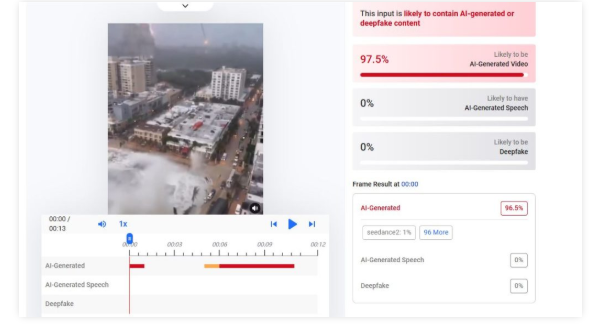
To verify the viral claim, we searched relevant keywords on Google but found no credible news reports supporting it.On closely examining the video, we observed several technical inconsistencies. The person seen in the video appears robotic, raising suspicion that the content may be AI-generated. To confirm this, we analyzed the video using AI detection tools. The tool Hive Moderation indicated that the video is approximately 97.5 percent likely to be generated using artificial intelligence.
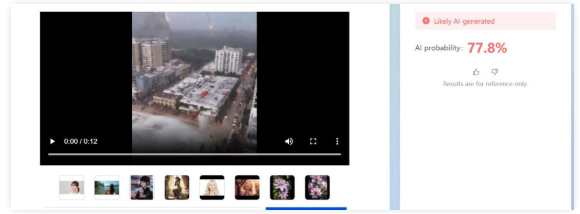
We also used the AI detection tool Matrix.Tencent. The results suggested that the video is likely AI-generated, with around a 77 percent probability.
Conclusion:
Our research found that the viral video claiming to show an Iranian attack on Israel is AI-generated and not related to any real incident.
