
Taming Bias in AI: Statistical Principles, Fairness-Aware Algorithms and Why It Matters
Artificial intelligence is revolutionizing industries such as healthcare to finance to influence the decisions that touch the lives of millions daily. However, there is a hidden danger associated with this power: unfair results of AI systems, reinforcement of social inequalities, and distrust of technology. One of the main causes of this issue is training data bias, which appears when the examples on which an AI model is trained are not representative or skewed. To deal with it successfully, this needs a combination of statistical methods, algorithmic design that is mindful of fairness, and robust governance over the AI lifecycle. This article discusses the origin of bias, the ways to reduce it, and the unique position of fairness-conscious algorithms.
Why Bias in Training Data Matters
The bias in AI occurs when the models mirror and reproduce the trends of inequality in the training data. When a dataset has a biased representation of a demographic group or includes historical biases, the model will be trained to make decisions in ways that will harm the group. This is a fact that has a practical implication: prejudiced AI may cause discrimination during the recruitment of employees, lending, and evaluation of criminal risks, as well as various other spheres of social life, thus compromising justice and equity. These problems are not only technical in nature but also require moral principles and a system of governance (E&ICTA).
Bias is not uniform. It may be based on the data itself, the algorithm design, or even the lack of diversity among developers. The bias in data occurs when data does not represent the real world. Algorithm bias may arise when design decisions inadvertently put one group at an unfair advantage over another. Both the interpretation of the model and data collection may be affected by human bias. (MDPI)
Statistical Principles for Reducing Training Data Bias
Statistical principles are at the core of bias mitigation and they redefine the data-model interaction. These approaches are focused on data preparation, training process adjustment, and model output corrections in such a way that the notion of fairness becomes a quantifiable goal.
Balancing Data Through Re-Sampling and Re-Weighting
Among the aforementioned methods, a fair representation of all the relevant groups in the dataset is one way. This can be achieved by oversampling underrepresented groups and undersampling overrepresented groups. Oversampling gives greater weight to minority examples, whereas re-weighting gives greater weight to under-represented data points in training. The methods minimize the tendency of models to fit to salient patterns and improve coverage among vulnerable groups. (GeeksforGeeks)
Feature Engineering and Data Transformation
The other statistical technique is to convert data characteristics in such a way that sensitive characteristics have a lesser impact on the results. In one example, fair representation learning adjusts the data representation to discourage bias during the untraining of the model. The disparate impact remover adjust technique performs the adjustment of features of the model in such a way that the impact of sensitive features is reduced during learning. (GeeksforGeeks)
Measuring Fairness With Metrics
Statistical fairness measures are used to measure the effectiveness of a model in groups.
Fairness-Aware Algorithms Explained
Fair algorithms do not simply detect bias. They incorporate fairness goals in model construction and run in three phases including pre-processing, in-processing, and post-processing.
Pre-Processing Techniques
Fairness-aware pre-processing deals with bias prior to the model consuming the information. This involves the following ways:
- Rebalancing training data through sampling and re-weighting training data to address sample imbalances.
- Data augmentation to generate examples of underrepresented groups.
- Feature transformation removes or downplays the impact of sensitive attributes prior to the commencement of training. (IJMRSET)
These methods can be used to guarantee that the model is trained on more balanced data and to reduce the chances of bias transfer between historical data.
In-Processing Techniques
The in-processing techniques alter the learning algorithm. These include:
- Fairness constraints that penalize the model for making biased predictions during training.
- Adversarial debiasing, where a second model is used to ensure that sensitive attributes are not predicted by the learned representations.
- Fair representation learning that modifies internal model representations in favor of
Post-Processing Techniques
Fairness may be enhanced after training by changing the model outputs. These strategies comprise:
- Threshold adjustments to various groups to meet conditions of fairness, like equalized odds.
- Calibration techniques such that the estimated probabilities are fair indicators of the actual probabilities in groups. (GeeksforGeeks)
Challenges
Mitigating bias is complex. The statistical bias minimization may at times come at the cost of the model accuracy, and there is a conflict between predictive performance and fairness. The definition of fairness itself is potentially a difficult task because various applications of fairness require various criteria, and various criteria can be conflicting. (MDPI)
Gaining varied and representative data is also a challenge that is experienced because of privacy issues, incomplete records, and a lack of resources. The auditing and reporting done on a continuous basis are needed so that mitigation processes are up to date, as models are continually updated. (E&ICTA)
Why Fairness-Aware Development Matters
The outcomes of the unfair treatment of some groups by AI systems are far-reaching. Discriminatory software in recruitment may support inequality in the workplace. Subjective credit rating may deprive deserving people of opportunities. Unbiased medical forecasts might result in the flawed allocation of medical resources. In both cases, prejudice contravenes the credibility and clouds the greater prospect of AI. (E&ICTA)
Algorithms that are fair and statistical mitigation plans provide a way to create not only powerful AI but also fair and trustworthy AI. They admit that the results of AI systems are social tools whose effects extend across society. Responsible development will necessitate sustained fairness quantification, model adjustment, and upholding human control.
Conclusion
AI bias is not a technical malfunction. It is a mirror of real-world disparities in data and exaggerated by models. Statistical rigor, wise algorithm design, and readiness to address the trade-offs between fairness and performance are required to reduce training data bias. Fairness-conscious algorithms (which can be implemented in pre-processing, in-processing, or post-processing) are useful in delivering more fair results. As AI is taking part in the most crucial decisions, it is necessary to consider fairness at the beginning to have a system that serves the population in a responsible and fair manner.
References
- Understanding Bias in Artificial Intelligence: Challenges, Impacts, and Mitigation Strategies: E&ICTA, IITK
- Bias and Fairness in Artificial Intelligence: Methods and Mitigation Strategies: JRPS Shodh Sagar
- Fairness and Bias in Artificial Intelligence: A Brief Survey of Sources, Impacts, and Mitigation Strategies: MDPI
- Ensuring Fairness in Machine Learning Algorithms: GeeksforGeeks
Bias and Fairness in Machine Learning Models: A Critical Examination of Ethical Implications: IJMRSET - Bias in AI Models: Origins, Impact, and Mitigation Strategies: Preprints
- Bias in Artificial Intelligence and Mitigation Strategies: TCS
- Survey on Machine Learning Biases and Mitigation Techniques: MDPI

Related Blogs
Introduction
Online dating platforms have become a common way for individuals to connect in today’s digital age. For many in the LGBTQ+ community, especially in environments where offline meeting spaces are limited, these platforms offer a way to find companionship and support. However, alongside these opportunities come serious risks. Users are increasingly being targeted by cybercrimes such as blackmail, sextortion, identity theft, and online harassment. These incidents often go unreported due to stigma and concerns about privacy. The impact of such crimes can be both emotional and financial, highlighting the need for greater awareness and digital safety.
Cybercrime On LGBTQ+ Dating Apps: A Threat Landscape
According to the NCRB 2022 report, there has been a 24.4% increase in cybercrimes. But unfortunately, the queer community-specific data is not available. Cybercrimes that target LGBTQ+ users in very organised and predatory. In several Indian cities, gangs actively monitor dating platforms to the point that potential victims, especially young queers and those who seem discreet about their identity, become targets. Once the contact is established, perpetrators use a standard operating process, building false trust, forcing private exchanges, and then gradually starting blackmail and financial exploitation. Many queer victims are blackmailed with threats of exposure to families or workplaces, often by fake police demanding bribes. Fear of stigma and insensitive policing discourages reporting. Cyber criminal gangs exploit these gaps on dating apps. Despite some arrests, under-reporting persists, and activists call for stronger platform safety.
Types of Cyber Crimes against Queer Community on Dating Apps
- Romance scam or “Lonely hearts scam”: Scammers build trust with false stories (military, doctors, NGO workers) and quickly express strong romantic interest. They later request money, claiming emergencies. They often try to create multiple accounts to avoid profile bans.
- Sugar daddy scam: In this type of scam, the fraudster offers money or allowance in exchange for things like chatting, sending photos, or other interactions. They usually offer a specific amount and want to use some uncommon payment gateways. After telling you they will send you a lot of money, they often make up a story like: “My last sugar baby cheated me, so now you must first send me a small amount to prove you are trustworthy.” This is just a trick to make you send them money first.
- Sextortion / Blackmail scam: Scammers record explicit chats or pretend to be underage, then threaten exposure unless you pay. Some target discreet users. Never send explicit content or pay blackmailers.
- Investment Scams: Scammers posing as traders or bankers convince victims to invest in fake opportunities. Some "flip" small amounts to build trust, then disappear with larger sums. Real investors won’t approach you on dating apps. Don’t share financial info or transfer money.
- Pay-Before-You-Meet scam: Scammer demands upfront payment (gift cards, gas money, membership fees) before meeting, then vanishes. Never pay anyone before meeting in person.
- Security app registration scam: Scammers ask you to register on fake "security apps" to steal your info, claiming it ensures your safety. Research apps before registering. Be wary of quick link requests.
- The Verification code scam: Scammers trick you into giving them SMS verification codes, allowing them to hijack your accounts. Never share verification codes with anyone.
- Third-party app links: Mass spam messages with suspicious links that steal info or infect devices. Don’t click suspicious links or “Google me” messages.
- Support message scam: Messages pretending to be from application support, offering prizes or fake shows to lure you to malicious sites.
Platform Accountability & Challenges
The issue of online dating platforms in India is characterised by weak grievance redressal, poor takedown of abusive profiles, and limited moderation practices. Most platforms appoint grievance officers or offer an in-app complaint portal, but complaints are often unanswered or receive only automated and AI-generated responses. This highlights the gap between policy and enforcement on the ground.
Abusive or fake profiles, often used for scams, hate crimes, and outing LGBTQ+ individuals, remain active long after being reported. In India, organised extortion gangs have exploited such profiles to lure, assault, rob, and blackmail queer men. Moderation teams often struggle with backlogs and lack the resources needed to handle even the most serious complaints.
Despite offering privacy settings and restricting profile visibility, moderation practices in India are still weak, leaving large segments of users vulnerable to impersonation, catfishing, and fraud. The concept of pseudonymisation can help protect vulnerable communities, but it is difficult to distinguish authentic users from malicious actors without robust, privacy-respecting verification systems.
Since many LGBTQ+ individuals prefer to maintain their confidentiality, while others are more vocal about their identities, in either case, the data shared by an individual with an online dating platform must be vigilantly protected. The Digital Personal Data Protection Act, 2023, mandates the protection of personal data. Section 8(4) provides: “A Data Fiduciary shall implement appropriate technical and organisational measures to ensure effective observance of the provisions of this Act and the rules made thereunder.” Accordingly, digital platforms collecting such data should adopt the necessary technical and organisational measures to comply with data protection laws.
Recommendations
The Supreme Court has been proactive in this regard, through decisions like Navtej Singh Johar v. Union of India, which decriminalised same-sex relationships. Justice K.S. Puttaswamy (Retd.) v. Union of India and Ors., acknowledged the right to privacy as a fundamental right, and, most recently, the 2025 affirmation of the right to digital access. However, to protect LGBTQ+ people online, more robust legal frameworks are still required.
There is a requirement for a dedicated commission or an empowered LGBTQ+ cell. Like the National Commission for Women (NCW), which works to safeguard the rights of women, a similar commission would address community-specific issues, including cybercrime, privacy violations, and discrimination on digital platforms. It may serve as an institutional link between the victim, the digital platforms, the government, and the police. Dating Platforms must enhance their security features and grievance mechanisms to safeguard the users.
Best Practices
Scammers use data sets and plans to target individuals seeking specific interests, such as love, sex, money, or association. Do not make financial transactions, such as signing up for third-party platforms or services. Scammers may attempt to create accounts for others, which can be used to access dating platforms and harm legitimate users. Users should be vigilant about sharing sensitive information, such as private images, contact information, or addresses, as scammers can use this information to threaten users. Stay smart, stay cyber safe.
References
- https://www.hindustantimes.com/htcity/cinema/16yearold-queer-child-pranshu-dies-by-suicide-due-to-bullying-did-we-fail-as-a-society-mental-health-expert-opines-101701172202794.html#google_vignette
- https://www.ijsr.net/archive/v11i6/SR22617213031.pdf
- https://help.grindr.com/hc/en-us/articles/1500009328241-Scam-awareness-guide
- http://meity.gov.in/static/uploads/2024/06/2bf1f0e9f04e6fb4f8fef35e82c42aa5.pdf
- https://mib.gov.in/sites/default/files/2024-02/IT%28Intermediary%20Guidelines%20and%20Digital%20Media%20Ethics%20Code%29%20Rules%2C%202021%20English.pdf
Executive Summary
A video showing protesters and smoke rising from an area is being widely shared on social media with the claim that it depicts violent protests in Nepal over demands to declare the country a Hindu nation. The CyberPeace Research Wing found that the claim is false. The viral video is actually from the Gen-Z protests in Nepal in September 2025 and is unrelated to the recent demands for a Hindu state.
Claim
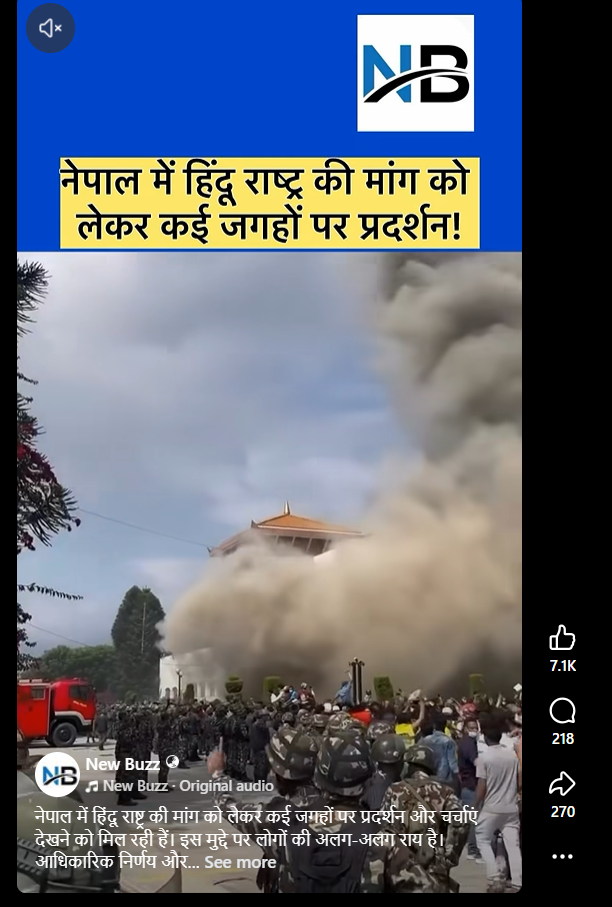
Following reports of communal violence in Nepal in July 2026, an organisation submitted a memorandum to Home Minister Soodan Gurung, calling for discussions on declaring Nepal a Hindu nation. Against this backdrop, a video showing protesters and smoke has gone viral on social media. A Facebook user, ‘New Buzz’, shared the video on August 5, 2026, with the caption:
"Protests and discussions are being seen in several places in Nepal over the demand for a Hindu nation. People have different views on this issue. One should reach a conclusion only on the basis of official decisions and credible information."
https://www.facebook.com/reel/27872198842449234
https://ghostarchive.org/archive/P89Qo
FactCheck:
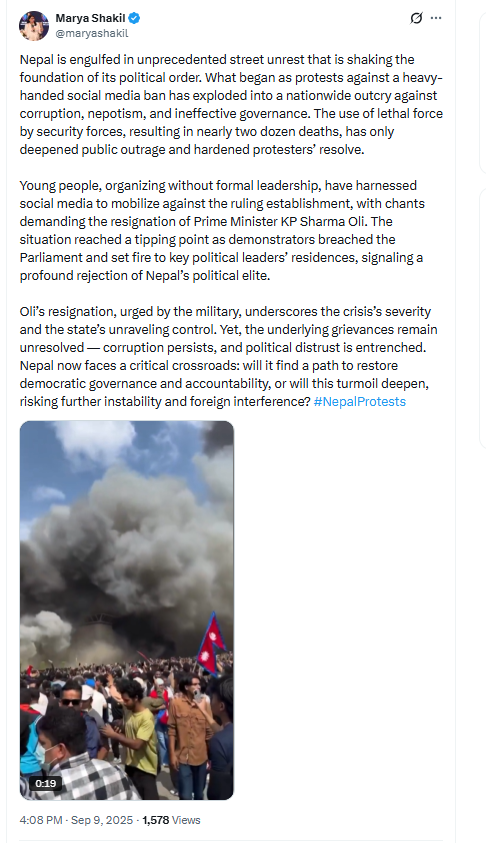
To verify the claim, we extracted keyframes from the viral video and conducted a reverse image search using Google Lens. The search led us to a post by India Today journalist Marya Shakil on X, dated September 9, 2025. She had shared the same video and identified it as footage from the Gen-Z protests in Nepal against corruption
https://x.com/maryashakil/status/1965364156992782723?s=20
We also found a related news report on the NBC News YouTube channel, published on September 9, 2025. The video report also identified the footage as being from the protests in Nepal..
https://www.youtube.com/watch?v=PXnhHoH0XKE
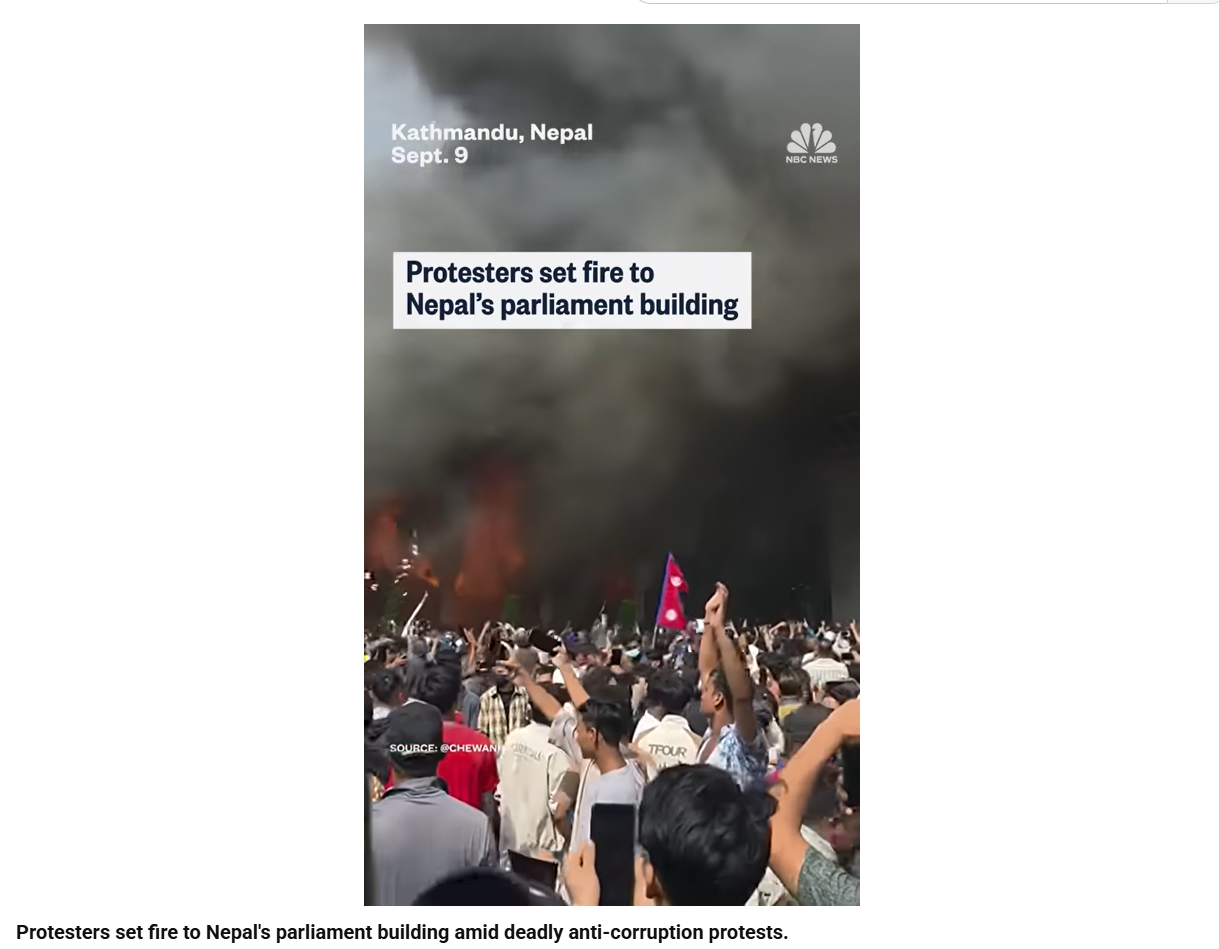
Conclusion
The viral claim is false. The video being shared as footage of violent protests in Nepal over the demand for a Hindu nation actually dates back to the September 2025 Gen-Z protests against corruption. Although an organisation submitted a 13-point memorandum to Nepal's Home Minister following the July 2026 communal violence, including a demand for discussions on declaring Nepal a Hindu nation, the viral video is unrelated to that development.
.webp)
Introduction
In the fast-paced digital age, misinformation spreads faster than actual news. This was seen recently when inaccurate information on social media was spread, stating that the Election Commission of India (ECI) had taken down e-voter rolls for some states from its website overnight. The rumour confused the public and caused political debate in states like Maharashtra, MP, Bihar, UP and Haryana, resulting in public confusion. But the ECI quickly called the viral information "fake news" and made sure that voters could still get access to the electoral rolls of all States and Union Territories, available at voters.eci.gov.in. The incident shows how electoral information could be harmed by the impact of misinformation and how important it is to verify the authenticity.
The Incident and Allegations
On August 7, 2025, social media posts on platforms like X and WhatsApp claimed that the Election Commission of India had removed e-voter lists from its website. The posts appeared after public allegations about irregularities in certain constituencies. However, the claims about the removal of voter lists were unverified.
The Election Commission’s Response
In a formal tweet posted on X, it stated categorically:
“This is a fake news. Anyone can download the Electoral Roll for any of 36 States/UTs through this link: https://voters.eci.gov.in/download-eroll.”
The Commission clarified that no deletion has been done at all and that all the voters' rolls are intact and accessible to the public. Keeping with the spirit of transparency, the ECI reaffirmed its overall practice of public access to electoral information by clarifying that the system is intact and accessible for inspection.
Importance of Timely Clarifications
By countering factually incorrect information the moment it was spread on a large scale, the ECI stopped possible harm to public trust. Election officials rely upon being trusted, and any speculation concerning their honesty can prove harmful to democracy. Such prompt action stops false information from becoming a standard in public discourse.
Misinformation in the Electoral Space
- How False Narratives Gain Traction
Election misinformation increases in significant political environments. Social media, confirmation bias, and increased emotional states during elections enable rumour spread. On this occasion, the unfounded report struck a chord with widespread political distrust, and hence, people easily believed and shared it without checking if it was true or not.
- Risks to Democratic Integrity
When misinformation impacts election procedures, the consequences can be profound:
- Erosion of Trust: People can lose faith in the neutrality of election administrators quite easily.
- Polarization: Untrue assertions tend to reinforce political divides, rendering constructive communication more difficult.
- The Role of Media Literacy
Combating such mis-disinformation requires more than official statements. Media skills training courses can equip individuals with the ability to recognise warning signs in suspect messages. Even basic actions like checking official sources prior to sharing can move far in keeping untruths from being spread.
Strategies to Counter Electoral Misinformation
Multi-Stakeholder Action
Effective counteracting of electoral disinformation requires coordination among election officials, fact-checkers, media, and platforms. Actions that are suggested include:
- Rapid Response Protocols: Institutions should maintain dedicated monitoring teams for quick rebuttals.
- Confirmed Channels of Communication: Providing official sites and pages for actual electoral news.
- Proactive Transparency: Regular publication of electoral process updates can anticipate rumours.
- Platform Accountability: Social media sites must label or limit the visibility of information found to be false by credentialed fact-checkers.
Conclusion
The recent allegations of e-voter rolls deletion underscore the susceptibility of contemporary democracies to mis-disinformation. Even though the circumstances were brought back into order by the ECI's swift and unambiguous denunciation, the incident itself serves to emphasise the necessity of preventive steps to maintain election faith. Even though fact-checking alone might not work in an environment where the information space is growing more polarised and algorithmic, the long-term solution to such complications is to grow an ironclad democratic culture where everyone, every organisation, and platforms value the truth over clickbait. The lesson is clear: in the age of instant news, accurate communication is vital for maintaining democratic integrity, not extravagances.
References
- https://www.newsonair.gov.in/election-commission-dismisses-fake-news-on-removal-of-e-voter-rolls/
- https://economictimes.indiatimes.com/news/india/eci-dismisses-claims-of-removing-e-voter-rolls-from-its-website-calls-it-fake-news/articleshow/123190662.cms
- https://www.thehindu.com/news/national/vote-theft-claim-of-congress-factually-incorrect-election-commission/article69921742.ece
- https://www.thehindu.com/opinion/editorial/a-crisis-of-trust-on-the-election-commission-of-india/article69893682.ece
