
Malware Targeting iOS

Introduction
Devices and interconnectivity are the pipelines which drive the data into cyberspace, and in turn, the users consume this data to perform different tasks in the digital age. The security of devices and networks is essential as they are the first defenders of cyberspace. Bad actors often target systems and networks with malware and ransomware, these attacks are differently motivated, but all wreak havoc upon the system and can impact individuals and organisations alike. Mobile users worldwide prefer iOS or Android, but both operating systems are vulnerable to cyberattacks these days. Some of these attacks go undetected for a long time.
Op Triangulation
As reported by Kaspersky, While monitoring the network traffic of their own corporate Wi-Fi network dedicated to mobile devices using the Kaspersky Unified Monitoring and Analysis Platform (KUMA), Kaspersky noticed suspicious activity that originated from several iOS-based phones. Since it is impossible to inspect modern iOS devices from the inside, they created offline backups of the devices in question, inspected them using the Mobile Verification Toolkit’s mvt-ios and discovered traces of compromise. This is known as Operation Triangulation and has been in action since 2019 and got detected in 2023.
The Malware
A portion of the filesystem, including some of the user data and service databases, is included in mobile device backups. The files, directories, and database entries’ timestamps make it possible to reconstruct the events that happened to the device roughly. The “timeline.csv” file created by the mvt-ios software contains a sorted timeline of events that is comparable to the super-timeline utilised by traditional digital forensic tools. Pinpointing particular artefacts that show the compromise using this timeframe. This made it possible to advance the research and reassemble the broad infection sequence:
Through the iMessage service, a message with an attachment containing an exploit is delivered to the target iOS device.
The message initiates a vulnerability that results in code execution without any user input.
The exploit’s code downloads multiple additional stages, including additional exploits for privilege escalation, from the C&C server.
After successful exploitation, a fully functional APT platform is downloaded as the final payload from the C&C server.
The first message and the attachment’s exploit are removed

The lack of persistence support in the harmful toolset is most likely a result of OS restrictions. Multiple devices’ timeframes suggest that after rebooting, they might get infected again. The earliest signs of infection that we found date to 2019. The most recent version of the devices that have been successfully attacked as of the time of writing in June 2023 is iOS 15.7.
The final payload analysis is still ongoing. The programme executes with root rights, implements a set of commands for gathering user and system data, and can run any code downloaded as plugin modules from the C&C server.
Malicious Domains
Using the forensic artefacts, it was possible to identify the domain name set used by the exploits and further malicious stages. They can be used to check the DNS logs for historical information and to identify the devices currently running the malware:
addatamarket[.]net
backuprabbit[.]com
businessvideonews[.]com
cloudsponcer[.]com
datamarketplace[.]net
mobilegamerstats[.]com
snoweeanalytics[.]com
tagclick-cdn[.]com
topographyupdates[.]com
unlimitedteacup[.]com
virtuallaughing[.]com
web-trackers[.]com
growthtransport[.]com
anstv[.]netAns7tv[.]net
Safeguards for iOS users
Despite its world-class safety and privacy architecture, iOS is vulnerable to a few attacks; the following steps can be undertaken to safeguard iOS users –
Keeping Device updated
Security patches
Disabling iMessage would prevent Zero clicks exploits or the Triangulation attacks
Paying zero attention to unwanted, unsolicited messages
The user should make sure that any application they are downloading or installing; it should be from a trusted source ( This Zero click attack does not occur by any other means, It exploits / it targets software vulnerabilities in operating systems networks and applications)
Being cautious with the messaging app and emails
Implement device restrictions (management features like parental control and restrictions over using necessary applications)

Conclusion
Operation Triangulation is one of the recent operations combating cyber attacks, but such operations are launched nearly daily. This is also due to a rapid rise in internet and technology penetration across the world. Cyberattacks have taken a new face as they have evolved with the new and emerging technology. The influence of the Darknet has allowed many hackers to remain on the black hat side due to easy accessibility to illegal tools and material over the dark net, which facilitates such crimes.

Related Blogs

Introduction
In today’s cybersecurity landscape, ransomware has emerged as one of the most significant and rapidly growing cyber threats. What began as attacks carried out by individual hackers has evolved into a highly organised criminal enterprise, with groups operating through structured business models and global networks. The emergence of The Gentlemen ransomware group reflects this transformation, demonstrating how modern threat actors can quickly expand their operations and target organisations across multiple sectors. Their rise highlights the increasing sophistication of ransomware campaigns and the growing challenges faced by organisations in defending against them. The attribution of the group's administrator to an identified individual in Izhevsk, Russia, provides a valuable lens through which to examine three interconnected developments: the maturation of ransomware-as-a-service (RaaS) business models, the inherent operational security (OPSEC) weaknesses that emerge over the course of cybercriminal careers, and the geopolitical environments that enable such actors to operate with relative impunity. Together, these dynamics illustrate the industrialisation of modern cybercrime.
The Industrialisation of Ransomware-as-a-Service
The remarkable rapid rise of The Gentlemen is impossible without discussing the maturation of ransomware-as-a-service (RaaS). RaaS systems utilize network intrusion experts as affiliates who conduct networks intrusions and secure access in exchange for a cut of the total ransoms paid, while a core group builds and maintains the ransomware framework itself. Although Reveton, one of the earliest Raas providers, can be credited with bringing early iterations of RaaS to fruition in 2012, the potential scale was truly evident in the mid-2020s. By 2025 it was estimated that there were over 100 active ransomware gangs operating; this proliferation is the direct result of the franchise-like system, which has lowered the barriers to entry for cybercrime.
The marketplace surrounding RaaS is intensely competitive, and this is clearly exemplified in the business structure of The Gentlemen: while many of the top ransomware groups provide an 80/20 profit share (with the majority of the profit going to the affiliates), The Gentlemen has an exceptionally profitable 90/10 split (affiliates keep 90% of the profit share) for affiliates, likely to draw experienced operators away from their rivals given recent decreases in victim willingness to pay and corresponding increases in the incentives RaaS platforms are required to offer.
The operational efficiency of the group is representative of a successful enterprise. They attack vulnerable internet-facing VPNs and firewalls and generally complete the network encryption within a matter of hours, leaving defenders with very little time to respond, as confirmed by Check Point Software, a renowned cybersecurity vendor.
Additionally, PRODAFT reports that the administrator of The Gentlemen, known by the alias Zeta88 (previously known as Hastalamuerte), directly provides affiliates with SSL VPN credentials, often obtained through brutal force attacks or their own private leaked databases, indicating an unusually high level of vertical integration for RaaS groups.
AI as a Force Multiplier in Ransomware Development
A particularly significant aspect of the Hastalamuerte case is PRODAFT's finding that the administrator employs artificial intelligence to develop and maintain ransomware, support associated tooling, and assist post-exploitation operations. This reflects a broader trend observed across the 2025–2026 threat landscape, where AI has increasingly lowered the capability threshold for participation in organised cybercrime. Researchers have documented its role in automating stages of intrusion, accelerating malware development cycles, and simplifying the maintenance of malicious infrastructure. These capabilities have been leveraged by both nation-state actors and criminal enterprises.
The trajectory of Hastalamuerte is especially illustrative. Cybersecurity Forum posts during 2019-2020 depict a hacker who is fairly novice at fundamental penetration testing procedures. A subsequent emergence as the operator of a top-tier ransomware-as-a-service operation indicates that AI-assisted development may be responsible for dramatically reducing the skill level and time necessary to create a successful criminal enterprise in cyberspace. The evolution of these tools should make the route from novice forum user to accomplished ransomware operator more attainable for a wider array of perpetrators in the future.
The OPSEC Paradox: How Cybercriminals Leave a Trail
The attribution of Hastalamuerte's identity by researchers from Intel 471, Flashpoint, and Constella Intelligence demonstrates the effectiveness of modern open-source and commercial intelligence methodologies. A forum registration traceable to an IP address from Izhevsk, Russia linked a Protonmail address, which linked to an Apple account, a GitHub profile, a Telegram handle, a Russian phone number, and finally to a 36 year old marketing professional named Alexander Andreevich Yapaev who was also living in Izhevsk. Investigators did not use an advanced capability in their attribution, but rather a simple OPSEC mistake of consistently reusing credentials. Every username and email address and every phone number creates a linkage between disparate data points, eventually building into a real-world persona.
It has also come out in the forum discussion that while training for a penetration testing course in 2020, Hastalamuerte displayed the kind of inexperience that a novice would display in traceable, recorded fashion to intelligence databases. It's an example of a broader rule about attribution; attacker mistakes provide the most value. With Russians the lack of apparent consequences may contribute to a lack of need to maintain tight OPSEC from the start.
The Russian Safe Haven: Conditional Impunity and Its Limits
Yapaev's base in Izhevsk is emblematic of the geostrategic situation that has allowed Russian cybercriminality to prosper. Security researchers routinely label Russia's policy as one of "controlled impunity," where the cybercriminality directed at foreign entities is ignored or implicitly condoned, while that directed at Russian interests will prompt a law enforcement response. This constitutes what has been called a "managed market" rather than an "unconditional sanctuary," where many of the named defendants could and likely will continue their illegal enterprise with little fear of reprisal, provided that they do not threaten the interests of the Russian state and do not attempt to move their operations outside of Russian control.
Yet this protection is neither absolute nor permanent. In May 2024, the transnational Operation Endgame campaign highlighted the growing global appetite for damaging the cybercrime ecosystem rooted in Russia. Russian authorities did indeed pursue and seize some assets and operators, but arrests seem largely confined to the lower-rung facilitators of these attacks (hosting providers and payment services), and it seems higher-end ransomware operators continue to evade scrutiny. Selective enforcement thus further bolsters the perception that protection is accorded according to strategic value, not legal standards. For operators such as Hastalamuerte, who possess no publicly documented intelligence connections, growing attribution capabilities, and sustained international pressure may gradually erode the security traditionally associated with operating from within Russia.
Attribution as a Deterrence Instrument
The public identification of Alexander Andreevich Yapaev as Hastalamuerte/Zeta88 shows the continued struggle with the utility of attribution in situations where immediate prosecution is not feasible. Its utility is far more extensive than simply an ability to make an arrest. Functionally, public naming forces a perpetrator into an open evidentiary space and can lead to alterations in their operational habits and effectiveness. Strategically, attribution provides future leverage for sanctions, indictments, financial restrictions, or extradition if the target can leave their safe haven country. The logic behind US rewards programs (paying up to $10 million for the capture and conviction of ransomware operators) relies on this principle. The analytical insight provided by the case cannot be understated either. Hastalamuerte's trajectory from a relative amateur forum participant on Nulled and Raidforums in 2019 to leading a significant ransomware operation by 2026 offers an invaluable look into the career progression of a cyber criminal. It confirms one of the lessons learned through deterrence and attribution: pseudonymity is not everlasting, and many years of OPSEC failures can be pieced together to establish a real-world identity.
Conclusion
The Gentlemen incident is emblematic of the three broad themes that currently characterise cyber warfare: ransomware-as-a-service through innovative competition, common OPSEC failures that enable attribution, and a new, conditional regime of protection for Russian cybercriminals. The obvious defense lesson: increasing attack surfaces require stronger identity, behavioural monitoring, and intelligence capacities. The policy lesson: effective attribution is still an essential tool for comprehension, deterrence, and disruption in an increasingly industrialised environment of criminals supporting each other's operations in ransomware-as-a-service.
References
- https://krebsonsecurity.com/2026/06/who-runs-the-ransomware-group-the-gentlemen/
- https://www.recordedfuture.com/
- https://www.vectra.ai/topics/ransomware-as-a-service
- https://www.trmlabs.com/es/resources/blog/new-disruption-opportunities-in-the-evolving-ransomware-ecosystem

In an exciting milestone achieved by CyberPeace, an ICANN APRALO At-Large organization, in collaboration with the Internet Corporation for Assigned Names and Numbers (ICANN), has successfully deployed and made operational an L-root server instance in Ranchi, Jharkhand. This initiative marks a significant step toward enhancing the resilience, speed, and security of internet connectivity in eastern India.
Understanding the DNS hierarchy – Starting from Root
Internet users access online information through different domain names and interactions with any web browser takes place through IP (Internet Protocol) addresses. Domain Name System (DNS) functions as the internet's equivalent of Yellow Pages or the phonebook of cyberspace. When a person uses a domain name like www.cyberpeace.org to access a website, their browser communicates with the internet protocol, and DNS converts the domain name to the corresponding IP address so that web browsers may load the web pages. The function of a DNS is to convert domain names to Internet Protocol addresses. It enables the respective browsers to load the resources from the Internet.
When a user types a domain name into your browser, a DNS query works behind the scenes to find the website’s IP address. First, your device asks a DNS resolver—often provided by your ISP or a third-party service—for the address. The resolver checks its cache for a match, and if none is found, it queries a root server to locate the top-level domain (TLD) server (like .com or .org). The resolver then asks the TLD server for the Authoritative nameserver responsible for the particular domain, which provides the specific IP address. Finally, the resolver sends this address back to your device, enabling it to connect to the website’s server and load the page. The entire process happens in milliseconds, ensuring seamless browsing.

Special focus on Root Server:
A root server is a name server that directly answers queries for records in the root zone and redirects requests for more specific domains to the appropriate top-level domain (TLD) servers. Root servers are an integral part of this system, acting as the first step in resolving a domain name into its corresponding IP address. They provide the initial direction needed to locate the authoritative servers for any domain.
The DNS root zone is served by 13 unique IP addresses, supported by hundreds of redundant root servers distributed worldwide connected through Anycast Routing to manage requests efficiently. As of January 8, 2025, the global root server system consists of 1921 instances operated by 12 independent root server operators. These servers ensure the smooth functioning of the internet by managing the backbone of DNS queries.

Type of Root Server Instances:
Well, in this regard, there are two types of root server instances that can be found– Global instance and Local instance.
Global root server instances are the primary root servers distributed strategically around the world. Local instances, on the other hand, are replicas of these global servers deployed in specific regions to handle local DNS traffic more efficiently. In each operator's list of sites, some instances are marked as global (globe icon) and some are marked as local (flag icon). The difference is in how widely available that instance will be, because of how routing for that instance is done. Recall that the routes for an instance are announced by BGP, the inter-domain routing protocol.
For global instances, the route advertisement is permitted to spread throughout the Internet, i.e., any router on the Internet could know the path to that instance. Of course, for a particular source, the route to that instance may not be the optimal route, so some other instance could be chosen as the destination.
With a local instance, however, the route advertisement is limited to only nearby networks. For example, the instance may be visible to just one ISP, or to ISPs that connect at a particular exchange point. Sources from farther away will not be able to see and query that local instance.
Deployment in Ranchi - The Journey & Significance:
CyberPeace in Collaboration with ICANN has successfully deployed an L-root server instance in Ranchi, marking a significant milestone in enhancing regional Internet infrastructure. This deployment, part of a global network of root servers, ensures faster and more reliable DNS query resolution for the region, reducing latency and enhancing cybersecurity.

The Journey of deploying the L-Root instance in Collaboration with ICANN followed the steps-
- Signing the Agreement: Finalized the L-SINGLE Hosting Agreement with ICANN to formalize the partnership.
- Procuring the Hardware: Acquired the required hardware appliance to meet technical standards for hosting the L-root server.
- Setup and Installation: Configured and installed the appliance to prepare it for seamless operation.
- Joining the Anycast Network: Integrated the server into ICANN's global Anycast network using BGP (Border Gateway Protocol) for efficient DNS traffic management.
The deployment of the L-root server in Ranchi marks a significant boost to the region’s digital ecosystem. It accelerates DNS query resolution, reducing latency and enhancing internet speed and reliability for users.
This instance strengthens cyber defenses by mitigating Distributed Denial of Service (DDoS) risks and managing local traffic efficiently. It also underscores Eastern India’s advanced digital infrastructure, aligning with initiatives like Digital India to meet evolving digital demands.
By handling local queries, the L-root server eases the load on global servers, contributing to a more stable and resilient global internet.
CyberPeace’s Commitment to a Secure and resilient Cyberspace
As an organization dedicated to promoting peace, security and resilience in cyberspace, CyberPeace views this collaboration with ICANN as a significant achievement in its mission. By strengthening the internet’s backbone in eastern India, this deployment underscores our commitment to enabling a secure, accessible, and resilient digital ecosystem.
Way forward and Roadmap for Strengthening India’s DNS Infrastructure:
The successful deployment of the L-root instance in Ranchi is a stepping stone toward bolstering India's digital ecosystem. CyberPeace aims to promote awareness about DNS infrastructure through workshops and seminars, emphasizing its critical role in a resilient digital future.
With plans to deploy more such root server instances across India, the focus is on expanding local DNS infrastructure to enhance efficiency and security. Collaborative efforts with government agencies, ISPs, and tech organizations will drive this vision forward. A robust monitoring framework will ensure optimal performance and long-term sustainability of these initiatives.
Conclusion
The deployment of the L-root server instance in Eastern India represents a monumental step toward strengthening the region’s digital foundation. As Ranchi joins the network of cities hosting root server instances, the benefits will extend not only to the local community but also to the global internet ecosystem. With this milestone, CyberPeace reaffirms its commitment to driving innovation and resilience in cyberspace, paving the way for a more connected and secure future.
Introduction
The trajectory of India's digital economy is growing at an unprecedented rate, and so is India's cybercrime ecosystem. Parliamentary data tabled before the Rajya Sabha in May 2024 by the MHA suggests an overwhelming 900% growth in cybercrime complaints from 2021 to '25, while annual losses crossed 22,800 crore in 2024. The structural issues like the low victim restitution rate, the lack of forensic infrastructure, issues of jurisdiction related to offshore fraud factories targeting Indian citizens, and the huge disparity in awareness levels amongst India's youngest online citizens continue to exist. This brief brings out the clear trends in cybercrime, the role of institutional mechanisms in its prevention and response, failure points, and recommends appropriate policy interventions from the perspective of CyberPeace.
The Data Imperative
Since its operationalisation in 2019 by the Indian Cyber Crime Coordination Centre (I4C), the NCRP serves as India's most significant institutional apparatus for cybercrime reporting and response. Data placed before the Rajya Sabha by the Ministry of Home Affairs on 30 July 2025 show that, with almost no exception, complaints of cybercrime have increased far more quickly than most traditional indicators of public safety. Between 2021 and June 2025, the NCRP received 6.59 million complaints, evidence of both a sustained and escalating expansion of India's cyber threat profile. Complaints per year more than quadrupled from 4.52 lakh in 2021 to 19.18 lakh in 2024 (324% over the period); by 2025, the NCRP had received 28.15 lakh complaints, a 523 percent rise compared with the 2021 baseline:
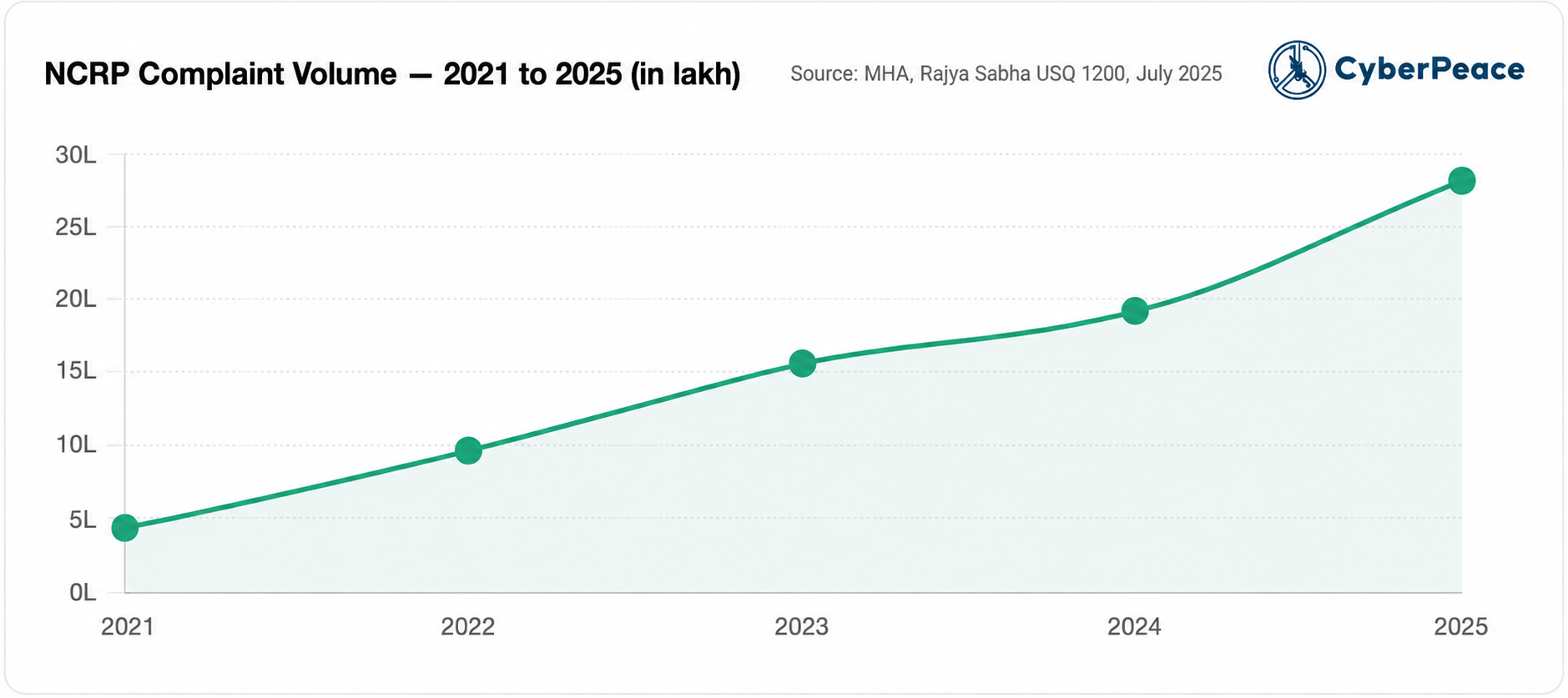
Clearly, cyber-enabled crime is no longer an occasional crisis but a systemic governance issue requiring consistent regulation and institution-building.
The financial fallout has also accelerated dramatically. Figures indicate that reported financial losses due to cybercrime jumped from 2,290 crore in 2022 to 22,812 crore in 2024 a 895% leap in two years:
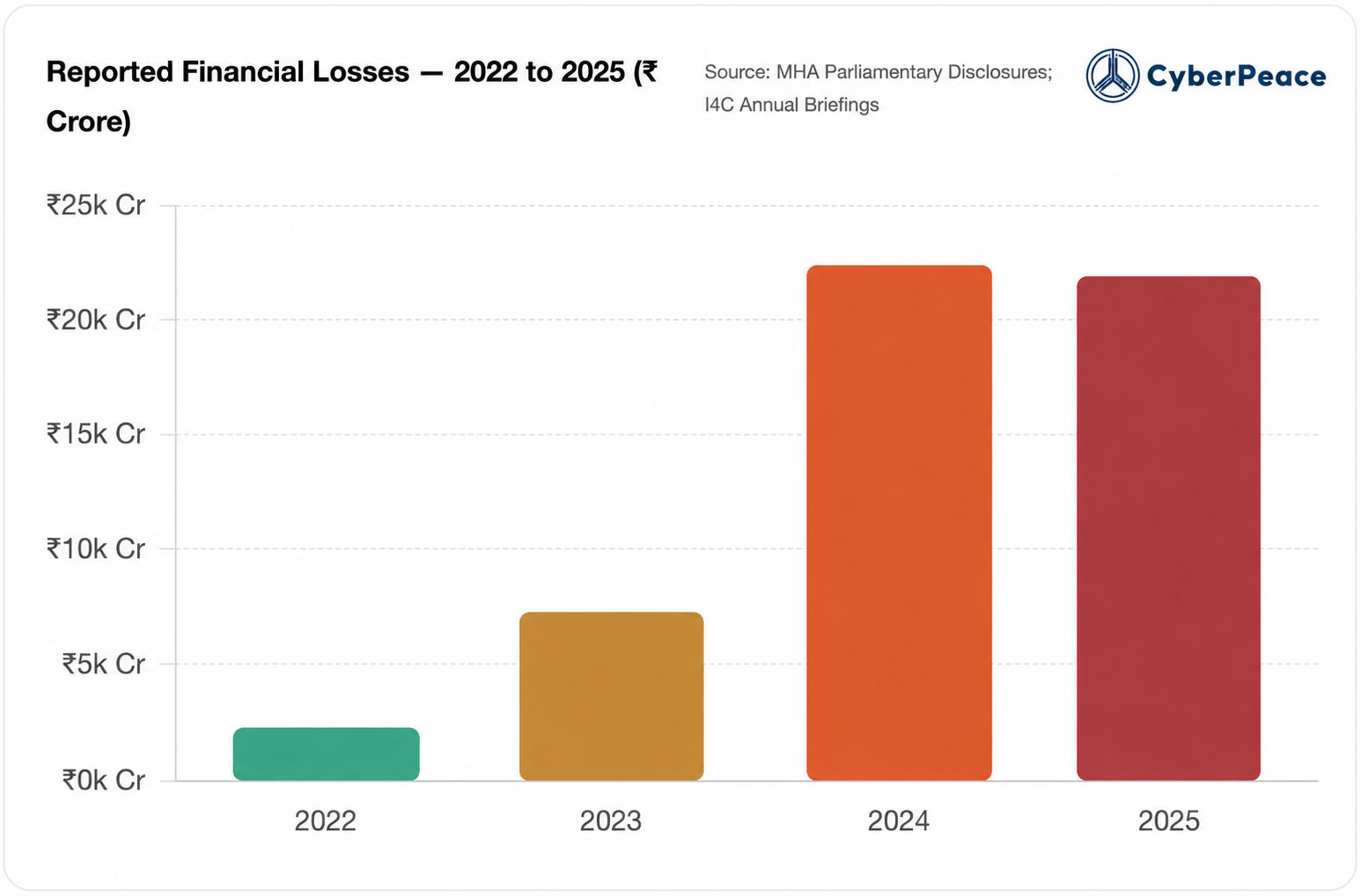
Though response mechanisms such as the Citizen Financial Cyber Fraud Reporting and Management System (CFCFRMS) successfully blocked or recovered close to 8,690 crore as of January 2026, victims appear to get back only about 2.18 percent of the losses they report.
In most areas, reporting and response have expanded greatly, but both the rate and scale of cyber-enabled financial fraud continue to outstrip India's remediation and law enforcement capacity.
Threat Typology of India’s Fraud Ecosystem
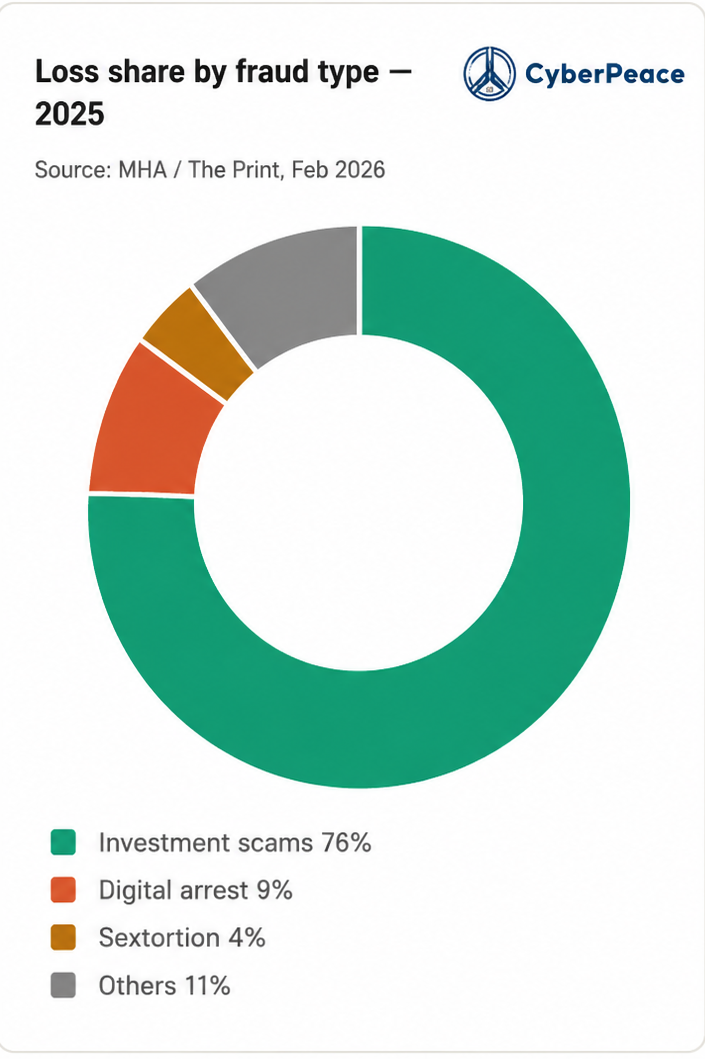
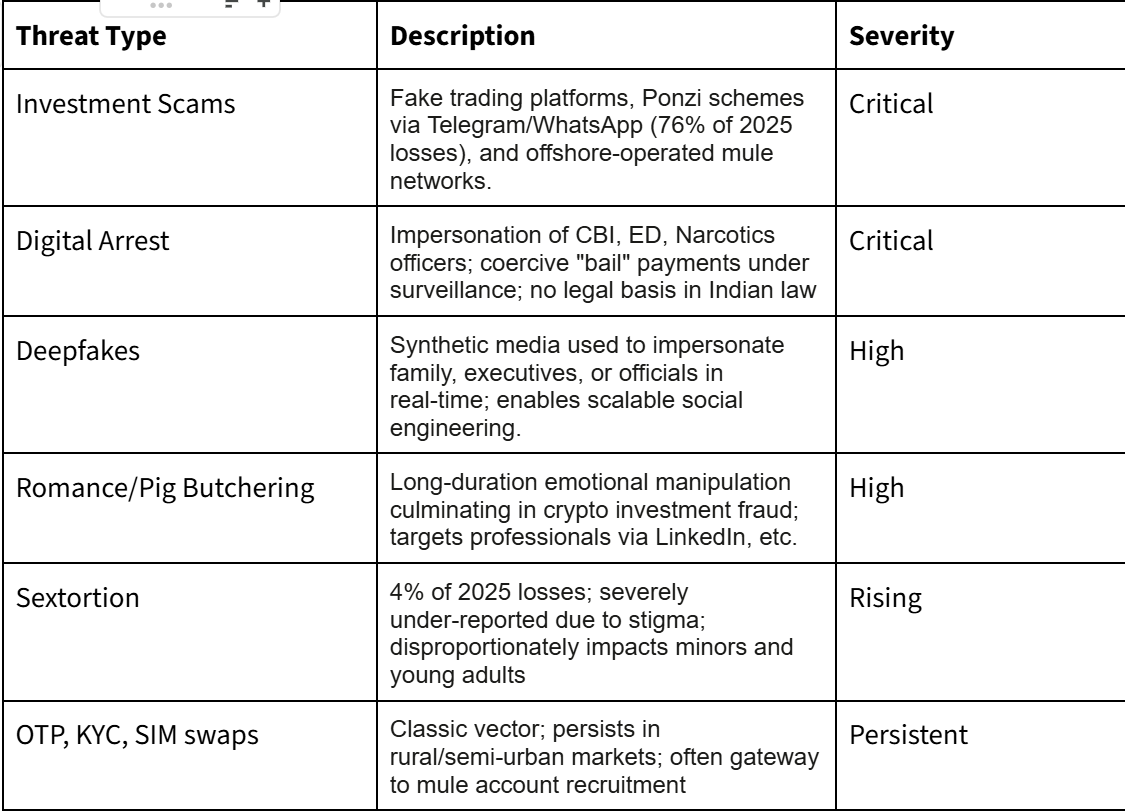
The nature of cyber crime in India has evolved from an opportunistic volume-based activity to a layered transnational criminal environment. I4C intelligence as tabled in Parliament reveals investment scams as the biggest threat: they accounted for 76% of the financial fraud lost in 2025 (although only 35% of complaints were filed, thus, a very high value per case was lost).
Digital arrest frauds, which tap on citizens' unawareness that "digital arrest" is not permissible under Indian law, rose from 39,925 cases (91 crore) in 2022 to 123,672 cases (1,935crore) in 2024.
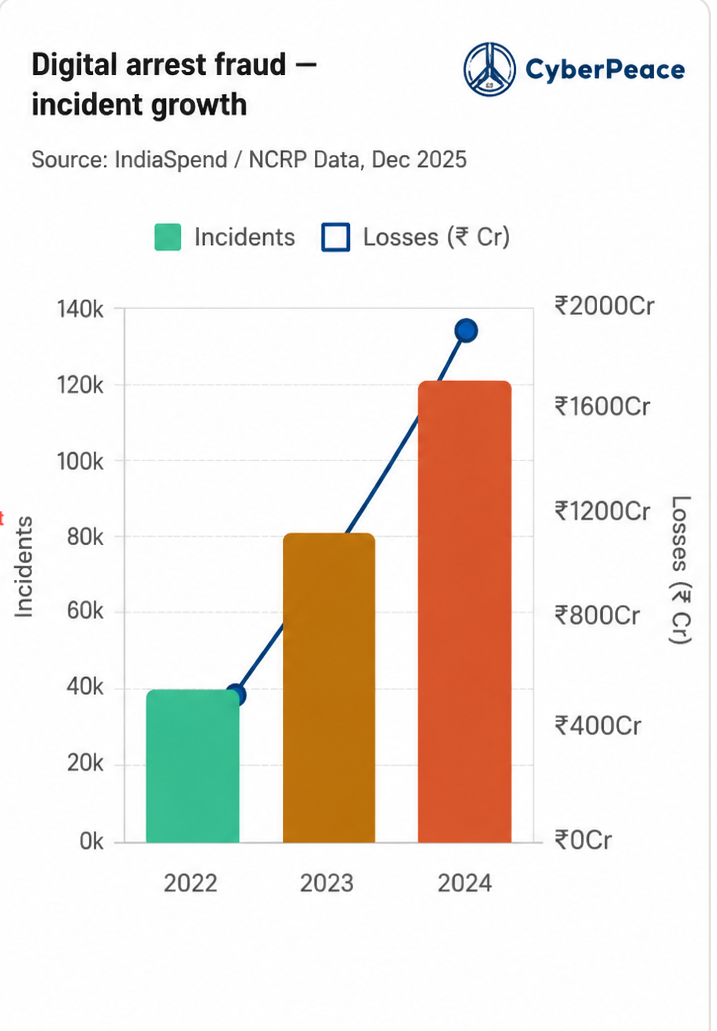
The fast rise in the number of incidents as well as in the volume of fraud clearly points out that digital arrest fraud has moved away from the phase of novel scam typology to a formidable cyber-extortion landscape. The main orchestrators of investment, trading, dating, and digital arrest scams targeting Indian citizens were recently identified by the I4C CEO Rajesh Kumar as transnational criminal scam networks in Cambodia, Myanmar, and Laos. Hence, this issue does not only fall within the domain of domestic law enforcement but constitutes a transnational cybercrime requiring parallel financial intelligence, diplomatic initiative, platform responsibility, and international investigative collaboration.
Geographic Concentration
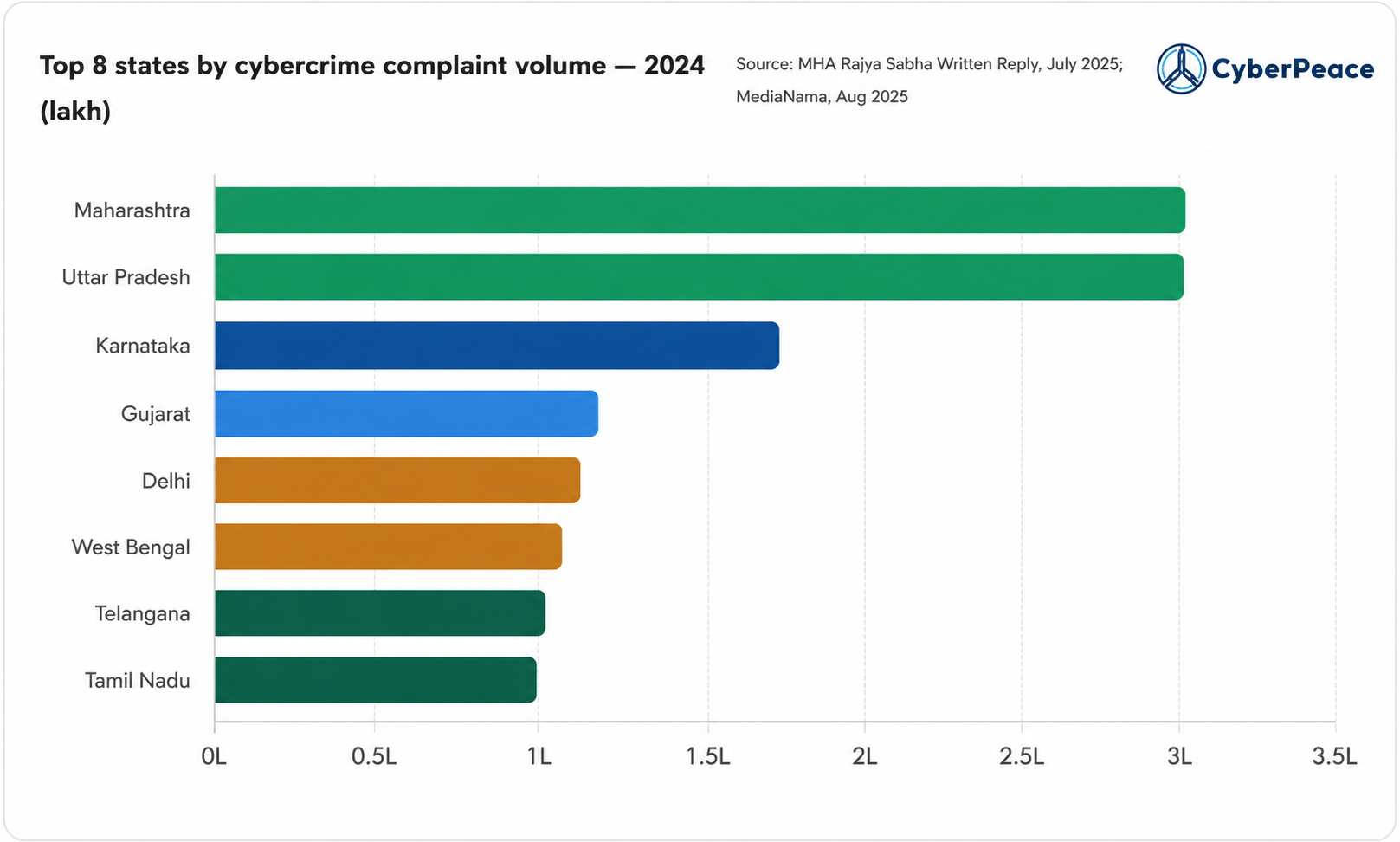
Maharashtra and UP register the highest volumes in total complaints at 3.03 lakh and 3.01 lakh, owing to them being the financial capital and most populous state, respectively. Karnataka, Gujarat, Delhi, WB, Telangana, TN, Rajasthan, and Haryana register above 1 lakh complaints each. However, the critical information that is being missed is that while complaint rate growth is the fastest in Tier 2 and 3 geographies (Haryana leads per-capita complaint rate with 381/100k people in 2023; Telangana (261); Uttarakhand (243)), this signifies rural digital growth as a risk multiplier.
Institutional Architecture: Mechanisms and Performances
India's institutional response to cybercrime, led by the Ministry of Home Affairs' Indian Cyber Crime Coordination Centre (I4C), is one of the world's largest real-time fraud detection and prevention ecosystems. The backbone of this is the Citizen Financial Cyber Fraud Reporting and Management System (CFCFRMS), which has onboarded over 700 banks, payment service providers, e-commerce portals, digital wallets, and, since the Standard Operating Procedure was issued on 2nd January 2026, virtual asset service providers and crypto exchanges. This interconnected network allows for prompt freezing of funds and timely fraud intervention during the 'golden hour' of a cybercrime report.
Institutional capacity is robust, with approximately 8,690 crore saved via the CFCFRMS since its inception for over 24.65 lakh complaints. The national cybercrime helpline (1930) receives close to 10,000 calls daily, while the Suspect Registry has enabled the rejection of 9,519 crore via the detection of 23.05 lakh suspect entities and 27.37 lakh mule accounts. In parallel, the CyTrain platform has expanded training by registering 151,081 police and judicial officers and issuing 142,025 certificates. Cyberforensic labs in all 33 States and Union Territories have received central assistance totalling 132.93 crore, and data-driven interstate crime analytics and offender linkages through the Samanvaya and Pratibimb platforms have led to 21,857 arrests.
Ecosystem Gaps
Through I4C, CFCFRMS, CyTrain, and the establishment of forensic infrastructure in states, India’s cybercrime ecosystem has greatly grown. But due to the rapid proliferation of cybercrime, systemic shortcomings are revealed regarding the restoration of victims, investigation, forensic capacity, cross-border enforcement, awareness, and stakeholder coordination:
- Victim Restitution Deficit: Although the total of ₹ 8,690 crore frozen has increased, the refund for victim compensation is limited to only ₹ 167 crore (2.18%) due to lengthy restoration processes relying on court orders.
- Forensic Capacity Limitations: 2 national, state-level, unevenly equipped cyber forensic labs can’t match the needs of over 10 million cybercrime complaints per year.
- Low conviction rate: The investigations of cybercrimes suffer from evidence collection and criminal proceedings, leading to limited conviction rates.
- Cross-border enforcement challenges: Many of the investment and digital arrest scams, in fact, are originating from Cambodia, Myanmar, and Laos, rendering the cybercrime response mechanisms of India helpless.
- Lack of Awareness: First-time digital users are quite prone to online scams and fraud, and many of the victims continue not reporting due to social stigma and lack of confidence.
- Partial Stakeholder Integration: Banks and small financial institutions, small companies, and emerging virtual asset providers not yet on board allow the money to slip through without being tracked.
CyberPeace Insights: Strategic Way Forward
India has already built a relatively mature response structure for cybercrime with I4C, CFCFRMS, and CyTrain and is coordinating the financial sector on it. The way ahead lies in outcome-oriented improvements and not just in the ability to report and intercept more. Here are the priority interventions that address the most important institutional shortcomings identified in the current ecosystem:
- Fast-track victim restoration: Introduce time-bound victim restoration mechanisms for low-value incidents through simplified processes and mandate national-level roll-out of successful Lok Adalat-based settlement mechanisms.
- District-level cyber forensics: Establish cyber forensic support units at the district level and enhance access to mobile, cloud, and blockchain forensic capabilities.
- AI-powered fraud prevention: Mandate deep-fake and voice-clone detection mechanisms across all financial institutions and telecom networks; embed predictive risk analytics into transaction screening frameworks.
- Cyber Suraksha Gram initiative: Increase digital fraud awareness across all common service centres, Jan Dhan enrollment schemes, and rural banking channels, and tackle the awareness asymmetry.
- Regional cybercrime coordination: Establish real-time, operational intelligence-sharing mechanisms with Southeast Asian economies, which have become home to large scam networks preying on Indian citizens.
- Specialised cyber prosecution ecosystem: Develop exclusive cyber courts, standardise digital evidence procedures, and broaden the scope of CyTrain to include the development of specialised cadres of investigators and prosecutors capable of handling increasingly complex cybercrime cases.
Conclusion
The 22,812 crore lost due to cybercrime in 2024 was more than a mere figure; it signifies a serious concern regarding citizen trust, economic security, and digital inclusion. Though India's institutional response to cybercrime is one of the largest, with an operational I4C and a CFCFRMS functioning in real time, the victim compensation and prosecution mechanism falls short. It's time for implementation: faster recovery of resources, increased enforcement, a larger scale of awareness, and finally, translating the institutional innovations into concrete justice for victims nationwide.
References
- https://sansad.in/getFile/annex/270/AU1341_tmaxdx.pdf?source=pqars
- https://www.mha.gov.in/MHA1/Par2017/pdfs/par2025-pdfs/LS02122025/452.pdf
- https://www.pib.gov.in/PressReleasePage.aspx?PRID=2244504®=3&lang=2
- https://static.pib.gov.in/WriteReadData/specificdocs/documents/2025/oct/doc2025107659501.pdf
- https://www.medianama.com/2025/08/223-india-cybercrime-500-percent-increase-2021-2024/
- https://theprint.in/india/cybercrime-saw-24-spike-in-2025-indians-lost-rs-22495-crore-mainly-in-investment-scams/2859930/
