
Honouring UN Peacekeepers: Safeguarding Peace in a Changing World
Introduction
Today, on the International Day of UN Peacekeepers, we honour the brave individuals who risk their lives to uphold peace in the world’s most fragile and conflict-ridden regions. These peacekeepers are symbols of hope, diplomacy, and resilience. But as the world changes, so do the arenas of conflict. In today’s interconnected age, peace and safety are no longer confined to physical spaces—they extend to the digital realm. As we commemorate their service, we must also reflect on the new frontlines of peacekeeping: the internet, where misinformation, cyberattacks, and digital hate threaten stability every day.
The Legacy of UN Peacekeepers
Since 1948, UN Peacekeepers have served in over 70 missions, protecting civilians, facilitating political processes, and rebuilding societies. From conflict zones in Africa to the Balkans, they’ve worked in the toughest terrains to keep the peace. Their role is built on neutrality, integrity, and international cooperation. But as hybrid warfare becomes more prominent and digital threats increasingly influence real-world violence, the peacekeeping mandate must evolve. Traditional missions are now accompanied by the need to understand and respond to digital disruptions that can escalate local tensions or undermine democratic institutions.
The Digital Battlefield
In recent years, we’ve seen how misinformation, deepfakes, online radicalisation, and coordinated cyberattacks can destabilise peace processes. Disinformation campaigns can polarise communities, hinder humanitarian efforts, and provoke violence. Peacekeepers now face the added challenge of navigating conflict zones where digital tools are weaponised. The line between physical and virtual conflict is blurring. Cybersecurity has gone beyond being just a technical issue and is now a peace and security issue as well. From securing communication systems to monitoring digital hate speech that could incite violence, peacekeeping must now include digital vigilance and strategic digital diplomacy.
Building a Culture of Peace Online
Safeguarding peace today also means protecting people from harm in the digital space. Governments, tech companies, civil society, and international organisations must come together to build digital resilience. This includes investing in digital literacy, combating online misinformation, and protecting human rights in cyberspace. Peacekeepers may not wear blue helmets online, but their spirit lives on in every effort to make the internet a safer, kinder, and more truthful place. The role of youth, educators, and responsible digital citizens has never been more crucial. A culture of peace must be cultivated both offline and online.
Conclusion: A Renewed Pledge for Peace
On this UN Peacekeepers’ Day, let us not only honour those who have served and sacrificed but also renew our commitment to peace in all its dimensions. The world’s conflicts are evolving, and so must our response. As we support peacekeepers on the ground, let’s also become peacebuilders in the digital world, amplifying truth, rejecting hate, and building safer, inclusive communities online. Peace today is not just about silencing guns but also silencing disinformation. The call for peace is louder than ever. Let’s answer it, both offline and online.

Related Blogs
.webp)
Executive Summary:
A viral video claims to show a massive cumulonimbus cloud over Gurugram, Haryana, and Delhi NCR on 3rd September 2025. However, our research reveals the claim is misleading. A reverse image search traced the visuals to Lviv, Ukraine, dating back to August 2021. The footage matches earlier reports and was even covered by the Ukrainian news outlet 24 Kanal, which published the story under the headline “Lviv Covered by Unique Thundercloud: Amazing Video”. Thus, the viral claim linking the phenomenon to a recent event in India is false.
Claim:
A viral video circulating on social media claims to show a massive cloud formation over Gurugram, Haryana, and the Delhi NCR region on 3rd September 2025. The cloud appears to be a cumulonimbus formation, which is typically associated with heavy rainfall, thunderstorms, and severe weather conditions.

Fact Check:
After conducting a reverse image search on key frames of the viral video, we found matching visuals from videos that attribute the phenomenon to Lviv, a city in Ukraine. These videos date back to August 2021, thereby debunking the claim that the footage depicts a recent weather event over Gurugram, Haryana, or the Delhi NCR region.


Further research revealed that a Ukrainian news channel named 24 Kanal, had reported on the Lviv thundercloud phenomenon in August 2021. The report was published under the headline “Lviv Covered by Unique Thundercloud: Amazing Video” ( original in Russian, translated into English).

Conclusion:
The viral video does not depict a recent weather event in Gurugram or Delhi NCR, but rather an old incident from Lviv, Ukraine, recorded in August 2021. Verified sources, including Ukrainian media coverage, confirm this. Hence, the circulating claim is misleading and false.
- Claim: Old Thundercloud Video from Lviv city in Ukraine Ukraine (2021) Falsely Linked to Delhi NCR, Gurugram and Haryana.
- Claimed On: Social Media
- Fact Check: False and Misleading.

Introduction
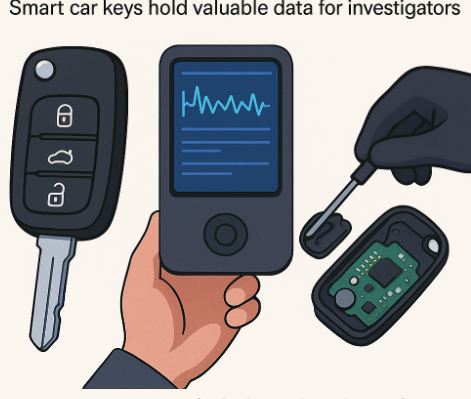
With the modernization of automobiles, so have the methods employed by criminals who seek to commit thefts. The old method of smashing a car window or bypassing an engine lock is no longer prevalent. Modern car thieves employ cloning techniques for keys and digital signals, and sophisticated methods to commit crimes without any traces left behind. In an era where intelligence is crucial, the forensic examination of car keys has become an indispensable tool for investigations, providing clues buried within ordinary car keys.
The Need for Car Key Forensics Today
Daily, thousands of cars worth millions are being hacked or stolen around the globe. The shocking thing is that most of these hacks do not have any sign of breakage or forced entry. It is because the thieves use vulnerabilities in the wireless key systems to unlock the vehicles without leaving any trace behind. Therefore, car-key forensics has now become more important than ever before.
Forensic Value of Smart Key
The smart key is not just comprised of locking and unlocking features for vehicles. Actually, it operates as a miniature computer within the key itself. Information such as pairing records, frequency of use, or the last instance that the key was used to unlock something could be contained in smart keys, thus offering evidence of any criminal activity conducted using these items.
Patterns of Vehicle Theft
Through the examination of the chip in a key, one will be able to establish whether the key was legally programmed or had been tampered with by some other means. Such forensics become more important when trying to detect and monitor any car theft rings, which employ cloning machines or software.
Confirming Ownership and Authenticity
In cases involving insurance claims or fraud, smart key data can help confirm whether the person making a claim actually owned or used the car during the incident. It’s digital proof that goes beyond what paperwork or statements can show.
Strengthening Legal Cases
When brought to court, data doesn’t lie. A properly handled forensic examination of a car key can provide hard evidence — the kind that holds up under questioning and supports or disproves claims with complete accuracy. In many cases, this small device becomes the most reliable witness in the investigation.
A Real-Life Example
Consider the following scenario: An expensive SUV is stolen from a parking lot secured with security surveillance. No one is captured on camera and there is no sign of forced entry. After days of investigation, the police end up arresting a suspect with a smart key.
During forensic analysis of the smart key, it is revealed that:
- The transponder has an ID number which can be matched against the immobilizer installed in the vehicle.
- The rolling code counter has been incremented in such a way that the date corresponds with the report of theft of the vehicle.
- The extracted information helps match the pair timestamp of the key with the particular make and model of the vehicle.
All this from a single piece of evidence – the smart key.
Inside a Smart Key: Where the Data Lives
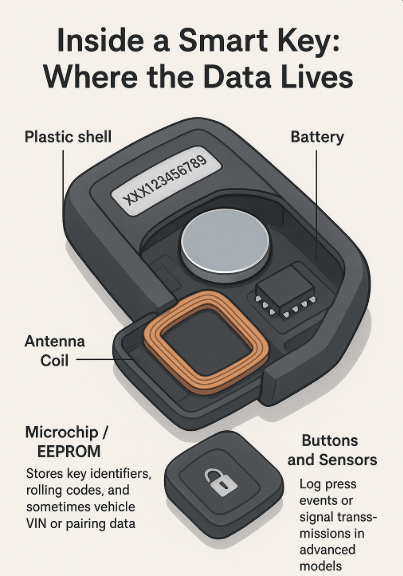
An average smart key is not only a remote but also a multi-level set of data carriers:
- Plastic Shell– could include serial numbers and information on the manufacture.
- Battery – helps calculate the time of using the key or detect any modifications.
- Antenna Coil – sends encrypted information to the immobilizer of a car. Draw the picture of this element.
- Microchip / EEPROM – holds key identification code, rolling code, VIN number, and/or other information of the vehicle.
- Buttons / sensors – could record any pressing or transmission actions in some cases.
All the little devices above, once properly studied via forensics software, provide valuable information.
How the Investigator Uncovers the Truth
In relation to investigating the true story about a vehicle, it is no different than handling other forms of digital evidence, as forensic analysts treat the car key in the same way. It is nothing more than an encrypted device in your hands, and using special techniques, they are able to reveal the information contained within the device.
Some of the methods used by modern forensic laboratories include:
1. Intercepting Radio Signals
Any intelligent key transmits radio signals to communicate with a car. Specialists employ advanced antennas and radio frequency (RF) analysers to catch and analyse them. This way, it is possible to understand the interaction between the key and the car – how often was it used, what kind of authentication procedure takes place, and if the signal matches the car’s one or has been forged somehow.
2. Checking Out the Key’s Brain (Analysis of EEPROM)
There is always a special chip on the key that is responsible for its activity. The chip contains an important memory module (EEPROM – Electrically Erasable Programmable Read-Only Memory), which holds various data, including key IDs and rolling codes. It can be carefully retrieved via advanced tools. Thus, it is possible to determine whether somebody tried to tamper with the key.
3. The Correlation between the Key and Car’s Information
The information stored inside the key will not be used separately since investigators will correlate the key's data with that of the vehicle itself (ECU and immobilizer). If the two kinds of information coincide, the investigation may conclude that the key belongs to the vehicle. Otherwise, this may mean either cloning or tampering.
4. Identifying the Tampering and Cloning Evidence
As was mentioned above, thieves sometimes resort to using unlawful programming devices for duplicating smart car keys. In order to detect possible cloning, experts examine the key using various diagnostic devices to find out whether the keys were modified by changing the encryption code, frequencies, and hardware itself.
At the end of the process, some kind of miracle occurs because of the following: all actions committed with this particular key become documented, recorded inside the device itself. Even if someone tries to hide anything or remove any information concerning this particular incident, there will always remain some data.
Car Key Forensics in the Future
The evolution of cars to connect with other devices and adopt self-driving technologies requires new investigative methods to be used for vehicle-related crimes. Advanced car keys or smartphone apps that replace physical keys will likely incorporate biometric authentication, cloud integration, or blockchain records of key activity in the near future.
Such improvements will pose several threats and offer many benefits:
- Artificial intelligence tools can determine if the car key is cloned based on its behaviour pattern.
- Blockchain validation ensures all key-related activities are recorded and cannot be altered.
- Cyber-forensic protocols will become increasingly necessary for investigating criminal activity related to vehicles.
Car key forensics technology will not only allow solving crimes but may become instrumental in crime prevention.
Conclusion
A car key in this era is more than just an unlocking mechanism; it is a miniature data storage facility, which can yield information about the user, intentions, and access rights. The more cars become technologically advanced, the more the examination of smart keys becomes necessary as part of correlating physical evidence with digital investigation. It clearly indicates how small objects such as keys can play pivotal roles in cracking cases.

Executive Summary
A video showing a house collapsing after a massive explosion is being widely shared on social media with the claim that it shows the Indian Armed Forces bombing the house of a minority community in Manipur. CyberPeace Research Wing ’s research found that the claim is false. The viral video dates back to 2023 and shows a house being demolished in Churachandpur during the ethnic violence between the Kuki and Meitei communities in Manipur.
Claim:
An X (formerly Twitter) user shared the video with the caption: “This is Manipur, not Palestine. The Indian Army is destroying minority houses in Manipur.”
The post claimed that the visuals showed the Indian Army carrying out an attack on minority community houses in Manipur.
https://www.facebook.com/reel/1042491035382024

Fact Check:
To verify the claim, CyberPeace Research Wing conducted a reverse image search using keyframes extracted from the viral video. During the search, we found the same video shared by NDTV’s official Instagram account on July 21, 2024.
According to the caption of the post, the video was from 2023, when ethnic clashes broke out between the Kuki and Meitei communities in Manipur. The post stated that the incident took place in Churachandpur, where the house of Naorem Ibomcha Meitei was destroyed by the Kuki community during the violence.
https://www.instagram.com/reels/C9sQWeTSCFx/

Further research revealed that India Today had also shared the same video with similar details
https://www.instagram.com/reels/C9sRq1nSy51/

Conclusion:
The research found that the viral video is being circulated with a misleading claim. The footage does not show the Indian Armed Forces bombing a minority community’s house in Manipur. It is from 2023 and shows the demolition of a house in Churachandpur during the ethnic violence between the Kuki and Meitei communities.
