
The GPS Spoofing Concern Raised at Indian Airports - What It Means for Aviation Security
Introduction
India is confronting a wake-up call as a recent cyber incident aimed at the aviation sector underscores the fragile nature of digital systems that guide national air travel. The disclosure in Parliament has pushed the conversation on flight safety, signal integrity, and cyber readiness back into urgent focus. In a written response to a Parliamentary question, Civil Aviation Minister Ram Mohan Naidu acknowledged that GPS spoofing, a malicious method employed to alter navigation signals, had been noticed at seven major airports of the country. New Delhi flights had not been affected during the incident, but still, it was an event that again made air travel's safety, GNSS interference, and the overall cyber threat to India's airspace an issue of concern.
The Incident: What Happened?
Initial notices came from Indira Gandhi International Airport in Delhi, where the pilots of the different inbound flights talked about GPS spoofing as the reason for their landing. Spoofing is the process of sending counterfeit GPS signals which mislead the aircraft's navigation systems and may cause a wrong measure of the altitude, the position or the runway alignment. In Delhi, pilots operating under GPS-based landing procedures over Runway 10 experienced errors in their approaches and promptly switched to the alternative procedures without any delay.
The Minister said that apart from Delhi, other airports, viz. Kolkata, Amritsar, Mumbai, Hyderabad, Bengaluru, and Chennai were the 6 airports that recorded similar GNSS interference patterns consisting of both jamming and spoofing. Though no major interruptions or incidents occurred, these occurrences are a sign of a steady and enlarging threat.
Why Is GPS Spoofing So Dangerous?
Satellite navigation and communication systems are the backbone of modern aviation, which is now a matter of great precision. Signal jamming by malicious actors comes with a bunch of risks:
- Diversions and Delays: Pilots may be forced to either give up attempts to land or divert flights, which translates into higher consumption of fuel and more complicated operations due to the case of jamming.
- Threat of Safety Issue: Pilots are trained to deal with such incidents by following the prescribed fallback procedures, but still they depend very much on the GNSS signals that are accurate for safe manoeuvring, especially in low visibility situations.
- Pressure on Old Systems: Indian airports are still in the process of completely converting from ground-based navigation aids to GNSS. Signal disruptions entail the use of older technologies, which results in putting additional pressure on the already overburdened air traffic control systems.
- Opening Up Possibilities for Direct Attacks: Signal jamming can be made a tool for more clever tactics of operation that can include causing confusion during the busy traffic period or performing coordinated attacks to create chaos.
Aviation and Cyber Threats
The disturbances that have been mentioned at the seven airports are not unique. The civil aviation regulators all over the world have already reported an increase in GNSS jamming. The exemplary cases in the Middle East, Eastern Europe, and East Asia have revealed that the safety of airspace has turned into a tactical issue.
Moreover, India's quick adoption of digital technology in the aviation sector could open threat vulnerabilities from state-sponsored groups, hackers. In this instance, the government has not yet announced who was responsible for the spoofing, but the trend points to an adversary with advanced technology.
Government and Regulatory Response
The confirmation from the Civil Aviation Minister underscores a proactive stance by agencies such as:
- Directorate General of Civil Aviation (DGCA)
- Ministry of Civil Aviation
- Airports Authority of India (AAI)
The involved entities are collaborating now to do an inquiry into the cases and set up preventive measures.
The main steps that are taken in response are:
- More thorough observation of GNSS signal anomalies
- More pilot briefings and training on dealing with spoofing situations
- Improving navigation aids to set up a backup
- Working with IT security experts to find out the sources of interference
- Communicating with other global aviation authorities to share the best practices
India, being a significant player in the world aviation market, is not allowed to relax its guard. Cyberattacks on airports show how digital as well as physical security are becoming more and more intertwined.
The Bigger Picture: Protecting Critical Infrastructure
Aviation is a sector that very clearly shows that threats from cyberspace can easily translate into security issues for a nation. The airport system not only becomes more vulnerable to attacks but also the whole aviation industry as the digital ecosystems gain more complex forms together with integrated telecommunications networks, the Internet of Things (IoT)-enabled systems, and cloud-based services.
One of the many threats in the form of GNSS spoofing demonstrates so-called:
- Ransomware attacks on airport systems
- Contamination of air traffic control infrastructure
- Data breaches conducted by insiders
- Passenger data attacks
- Hinderance of airport logistics and baggage systems
What Needs to Happen Next?
India is compelled to embrace a multi-faceted approach in order to manage the intricacies of GNSS interference risk:
- Cybersecurity Measures in Aviation Enforced: New monitoring tools, anomaly detection systems, and instant response plans will be put into service.
- Redundant Technology: The non-GNSS-based navigation system will be expanded to guarantee the continuity of operations in the event of jamming.
- Cyber Drills Across all Sectors: To get pilots, air traffic control personnel, and airport operators ready, the aviation cyber drills will be conducted at the national level.
- Global Cooperation: International organisations will be approached to share the information and standardise the procedures.
- R&D and Innovations: Funding will be directed towards anti-spoofing technology, stronger satellite signals, and the domestic navigation system, like NavIC.
Conclusion
The cyberattack that targeted the seven airports serves as a clear reminder that aviation cybersecurity should not be considered a secondary issue anymore. Even though the quick reaction from the authorities managed to averted any disruptions, the event still shows the vulnerabilities of modern aviation systems. India's air travel infrastructure expansion will be a good time for the country to install its strong cybersecurity frameworks to protect its passengers, maintain the continuity of operations, and secure the airspace of its territory. At CyberPeace, we believe that a coordinated, proactive, and technology-driven approach is no longer an option, it is the new fundamental of aviation security in the digital age.
Reference

Related Blogs
.webp)
Introduction
Cybersecurity remains a crucial component in the modern digital era, considering the growing threat landscape caused by our increased reliance on technology and the internet. The Karnataka Government introduced a new ‘Cyber Security Policy 2024’ to address increasing cybercrimes and enhance protection measures for the State's digital infrastructure through awareness, skill development, public-private collaborations, and technology integration. Officials stated that the policy highlights various important aspects including raising awareness and providing education, developing skills, supporting the industry and start-ups, as well as forming partnerships and collaborations for enhancing capacity.
Key Highlights
- The policy consists of two components. The initial segment emphasizes creating a robust cyber security environment involving various sectors such as the public, academia, industry, start-ups, and government. The second aspect of the policy aims to enhance the cybersecurity status of the State's IT resources. Although the initial section will be accessible to the public, the second portion will be restricted to the state's IT teams and departments for their IT implementation.
- The Department of Electronics, IT, BT and S&T, the Department of Personnel and Administrative Reforms (e-Governance),and the Home Department, in collaboration with stakeholders from government and private sectors, have collectively formulated this policy. The Indian Institute of Science, the main institute for the state's K-tech Centre of Excellence for Cyber Security (CySecK), also examined the policy.
- The Department of Electronics, IT, BT and S&T, the Department of Personnel and Administrative Reforms (e-Governance),and the Home Department, in collaboration with stakeholders from government and private sectors, have collectively formulated this policy. The Indian Institute of Science, the main institute for the state's K-tech Centre of Excellence for Cyber Security (CySecK), also examined the policy.
- Approximately ₹103.87 crore will be spent over five years to implement the policy, which would be fulfilled from the budget allocated to the Department of Information Technology and Biotechnology and Science & Technology. A total of ₹23.74 crore would be allocated for offering incentives and concessions.
- The policy focuses on key pillars of building awareness and skills, promoting research and innovation, promoting industry and start-ups, partnerships and collaborations for capacity building.
- Karnataka-based undergraduate and postgraduate interns will receive a monthly stipend of INR 10,000- Rs15,000 fora maximum duration of three months under the internship program. The goal is to support 600 interns at the undergraduate level and 120 interns at the post-graduate level within the policy timeframe.
- Karnataka-based start-ups collaborating with academic institutes can receive matching grants of up to 50% of the total R&D cost for cybersecurity projects, or a maximum of ₹50 lakh.
- Reimbursement will be provided for expenses up to a maximum of INR 1 Lakh for start-ups registered with Karnataka Start-up Cell who engage CERT-In empanelled service providers from Karnataka for cyber security audit.
- The Karnataka government has partnered with Meta to raise awareness on cyber security. By reaching out to educational institutions, schools and colleges, it is piloted to provide training to 1 lakh teachers and educate 1 million children on online safety.
CyberPeace Policy Wing Outlook
The Cyber Security Policy, 2024 launched by the Karnataka government is a testament to the state government's commitment to strengthening the cyber security posture and establishing cyber resilience. By promoting and supporting research and development projects, supporting startups, and providing skill training internships, and capacity building at a larger scale, the policy will serve asa positive step in countering the growing cyber threats and establishing a peaceful digital environment for all. The partnership and collaboration with tech companies will be instrumental in implementing the capacity-building initiatives aimed at building cognitive and skill defenses while navigating the digital world. The policy will inspire other state governments in their policy initiatives for building safe and secure cyber-infrastructure in the states by implementing strategies tailored to the specific needs and demands of each state in building safe digital infrastructure and environment.
References:
- https://www.hindustantimes.com/cities/bengaluru-news/karnataka-govt-launches-new-cyber-security-policy-amid-frequent-scams-101722598078117.html
- https://ciso.economictimes.indiatimes.com/amp/news/grc/karnataka-govt-launches-new-cyber-security-policy/112214121
- https://cybermithra.in/2024/08/09/karnataka-cyber-security-policy/

Introduction
As the sun rises on a new chapter in the Indian telecommunications narrative, the corridors of power in New Delhi are abuzz with palpable excitement and a hint of solemnity. Here, a groundbreaking proposal stands before the lawmakers of the Lok Sabha, not simply a proposed amendment or update to an existing statute, but the cornerstone of a reimagined communications epoch—the Telecommunications Bill of 2023. In every sense, this legislative masterpiece embodies a country at the intersection of tradition and innovation, eager to part ways with vestiges of colonial infrastructure that have shaped its modern landscape.
The Origins
Steeped in history, India's telecommunications system has persevered through a patchwork of regulations and ad hoc policies, growing somewhat unwieldy under the shadow of the Indian Telegraph Act (1885), the Wireless Telegraphy Act (1933), and the Telegraph Wires (Unlawful Possession) Act (1950). Yet, it is within this context of the old guard, a relic of British administration, that the new Telecommunications Bill seeks to transcend the limitations of the past. It aims to dismantle barriers and create an ecosystem that is fluid, adaptable, and resonant with the rapid cadence of technological advancements and the demands of a population increasingly reliant on digital connectivity.
In crafting this bill, the creators have meticulously knitted together an intricate fabric of vibrant threads, each signifying a pillar of progress. To herald an era of unparalleled growth and dynamism, the bill looks beyond the scope of traditional telecommunication services, boldly embracing the convergence of digital mediums such as wire, radio, and optical fibers, aligning with the modalities of 21st-century communication. The bill’s very essence is innovation, etching a new paradigm through its provisions and signalling India's readiness to interface with the ever-expanding digital frontier.
The Defining Features
A novel and defining feature of this bill is its departure from a rigid licensing regime. It forges ahead with 'authorizations'—a signifier that resonates with flexibility, adaptability, and a regulatory approach that isn't mired in bureaucratic inertia but is rather an enabler of swift technological adoption and market responsiveness. This transformative philosophy signifies a departure from the byzantine processes of yore, orbiting instead toward an agile governance model that is both responsive to current needs and anticipative of future trends.
The introduction of mandatory biometric authentication for telecom customers articulates an unyielding stance against the rampant misuse of communication networks. Indeed, this measure draws a fine line between the right to privacy and the exigencies of data protection, posing ethical questions that animate public discourse. This balance seeks to thwart unsolicited commercial communication, exemplifying the state's vigil on the sanctuaries of personal space and tranquility.
In addition, the forward-looking bill tactically addresses the strategic use of spectrum resources with an undercurrent of prescience. By granting ‘spectrum assets’ legislative stature through the National Frequency Allocation Plan and enabling operators to adapt through 'refarming', the bill forms a visionary blueprint for resource optimization. It inherently recognizes that bandwidth is not simply a commercial commodity but one that serves the wider canvas of national imperatives, connectivity goals, and developmental aspirations.
Further embodying the dual themes of openness and vigilance, the bill incorporates provisions for interception and the implementation of a 'trusted sources' regime, a tacit acknowledgement of the cybersecurity challenges that loom on the horizon amidst increasing geopolitical strains. These measures exemplify the act of walking a tightrope between the democratic ideals of transparency and the unyielding requirements of state security.
Looking to the skies, the bill embraces satellite technologies, foreseeing their potential in unshackling the remote and marginalized areas from the constraints of terrestrial infrastructure and thus forging a digitally inclusive society. Acknowledging the expanse of the Indian subcontinent, the bill paves the way for an interconnected, digital hinterland via thoughtful satellite spectrum allocations.
Emphasizing the human thread in the digital weave, the reformulation of the Universal Service Obligation Fund into 'Digital Bharat Nidhi' underscores an unwavering commitment to reaching the unreached. It's the crystallization of a promise that every Indian, regardless of geographical and socio-economic divides, will be privy to the lenses of opportunity presented by the digital revolution.
The Watershed Moment
The introduction of the Telecommunications Bill of 2023 is a watershed moment, a convergence where history and opportunity coalesce, propelling a nation forward with the ambitions of a burgeoning superpower replacing the Indian Telegraph Act (1885), the Wireless Telegraphy Act (1933), and the Telegraph Wires (Unlawful Possession) Act (1950). It carries within its articles and clauses the anticipation of a billion dreams, the catalyst to a regulatory environment that nurtures innovation, equality, and a forward leap into the future.
Conclusion
Through its comprehensive scope and visionary approach, the bill writes a fresh chapter in India's digital saga. It is an unfolding story, pregnant with the possibilities of a nascent digital age, charting a trajectory for an India poised to define its own digital dome of the sky, under which its citizens will thrive for generations to come. With every legislative step, India crafts its legacy, a narrative of evolution, a tableau that reflects the aspirations of its people and their resolve to embrace the force of technology for the collective good. As this bill advances through the legislative labyrinth, it carries the spirit of a digital renaissance nestled in the heart of the world's largest democracy.
References

Executive Summary
A video circulating on social media falsely claims to show West Bengal leader Suvendu Adhikari making inflammatory and communal remarks. In the viral clip, he is allegedly heard saying that if elected, his party would “work only for Hindus” and “eliminate the 27% Muslim population in West Bengal,” while also claiming that the BJP would remain in power for over 100 years. CyberPeace Research Wing research found that the viral video, which allegedly shows West Bengal leader Suvendu Adhikari making a statement about eliminating the Muslim population in West Bengal to ensure long-term BJP rule, is AI-generated and not real.
Claim
An X user (@Naira_Seth1) shared the clip alleging it reflects “majoritarian extremism disguised as politics,” suggesting that Suvendu Adhikari made communally charged and unconstitutional statements.

Fact Check
A detailed analysis of the video shows clear signs of manipulation. The person appearing in the latter part of the clip does not match Suvendu Adhikari.

Additionally, the video was tested using an AI detection tool (Hive Moderation), which indicated a 98.8% probability of AI-generated content, particularly around the 0:25 timestamp.
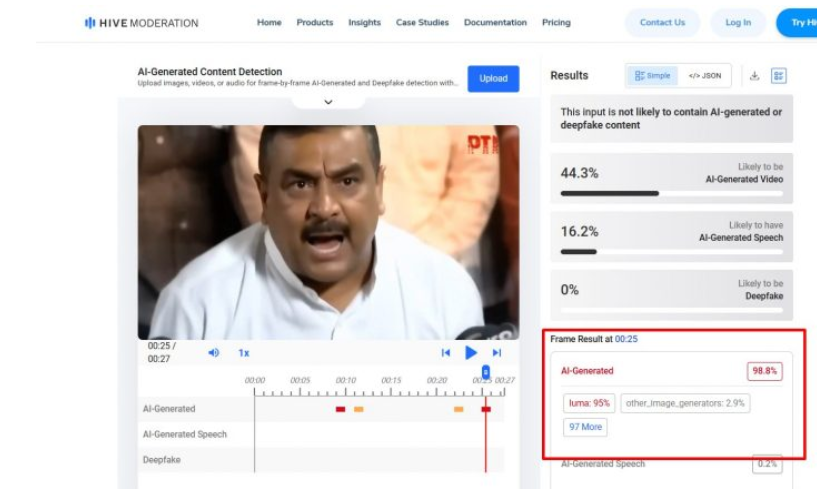
Further verification through reverse image search of key frames led to an original press byte of Suvendu Adhikari posted by PTI News on May 6. In that authentic video, he is seen speaking about taking strict legal action against criminals, with no mention of any religious community or communal statements.
https://x.com/PTI_News/status/2052020784152068114?s=20

Conclusion
The viral video allegedly showing Suvendu Adhikari making communal remarks is AI-generated and misleading. The original footage confirms that no such statements were made, and the clip has been digitally manipulated to spread misinformation.
