
Misinformation in Local Languages: How Vernacular Content Amplifies False Narratives in Communities
Introduction
Misinformation is no longer a challenge limited to major global platforms or widely spoken languages. In India and many other countries, false information is increasingly disseminated through local and vernacular languages, allowing it to reach communities more directly and intimately. While regional language content has played a crucial role in expanding access to information, it has also emerged as a powerful driver of misinformation by bad actors, and it often becomes harder to detect and counter. The challenge of local language misinformation is not merely digital in nature; it is deeply social, cultural, and shaped by specific local contexts.
Why Local-Language Misinformation Is More Impactful
A person’s mother tongue can be a highly effective medium for misinformation because it carries emotional resonance and a sense of authenticity. Information that aligns with an individual’s linguistic and cultural background is often trusted the most. When false narratives are framed using familiar expressions, local references, or community-specific concerns, they are more readily accepted and shared more widely.
Misinformation in a language like English, which is more heavily moderated, does not usually have the same impact as content in vernacular languages. In the latter case, such content tends to circulate within closed networks such as family WhatsApp groups, regional Facebook pages, local YouTube channels, and community forums. These spaces are often perceived as safe or trusted, which lowers scepticism and encourages the spread of unverified information.
The Role of Digital Platforms and Algorithms
Although social media platforms have opened up access to the content of regional languages, the moderation mechanisms have not kept up. The automated control systems for content are frequently trained mainly on the dominant languages, thus missing the detection of vernacular speech, slang, dialects, and code-mixing.
This results in a disparity in the enforcement of laws where misinformation in local languages:
- Doesn’t go through automated fact-checking tools
- Is subject to human moderation takes place at a slower pace
- Is less prone to being reported or flagged
- Gains unrestrained access for a longer time period than first imagined
The problem is further magnified by algorithmic amplification. Content that triggers very strong emotional reactions fear, anger, pride, or outrage, has a higher chance of being promoted, irrespective of its truthfulness. In regional situations, such content may very quickly sway public opinion even in very closely knit communities.
Forms of Vernacular Misinformation
Local-language misinformation appears in various forms:
- Health misinformation, with such examples as panic remedies, vaccine myths, and misleading medical prescriptions
- Political misinformation, which is mostly identified with regional identity, local grievances, or community narratives
- Rumours regarding disasters that are very hard to control and spread hatred during floods, earthquakes, or other public emergencies
- Economic and financial frauds that are perpetrated via the local dialect authorities or trusted institutions
- Cultural and religious untruths, which are based on exploiting the core of the beliefs
The regional aspect of such misinformation makes it very difficult to be corrected because the fact-checks in other languages may not get to that audience.
Community-Level Consequences
The effect of misinformation in local languages is not only about the misdirection of individuals. It can also:
- Negatively affect the process of public institutions gaining trust
- Support social polarisation and communal strife
- Get in the way of public health measures
- Help shape the decision-making process in elections at the grassroots level
- Take advantage of the digitally illiterate poor people
In a lot of scenarios, the damage done is not instant but rather accumulative, thus changing perceptions and supporting false worldviews more.
Why Countering Vernacular Misinformation Is Difficult
Multiple structural layers make it difficult to respond effectively:
- Variety of Languages: Just in India, there are many languages and dialects, which are very hard to monitor universally.
- Culturally Aware Systems: The local languages sometimes bear meanings that are deeply rooted in the culture, such as by using sarcasm or referring to history, and automated systems are unable to interpret it correctly.
- Reporting Not Common: Users might not spot misinformation or may not want to be a part of the struggle by showing the content shared by reliable members of the community.
- Insufficient Fact-Checking Capacity: Resources are often unavailable for fact-checking organisations to perform their duties worldwide in different languages effectively.
Building a Community-Centric Response
Overcoming misinformation in local languages needs a community-driven resilience approach instead of a platform-centric one. Some of the key actions are:
- Boosting Digital Literacy: Users will be able to question, verify, and put the content on hold before sharing it, thanks to the regional language awareness campaigns that will be conducted.
- Facilitating Local Fact-Checkers: Local journalists, educators, and NGOs are the main players in providing the context for verification.
- Accountability of Platforms: It is necessary for technology companies to support global moderation in several languages, the hiring of local experts, and the implementation of transparent enforcement mechanisms.
- Contemplating Policy and Governance: Regulatory frameworks should facilitate proactive risk assessment while controlling the right to free expression.
- Establishment of Trusted Local Intermediaries: Community leaders, health workers, teachers, and local organisations can engage in preventing misinformation among the networks that they are trusted in.
The Way Forward
Misinformation in local languages is not a minor concern; it is an issue that directly affects the future of digital trust. As the number of users accessing the internet through local language interfaces continues to grow, the volume and influence of regional content will also increase. If measures do not include all language groups, misinformation will remain least corrected and most influential at the community level, where it is also the hardest to identify and address.
Such a problem exists only if the power of language is not recognised. Therefore, one can say that it is necessary to protect the quality of information in local languages, not only for digital safety but for other factors as well, such as social cohesion, democratic participation, and public well-being.
Conclusion
Vernacular content has the potential to be very powerful in the ways it can inform, include and empower; meanwhile, if it goes unmonitored, it has the same potential to mislead, divide, and harm. Mis-disinformation in local languages calls for the cooperation of platforms, regulators, NGOs, and the communities involved. To win over the digital ecosystem, it has to speak all languages, not only for communication but also for protection.
References
- https://www.mdpi.com/2304-6775/10/2/15
- https://afpr.in/regional-languages-shaping-indias-online-discourse/
- https://medium.com/@pratikgsalvi03/how-indias-misinformation-surge-and-media-credibility-crisis-are-undermining-democracy-public-dc8ad7be8e12
- https://projectshakti.in/
- https://journals.sagepub.com/doi/10.1177/02683962211037693
- https://rsisinternational.org/journals/ijriss/Digital-Library/volume-8-issue-11/505-518.pdf
- https://www.irjmets.com/upload_newfiles/irjmets71200016652/paper_file/irjmets71200016652.pdf

Related Blogs

Executive Summary
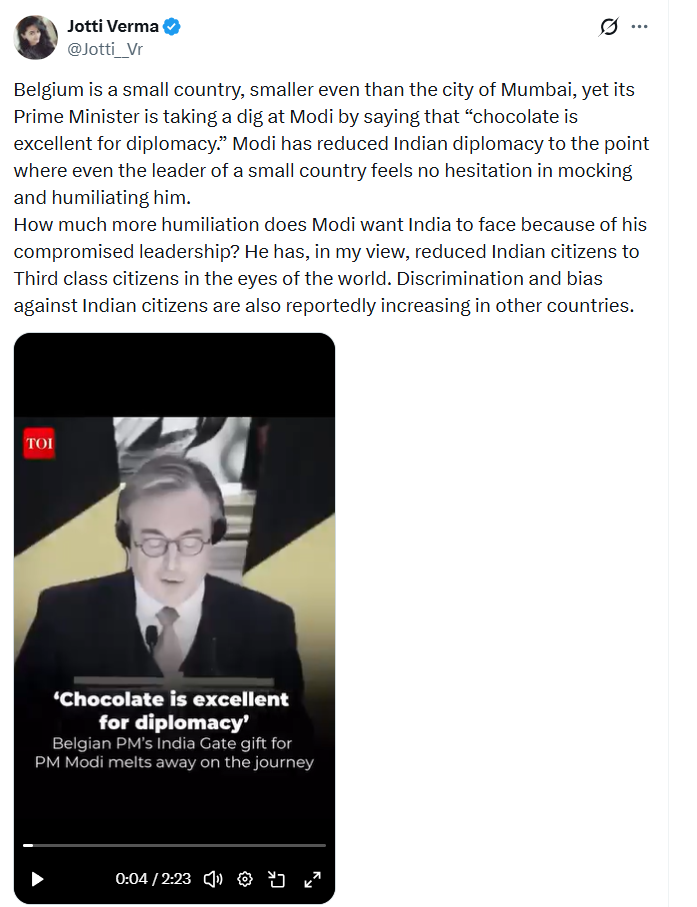
Belgian Prime Minister Bart De Wever is on an official visit to India. During the visit, he met Prime Minister Narendra Modi. Meanwhile, a video of his speech is going viral on social media. In his speech, Bart De Wever can be heard saying to PM Modi, “Chocolate is excellent for diplomacy, but not for diplomatic travel.” The video is being shared with the claim that Belgian Prime Minister Bart De Wever took a jibe at Prime Minister Narendra Modi’s diplomacy by referring to “chocolate diplomacy.” A research done by the CyberPeace Research Wing found that Belgian Prime Minister Bart De Wever had brought an unusual and thoughtful gift for Prime Minister Narendra Modi. It was a miniature replica of Delhi’s iconic India Gate, made entirely from Belgian chocolate. However, the chocolate replica melted during the journey to India. Referring to the incident, Bart De Wever made the remark in a humorous manner, saying that the chocolate gift could not withstand the journey. The video is now being shared by users with a misleading claim.
Claim:
X user Jyoti Verma wrote, “Belgium is a small country, smaller than the city of Mumbai, yet its Prime Minister is taking a jibe at Modi by saying that ‘chocolate is a very good thing for diplomacy.’ Modi has brought the level of Indian diplomacy down so much that even the leader of a small country does not hesitate to mock and belittle him. How much more humiliation does Modi want India to face because of his weak leadership? In my view, he has turned Indian citizens into ‘third-class’ citizens in the eyes of the world. There are also reports that discrimination and bias against Indian citizens are increasing in other countries.”
https://x.com/Jotti__Vr/status/2096154750425424086?s=20
Fact Check
During the research of the claim, a search using relevant keywords led us to the full video of the Belgian Prime Minister posted on ANI’s official X handle. In the video, Bart De Wever can be seen mentioning the chocolate replica of India Gate during a joint press conference with Prime Minister Narendra Modi.
https://x.com/ANI/status/2095426762243281060?s=20
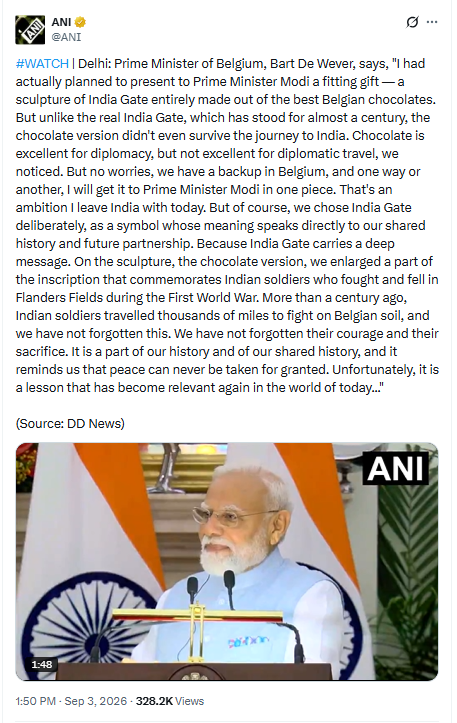
As part of the research, we found a report published on the Times of India website on September 4, 2026. According to the report, Belgian Prime Minister Bart De Wever arrived in India carrying a unique and special gift for Prime Minister Narendra Modi. It was a miniature replica of Delhi’s iconic India Gate, made entirely of Belgian chocolate. However, there was one problem—the chocolate replica melted during the journey to India. During a joint press conference with Prime Minister Modi in New Delhi on September 3, De Wever shared the anecdote in a light-hearted manner. He said he had planned to gift Modi a replica of India Gate made from “the finest Belgian chocolate.” However, unlike the real India Gate, which has stood for nearly a century, the chocolate replica did not survive the journey intact. De Wever jokingly remarked, “Chocolate is great for diplomacy, but not for diplomatic travel.”

Conclusion:
Our research found that the viral claim is misleading. Belgian Prime Minister Bart De Wever did indeed bring a miniature replica of India Gate made entirely of Belgian chocolate as a gift for Prime Minister Narendra Modi. However, the claim that the replica “melted during the journey” needs context. De Wever mentioned the incident humorously during his joint press conference with PM Modi, explaining that the chocolate replica did not survive the journey intact. Therefore, the viral post is based on a genuine incident but may present the context in a misleading manner.

Introduction
With mobile phones at the centre of our working and personal lives, the SIM card, which was once just a plain chip that links phones with networks, has turned into a vital component of our online identity, SIM cloning has become a sneaky but powerful cyber-attack, where attackers are able to subvert multi-factor authentication (MFA), intercept sensitive messages, and empty bank accounts, frequently without the victim's immediate awareness. As threat actors are becoming more sophisticated, knowing the process, effects, and prevention of SIM cloning is essential for security professionals, telecom operators, and individuals alike.
Understanding SIM Cloning
SIM cloning is the act of making an exact copy of a victim's original SIM card. After cloning, the attacker's phone acts like the victim's, receiving calls, messages, and OTPs. This allows for a variety of cybercrimes, ranging from unauthorised financial transactions to social media account hijacking. The attacker virtually impersonates the victim, often leading to disastrous outcomes.
The cloning can be executed through various means:
● Phishing or Social Engineering: The attack compels the victim or a mobile carrier into divulging personal information or requesting a replacement SIM.
● SIM Swap Requests: Attackers use fake IDs or stolen credentials to make telecom providers port the victim's number to a new SIM.
● SS7 Protocol Exploitation: Certain sophisticated attacks target weaknesses in the Signalling System No. 7 (SS7) protocol employed by cellular networks to communicate.
● Hardware based SIM Cloning: Although uncommon, experienced attackers will clone SIMs through the use of specialized hardware and malware that steals authentication keys.
The Real-World Consequences
The harm inflicted by SIM cloning is systemic as well as personal. The victims are deprived of their phones and online accounts, realising the breach only when improper dealings or login attempts have occurred. The FBI reported over $50 million loss in 2023 from crimes associated with SIM, most of which involved cryptocurrency account and high net-worth persons.
Closer to home, Indian entrepreneurs, journalists, and fintech users have reported losing access to their numbers, only to have their WhatsApp, UPI, and banking apps taken over. In a few instances, the attackers even contacted contacts, posing as the victim to scam others.
Why the Threat Is Growing
Dependence on SMS-based OTPs is still a core vulnerability. Even as there are attempts to move towards app-based two-factor authentication (2FA), most banking, government, and e-commerce websites continue to employ SMS as their main authentication method. This reliance provides an entry point for attackers who can replicate a SIM and obtain OTPs without detection.
Vulnerabilities in telecom infrastructure are also a part of the issue. Insider attacks at telecom operators, where malicious employees handle fraud SIM swap requests, also keep cropping up. On top of that, most users are not even aware of what exactly SIM cloning is or how to identify it, leaving attackers with a head start.
Very often, the victims are only aware that their SIM has been cloned when they lose mobile service or notice unusual activity on their accounts. Red flags include loss of signal, failure to send or receive messages, and inability to receive OTPs. Alerts on password changes or unusual login attempts must never be taken lightly, particularly if this is coupled with loss of mobile service.
How Users Can Protect Themselves
● Use A Strong SIM Pin: This protects your SIM from access by unauthorized users should your phone be lost or stolen.
● Secure Personal Information: Don't post sensitive personal information online that can have a place in social engineering.
● Notify your Carrier of Suspicious Activity: If your phone suddenly has lost service or is behaving strangely, contact your mobile operator immediately.
● Register for Telecom Alerts: Many providers offer alerts to SIM swap or porting requests that are useful to preliminarily detect a possible takeover.
● Verify SIM card status using Sanchar Saathi: Visit [https://sancharsaathi.gov.in](https://sancharsaathi.gov.in) to check how many mobile numbers are issued using your ID. This government portal allows you to identify unauthorized or unknown SIM cards, helping prevent SIM swapping fraud. You can also request to block suspicious numbers linked to your identity.
Conclusion
SIM cloning is not a retrograde nod to vintage cybercrime; it's an effective method of exploitation, especially where there's a strong presence of SMS-based authentication. The attack vector is simple, but the damage it causes can be profound, both financial and reputational. With telecommunication networks forming the backbone of digital identity, users, regulators, and telecom service providers have to move in tandem. For the users, awareness is the best protection. For Telecoms, security must be a baseline requirement, not a value-add option. It's time to redefine mobile security, before your identity is in anyone else's hands.
References
● https://www.trai.gov.in/faqcategory/mobile-number-portability
● https://www.cert-in.org.in/PDF/Digital_Threat_Report_2024.pdf
● https://www.ic3.gov/PSA/2022/PSA220208/
● https://www.hdfcbank.com/personal/useful-links/security/beware-of-fraud/sim-swap
● https://security-gen.com/SecurityGen-Article-Cloning-SimCard.pdf
● https://www.p1sec.com/blog/understanding-ss7-attacks-vulnerabilities-impacts-and-protection-measures

Executive Summary
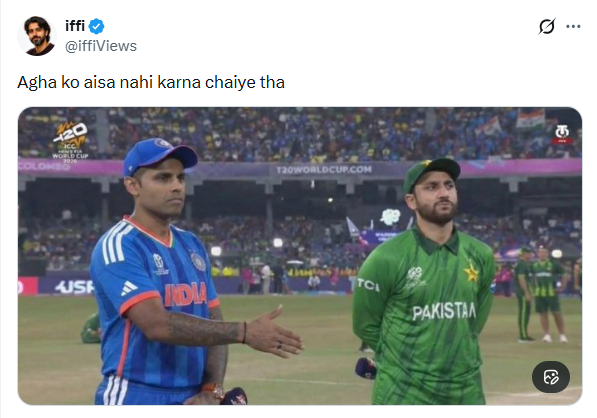
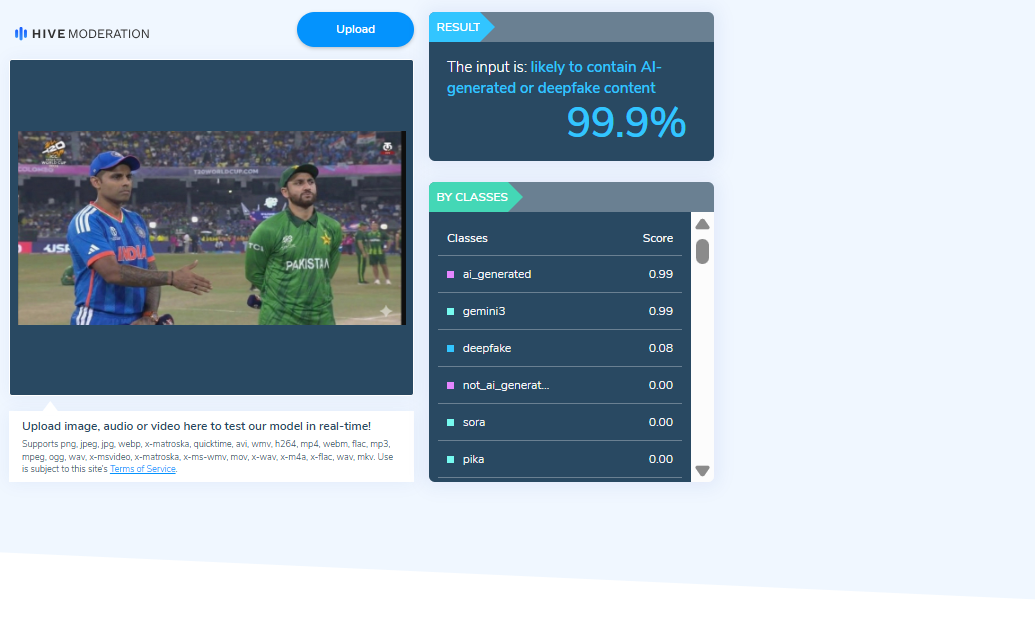
An image circulating on social media claims to show Suryakumar Yadav, captain of the Indian cricket team, extending his hand to greet Pakistan’s skipper Salman Ali Agha, who allegedly refused the gesture during the India–Pakistan T20 World Cup match held on February 15. Users shared the image as evidence of a real incident from the high-profile clash. However, a research by CyberPeace found that the image is AI-generated and was falsely circulated to mislead viewers.
Claim
On February 15, an X account named “@iffiViews,” reportedly operated from Pakistan, shared the image claiming it was taken during the India–Pakistan T20 World Cup match at the R. Premadasa Stadium in Colombo. The viral image appeared to show Yadav attempting to shake hands with Agha, who seemed to decline the gesture. The post quickly gained significant traction online, attracting around one million views at the time of reporting. Here is the link and archive link to the post, along with a screenshot.
- https://x.com/iffiViews/status/2023024665770484206?s=20
- https://archive.ph/xvtBs
Fact Check:
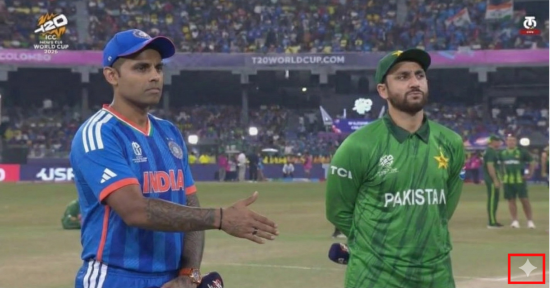
To verify the authenticity of the image, researchers closely examined the visual and identified a watermark associated with an AI image-generation tool. This raised strong indications that the image was digitally created and did not depict an actual event.
The image was further analysed using an AI detection tool, which indicated a 99.9 percent probability that the content was artificially generated or manipulated.
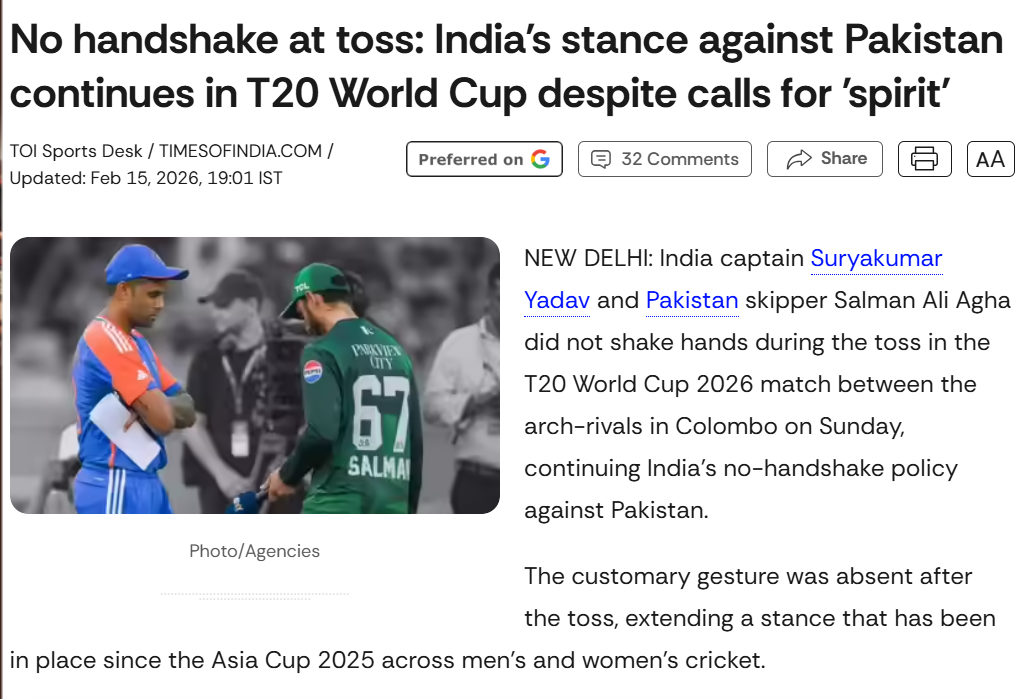
Researchers also conducted keyword searches to check whether the two captains had exchanged a handshake during the match. The search revealed media reports confirming that the traditional handshake between players has been discontinued since the Asia Cup 2025 in both men’s and women’s cricket. A report published by The Times of India on February 15 confirmed that no such customary exchange took place during the match between the two teams in Colombo.
Conclusion
The viral image claiming to show Suryakumar Yadav attempting to shake hands with Salman Ali Agha is not authentic. The visual is AI-generated and has been shared online with misleading claims.
