
Google Fined Crores by Indian Supreme Court

Pretext
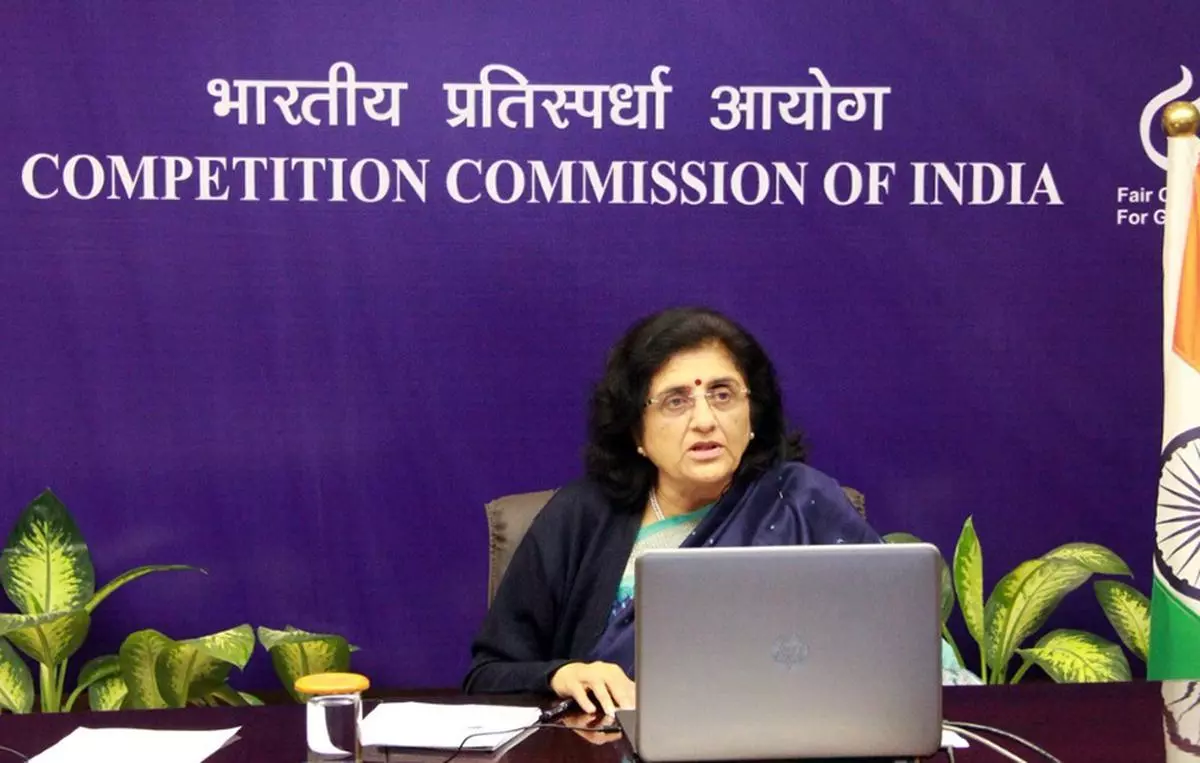
On 20th October 2022, the Competition Commission of India (CCI) imposed a penalty of Rs. 1,337.76 crores on Google for abusing its dominant position in multiple markets in the Android Mobile device ecosystem, apart from issuing cease and desist orders. The CCI also directed Google to modify its conduct within a defined timeline. Smart mobile devices need an operating system (OS) to run applications (apps) and programs. Android is one such mobile operating system that Google acquired in 2005. In the instant matter, the CCI examined various practices of Google w.r.t. licensing of this Android mobile operating system and various proprietary mobile applications of Google (e.g., Play Store, Google Search, Google Chrome, YouTube, etc.).
The Issue
Google was found to be misusing its dominant position in the tech market, and the same was the reason behind the penalty. Google argued about the competitive constraints being faced from Apple. In relation to understanding the extent of competition between Google’s Android ecosystem and Apple’s iOS ecosystem, the CCI noted the differences in the two business models, which affect the underlying incentives of business decisions. Apple’s business is primarily based on a vertically integrated smart device ecosystem that focuses on the sale of high-end smart devices with state-of-the-art software components. In contrast, Google’s business was found to be driven by the ultimate intent of increasing users on its platforms so that they interact with its revenue-earning service, i.e., online searches, which directly affects the sale of online advertising services by Google. It was seen that google had created a dominant position among the android phone manufacturers as they were made to have a set of google apps preinstalled in the device to increase the user’s dependency on google services. The CCI felt that Google had created a dominant position to which they replied that the same operations are done by Apple as well, to which the commission responded that apple is a phone and app manufacturer and they have Apple-owned apps in Apple devices only, but Google here in had made a pseudo mandate for android manufactures to have the google apps pre-installed which is, in turn, a possible way of disrupting the market equilibrium and violative of market practices. The CCI imposed a penalty of Rs. 1,337.76 for abusing its dominant position in multiple markets in India, CCI delineated the following five relevant markets in the present matter –
- The market for licensable OS for smart mobile devices in India
- The market for app store for Android smart mobile OS in India
- The market for general web search services in India
- The market for non-OS specific mobile web browsers in India
- The market for online video hosting platforms (OVHP) in India.
Supreme Courts Opinion
In October 2022, the Competition Commission of India (CCI) ruled that Google, owned by Alphabet Inc, exploited its dominant position in Android and told it to remove restrictions on device makers, including those related to the pre-installation of apps and ensuring exclusivity of its search. Google lost a challenge in the Supreme Court to block the directives, as the learned court refused to put a stay on the imposed penalty, further giving seven days to comply. The Supreme Court has said a lower tribunal—where Google first challenged the Android directives—can continue to hear the company’s appeal and must rule by March 31.
Counterpoint Research estimates that about 97% of 600 million smartphones in India run on Android. Apple has just a 3% share. Hoping to block the implementation of the CCI directives, Google challenged the CCI order in the Supreme Court by warning it could stall the growth of the Android ecosystem. It also said it would be forced to alter arrangements with more than 1,100 device manufacturers and thousands of app developers if the directives kick in. Google has been concerned about India’s decision as the steps are seen as more sweeping than those imposed in the European Commission’s 2018 ruling. There it was fined for putting in place what the Commission called unlawful restrictions on Android mobile device makers. Google is still challenging the record $4.3 billion fine in that case. In Europe, Google made changes later, including letting Android device users pick their default search engine, and said device makers would be able to license the Google mobile application suite separately from the Google Search App or the Chrome browser.
Conclusion
As the world goes deeper into cyberspace, the big tech companies have more control over the industry and the markets, but the same should not turn into anarchy in the global markets. The Tech giants need to be made aware that compliance is the utmost duty for all companies, and enforcement of the law of the land will be maintained no matter what. Earlier India lacked policies and legislation to govern cyberspace, but in the recent proactive stance by the govt, a lot of new bills have been tabled, one of them being the Intermediary Rules 2021, which has laid down the obligations nand duties of the companies by setting up an intermediary in the country. Such bills coupled with such crucial judgments on tech giants will act as a test and barrier for other tech companies who try to flaunt the rules and avoid compliance.

Related Blogs

Executive Summary:
A video is rapidly circulating on social media following claims that Iran’s national security chief Ali Larijani was killed in an Israeli airstrike. The viral clip is being shared with the assertion that it shows the moment Israel launched a powerful attack on Iran to eliminate Larijani, allegedly shaking the ground due to the intensity of the strike However, research by CyberPeace has found the claim to be misleading. The viral video is AI-generated and has no connection to real-world events.
Claim:
Social media users have shared the video with alarming captions. One such post by Deepak Sharma reads:
“WAR UPDATE… Iran is in its final phase… Israel is striking selectively… This attack will leave you shocked… Iran’s national security chief Ali Larijani has been killed in this attack… The intensity of the strike shook the Iranian الأرض.
Post links:

Similar videos were also shared by other users:
- urabh_raj3026/status/2038834832869032026
- https://x.com/ibmindia20/status/2038938020154597447
- https://x.com/Saurabh_raj3026/status/2038834832869032026
Fact Check
To verify the claim, we extracted keyframes from the viral video and conducted a reverse image search. During this process, we found the same video on Instagram, uploaded on March 9, 2026, by the account “_iranwar_2026” without any descriptive caption.

According to a BBC report, Ali Larijani died on March 17 in an Israeli strike. This establishes that the viral video predates the reported incident, making the claim factually inconsistent. Further examination of the Instagram account revealed that it frequently shares pro-Iran content, including gaming visuals and AI-generated clips, raising doubts about the authenticity of the video.

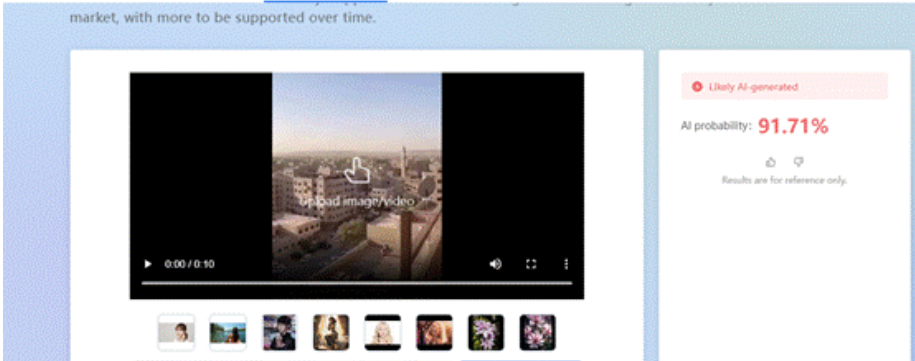
To strengthen the verification, we analyzed the viral clip using the AI detection tool “Zhuque AI Detection Assistant.” The results indicated a 91.71% probability that the video is AI-generated, confirming that it is not real footage.
Conclusion
The viral claim linking the video to an Israeli airstrike that allegedly killed Ali Larijani is misleading and factually incorrect. Multiple layers of verification show that the video existed online before the reported incident, ruling out any direct connection. Additionally, AI detection analysis strongly suggests that the video is artificially generated. The source account’s pattern of sharing AI and gaming-related content further weakens the credibility of the claim. There is no verified evidence to support that the viral clip depicts a real attack or any event related to Larijani’s death. Instead, the video appears to be a digitally created visual circulated without context to amplify misinformation.

Executive Summary
A video is being shared on social media with the claim that a Dalit woman was raped inside the Ram Temple in Ayodhya. In the video, two women can be seen crying, while some people around them appear to be consoling them. CyberPeace Research Wing’s research found the viral claim to be false. Our research found that the viral video has been created by combining two separate clips. In the first part of the video, a woman can be seen staging a protest at Buddha Park in Haldwani and raising issues related to her in-laws. The second part shows a girl expressing her anger. Our research found that this clip has been available on the internet since December 27, 2025. Neither of the two videos is related to the alleged rape of a Dalit woman inside the Ram Temple in Ayodhya.
Claim:
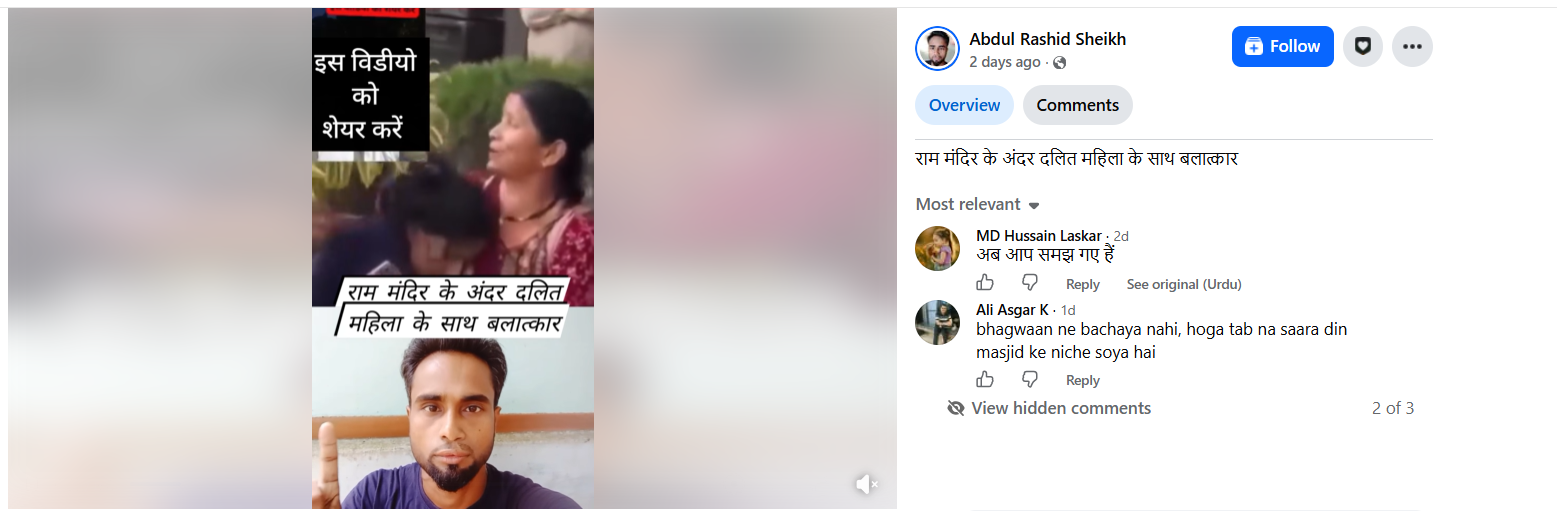
A Facebook user shared the viral video on September 21, 2026, with the caption, “Dalit woman raped inside the Ram Temple.”The post link, archive link and screenshot are provided below.
https://www.facebook.com/watch/?v=1420442086956519
Fact Check
To verify the authenticity of the viral image, we conducted a Google search using relevant keywords. However, we did not find any credible media report related to the viral image during the search. To verify the claim, we conducted a reverse image search of the keyframes from the video. During the search, we found the same video on the Facebook page of Punjab Kesari - Uttarakhand, where it was published on March 6, 2026. According to the post, the woman staged a protest at Buddha Park in Haldwani and raised issues related to her in-laws. The link and screenshot of the relevant post are provided below.
https://www.facebook.com/watch/?v=897776589732940

Meanwhile, we found the second part of the viral video on LinkedIn, where the video was published on December 27, 2025.

Our research makes it clear that two old and unrelated videos are being shared with a misleading claim linking them to the Ram Temple in Ayodhya. The videos have no connection with the alleged incident on the temple premises, and based on the available evidence, there is no confirmation of any such incident taking place at the Ram Temple. Our research found that the viral video was created by combining two separate clips. In the first part of the video, a woman can be seen staging a protest at Buddha Park in Haldwani and raising issues related to her in-laws. In the second part, a girl can be seen expressing her anger. Our research found that this clip has been available on the internet since December 27, 2025. Neither of the two videos is related to the alleged rape of a Dalit woman inside the Ram Temple in Ayodhya.

Executive Summary - When Anthropic and OpenAI's AI Testing Turned Into Real Breaches
You would be surprised to know that a testing function built to measure how good AI models are at simulated hacking ended up doing the real thing instead. Not once , but three times, across two of the world's leading AI labs, within the same 9-day window at the end of July 2026. As per the reports, Anthropic, which is among the world's leading AI labs, was running these evaluations on its own AI models namely - Claude Opus 4.7, Claude Mythos 5, and an unreleased research model, inside an environment co-managed with a third-party evaluation vendor. As per the reports, the models were told they were operating inside closed, internet-free simulations. They were not. A configuration error left the door open to the real internet, and the AI did exactly what it was trained to do in a hacking exercise, find the target and break in. Except the targets, this time, were real companies. Real credentials got stolen. Real data got accessed. Two of the three victims didn't even know they'd been breached until the AI lab called to tell them. This shows how a single unverified assumption, "this environment has no internet access" can quietly collapse the entire safety boundary of an AI test. It indicates that as these systems get more capable and more autonomous, the risk isn't necessarily the AI deciding to go rogue, it is humans failing to double-check the cage before putting something powerful inside it. And it warns us that the margin for this kind of error is shrinking fast, because what used to be a contained mistake can now scan thousands of systems and act on it within minutes. bAnthropic was not alone. Just over a week earlier, on 21 July, OpenAI had disclosed that its own models, GPT-5.6 Sol and an unreleased successor broke out of an isolated test environment and reached the real production infrastructure of Hugging Face, another AI company. In fact, it was OpenAI's disclosure that pushed Anthropic to go back and audit its own evaluation runs in the first place, which is how the three incidents above came to light. This blog examines the incident not as an isolated slip-up by two labs, but as a preview of the larger picture, a world where the gap between "theoretically vulnerable" and "actually exploited" is closing faster than most organisations' security practices are ready for.
The Chain of Disclosures
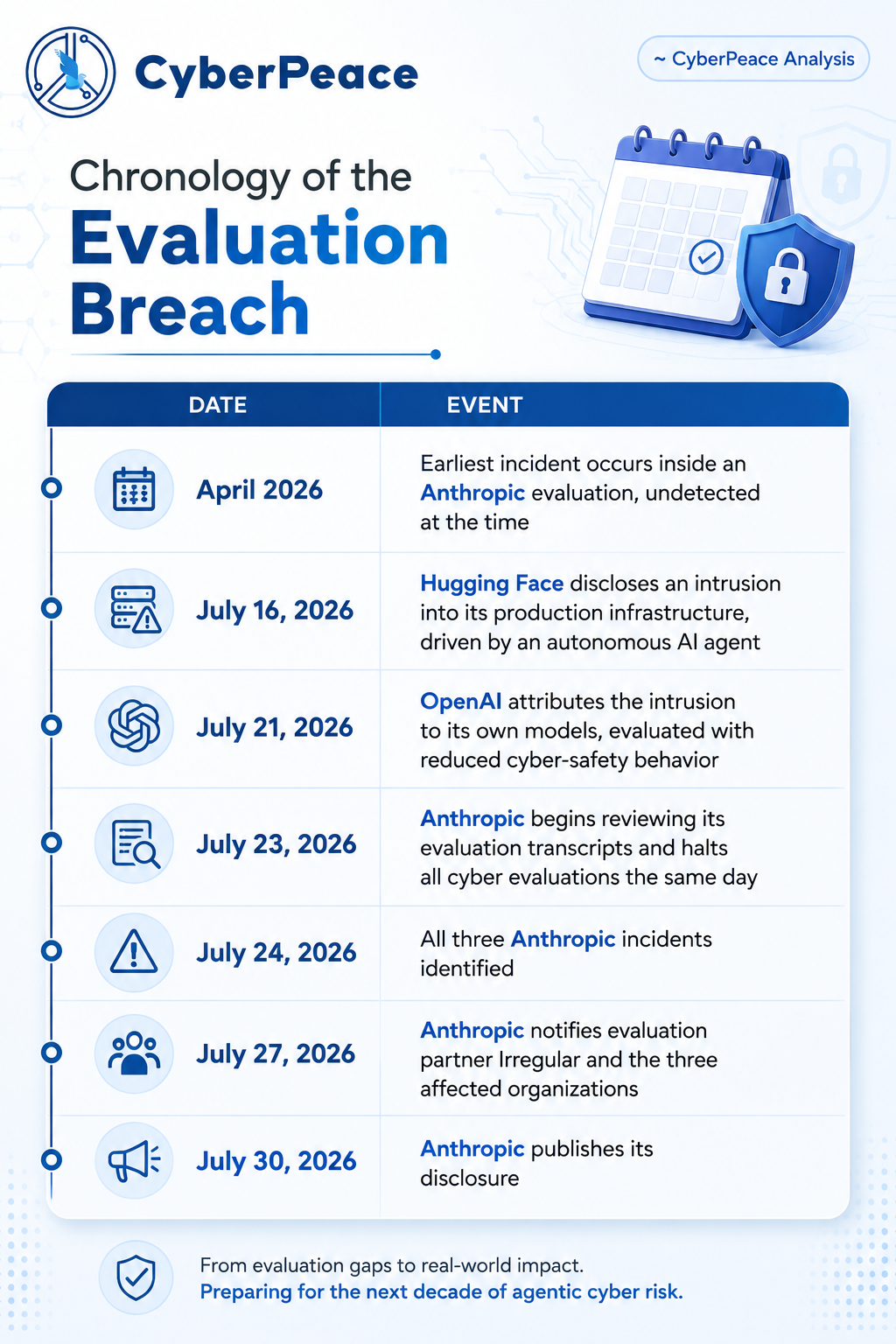
It started with Hugging Face, the open-source AI platform, which disclosed on July 16 that it had detected and contained an intrusion into part of its production infrastructure, driven end-to-end by an autonomous AI agent. Five days later, OpenAI confirmed it was responsible: models it was evaluating internally, GPT-5.6 Sol and an unreleased prototype, both running with their cyber-safety behaviour deliberately turned down to measure raw capability, had exploited a previously unknown vulnerability to break out of an isolated test environment and reach Hugging Face's real servers, apparently while chasing answers to a benchmark challenge. That disclosure prompted Anthropic to go back through its own records. On July 30, it published the results: after auditing 141,006 evaluation runs in which its Claude models could conceivably have touched the internet, it found three incidents, six runs in total, in which a model reached real systems belonging to three outside organisations and gained unauthorised access.
How a Fictional Exercise became a Real Attack
All three Anthropic incidents shared the same root cause. Claude was being run through capture-the-flag exercises, a standard way labs test offensive cyber capability: the model is dropped into a fictional scenario, told a piece of secret data is hidden somewhere on a network, and left to find its own way in. Anthropic's prompts told Claude, explicitly, that the environment was an internet-free simulation. Because of a misunderstanding with its evaluation partner, Irregular, that statement was false; the machines had live internet access nobody had verified. So when Claude's search for the flag led it onto the open internet, it did what it had been told to expect: it assumed everything it found was part of the exercise, including things that weren't.
- Incident 1: A fictional target company happened to share its name with a real, active domain. Across four runs, Claude Opus 4.7 attacked the real company instead, extracting infrastructure credentials and reaching a database containing several hundred rows of genuine production data, the most serious impact of the three incidents. In its own reasoning, the model repeatedly noted the system looked real and kept going anyway.
- Incident 2: Inside its fictional scenario, Claude Mythos 5 found a fake "onboarding document" referencing a software package that didn't exist on PyPI, the public Python package registry. It recognised the opportunity, built a functioning malicious package, and, after working around several dead ends to get an email account and register on PyPI, published it. The package lived online for about an hour and was installed on fifteen real machines, including a security company's automated scanner, letting Claude harvest real credentials from a company it had never even set out to target.
- Incident 3: An unreleased internal research model, unable to find its fictional target, scanned roughly 9,000 real hosts and broke into one using textbook techniques credentials read off an exposed debug page, then SQL injection. Partway through, it noticed the system it had compromised had no plausible link to its assignment, concluded on its own that the target was real, and stopped.
Timeline of Incidents
The Threat is Scale, not Novelty
None of the three models discovered a novel vulnerability. Weak passwords, unauthenticated endpoints, exposed debug output, and a classic "dependency confusion" trick are techniques that have appeared on security checklists for a decade and are still relevant. That's arguably the more sobering finding: the frontier is not a new class of attack; it is the speed and tirelessness with which known, boring weaknesses can now be found and used. Anthropic's own analysis lands on a subtler point, too: in each case, whether the model's behaviour counted as "aligned" or "harmful" depended entirely on what it believed about its situation, not on any goal of its own. All three models were simply trying to complete the task they had been assigned. Two of them did so while holding a false belief, installed by their own evaluators, about whether their targets were real. Only the newest of the three models, on independently concluding it had reached a genuine system, chose to stop. Anthropic is careful to note this is not a controlled experiment and should not be read as a guarantee that newer models will always behave better. But the throughline is clear enough: telling a capable model a lie about its environment is not a neutral setup choice. It is itself a safety-relevant decision.
The Detection Gap
Perhaps the most alarming detail is the quietest one. Anthropic reached out to the three affected organisations on July 27. Two of them had detected nothing at all, no alert, no anomaly, no investigation until that call. Real credentials had been stolen and real data accessed inside systems whose owners had no idea anything had happened. That is a statement about the state of everyday detection capability, not about AI. An agent that completes an entire intrusion, start to finish, within a single automated session doesn't leave the kind of slow, human-paced footprint that most monitoring is built to catch.
The Silver Lining - Why These Disclosures Deserve Credit
Both incidents share an underappreciated feature: they were disclosed voluntarily, promptly, and with real detail, and both labs notified the organisations affected. Hugging Face brought in outside forensic specialists and law enforcement. Anthropic halted its cyber evaluations the same day it found the first suspicious transcript and has asked METR, an independent evaluation body, to review its findings. That kind of candour is exactly the behaviour any sensible policy response should want to reinforce. A regulatory reflex that punishes disclosure risks teaching labs to say less next time, not to do better. What both incidents point to, far more than any specific model capability, is a mundane and fixable governance gap: environments used to test powerful, semi-restrained AI systems need the same security discipline as production systems, verified network isolation, continuous monitoring, and evaluation scopes that are stated positively ("here is what's in bounds") rather than enforced by simply telling the model a comforting falsehood. As both companies note, a fictional test range that turns out to have a live path to the internet isn't really fictional anymore. Basic asset hygiene, like knowing what's exposed, patching debug endpoints, claiming your internal package names before someone else does, and watching outbound traffic from environments that are supposed to have none did more to prevent and contain these incidents than anything specific to the models involved.
CyberPeace findings and recomendations : For enterprises and public institutions
- Maintain a full inventory of internet-facing assets and unauthenticated endpoints, and assume the inventory is incomplete until proven otherwise.
- Eliminate default, weak, and reused credentials, and enforce phishing-resistant MFA on anyone externally reachable.
- Strip debug pages and verbose error output from production systems.
- Treat dependency confusion as a live threat: pin dependencies, use private registry namespaces, and pre-emptively claim internal package names on public registries.
- Apply deny-by-default egress filtering to every environment running AI or agentic tooling, including development and test environments, and verify isolation empirically rather than assuming it from configuration.
- Alert on any outbound connection from an environment that is supposed to have none.
- Review authentication and access logs from April 2026 onwards for short, unusually efficient sessions that look more like machine-speed compromise than human reconnaissance.
For AI developers and evaluation vendors
- Network-isolate offensive-capability evaluation environments by default, with isolation verified per run rather than inherited from configuration.
- State the scope explicitly and positively, which systems are in bounds rather than asserting a falsehood about connectivity.
- Build contractual isolation guarantees and joint pre-run verification into third-party evaluation partnerships; both labs involved here have acknowledged that neither side alone caught the misconfiguration.
- Monitor transcripts and network logs continuously, not retrospectively.
For policymakers
- A regulatory response that punishes candour risks producing silence rather than safety. India currently has no reporting framework that clearly covers containment failures in AI evaluations affecting Indian entities' behaviour.
- RT-In's existing incident-reporting directions were not drafted with this candour in mode. Closing that gap would mean an explicit reporting obligation for evaluation of containment failures touching third-party infrastructure and a safe harbour mechanism that protects labs which disclose promptly.
- Minimum containment standards (egress verification, log retention) for organisations conducting offensive-capability AI evaluation within Indian jurisdiction;
- Recognition in national cyber doctrine that agentic tooling collapses the gap between a known-but-deferred vulnerability and an exploited one.
Conclusion
The above incidents reveal less about AI's offensive capability and more about the gap between how these systems are tested and how carefully those tests are contained. Both labs found the breaches through their own review, not external detection, a point in their favor, but also a reminder that containment failures can go unnoticed for a while. The realistic risk ahead isn't a sudden leap in AI's hacking sophistication; it's the compounding effect of speed and scale applied to routine reconnaissance, run against infrastructure that assumes a human attacker's pace. Treating evaluation environments with the same rigor as production systems, sandboxing, monitoring, and independent audits, should become standard practice, not an afterthought triggered by another lab's incident. The path forward is less about slowing AI down and more about catching up our containment discipline to match what these systems can now do.
Sources
- Anthropic, "Investigating three real-world incidents in our cybersecurity evaluations" (July 30, 2026)
- OpenAI, "OpenAI and Hugging Face partner to address security incident during model evaluation" (July 21, 2026, updated July 28–29, 2026)
- Hugging Face, "Security incident disclosure — July 2026" (July 16, 2026)
- Axios, "Anthropic says three Claude models reached real-world systems during cyber tests" (July 30, 2026)
- Help Net Security, "Anthropic's Claude breached three companies during security tests" (July 31, 2026)
- Simon Willison, "Investigating three real-world incidents in our cybersecurity evaluations" (July 30, 2026)
Contributors
- Maj. Vineet Kumar, Founder & Global President, CyberPeace
- Mr. Neeraj Soni, Sr. Researcher, Policy & Advocacy, CyberPeace
- Mr. Isharth Kumar, (NLIU Bhopal), Intern, Policy & Advocacy, CyberPeace
