
#FactCheck - Edited Video Falsely Attributed to Arnab Goswami; Claim of Remarks Against Prime Minister Modi Is Misleading
A video has been going viral on social media in recent days in which Republic TV’s Editor-in-Chief and anchor Arnab Goswami can allegedly be heard using objectionable language against Prime Minister Narendra Modi. While sharing the video, users are claiming that Arnab Goswami publicly made controversial remarks about the Prime Minister.
An investigation by CyberPeace Foundation found this claim to be completely false. Our probe revealed that the viral video is edited and is being circulated on social media with a misleading narrative. In the original video, Arnab Goswami was not making any personal statement; rather, he was referring to an old statement made by Congress leader Rahul Gandhi.
Viral Claim
An Instagram user posted this video on 5 January 2026. In the video, a voice resembling Arnab Goswami is heard saying, “Ye jo Narendra Modi hain, ye chhe mahine baad ghar se nahi nikal paayenge aur Hindustan ke log inhein danda maarenge.”
(Translation: “This Narendra Modi will not be able to step out of his house after six months, and the people of India will beat him with sticks.”)
The post link, its archive link, and screenshots can be seen below:
- Instagram link: https://www.instagram.com/reel/DTHrO7bk7Rf/?igsh=MThzbzBlcm82eWN0ZA%3D%3D
- Archive link: https://archive.ph/oaYsf

Fact Check
To verify the viral claim, we first examined the video using Google Lens search. During this process, we found a video published on 18 July 2024 on the official YouTube channel of Republic Bharat. The investigation revealed that this video is the longer (extended) version of the viral clip.
After carefully watching the full video, it became clear that Arnab Goswami was not making the statement himself. Instead, he was referring to a remark made by Congress leader Rahul Gandhi during the 2020 Delhi Assembly elections against Prime Minister Narendra Modi. This confirms that the viral video was clipped and presented out of context.
The related video link can be seen below: https://www.youtube.com/shorts/KlQV25-3l8s
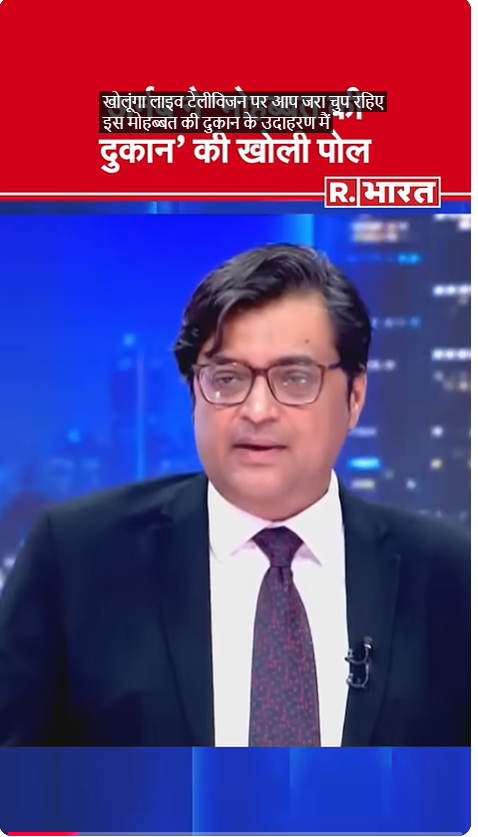
In the next step of the investigation, to verify whether Rahul Gandhi had indeed made such a statement, we conducted a customized keyword search on Google. During this, we found a video published on 6 February 2020 on the official YouTube channel of India Today.
In this video, recorded during a public event ahead of the 2020 Delhi Assembly elections, Rahul Gandhi is seen sharply attacking Prime Minister Narendra Modi, stating that if the Prime Minister fails to resolve the issue of unemployment in the country, the youth would beat him with sticks.
The video link is given below: https://www.youtube.com/watch?v=t5qCSA5nG9Y

Conclusion
The CyberPeace Foundation’s investigation found this claim to be completely fake. The viral video is edited and is being shared in a misleading context. In the original video, Arnab Goswami was referring to an old statement made by Rahul Gandhi, which was selectively clipped and presented in a way that falsely suggests Arnab Goswami himself made objectionable remarks against Prime Minister Narendra Modi.

Related Blogs

Executive Summary
Nepal witnessed severe devastation after floods struck the country on August 26, 2026. Amid this, a video showing a bridge being swept away by floodwaters is being widely shared on social media. Some users are sharing the video claiming that it shows scenes of destruction caused by the floods in Nepal.A research done by the Research Wing of the CyberPeace found that the video being shared with the claim of flood devastation in Nepal is AI-generated. However, it is true that the floods in Nepal have claimed hundreds of lives.
Claim
A user on X shared the video with the caption: “Scenes of devastation in Nepal after the disaster.”
https://www.instagram.com/reels/Dch-EmYNUwz/
https://perma.cc/5VY5-ZFCN?type=standard

Fact Check
We closely examined the video showing the bridge being swept away. A person can be seen standing on top of a truck, which appears unnatural in such a situation. Moreover, even as the bridge collapses, the people on it do not appear to fall directly into the water. These observations led us to suspect that the video was likely AI-generated.

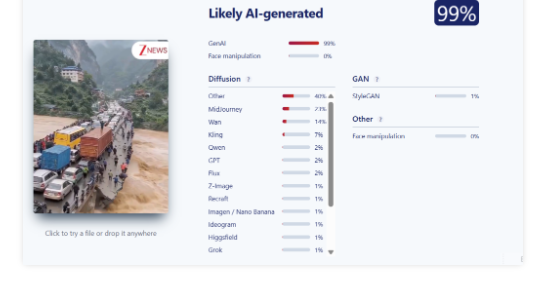
We scanned the viral video using the AI detection tool ‘WasItAI’, which identified it as 99 percent AI-generated.
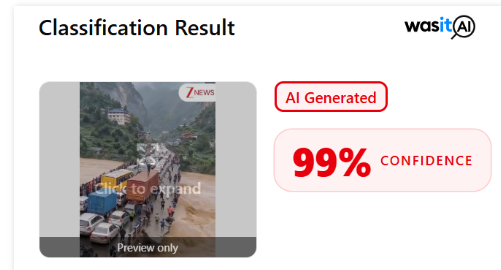
Meanwhile, another AI detection tool, Sightengine, also identified the video as 99 percent AI-generated.
Conclusion:
A video being shared with the claim that it shows devastation caused by floods in Nepal is actually from the shooting of an Indonesian TV serial, while another viral video is AI-generated.
.webp)
Introduction
The advent of frontier AI has significantly widened the range of actors who can launch cyberattacks, extending beyond state actors with immense capabilities or organized professional cybercriminal rings. In its most critical advisory, CIAD-2026-0020, titled "Defending against frontier AI-driven cyber risks," which was released on April 26, 2026, the Indian Computer Emergency Response Team (CERT-In) officially stated that AI can now carry out autonomous cyber activities of unprecedented scale and speed. The advisory highlights that these frontier AI models can perform automated reconnaissance, phishing, malware creation, vulnerability identification, and social engineering with minimal human involvement, thus "lowering the barrier to orchestrating complex cyber attacks." The risks that such AI models pose are not restricted to state actors and corporate entities anymore and also extend to MSMEs, public organizations, and individuals.
India’s Escalating Cybercrisis
The Indian digital economy has been developing at a very fast pace, but the same cannot be said about its cybersecurity. Having a base of over 850 million internet users and a digital payment sector that records a massive 22,495 crore in monthly transaction volumes, coupled with the fastest-growing cloud sector in the world, India continues to remain a lucrative prey for cybercriminals. There were over 265 million attempts reported in the last year, 2025, alone, where close to 46% of all incidents detected were in enterprises with fewer than 1,000 employees, a very grave reality for MSMEs. MHA confirmed there were 28.15 lakh reported cybercrime complaints in 2025 as compared to 2024, with a jump of 24%. In this worsening environment the advisory is a breakthrough in Indian cyber governance. Where previously advisories covered only conventional threats like phishing and malware, the new warning names frontier agentic AI systems as autonomous multipliers of threats, capable of conducting operations at scale and speed with significantly reduced human oversight.
What is “Frontier AI” and why does it matter?
CERT-In’s decision to adopt the term "Frontier AI" is deliberate and meaningful. The advisory’s scope is a new category of agentic AI, which moves well beyond traditional chatbot-style AI, having the capacity to reason, plan, perform multiple actions in a single task autonomously, and carry out complicated tasks with minimal or no human guidance. CERT-In highlights that these tools now possess the capabilities that were "previously carried out by a coordinated team of skilled cybersecurity professionals." The advisory clearly flags the risk that these advanced models have the capability to generate malicious code, conduct network scans, probe systems for vulnerabilities, and even orchestrate intricate multi-stage cyberattacks in a single session. Their capacity to analyse a vast number of source code libraries to identify vulnerabilities, even unknown zero-day ones, and then develop proof-of-concept exploits at high speed. This means that the historical lead time to turn a vulnerability discovery into an exploit tool has reduced from weeks to just hours.
Six Core Threat Vectors identified by CERT-In
- AI-driven Automatic Zero-Day Discovery: AI-based solutions discover zero-day vulnerabilities and automatically create exploits in minutes, reducing the time taken by defenders.
- AI-driven Autonomous Reconnaissance: AI-driven agents scan cloud infra, APIs, and enterprise networks and outline attack vectors.
- AI-driven phishing & deepfakes: Multilingual, highly targeted phishing emails, deepfake audio, and deepfake voice/video calls bring sophistication to social engineering.
- Deepfake Financial Fraud: AI creates deepfake executives for high-value money transfers. For example, reports have indicated crore-level fund loss cases in India.
- AI-powered Autonomous Attack Chains: Advanced AI models are able to automatically perform multiple malicious stages like privilege escalation, lateral movement, data exfiltration, and data extraction.
- Cascading failures of interconnected systems: A single AI-supported security breach can have catastrophic domino effects on connected digital systems and critical infrastructures.
Why are MSMEs a target?
CERT-In’s warning is specifically targeted toward the weakness of the Indian MSMEs. Contributing almost 30% to India's GDP and employing over 110 million individuals, most MSMEs have failed to adequately prepare themselves against contemporary cyber threats. While a large corporation would have a full-time cybersecurity team, a security operation centre, and frequent vulnerability assessments, the majority of MSMEs lack such infrastructure due to budget constraints, out-of-date software, etc. This lack of security has proved to be quite disadvantageous for smaller businesses, as India was identified as one of the top global targets for cyberattacks, where approximately 46% of the total breaches worldwide targeted organizations having fewer than 1000 employees. The advisory claims that frontier AI systems have significantly increased the threats, for the skills necessary to carry out advanced cyberattacks have dramatically decreased. Ransomware, phishing and data exfiltration can be executed by even unsophisticated attackers. The aftermath could result in critical financial, operational, and compliance impact on these MSMEs.
The Global Context
These developments seem to validate CERT-In's warning about threats posed by frontier AI. In its 2026 State of Cybersecurity Report, ISACA listed AI-related threats as the top concern of cybersecurity professionals; 61% of those surveyed reported generative AI/large language models as the top technology trend impacting cyber risk. Worryingly, in 2026 only 7% were confident in their organizations' defenses against ransomware. Check Point Software's Cyber Security Report 2026 corroborates this; in 2025 the report stated that in a single year, the trend of combined social engineering-based campaigns with automated operational execution has risen considerably. In all phases of the lifecycle of a cyberattack reconnaissance, social engineering, and tactical decision-making AI is being applied. KPMG is warning of deepfake-enabled fraud now "spreading at a faster rate than that experienced at the beginning of the phishing era, which is currently still the leading type of attack in the world."
CERT-In Recommendations
For Large Organisations:
- The use of security monitoring, threat detection, and log analysis should be increased.
- DDoS protection systems and multi-factor authentication (MFA) should be implemented on all internet-facing devices and assets.
- Critical security patches should be installed within 24 hours of release.
- Old VPN and remote-access infrastructure should be updated or replaced.
- AI-driven cyber drills and incident response simulations should be regularly performed.
For MSMEs:
- Software and security updates should be automatically enabled on all devices and systems.
- MFA should be enabled on organisational accounts and sensitive platforms.
- MSMEs should utilize MSSPs for specialized support and monitoring.
- Detailed inventories of IT assets and system logs should be kept for fast incident response.
- Staff should be educated about identifying AI-generated phishing, deepfakes, and scams.
For Individuals:
- Independent communication channels should be used to verify any dubious message or money request.
- Software from unverified sources or unauthorised channels should not be downloaded.
- The use of strong and unique passwords along with MFA wherever possible should be enforced.
From Advisory to Action
The May 2026 cybersecurity road map released by CERT-In signals a departure from identification of threats to enabling operations against frontier AI-led cyber threat landscapes. This initiative builds on their April advice and delineates a clearly articulated three-phase roadmap comprising immediate cyber readiness, AI governance controls, and deep integration of AI-driven defenses. It also provides for the establishment of a focused AI Cyber Defense Center and various multisector governance provisions. A prominent area is the increased threat of impersonation via deepfakes, and companies are encouraged to institute executive verification procedures prior to approving high-value transactions. The framework also emphasizes the establishment of an AI asset register requiring formal accounting and governance of all AI systems utilized in an enterprise. Meanwhile, CERT-In also recognizes the twin-use nature of frontier AI: for every threat, the same technology can bolster security with automated threat detection, phishing, and log analysis in real time. However, the deployment of state-of-the-art defenses is uneven, especially with MSMEs, where there isn’t the requisite domain expertise and funding for this infrastructure. Accordingly, the road map puts the emphasis on immediate and stronger cyber hygiene, compulsory incident reporting, enhancing AI literacy, and proper implementation of the Digital Personal Data Protection Act for long-term security investment and resilience.
Conclusion
The CERT-In advisory CIAD-2026-0020 signifies a vital acknowledgment of AI's transformational impact on the cybersecurity ecosystem. Capabilities formerly exclusive to elite state actors are being deployed by low-skilled users, leveraging state-of-the-art frontier AI tools. India’s MSMEs, enterprises, and digital citizens are experiencing a rapidly accelerating threat milieu. In this context, the CERT-In advisory and the ensuing blueprint can no longer be dismissed as ordinary government pronouncements but as critical operational imperatives. It is the country’s ability over the next few years to shore up its collective cyber resilience to the ever-increasing scale and sophistication of AI-powered attacks that will prove crucial.
References:
- https://www.cert-in.org.in/s2cMainServlet?pageid=PUBVLNOTES02&VLCODE=CIAD-2026-0020
- https://www.zeebiz.com/technology/news-cert-in-flags-high-severity-ai-cyber-risks-amid-claude-mythos-concerns-394448
- https://www.business-standard.com/technology/tech-news/cert-in-warning-ai-scams-frontier-models-mythos-gpt-5-5-what-it-means-126042800988_1.html
- https://www.businesswire.com/news/home/20251020612551/en/
- https://corporate.indiamart.com/2025/07/29/staying-ahead-of-cyber-threats/
- https://kpmg.com/kpmg-us/content/dam/kpmg/pdf/2025/deepfakes-real-threat.pdf

Executive Summary
Talks between the United States and Iran over a ceasefire reportedly held in Islamabad on Saturday ended without a resolution. Meanwhile, a video circulating on social media claims to show US troops returning home following a ceasefire in the Middle East conflict.
However, a research by the CyberPeace found the claim to be false. The viral video is not linked to any recent ceasefire. It actually dates back to March and shows the return of Iowa National Guard troops after months of deployment in the Middle East.
Claim
An X (formerly Twitter) user posted the video on April 7, 2026, claiming,“Another victory for Iran: American soldiers have started arriving home. After leaving the Middle East, American soldiers are saying, ‘Why did we fight for Israel? If Iran is talking about peace, we will also stand with them.’”

Fact Check
To verify the claim, we extracted keyframes from the viral video and conducted a reverse image search using Google Lens. This led us to posts by Newsradio 1040 WHO, which had shared the same footage on March 12 across Facebook and Instagram.


In its caption, the radio station stated that nearly 600 Iowa soldiers had returned home after a nine-month deployment in the Middle East as part of Operation Inherent Resolve. The segment, narrated by journalist Claire Burnett, explained that the soldiers belonged to the 2nd Brigade Combat Team, 34th Infantry Division, and had been deployed to Iraq and Syria. The footage was recorded at the 132nd Wing base of the Iowa Air National Guard in Des Moines.

For further confirmation, a March 12 report by KCCI 8 News also showed the same aircraft and troops, verifying the authenticity and timeline of the footage

Operation Inherent Resolve, launched in 2014, is a US-led campaign aimed at supporting local forces in the fight against the Islamic State (ISIS) and ensuring its lasting defeat.
https://www.kcci.com/article/iowans-welcome-national-guard-unit-home-from-deployment-in-middle-east/70729105

Conclusion
The viral claim is false and misleading. The video does not show US troops returning due to any recent ceasefire between the United States and Iran. Instead, it captures the routine homecoming of Iowa National Guard soldiers in March after completing a scheduled deployment in the Middle East.There is no evidence linking the footage to current geopolitical developments or any ceasefire agreement. The claim has been taken out of context and shared with a misleading narrative to create confusion around ongoing international events.
